

Independent research on consumer cross-border money transfers: market structure, economics, fintechs, banks, remittances, crypto and stablecoins.
Joined October 2014
- Tweets2.2K
- Following43
- Followers788
- Likes481







Every quarter, investors are shocked to rediscover Wise's unique business model, just to immediately forget it.


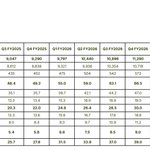
Wise consumer volumes keep growing almost at 20%, reaching almost $50B per quarter. It is 50% higher than JPMC does per year and twice of BofA.
owners.wise.com/financials/f…


(3/3) A directionally sound estimate is feasible, but only bottom-up: obtain actual stablecoin-linked transfers from MTOs, payout partners and off-ramps by corridor; separate consumer transfers from trading/treasury; de-duplicate settlement legs and use wallet data to cross-check
(1/3) Allium makes a better attempt than most to estimate stablecoin XB C2C, but its precision is illusory. Wallet activity reveals neither users’ identities nor payment purpose, so it extrapolates from a tiny geographic sample without validating actual remittance flows.


Our Q3 State of Stablecoins & Payments report is live.
9 months of onchain data. 15+ industry perspectives, including Visa, Stripe, Coinbase, Citizens, Stellar, Moody's Ratings and more.
From stablecoin supply to payments, cards and AI agents.
Download the full report: allium.so/reports/state-of-s…

The only thing funnier than stablecoin players trying to prove their tech is superior for remittances is when they try to prove they are superior to other stablecoin players. Enjoy rumblings of MAJORITY CEO against Felix.
linkedin.com/pulse/four-gene…

But the best news is that analysts finally stopped asking about stablecoins. Either they are tired of hearing the same answers for years, or they are beginning to suspect the hype is mostly due to the current US administration’s benevolence.
For the first time, Wise disclosed its Platform’s average take rate: a surprisingly high ~40 bps. A testament to its value proposition, but perhaps also an explanation for its limited penetration among top cross-border players.
investing.com/news/transcrip…

Wise consumer volumes keep growing almost at 20%, reaching almost $50B per quarter. It is 50% higher than JPMC does per year and twice of BofA.
owners.wise.com/financials/f…
Finally, a data-driven answer to the puzzle of why draconian immigration restrictions didn't stop growth in remittance volumes. Central American remitters fell from 6.2M in 2024 to 5.7M in 2026, but the average transfer rose from $386 to $470.
thedialogue.org/analysis/cur…
WU and IMXI say California approval won’t return before Oct. 6, forcing a fresh HSR filing and tightening the clock to Nov. 10. Yet neither stock moved after hours: apparently nothing new for merger-arb investors.
ir.westernunion.com/investor…
Real mobile money is negligible for outbound remittances, even to Africa. They matter a bit more for last-mile, at ~10% of inbound volume in Africa, but the supposed pricing edge is also questionable. Airtel calls remittances high-margin.
fxcintel.com/research/report…

What’s funnier: that MoneyGram confuses its 1940s domestic money-order roots with its first cross-border transfers in the late 1980s, or that it illustrates the story with a 1920s photo of random telecom operators?
Before money moved at the tap of a screen, it moved through rooms like this.
Payment instructions clicked out over telegraph wires from one office to another. On the other end, real people received them, checked and verified names and amounts, recorded each detail by hand, and carried each transaction forward, one careful step at a time.
MoneyGram’s roots go back to 1940.
For those early networks, moving money depended on more than wires and machines. It depended on people trusting that what they sent would make it where it needed to go.
The tools look very different today,
Paper ledgers became digital records. Wires gave way to modern payment networks. Money transfers have shifted from days to minutes.
But the reason people send money is still familiar.
Rent. A medical bill. School supplies. A little help from someone hundreds or even thousands of miles away.
Because being there isn’t always possible.
Showing up still is.

After Chivo’s spectacular failure, El Salvador hasn’t completely given up. Sivar is a privately operated, state-backed digital platform: identity, government services, and communities first, with invisible stables for remittances as the wishful hook.
businesswire.com/news/home/2….

50/50 that California allows the WU-IMXI merger by the Nov. 10 deadline, when WU could walk away without paying the $27M breakup fee. That should be a godsend, but WU leadership has no other game plan, so it is still pushing to close.

Ironically, Wise’s own report provides no evidence that opening domestic payment rails to nonbanks lowers consumer prices. Countries with full access can still have very high bank FX markups, while some markets with restricted nonbank access have low ones.
wise.com/p/g20-report-2026

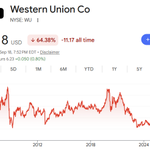
WU stock keeps discovering new all-time lows, ironically due to the lower likelihood of closing its acquisition of another struggling legacy player.


Has there been a single new talking point from crypto money transfer advocates since 2015?

“You should be able to send money the same way you send a text message.”
Mina Khattak, Head of US at @velocityxyz_ , explains how stablecoins could reduce the cost, complexity and delays behind global payments, free up capital currently parked in emerging markets, and move settlement closer to T+0.
#Stablecoins #Payments #Fintech
Because the market doubled over the last decade, trad MTO share is sharply down into Africa, while their volumes are flat to higher. WU is still bigger than Zepz (WorldRemit + Sendwave), with similar pricing. Stablecoins remain irrelevant to this dynamic.
techtrends.africa/how-remitt…
