

Degrees in Psychology and Law • Corporate Lawyer • Proud Sephardic Jew • Personal Blog | Views Are My Own • Tweets ≠ Legal Advice | Retweets ≠ Endorsements
Montreal
Joined October 2009
- Tweets954
- Following598
- Followers4.3K
- Likes3.1K




Sarah Ettedgui retweeted

NAZA, le documentaire de Yuval Abraham et Rachel Szor produit par The Guardian, a reçu le Prix spécial du jury à Venise et vingt-cinq minutes d’ovation. Il sort en France depuis le 12 octobre. Sa thèse tient en un mot : génocide.
J’ai regardé ce film en juriste. Vingt-quatre témoins sans visage, sans grade, sans rien. Aucune frappe datée, aucune cible nommée, aucun document. Un chiffre, 500 morts civils anticipés pour une cible, lancé par une seule voix et démenti catégoriquement par l’armée. Des sous-titres qui ajoutent aux témoins ce qu’ils ne disent pas. Pas un juriste à l’écran, pas une règle citée, pas un mot sur le Hamas.
Surtout, le film porte dans son titre la réfutation de sa thèse. Nezek agavi, dommage collatéral, désigne l’estimation préalable des pertes civiles d’une attaque dirigée contre un objectif militaire. C’est l’article 57 du Protocole additionnel I.
Une armée qui compte les civils avant de frapper, qui avertit, qui évacue, puis qui compte ceux qui restent, ne décrit pas une entreprise d’extermination. Elle décrit un processus de ciblage, que l’on peut critiquer frappe par frappe, mais qui exclut la seule déduction raisonnable d’une intention de détruire un peuple, selon le critère fixé par la Cour internationale de Justice.
Distinction, proportionnalité, précautions, outils d’aide à la décision, intention génocidaire : j’ai repris chaque point avec les textes et la jurisprudence, de la CIJ au TPIY, de la Cour suprême d’Israël à la Cour européenne des droits de l’homme.
En voulant prouver un génocide, « NAZA » filme le contraire. sarahscialom.substack.com/p/…
Sarah Ettedgui retweeted

Témoignage déchirant d’Audelia Sitbon, pharmacienne à Paris, qui découvre, en larmes, l’état de sa pharmacie complètement détruite. 💔
Rarement je n’avais ressenti une telle haine envers ces salauds de casseurs…
De tout cœur avec elle. ❤️
Before condemning the violence, I think we need to understand the historical grievances of the resistance. All eyes on Paris.

We call on France to exercise restraint when dispersing the freedom fighters on the streets of Paris. These brave warriors for justice must receive immediate humanitarian aid, and their safety must be guaranteed in accordance with international law. Failure to comply will leave us no choice but to bring a case before the ICJ, in close cooperation with that renowned champion of human rights, Afghanistan.
Nothing but love and respect for the important work Hen does. But, I really wish we would stop responding to accusations of European colonialism by pointing out that not all Jews came from Europe. Jews are not originally from Europe. Full stop. Ashkenazi Jews are not any less indigenous to the Land of Israel than Mizrahi or Sephardi Jews. The fact that Jewish populations spent centuries in exile across different continents does not somehow change the geographic origins of the Jewish people. Every time we respond by emphasizing that some Jews never lived in Europe, we inadvertently concede the premise that Ashkenazi Jews are European colonizers, or at least suggest that there is a shred of truth to that accusation.
Signed,
A Sephardi Jew.

"They took land off people and they were excessive."
Obama's comments in Belfast make it seem like Israel was a random place Jews had no connection to, not a homeland we had been continuously connected to for millenia.
He ignores the fact that before Israel, Britain controlled the territory. When Israel was established, 7 Arab countries immediately attacked. That's the context in which displacement occurred.
He also ignores the displacement that my Iraqi and Tunisian Jewish family experienced. My grandmother survived the Farhud, a massacre of Bagdhad's Jews.
My family never lived in Europe. They were among the 850,000 Jews from the Middle East and North Africa who lost their homes. Israel was their only refuge.
I will never be silent while the expulsion of Mizrahi Jews, who are the majority of Israeli Jews today, are erased from history to fit a narrative.

Sarah Ettedgui retweeted

Three years ago today:
1,200 murdered. 251 taken hostage. The deadliest day for Jews since the Holocaust.
Since then, antisemitism hasn't returned. It's exploded. Attacked in the streets. Hunted on campuses. Murdered from Washington to Sydney. For one reason: being Jewish.
October 7th didn't create this hatred, it revealed it.
I'm raising my daughters to be proud Jews.
Loud. Visible. Unapologetic.
We will not hide 💙
Aujourd’hui, nous sommes le 7 octobre.
Le regard terrifié de Shiri Bibas alors qu’elle serrait Ariel et Kfir contre elle ne quittera jamais ma mémoire. Elle et ses fils ont été enlevés du kibboutz Nir Oz ce matin-là. Ils ne sont jamais revenus vivants.
Nova non plus ne me quittera jamais. Des milliers de personnes étaient allées dans le désert pour danser, célébrer et vivre. Des terroristes les ont traquées. Des centaines y ont été assassinées. Alexandre Look, l’un des nôtres, un Montréalais, s’est tenu à l’entrée d’un abri sans porte et a utilisé son corps pour bloquer les hommes armés. Des survivants ont raconté par la suite qu’il avait été leur bouclier et que des gens derrière lui avaient survécu parce qu’il était resté là. Il a été assassiné à cette entrée.
Trois ans plus tard, je refuse toujours les contorsions intellectuelles auxquelles certains se livrent pour décider quelle haine des Juifs compte comme telle et quelle haine des Juifs devient soudainement acceptable dès qu’Israël entre dans l’équation.
Un Juif agressé au Canada ou aux États-Unis parce qu’il porte une kippa est victime d’un crime haineux. Un Juif agressé parce que sa Magen David révèle un attachement à Israël n’est pas moins victime d’un crime haineux. Un Juif ou un Israélien assassiné en Israël par un terroriste qui veut chasser les Juifs de la terre « du fleuve à la mer » ne perd pas cette protection contre la haine simplement parce que l’attaque a eu lieu en Israël.
L’objet utilisé pour identifier le Juif peut changer. Mais l’animosité qui l’alimente reste la même, vieille comme le monde.
Au Canada, le travail acharné et inlassable des membres et des dirigeants de notre communauté commence heureusement à porter ses fruits. Il y a à peine quelques semaines, le gouvernement fédéral a expressément déclaré que l’antisémitisme inclut l’antisionisme et a reconnu l’antisionisme comme une manifestation contemporaine de l’antisémitisme.
Il a également souligné la première décision judiciaire canadienne, dans R. c. Amor (Windsor, 2026), reconnaissant que le terme « sionistes » peut servir de substitut péjoratif au mot « Juifs » et que le fait de tenir collectivement les Juifs responsables des politiques ou actions alléguées d’Israël constitue une forme contemporaine d’antisémitisme susceptible d’atteindre le seuil criminel de la haine.
Et pourtant, de l’autre côté de l’Atlantique, le Green Party of England and Wales nous ramène tout droit en 1975. Plus de cinquante ans après que les Nations Unies ont déclaré que « le sionisme est une forme de racisme », et trente-cinq ans après que l’ONU elle-même a abrogé cette résolution, un parti politique britannique ressuscite aujourd’hui la même formule et l’adopte comme politique officielle du parti.
Je me battrai chaque jour pour que l’antisionisme soit reconnu pour le mouvement de haine discriminatoire, mondial et transnational qu’il est devenu, un mouvement qui cible les Juifs et les Israéliens où qu’ils se trouvent en raison de leur origine nationale, qui traite l’attachement juif à Israël comme une preuve de culpabilité et qui transforme le sionisme en justification de l’exclusion, de l’intimidation et de la violence.
Je continuerai à le répéter : un Juif ne devient pas une cible plus acceptable parce que le symbole qu’il porte autour du cou est une Magen David, parce que ceux qui le ciblent utilisent le mot « sioniste » plutôt que le mot « Juif », ou simplement parce qu’il vit à Tel-Aviv plutôt qu’à Montréal.
Je ne reculerai jamais. Pas après le 7 octobre. Pas après Shiri, Ariel et Kfir, Alexandre, Hersh, Almog et tous les autres, innombrables, dont nous portons désormais avec nous les noms, les visages et les histoires. Je refuse d’accepter un monde qui rationalise, rebaptise ou excuse la haine qui a servi, et qui sert encore aujourd’hui, à justifier leur enlèvement et leur assassinat.
Today is October 7.
The terrified eyes of Shiri Bibas as she held Ariel and Kfir will never leave my mind. She and her sons were taken from Kibbutz Nir Oz that morning. They did not come home alive.
Neither will Nova. Thousands of people went into the desert to dance, celebrate, and live. Terrorists hunted them down. Hundreds were murdered there. Alexandre Look, one of our own from Montreal, stood at the entrance of a shelter with no door and used his body to block the gunmen. Survivors later said he was their shield, and that people behind him lived because he stood there. He was murdered at that entrance.
Three years later, I still refuse to accept the intellectual contortions people perform to decide which hatred of Jews counts and which hatred of Jews becomes permissible the moment Israel enters the equation.
A Jew attacked in Canada or the United States because they wear a kippah is the victim of a hate crime. A Jew attacked because their Magen David signals an attachment to Israel is no less the victim of a hate crime. A Jew or an Israeli murdered in Israel by a terrorist who wants Jews removed from the land “from the river to the sea” does not lose that protection from hatred simply because the attack happened in Israel.
The object used to identify the Jew can change. But the animus fueling it is the same old one.
In Canada, the tireless work of members and leaders of our community has thankfully begun to resonate. Just weeks ago, the federal government expressly stated that antisemitism includes antizionism and recognized antizionism as a contemporary manifestation of antisemitism.
It also highlighted the first Canadian judicial finding, in R. v. Amor (Windsor, 2026), that “Zionists” can be used as a pejorative proxy for Jews, and that holding Jews collectively responsible for the alleged policies or actions of Israel constitutes a modern form of antisemitism capable of meeting the criminal threshold for hate.
And yet, across the Atlantic, the Green Party of England and Wales has dragged us straight back to 1975. More than fifty years after the United Nations declared that “Zionism is racism,” and thirty-five years after the UN itself repealed that resolution, a British political party has resurrected the same formulation and adopted it as official party policy.
I will fight every day to have antizionism recognized for the discriminatory global and transnational hate movement it has become, targeting Jews and Israelis wherever they stand on the basis of national origin, treating Jewish attachment to Israel as evidence of guilt, and turning Zionism into a justification for exclusion, intimidation, and violence.
I will keep saying that a Jew does not become a more acceptable target because the symbol around their neck is a Magen David, because the language used against them is “Zionist” instead of “Jew,” or because they happen to live in Tel Aviv instead of Montreal.
I will never back down. Not after October 7. Not after Shiri, Ariel and Kfir, Alexandre, Hersh, Almog, and the countless others whose names, faces and stories we now carry with us. I will not accept a world that rationalizes, renames or excuses the hatred that helped justify, and still justifies, their kidnapping and murder.
Au lendemain de cette élection, j’ai envie de dire quelque chose comme Juive, comme Québécoise et comme Canadienne.
Je suis attachée au Canada. Mais je comprends aussi profondément l’aspiration nationale québécoise.
Peut-être parce que, comme Juive, l’idée qu’un peuple puisse vouloir préserver sa langue, sa culture, sa mémoire collective et sa capacité de décider de son propre avenir ne m’est absolument pas étrangère. L’histoire juive et l’histoire québécoise sont évidemment différentes, et les parallèles ont leurs limites. Mais je reconnais quelque chose de profondément familier dans cette volonté de continuité nationale, dans cette peur de voir une langue et une culture s’effacer avec le temps, et dans ce désir de demeurer maître de ce que l’on transmettra aux générations suivantes.
Les Juifs savent ce que signifie vouloir assurer la pérennité d’un peuple. Nous savons aussi que la souveraineté, une fois acquise, ne règle pas miraculeusement toutes les questions : elle crée de nouvelles responsabilités, de nouveaux débats et parfois de nouvelles vulnérabilités. Mais le principe d’autodétermination des peuples demeure pour moi parfaitement compréhensible.
Cela ne signifie pas que tous les Québécois doivent être souverainistes, ni que l’élection d’hier constitue en elle-même un mandat pour l’indépendance. Mais elle rappelle avec force que la question nationale québécoise, la protection du français et la volonté d’affirmer une identité collective demeurent bien vivantes.
Et pour ceux d’entre nous dont les familles sont arrivées au Québec plus récemment, je crois qu’il y a aussi quelque chose d’important là-dedans : devenir Québécois ne devrait pas seulement signifier habiter le Québec. Cela peut aussi vouloir dire participer à son projet collectif, apprendre son histoire, contribuer à son économie, parler sa langue et prendre au sérieux les aspirations de la société dont nous faisons désormais partie.
Je souhaite donc bonne chance à @PaulPlamondon et au @partiquebecois dans le mandat que les Québécois leur ont confié hier. Ils gouverneront en situation minoritaire, ce qui exigera nécessairement dialogue et compromis. J’espère que ce gouvernement contribuera à rendre le Québec plus prospère, plus fort et plus confiant dans ce qu’il est.
Today is my birthday, and I genuinely cannot imagine a greater gift than watching nearly 180 people who came terrifyingly close to death walk away alive.
Obviously, the real gift would have been for none of this to happen at all. But there is something almost impossibly Jewish about what happened on that plane.
A plane full of Israelis suddenly plunges thousands of feet. From what I understand, one pilot attacked the other and then apparently tried to bring the aircraft down. And the people on board did not simply wait to see what happened to them. They acted. They fought their way into the cockpit. They overpowered the attacker. Pilots on board stepped forward to help fly the plane. They saved one another.
And then they survive.
And what do they do afterward?
They celebrate.
That part keeps getting me.
There is something here that feels much bigger than one extraordinary story. Jewish history has given us far too much experience with people trying to kill us. But it has also produced this almost unreasonable attachment to life. The instinct to fight for it, protect one another, get back up, and then somehow find a reason to sing and dance.
You can call the people on that plane literal Doron Kabilios. I probably will. But underneath the joke is something very serious.
Again and again, people have tried to terrorize Jews. Again and again, we fight for our lives, protect one another, get back up and choose life anyway.
Someone tried to bring down a plane full of Israelis today. Instead, people on board fought to save one another, took control of the situation, landed safely, took care of each other, and then celebrated being alive.
On my birthday, I cannot think of a more powerful reminder of what it means to choose life. And what it means to be Jewish.
עם ישראל חי. 🇮🇱💙
I don’t know who needs to hear this, but Jew hatred is not a partisan issue. It never has been, and it never will be.
We need to stop treating it like one.


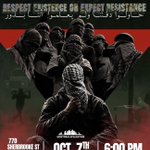
The antizionist gaze increasingly rewards psychopathic tendencies. It trains people to look directly at Jewish fear, grief and vulnerability and feel nothing. It takes the anniversary of a massacre, strips the victims of their humanity, transforms the killers’ visual language into revolutionary imagery, and then carries masked men, guns, barbed wire, clenched fists and “resistance” through the streets of Montreal as though terror itself had become the aesthetic.
That process runs on dehumanization. Once the movement reduces Jews to “Zionists,” it can treat their pain as propaganda, their fear as manipulation, their dead as context, and violence against them as something to romanticize or celebrate. The same people who handed out candy while Israelis were still being murdered and kidnapped in 2023 can now mark October 7 with images that openly glorify militant violence, because the antizionist gaze has already taught them whose humanity counts and whose does not.
Look at the posters. Look at the date. Look at the city.
This is not Gaza or Ramallah. This is Montreal.


I don’t know who needs to hear this, but playing a rabbi on Netflix does not turn Adam Brody’s political opinions into Jewish wisdom any more than playing Steve Wozniak made Seth Rogen qualified to design a computer.
Please be serious.
Sarah Ettedgui retweeted

I'm a journalist. And I happen to be Jewish. On Yom Kippur I went to a synagogue service in Toronto and was met by protesters trying to taunt and intimidate me from entering the building. 1/5
Sarah Ettedgui retweeted

I stand by every word that I said here. By the way, this is the 100th time that Yves Engler has accosted me and he still can’t spell my name right. His research skills are remarkable.

I actually think Guterres is entirely sincere when he says Gaza’s destruction is “unlike anything I have witnessed in all my years as Secretary-General.” Sincerity is not the issue. The issue is what that sentence is actually measuring.
Gaza has been examined à la loupe for nearly three years. Every strike, every hospital, every body, every grieving parent, every ruined block has been filmed, named, circulated and replayed with a granularity almost no other contemporary war has received. But that is, in significant part, a fact about cameras, access, population density and political attention.
Meanwhile, Sudan, Syria and other wars or conflicts have killed or displaced people on an enormous scale, often amid famine, ethnic massacre and the destruction of entire health systems, without anything approaching the same sustained visual record in the media.
A war can be uniquely documented without being uniquely large.
There is a difference between a catastrophe that is uniquely devastating and one that is uniquely visible. What the world is made to witness is not wholly independent of where the camera is pointed.
I deliberately tried to stay off social media during Yom Kippur. Partly because that is the point of the day, and partly because I knew that if I wrote the moment I heard about what happened in Belleville, I would be writing from anger rather than reflection.
So I reflected.
And I keep coming back to these two statements from Avi Lewis because, placed side by side, they illustrate exactly the problem I have been trying to articulate.
On Yom Kippur, before the shooting in Belleville, Avi Lewis, the leader of Canada’s federal New Democratic Party (NDP), one of the country’s longstanding national political parties, told Jewish people that “we failed to do our part” to stop what he calls a genocide “committed in our name.” The next day, after an armed man opened fire on the police officer stationed outside a synagogue where Jews had gathered for Yom Kippur, Lewis wrote that Jewish Canadians should be able to worship and live without fear.
Yes. We should.
But you do not get to demand that Jews be treated as ordinary Canadians when we are targets of hatred while simultaneously treating us as a collective political constituency responsible for the actions of Israel.
That contradiction is the problem.
We still do not know the gunman’s motive, and I will not invent one. Past incidents have taught me to wait before assigning motive. But factual caution about this particular man cannot require intellectual dishonesty about the environment in which Canadian Jews are living.
If a Canadian Jew bears no collective responsibility for an attack on a synagogue, then a Canadian Jew bears no collective responsibility for decisions made by the Israeli government either.
You cannot tell Jews that a war 9,000 kilometres away is being waged “in our name,” tell us that “we” have collectively failed to stop it, and then act surprised that Jews increasingly feel unsafe in Canadian Jewish spaces.
This is precisely why “but Israel” has become such a dangerous response to antisemitism. It accepts the premise that something happening in Israel belongs in the explanatory paragraph after a Jew is attacked in Montreal, Toronto, Vancouver or anywhere else in Canada.
Israel is not irrelevant to Jewish identity. Quite the opposite. The Land of Israel has been embedded in Jewish prayer, history, ritual, collective memory and peoplehood for millennia. But love or attachment to Israel does not make every Jew an agent of its government, any more than love or attachment to Canada makes every Canadian personally answerable for every decision made in Ottawa.
There is no contradiction between criticizing Israel and protecting Jews from collective blame. The contradiction is condemning collective hatred of Jews while participating in the collective assignment of responsibility to Jews.
And perhaps that is what I am taking out of Yom Kippur this year.
Teshuvah demands that we examine what is actually ours to answer for. It does not demand that we accept responsibility for sins that are not ours.
Jews are responsible for our own actions. We are not collectively responsible for decisions of the Israeli government. And our safety in Canada cannot be conditional on proving that distinction every time someone decides to hate us.


The shooting outside a synagogue in Belleville is deeply upsetting, and has traumatized a community that gathered to pray.
It is yet another reminder of the work that remains to create a Canada that is truly safe for people of all faiths, including Jewish people – to worship, to come together, to live without fear.
Today, I am sending love and solidarity to the Jewish community in Belleville and across the country on this Yom Kippur, the most solemn and holiest day of the year.
You know what I find very revealing?
For a lot of Jews and their allies, the bar has become so low that even a brief acknowledgment of Nova and of the generational trauma October 7 awakened in the Jewish community feels so meaningful.
Sheeran did not talk about the kibbutzim. He did not talk about the hostages. He did not talk about Hersh, the Bibas family, the gaslighting we’ve endured, or really the magnitude of what Israelis and Jews have been carrying for nearly three years.
And Sheeran himself got a small glimpse of that same dynamic when, after refusing to adopt Macklemore’s position and refusing to take responsibility for a decision made by promoters and venues, he was depicted in vampiric and satanic imagery drawn from an anti-Jewish libels that go back centuries.
And still, many of us heard that small acknowledgment and thought: thank you. At least you saw us for a second.
That is where we are.
We have become accustomed to taking whatever fragments of recognition people are willing to throw at us.
And yet, for the mob on the other side, acknowledgment of Palestinian suffering is never enough. “Disproportionate” is not enough. Calling for peace is not enough. There is a constantly expanding litmus test: genocide, apartheid, Israel as an illegal state, Zionism itself as illegitimate, and ultimately the idea that Israel as a Jewish state must disappear.
Miss one article of faith and the mob comes for you anyway.
I hope people come to realize this.
I’m increasingly irritated by artists and public figures saying, “I don’t know enough to say whether this is genocide, but the military response was obviously disproportionate.”
Disproportionate according to what?
Proportionality is itself a legal assessment under the law of armed conflict. It does not mean “I have seen horrifying images and believe too many people have died.”
It asks whether the civilian harm expected from a particular attack was excessive in relation to the concrete and direct military advantage anticipated, based on the information reasonably available to those making the decision at the time.
That requires knowing what was being targeted, why it was considered a military objective, what intelligence existed, what civilian harm was anticipated, what precautions were taken, what weapons and alternatives were available, and what military advantage was expected.
In an extraordinarily dense urban battlefield involving an extensive tunnel network and military infrastructure operating within and around civilian areas, those questions are not remotely answered by watching footage of the aftermath.
The images of war are horrific. They should disturb you. But they also do not magically give you the information required to conduct a proportionality analysis.
If your position is “I don’t know enough to reach a legal conclusion,” that is perfectly respectable.
Then stop one sentence earlier.


I’m trying to follow this.
Ed Sheeran says he doesn’t want his concerts to be political because people come to hear music.
Macklemore gets dropped. His supporting acts walked out. The pressure campaign goes into overdrive.
Fans still fill the stadium because, surprise, surprise, they did in fact come to hear Ed Sheeran sing.
And then a teary-eyed Ed Sheeran takes the mic and… makes it political?
The effectiveness of sustained bullying from the pro-Palestine activist ecosystem really needs to be studied.