

I make colorful bubbles
Chicago
Joined March 2021
- Tweets578
- Following91
- Followers1.9K
- Likes755




Pinned Tweet
RNAseq counting tools are not perfect. I simulated 240 GTEx samples to test multiple tools. Below I show the difference between actual and estimated counts for each simulated sample.
But, what is causing this? And will it affect differential expression? (1/7) #Bioinformatics


Mark retweeted

Short Tweetorial about a recent publication from our lab by @Sanbomics on detecting cellular #senescence in scRNA-seq data nature.com/articles/s41467-0… in @NatureComms with a great @sanbomics video tutorial youtube.com/watch?v=mc7rnlRr… #computationalbiology #aging

Mark retweeted
Thrilled to share this new publication from our lab on muscle wasting in #Cancer and #vascularbiology, spearheaded by Young-Mee Kim in @NatureCancer nature.com/articles/s43018-0…. Here is a tweetorial on #cachexia, #cancersurvivorship and #cardiovascular #health @thisisUIC

We show that muscle vasculature loss precedes cancer cachexia and identify PGC1α and INHBA as causal factors. This was a huge effort with several models, clinical biopsies, massive amounts of imaging, sequencing, bioinformatics, and much more. nature.com/articles/s43018-0…
Mark retweeted

1/: Excited to share our new study led by Luke Zappia on feature selection methods for single-cell RNA-seq data, now published @naturemethods ! We explore how choosing features impacts reference atlases & downstream analyses. 📊📚 nature.com/articles/s41592-0…

Senescent cells contribute to disease and are found in many tissues but are hard to analyze because markers have been derived in culture and do not account for cell-type differences. Here, we define new signatures based on millions of single cells (1/5) nature.com/articles/s41467-0…

In addition to aging, SenePy is widely applicable in many disease contexts. We show how it can be applied to cancer, heart disease, and infection. Here is an example of senescent-like foci in infarction spatial data (4/5)


Mark retweeted
Trump's proposal is ILLEGAL & amounts to an indiscriminate funding cut for research centers of all sizes, NOT just Ivies. It will mean shuttering labs across the country, layoffs in red & blue states, & derailing lifesaving research on everything from cancer to opioid addiction.

Last year, $9B of the $35B that the National Institutes of Health (NIH) granted for research was used for administrative overhead, what is known as “indirect costs.” Today, NIH lowered the maximum indirect cost rate research institutions can charge the government to 15%, above what many major foundations allow and much lower than the 60%+ that some institutions charge the government today. This change will save more than $4B a year effective immediately.

Mark retweeted

The indiscriminate and ill-conceived slashing of indirects by the @NIH yesterday must be amended if want to restore America’s leadership role biomedical research. 15% simply isn’t enough for institutions to provide the basic infrastructure needed to run a successful lab. I say this as someone who has been and remains deeply critical of the NIH, its funding system and of the ways universities are structured and spend money. We would all benefit from a genuine reexamination of how and to what @NIH funds are allocated, and I remain optimistic that once the dust settles and new NIH leadership is in place that this is what will happen and this hack job by people who don’t understand or care about research will be forgotten.
And I’m sorry but I can’t help but laugh at the people who are demanding a full-throated defense of the current indirect levels. Nearly every PI I’ve known for my entire career has complained about excessive indirect rates. This is mostly because, despite their importance, even most PIs haven’t bothered to actually understand them, and because they don’t FEEL that universities are actually spending the money to support their research. Whether they are or not nobody really knows because in the typically Byzantine maze of university budgets it’s often very hard to figure out.
There are also lots of actual shenanigans that go on especially at places with the highest indirect rates to use funds to build out the institution and increase its power rather than to directly support funded research projects. And anyone who says administrative bloat at universities isn’t real and partially fueled by indirects is either blind or part of the bloat.
So let’s get organized to have an actual constructive response to this firebomb. Scientists need to advocate for what is best for research - and we have to do it ourselves because the institutions that claim to represent us - universities and scientific societies in particular - have their own goals that often do not align with ours.
We also have to remember that grants are not an entitlement. We are not owed anything. If we want to continue benefiting from the public support we have always enjoyed, we have to show the public and their representatives - even ones we might not always agree with - that we’re spending their money wisely.

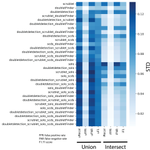
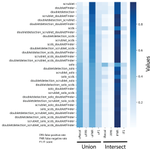
No methods performed that well. With caveats, 1) hashed data probably isn't a true ground truth, and 2) results vary based on the datasets tested. Others have compared methods, but not overlap (5/6) cell.com/cell-systems/pdf/S2…
There was more analysis I wanted to do, but I've gone on this tangent long enough. You can find a notebook to run all 5 methods (two of which are in R) directly on your anndata objects: (6/6) github.com/mousepixels/sanbo…

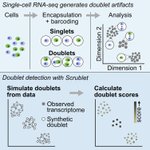
Doublet detection methods simulate doublets by adding or averaging random cells. But, there is technical variation between cells. A true doublet is 2+ cells processed in the same droplet with no technical variation. Eg, cell A (900 UMI)+ cell B (100 UMI) still looks like cell A

ALT Scrublet ,Wolok et al 2019
Should we instead normalize cell a/b to some shared technical/depth factor? Eg, cell A is 0.4x depth compared to other A cells. So scale cell B to 0.4x to other B cells. Then combine? In my mind this is more true to reality

