

☀️ASTRID Founder. Mission: AI Healthcare for Billions.
Nevada, USA
Joined November 2012
- Tweets3.9K
- Following598
- Followers3.3K
- Likes7.7K




Docs vs AI, the big debate.
Will docs be replaced by AI?
Depends. If docs:
- Listen without judgement
- Don’t interrupt constantly
- Give patients time to exhaust their concerns
- Schedule visits per patient preference, not their own
- Aren’t condescending
- Put care in their words
- Offer gobs of information on a subject
- Answer the questions
- Just listen
There’s a chance.


These are my parents. Dad lost his legs and fingers in a heart attack. Mom recently lost her life to cancer.
For many years, I was their caretaker. As the eldest son and a doctor, it just made sense. I also loved them.
My parents' room was down the hall. Anytime they had a medical concern, they'd have immediate access to me.
"My chest is uncomfortable. Is my heart okay?"
"The doctor wanted to try a new chemo drug. Will my hair fall out?"
They trusted me. Not only was I their son, I was a highly trained physician with decades of experience. They didn't trust anyone else.
When I didn't have the answers, I spent time researching vetted medical resources to arrive at the proper conclusion. Sometimes for hours.
It didn't take me long to realize how fortunate my parents were to have this arrangement.
Immediate answers to tough medical concerns. Thoroughly researched responses when the answers weren't obvious.
What about other people? Not everyone had children who were medically tuned to instantly address questions.
Was it fair that my elderly neighbors who lived alone didn't have this access?
Or the rural villager who was desperate to know whether his daughter's situation was serious?
When our bodies stop cooperating, it's an uneasy feeling.
When we don't know why doctors prescribe certain medicines, it's frustrating.
When we are hurt and are reminded of our biggest fears, it's scary.
While I was having these thoughts, AI was making its grand entrance.
What if I could program an AI agent to do what I did for my parents?
A technological entity that would answer medical questions. Research the right answers. Help you understand test results, new conditions, and medical investigations?
One that would always be "on call" for you, like I was for Mom and Dad?
That's when the idea for ASTRID was born.
With my co-founder, Samantha Rivera, and a small team of exceptionally bright and passionate individuals, we launched ASTRID in February.
Less than 3 months later, ASTRID has organically grown to users in 81 countries.
Health intelligence for medical, dental, and veterinary conditions.
We just launched Spanish ASTRID after starting in English.
ASTRID speaks. ASTRID listens. ASTRID writes. ASTRID reads.
I personally programmed her bedside manner. Her clinical thought process. Her systems-based thinking. Follow-up questions. Data sources.
We've worked tirelessly to create anti-hallucination protocols. Citation accuracy. Cybersecurity at all levels. Privacy. Regulatory compliance.
Right now ASTRID is free -- no downloads, no sign-up. Free for the world.
ASTRID 1.0 will always be free, but we're also creating paid options with special features for our users.
Chat memory. Uploads. Records. Escalation to human care. It's all coming. Along with tools never seen before. Made for regular people.
Our mission -- to provide health intelligence for a billion people using responsible AI.
My mission -- to give the world what my parents had.

Much of primary care as we know it will be replaced by AI.
I say this as a primary care physician with 25 years of global practice experience, as well one who's building in AI.
I'm not catastrophizing. I'm making a prediction.
32% of Americans now use AI chatbots for health information. 64% of those do it weekly. Among millennials and Gen Z, usage is approaching 50%. These are the patients of tomorrow — they're not waiting.
AI is in its infancy. It hallucinates. It gets things wrong. People still use it. Imperfections eventually get sorted out, an imperative for healthcare.
Primary care was already on life support.
Only 24.4% of U.S. physicians practice in primary care, well below the 50% benchmark. As of December 2025, 92 million Americans live in federally designated primary care shortage areas.
We don't have enough primary care doctors, and we're not going to catch up.
It's not like AI is displacing a thriving PCP workforce. It's filling an access gap patients have suffered for years.
Procedures will migrate to specialists. Pap smears to gynecologists, lacerations to urgent care, skin biopsies to dermatologists. Human needs — anxiety, grief, chronic loneliness — will go to nurses, therapists, and social workers. Those who spend more than 15 minutes with you.
Primary care was never about procedures. It was about the "relationship". That relationship was destroyed by the system long before AI arrived.
Trust in doctors dropped from 71.5% in 2020 to 40.1% in 2024.
Trust in one's own doctor fell from 93% to 85% in just two years.
People don't distrust science. They distrust being dismissed.
AI doesn't dismiss you. It doesn't judge you. It has infinite patience. It doesn't get up after 15 minutes.
The healthcare AI companies being built today, including the ones called "chatbots", are the beginning of something massive.
The global healthcare AI market was $32 billion in 2024. It's projected to reach $431 billion by 2032.
Some of these companies will become the largest in the world. The ones that win will be built by clinicians. Technical brilliance without clinical insight produces falsely-impressive tools that give dubious or dangerous answers.
Regulation is coming. Guardrails are coming. Malpractice frameworks are coming. That's not a bad thing, it's legitimacy.
Primary care won't disappear. It will transform.
The doctor who triages 30 patients in a morning, refills metformin, orders routine labs, and manages hypertension by protocol? AI will do that. Better. Faster. At all times. In any language.
Doctors won't disappear, but their roles will change. They'll become diagnosticians. Guides. The necessary human presence.
When auto-pilot fails, pilots are needed.
The question isn't whether primary care will change.
The question is who builds what people want, not what doctors and payers want.
A new dawn approaches.

This is my daily reminder of struggle, resilience, and triumph.
I acquired this photo by Cath Simard, and it sits directly in front of my desk.
One person. One headlamp. Surrounded by mountains that make you feel insignificant.
I've trekked the Himalayas and the Andes. I know what it feels like to stand at the start of something that completely dwarfs you.
Startup founders trying to change the world.
VCs trying to raise a fund.
Patients fighting a new diagnosis.
Students about to take career-defining exams.
Professionals starting over somewhere new.
All have the same look in their eyes.
Anxiety mixed with excitement. All wondering if they'll make it.
Then there are the ones who jump in anyway.
Who see something others don't.
Who keep moving forward without needing anyone's validation.
You don't need an investor, a doctor, a boss, or anyone to believe in you.
You just need you.
Self-conviction is a superpower. We all have it. Sometimes it just needs to be found.
Some mountains are big. Some are bigger. The path disappears and reappears. Sometimes you create your own.
If it's a noble goal, a worthy mission, a necessary destination, a requirement for your health or your life or your career — don't stop. No matter the odds. No matter what others think. Even if you're alone, in the dark, with no one but yourself.
One foot. Then the other. Keep going.
No matter what. No matter what.

If you're looking for some inspiration on grit, this story is for you.
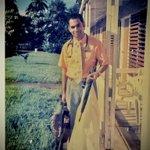
This is my father. He has more grit than the strongest founders in Silicon Valley.
Born in India, he learned how to read and write under a tree. Not a school with air conditioning, pencils, and notebooks. Under a tree, with stone chalk and a portable blackboard. In the 110F heat.
He excelled through school. Later in college, my mother sold her wedding jewelry to support his trip to Cornell where he was accepted for graduate studies. When he arrived in NYC, he slept at the local YMCA before catching a bus to Ithaca the next day.
On the bus he met other students. When he asked how long it takes to complete a PhD, he was told five years or more. Dad finished his Cornell PhD in two.
He applied for hundreds of jobs after his degree. All said no for years, until one said yes. That one? The United Nations.
Dad became a diplomat and we were the better for it. We traveled everywhere and had an amazing life.
Then Dad had a heart attack at 74 and lost his legs and hands. The grit returned.
At 75, my father learned how to walk again on double prosthetics. I helped him learn how to drive again. His drive to live was even more profound.
He'll be 82 this year. He recently lost his wife, my mother, of 60 years. He's lost brothers and sisters and dear friends. He continues to move forward. With laughter. With positivity. With resilience.
I'm building an ambitious healthcare AI company, ASTRID, to serve billions of people. I won't have a problem with founder grit. I've been trained by the best.
My father lives with me. We watch television every night. This week it's The Count of Monte Cristo.
The lesson he's taught me that never fails:
Never, never, never give up.

I'm proud to announce that ASTRID now has a Dental AI Companion.
Medical. Veterinary. Dental.
Our Healthcare AI Trio is complete.
As I build ASTRID, I keep thinking of my mother.
She passed away last year.
She was the kind of person who would worry quietly. A toothache she didn't want to bother anyone with. A question she felt embarrassed to ask. A concern she carried silently because she didn't want to be a bother.
Taking care of her was the greatest honor of my life.
She had me. But who do other people have?
People need a healthcare companion that is just... there.
Any hour. Their native language. No judgment.
I built ASTRID for people like my mother. For anyone who carries quiet worries alone.
Today, ASTRID provides health guidance for the whole family. Including pets.
Our Dental AI Companion launches today. Completely free.
No download. No signup. Open your browser and you're in.
Already trusted by users in 75 countries and growing.
Built on our three founding principles: Security. Privacy. Accuracy.
This version also comes with platform improvements.
Faster. More conversational. A larger chat window. Voice that feels like a dialogue. A new ASTRID orb design that signals something alive, something present.
If you have a question about your teeth, your child's teeth, your aging parent's gums, your own anxiety about an upcoming dentist visit...
ASTRID's Dental AI will see you now.
➡️ myastrid.ai

My parents were hard-working immigrants who prioritized education and financial security over health.
It cost them.
My mother developed cancer in her 50's, and my father's silent heart disease ultimately surprised him with a massive heart attack that left him disabled and forever changed his life.
They practiced what I call 'passive healthcare'. Going to the doctor only when needed. Screening tests taking a back seat to convenience. Exercise being a leisure activity that isn't prioritized. Many people today practice passive healthcare. Most, in fact.
What we need to practice is 'active healthcare'.
Active healthcare gets us ahead of our health. It's proactive, not reactive. An active approach allows us to catch things early, offering better treatment options when issues aren't yet complicated. It's an investment in your own health, and pays dividends in the form of longevity.
Our work at ASTRID is being designed to gently guide you into an active healthcare mindset, enabling you to live your best life.
How do you switch your health mindset from passive to active?
Below is a chart that highlights some differences.
Start making changes today, and live healthier. Live longer.
If you have any active healthcare practices that have worked for you, please share them here.

A year ago today, one week before my birthday, my mother passed away.
The photo below is from Hyde Park, London. I'm three months old. My parents are young, full of possibility, standing on the edge of a life they're about to build from nothing.
Weeks later, my father would take us to the United States. Cornell. Two jobs for my mother — librarian by day, retail by night. While he earned his degree, she made sure we ate.
Their efforts became everything.
My father became a United Nations diplomat. We became global citizens. By the time I finished high school, I'd visited nearly 100 countries and spoke seven languages. The delayed gratification they modeled shaped every decision I've made since.
I became a physician. Then an entrepreneur. Then their caretaker.
I diagnosed my mother's cancer. I diagnosed my father's condition as his heart attack stole both his legs. I kissed them goodnight every night they were with me. When they weren't, I called daily — because I knew the day would come when I couldn't.
My mother was given five years. She lived fifteen.
I don't have children. What I have is my work — three healthcare companies launched while taking care of two seriously ill parents. ASTRID exists in part because of what I watched them endure. I'm building it to give billions of people access to healthcare, everywhere.
I hope she knows. I hope I can make her proud. I won't stop until I do.
To anyone reading this: your loved ones won't always be here. Take the photos. Make the calls. Don't wait for the right time — there isn't one.
One day those photos become the only version of them you have left.
