

Innovation policy @progressireland, writing @_fitzwilliam, fellow @rootsofprogress @joininteract
Joined September 2017
- Tweets1.7K
- Following1.9K
- Followers2.6K
- Likes12.5K





Pinned Tweet
It was an honour to be asked to join Mario Draghi and @patrickc's Rhine Group. While major reform is necessary, a flourishing and abundant future for Europe is possible

An announcement: Under the leadership of Mario Draghi and @patrickc we have set up the Rhine Group: policymakers, economists, entrepreneurs and business people pushing European reforms and the Draghi agenda.
rhinegroup.eu/

Guinnessbench is reaching saturation

Who would have thought that it took a 29-year-old Irishman to put the teetotalers of San Francisco in their place
I have been training to competitively drink Guinness for decades
I was born for this
Sorry @elonmusk

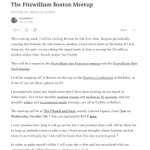
For any of you in the greater Boston area, @_fitzwilliam will be hosting a meetup on October 7th. Hope you can make it!


Sam Enright retweeted

Everywhere we look, researchers appear to be growing less productive. We throw more and more people tasks, just to stay where we are. The implications are enormous. As our population caps out, we are likely to stagnate, and die. 1/

This is a good list if you read my Milton Friedman essay and want to know what to read next: thefitzwilliam.com/p/my-teen…


Sam Enright retweeted
The Colonial Origins of Comparative Development has the rare distinction of changing economics for the better, and being totally wrong. A thread on what it did, why it mattered, and why it’s wrong. 1/

Sam Enright retweeted

What are your favorite syllabi?
Any field welcome. Commentary/annotations especially appreciated, though just a raw list of core papers/ books/ essays is also very useful.
Sam Enright retweeted

Fun question from @Sam__Enright:
What’s the “anti-reading list” in your field of expertise?

Sam Enright retweeted

My Irish name apparently invalid on Ireland's flag carrier airline @AerLingus 👎

Sam Enright retweeted

A young person asked me today for a few papers that would be great to read early on in one’s career. Here is a list I came up with (I posted a shorter list earlier in reply to a comment). There are many other great papers (and I apologize if I didn’t include yours), but my goal was to focus on papers that a 21-year-old undergrad would enjoy a lot. A paper on the asymptotic properties of the bootstrap or on some subtle point about New Keynesian models, as important as it might be, is not what I am looking for. Also, of course, the list reflects my deeply biased taste. So, feel free to add in the comment section other papers you love!
Philippe Aghion and Peter Howitt (1992), “A Model of Growth Through Creative Destruction,” Econometrica.
George A. Akerlof (1970), “The Market for ‘Lemons’: Quality Uncertainty and the Market Mechanism,” Quarterly Journal of Economics.
Armen A. Alchian (1950), “Uncertainty, Evolution, and Economic Theory,” Journal of Political Economy.
William J. Baumol (1967), “Macroeconomics of Unbalanced Growth: The Anatomy of Urban Crisis,” American Economic Review.
Gary S. Becker (1973), “A Theory of Marriage: Part I,” Journal of Political Economy.
Douglas W. Diamond and Philip H. Dybvig (1983), “Bank Runs, Deposit Insurance, and Liquidity,” Journal of Political Economy.
Xavier Gabaix (1999), “Zipf’s Law for Cities: An Explanation,” Quarterly Journal of Economics.
Xavier Gabaix and Augustin Landier (2008), “Why Has CEO Pay Increased So Much?,” Quarterly Journal of Economics.
Luis Garicano (2000), “Hierarchies and the Organization of Knowledge in Production,” Journal of Political Economy.
Edward L. Glaeser, Bruce Sacerdote and José A. Scheinkman (1996), “Crime and Social Interactions,” Quarterly Journal of Economics.
Sanford J. Grossman and Joseph E. Stiglitz (1980), “On the Impossibility of Informationally Efficient Markets,” American Economic Review.
Oliver Hart and John Moore (1990), “Property Rights and the Nature of the Firm,” Journal of Political Economy.
Friedrich A. Hayek (1945), “The Use of Knowledge in Society, American Economic Review.
Bengt Holmström (1979), “Moral Hazard and Observability,” Bell Journal of Economics.
Charles I. Jones (1995), “R&D-Based Models of Economic Growth,” Journal of Political Economy.
Charles I. Jones (2005), “The Shape of Production Functions and the Direction of Technical Change,” Quarterly Journal of Economics.
Michael Kremer (1993), “Population Growth and Technological Change: One Million B.C. to 1990,” Quarterly Journal of Economics.
Michael Kremer (1993), “The O-Ring Theory of Economic Development,” Quarterly Journal of Economics.
Paul Krugman (1991), “Increasing Returns and Economic Geography,” Journal of Political Economy.
Robert E. Lucas, Jr. (1978), “On the Size Distribution of Business Firms,” Bell Journal of Economics.
Kevin M. Murphy, Andrei Shleifer and Robert W. Vishny (1989), “Industrialization and the Big Push,” Journal of Political Economy.
Paul M. Romer (1990), “Endogenous Technological Change,” Journal of Political Economy.
Sherwin Rosen (1981), “The Economics of Superstars,” American Economic Review.
Alvin E. Roth (2007), “Repugnance as a Constraint on Markets,” Journal of Economic Perspectives.
Thomas C. Schelling (1971), “Dynamic Models of Segregation,” Journal of Mathematical Sociology.
Andrei Shleifer and Robert W. Vishny (1993), “Corruption,” Quarterly Journal of Economics.
Michael Spence (1973), “Job Market Signaling,” Quarterly Journal of Economics.
Robert M. Townsend (1979), “Optimal Contracts and Competitive Markets with Costly State Verification,” Journal of Economic Theory.
Martin L. Weitzman (1974), “Prices vs. Quantities,” Review of Economic Studies.

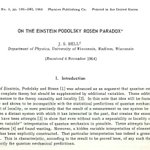
On September 26th in Belfast, @_fitzwilliam will be hosting a meetup about the life and work of the great Northern Irish physicist John Stewart Bell. DM if you'd like to join!

Sam Enright retweeted

Worrying developments in Irish maths.
Scotland's Curriculum for Excellence has been a disaster that has seen Scottish students fall behind their English counterparts.
Ireland must not repeat this mistake.
As usual, @_fitzwilliam @Sam__Enright are fighting the good fight

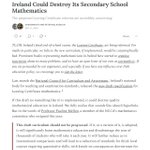
The government has released its draft mathematics curriculum for the Leaving Certificate, the main qualification that Irish teenagers leave secondary school with.
It is astonishingly bad. For @_fitzwilliam, we have written about why:


Sam Enright retweeted

@Sam__Enright and @ptr_mcl have written about the proposed new curriculum for mathematics in Irish schools.
They argue it is a perfect case study in what not to do: it is committed to 40% "continuous" assessment, greatly reduces content, and contains many factual errors (!)

Sam Enright retweeted

If you're feeling blue about English curriculum reform, read the draft curriculum for Irish Leaving Cert maths and count your lucky stars that no-one's proposing 40% of the grade is based on a 'one-day event'.
thefitzwilliam.com/p/leaving…

Sam Enright retweeted

Dumbing down maths is a terrible idea for the future of the country. These leaving cert reforms are very concerning and should be paused.

Trouble brewing in the maths curriculum... thefitzwilliam.com/p/leaving…

Sam Enright retweeted

If you value the education of this and next generations please sign the petition in the best interest of our young people. Don't allow the dumbing down of Mathematics. Our best and brightest need you to protect the quality and integrity of the curriculum. It benefits everyone.
We have contributed to an open letter from mathematicians, teachers, and entrepreneurs outlining some of these concerns. We encourage you to sign: savemaths.ie/
Sam Enright retweeted

It’s concerning that they’re dumbing down Leaving Cert maths.
thefitzwilliam.com/p/leaving…
