

Director of Educational Systems & Strategic Programs @GarnetValleySD | Ed.D in Educational Leadership @WidenerUniv | Founder Edvative Learning | OpenAI K-12 Adv
Pennsylvania, USA
Joined November 2014
- Tweets915
- Following487
- Followers811
- Likes2K







Pinned Tweet
Three books. Three years. Three very different moments in the AI conversation.
In 2024, I co-authored Navigating the AI Revolution in Our Schools with two of my colleagues. At the time, the message was pretty simple:
AI is here. Schools need to pay attention.
There was so much uncertainty. What should our policies look like? What does this mean for academic integrity? Should we embrace AI? Restrict it? How do we even begin preparing teachers and students for what’s coming?
Then came 2025. The conversation had changed, and so had my thinking. In Shift the Entry Point, I focused much more on the classroom. If students have access to tools that can generate writing, solve problems, explain concepts, and create content, then simply adding an AI policy isn't enough. We have to rethink how we design, deliver, and assess learning.
Then, in 2026, I wrote AI Without the Anxiety. By then, I was noticing something different.
The technology was continuing to move incredibly fast, but the biggest challenge I was seeing wasn't necessarily technical. It was human.
Teachers were overwhelmed. Leaders were getting questions from staff and families they didn't always know how to answer. Some people were excited. Others were anxious, skeptical, or simply exhausted by the pace of change.
And I realized leadership in the age of AI isn't just about helping people learn how to use new tools. It's about helping people navigate change.
Looking back at these three books, I can see my own thinking evolving right alongside AI.
2024: How do we prepare for this?
2025: How does this change teaching and learning?
2026: How do we lead people through it?
And now I'm finding myself wrestling with an even bigger question:
What happens when the world outside of education changes faster than the system inside of it?
I don't think I have the complete answer yet. But I think that's the question I'm going to be spending a lot of time on next.
🤖 Made with AI

AI Can Now Predict Cancer Survival from a Selfie
Researchers at Mass General Brigham have developed an AI system that can estimate biological age and predict cancer survival risk using a single photograph of someone's face.
The system, called FAHR-Face, was trained on more than 40 million facial images. Researchers developed two tools, one that estimates biological age and another that predicts survival risk for cancer patients.
The findings are remarkable. Patients whose faces appeared biologically older than their actual age had higher mortality risks. Another model identified facial patterns associated with a patient's likelihood of surviving the next 90 days.
The technology is still being evaluated. Researchers need to determine whether these predictions can improve treatment decisions and whether the system performs fairly across different populations.
Why it matters: This research raises questions that extend far beyond healthcare. If AI can identify health information from a photograph, imagine what future systems might infer from images collected in schools, workplaces, and public spaces. For educators, this is an important AI literacy conversation. Just because AI can identify patterns doesn't mean its conclusions are always accurate, appropriate, or ethical to use.


This message is for all school administrators: if you aren’t using AI, your job is too easy!
Is that true? Probably not. But if you’re overwhelmed, working every weekend, and struggling to find time for your personal life, I do think it’s worth asking: Have you explored a different way to do the work, or have you accepted that this is just what the job requires?
I’m not suggesting AI can solve staffing shortages or make the hard decisions for you. But the hours spent organizing information, analyzing PD feedback, preparing Board reports, and managing processes that involve way too many spreadsheets? AI can definitely support that kind of work.
And I’m talking about more than asking AI to write an email. I mean looking at a process your team dreads and figuring out how to make it work better. Or finally building something you’ve needed for years but never had the time or resources to take on.
You may still have to do the work but you may not have to keep doing it the same way.
🤖 Made with AI

What if the greatest threat AI poses to education isn't what AI will do to our schools, but what happens if our schools don't change?
I've been spending a lot of time lately thinking, researching, and writing about the future of education in an AI-driven world. And there's one idea I keep coming back to.
For the past few years, much of our conversation about AI in education has focused on what AI might change inside our schools.
• Will it replace teachers?
• Will students stop thinking for themselves?
• How will we assess learning?
• What happens to academic integrity?
These are important questions, and we absolutely need to address them. But I'm becoming increasingly concerned that we're overlooking a much bigger issue.
What happens when AI changes everything outside of our schools faster than we're willing or able to change what's happening inside them?
Think about it...
• The way people work is changing.
• The skills employers value are evolving.
• The way we access information, solve problems, communicate, and create is being redefined.
And yet, many of the fundamental structures of education remain largely unchanged. We still organize learning around many of the same schedules, subjects, assignments, assessments, and expectations that have existed for decades.
I'm not suggesting we abandon everything we've built. There are timeless aspects of teaching and learning that we should absolutely protect.
But I do think we need to question whether our systems are adapting quickly enough to prepare students for the world they're entering. And perhaps that's the bigger challenge facing education.
The greatest threat AI poses to education may not be that AI changes education too quickly. It may be that AI changes everything else too quickly for education to keep doing what it has always done.
That's the idea I've been wrestling with lately, and it's becoming a central focus of something new I'm working on.
I'm curious what others think. Are we spending too much time talking about how AI will change schools and not enough time considering how the world outside our schools is already changing?

What if we stopped thinking about AI as something students either can or can't use on an assignment?
I've been thinking a lot about how we can help teachers move beyond the all-or-nothing approach to AI in the classroom.
Too often, the conversation comes down to two choices:
Students can use AI. Or students can't use AI. But I think there's a much more interesting conversation to be had.
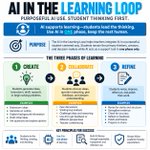
What if we allowed AI to support one part of the learning process while keeping the rest of the thinking in the hands of students? That's the idea behind the AI in the Loop Framework.
The framework breaks learning into three phases:
1. CREATE — Students generate ideas, brainstorm, research, and begin solving problems.
2. COLLABORATE — Students discuss their thinking, challenge ideas, provide feedback, and deepen their understanding.
3. REFINE — Students revise, improve, reflect, and strengthen their work.
Here's the important part:
AI can support ONE of these phases, while the other two remain student-driven.
For example, students might use AI to brainstorm initial ideas, but then collaborate with classmates and independently refine their work.
Or they might develop their own ideas, discuss them with peers, and then use AI to provide feedback during the revision process.
The goal isn't to eliminate AI from learning. And it certainly isn't to have AI do the learning.
The goal is to be intentional about where AI adds value and where students need to do the cognitive work themselves.
I also think frameworks like this help us move beyond simply writing AI policies and toward designing better learning experiences.
Of course, not every assignment needs AI. And there are times when students should complete all three phases without it.
But when we do introduce AI, we should be able to explain why we're using it and what students are expected to learn.
I'm curious what teachers think about this approach. Would a framework like this help you make more intentional decisions about AI use in your classroom?

Two years ago, we wrote a book about the coming AI tsunami in education. Here's what I think we got right...and what I'd change today.
In 2024, I had the opportunity to co-author Navigating the AI Revolution in Our Schools with two of my colleagues, Christine Gumpert and Julie Devine.
At the time, generative AI was still relatively new to most educators, and our message was pretty straightforward: AI isn't going away. We need to understand it, embrace its potential, and start preparing our schools for what's coming.
Looking back at those early chapters two years later, a few things stand out.
What I think we got right:
• We recognized that AI was going to be much more than another educational technology tool.
• We emphasized that teachers wouldn't be replaced by AI, but that their roles and responsibilities could evolve.
• We understood the importance of addressing privacy, bias, academic integrity, and responsible use from the beginning.
• And perhaps most importantly, we recognized that successful AI adoption would require thoughtful leadership, not just professional learning about new tools.
But here's what I'd change today.
• I think we spent too much time thinking about how educators could use AI within the systems and structures we already had.
• How could teachers create resources more efficiently?
• How could AI personalize instruction?
• How could administrators reduce their workload?
Those are still valuable questions. But I've become much more interested in a different set of questions.
• What if AI gives us an opportunity to rethink the systems themselves?
• What if we reconsider how we design learning experiences?
• How we assess what students actually understand?
• How we organize professional learning?
• How we build more effective systems for running our schools?
In 2024, we encouraged educators to learn how to surf the coming AI tsunami.
In 2026, I'm realizing that simply learning to ride the wave isn't enough.
We also need to rethink where we're trying to go. And perhaps that's been my biggest shift in thinking over the past two years.
AI shouldn't just help us do what we've always done more efficiently. It should challenge us to consider whether there's a better way to do it in the first place.
I'm curious: How has your thinking about AI in education changed over the past two years?
Link to book: bit.ly/49M3Uaj

What has AI made you reconsider about teaching that has nothing to do with AI?
One of the most interesting things about AI in education is that it's forcing us to question practices we've accepted for years. Not necessarily because those practices were wrong, but because we haven't always had a reason to rethink them.
For me, it's made me think differently about the relationship between the work students produce and the learning that actually takes place.
We've often used the finished product as evidence of learning. An essay. A presentation. A research project. A completed assignment.
But if AI can now help produce many of those things in seconds, perhaps we need to pay more attention to the thinking, decisions, conversations, and struggles that happen along the way.
And here's what's interesting: Those things mattered long before AI arrived. AI didn't make them important. It just made it harder for us to ignore them.
I'm curious what others think. What's one thing AI has made you rethink about teaching and learning that really has nothing to do with the technology itself?

We spent the first phase of AI in education asking, "How do we stop students from using it?" I think it's time we started asking better questions.
When generative AI first arrived in our schools, much of the conversation centered around preventing students from using it.
• How do we detect AI-generated work?
• Should we block ChatGPT?
• How do we prevent cheating?
• What should our AI policies say?
These were understandable questions, and some are still important today.
But nearly four years into the generative AI era, I wonder if we're spending too much time trying to protect the way we've always done things and not enough time rethinking what teaching and learning could look like.
Here are four questions I'd love to see more schools asking:
1. What should students be learning now that AI can do so much of what we've traditionally asked them to do?
2. How do we design learning experiences that make student thinking, creativity, and problem-solving more important than the final product?
3. How do we teach students to use AI responsibly, critically, and effectively rather than simply telling them when they can't use it?
4. How do we rethink assessment so we're measuring what students actually understand, not just what they can produce?
None of these questions have easy answers.
And I'm certainly not suggesting that academic integrity, policies, or guardrails don't matter. They absolutely do.
But I worry that if our primary response to AI is focused on preventing its use, we're missing an opportunity to fundamentally improve teaching and learning.
The question shouldn't just be how we protect education from AI. It should also be how we make education better because AI exists.
What other questions should schools be asking?

One of the things I'm learning about AI is that you don't have to be an expert in an area to use AI to make a meaningful difference.
This month, I had the opportunity to work with @SalisburySchool on a Dynamic Scenario Tool for five-year budget forecasting.
I'm not a school finance expert. I don't spend my days building district budgets. And yet, with the right questions, some curiosity, and AI as a thinking partner, we were able to work through a complicated problem and build something that could help district leaders explore different financial scenarios and see how those decisions might affect the future.
That got me thinking. We've spent a lot of time talking about AI in terms of expertise:
"You need to know how to use AI."
But I'm starting to think there's another skill that may matter just as much:
Knowing how to think with AI.
You don't necessarily need to be the person with all the answers. You need to be able to define the problem, ask good questions, evaluate what AI gives you, challenge the assumptions, and keep refining the solution.
That's a very different way of thinking about AI. And honestly, I find it much more exciting.
What problems could you tackle with AI that you wouldn't normally consider yourself an expert in?

If AI can complete the assignment, should we be redesigning the AI policy...or the assignment?
I've been thinking about this a lot. When generative AI became widely available to students, one of our first reactions in schools was to create rules.
Don't use AI for this.
Don't use AI for that.
Put your phone away.
Show your work.
Write it without AI.
And some of those guardrails are necessary. But I wonder if we've sometimes focused so much on how to prevent AI use that we haven't spent enough time asking a different question:
Why can AI complete the assignment so easily in the first place?
If a student can put our prompt into ChatGPT and get a strong response in seconds, maybe the problem isn't only the technology. Maybe the assignment is asking for something AI can now do remarkably well.
That doesn't mean we lower expectations. It means we may need to change where the learning happens.
Instead of asking students only to produce the final product, perhaps we ask them to:
• Explain their thinking.
• Make decisions and defend them.
• Connect ideas to their own experiences.
• Critique AI-generated work.
• Revise something that isn't quite right.
• Document their process.
• Apply what they know to a new situation.
• Collaborate, discuss, create, and reflect.
The goal isn't to design assignments that AI can't do. The goal is to design learning experiences where the student's thinking matters.
That's a big part of what I mean by "Shift the Entry Point." AI has changed the tools our students have. Maybe it's time to rethink where we begin the learning, too. What assignments have you redesigned because of AI?

Sometimes the best use of AI isn't creating the work. It's improving the system around the work.
We're getting ready for our upcoming CHOICE Day in Garnet Valley, where our staff have the opportunity to choose from a wide range of professional learning experiences.
There are a lot of moving pieces behind something like this.
Session descriptions. Presenters. Locations. Schedules. Audience recommendations. Registration information. Helping hundreds of employees figure out which opportunities are most relevant to them.
This year, we've been using AI to help us rethink some of those systems and structures.
One example is the CHOICE Day Menu we've built to give our staff a much better way to explore the professional learning available to them.
But here's what I think is important: AI didn't decide what our professional learning should be. Our people did that.
The expertise, ideas, presenters, and learning experiences still come from educators. We used AI to help us build a better system around those people and ideas.
That's one of the areas where I think AI has enormous potential in schools.
Not simply:
"What can AI create for me?"
But:
"What systems have we accepted as cumbersome or inefficient that we could now completely rethink?"
For me, that's a much more interesting AI conversation.
choice-day-menu.lovable.app/…

How do we know whether the technology we’re paying for is making a difference?
In schools, I think ROI needs to mean two things: return on investment and return on instruction.
The financial questions matter. Are we using what we purchased? Are we paying for overlapping tools? Does the value justify the cost?
But we also need to ask what’s changing for teachers and students.
• Is feedback becoming more timely and useful?
• Can teachers better respond to different learning needs?
• Are students doing more meaningful thinking, creating, and problem-solving?
• Are we expanding what students can do and demonstrate?
• When we save teachers time, what does that time make possible?
Usage data can tell us whether people open a tool. But we need to take a closer look at teaching and student work to understand whether that tool is helping.
A license renewal should be a conversation about cost, purpose, and evidence of impact. What are we getting for our money, and what are students gaining from the experience?
I'm curious, does does your district measure both?


AI adoption isn't really a technology problem. It's a change-management problem.
I think I understood this intellectually when generative AI first arrived. But the more I've worked with teachers and school leaders over the past few years, the more I've come to believe it.
We can give people access to the best AI tools.
We can create guidelines and policies.
We can offer professional learning.
We can show people dozens of ways AI might improve teaching, learning, or their work.
And some people will jump right in. Others won't. Because adoption isn't just about whether someone knows how to use the technology.
It's about trust.
It's about confidence.
It's about whether people understand why we're changing.
It's about whether they feel like change is happening with them or to them.
And sometimes, it's about giving people permission to say, "I'm not comfortable with this yet."
That's why I think one of the biggest mistakes we can make as leaders is assuming that the people who aren't embracing AI simply need more training.
Sometimes they need training.
But sometimes they need to be heard.
Sometimes they need time.
Sometimes they need to see someone they trust use it successfully.
And sometimes they need a leader who's willing to acknowledge that their concerns are legitimate instead of immediately trying to convince them they're wrong.
That's a big part of what led me to write AI Without the Anxiety. The more I thought about AI adoption, the less I thought about the technology. And the more I thought about the people.
Because ultimately, successful AI adoption won't be determined by how quickly we get people using AI. It'll be determined by how well we lead people through the change.

White House Accord on Super Intelligence
On September 29, 2026, President Trump met with major AI industry leaders at the White House to discuss the safe development of increasingly powerful AI.
The meeting produced the White House Accord on Super Intelligence, a voluntary agreement on company safeguards and oversight.
The six industry signatories were:
Sundar Pichai, Google
Dario Amodei, Anthropic
Mark Zuckerberg, Meta
Greg Brockman, OpenAI
Elon Musk, xAI
Jensen Huang, Nvidia
The companies committed to four layers of protection:
• Controls to identify dangerous or unintended model behavior, including serious cyber, biological, and chemical risks.
• Internal teams empowered to check those safeguards and address problems.
• Independent external evaluations.
• Independent board committees overseeing the process and corrective action.
They also agreed to meet regularly to develop shared safety standards.
Why does this matter?
Stronger safeguards could help make AI more trustworthy as it supports medical research, education, scientific discovery, and everyday work. Shared expectations could also encourage companies to identify problems earlier and take responsibility for fixing them.
But those are potential benefits, not guaranteed outcomes. The agreement is voluntary, and it doesn’t guarantee affordable access or equal benefits for everyone. Its value will depend on implementation and what companies do when problems are found.
🤖 Made with AI

AI isn't moving too fast. Education is moving too slowly.
I've heard a lot of people say that AI is moving so quickly that schools can't possibly keep up.
I'm not sure that's the problem. Technology has always changed. The bigger problem may be that our education systems were built for a world where change happened slowly enough that we could take our time responding to it.
Write a new curriculum.
Adopt a new textbook.
Change a grading policy.
Introduce a new technology.
Provide some professional development.
These things can take months or even years. But the world outside of school doesn't operate that way anymore.
AI is changing how people find information.
How they create.
How they solve problems.
How they communicate.
How they work.
And it's happening while our schools are still trying to figure out how to respond to the last change.
That doesn't mean schools should chase every new technology. It doesn't mean everything needs to change.
And it certainly doesn't mean we should abandon the things we know matter about teaching and learning.
But it does mean we need to ask a harder question:
Can a system designed for slow change successfully prepare students for a world of rapid change?
That's the question I keep coming back to. And honestly, I don't think it's just an AI question. It's an education question.

What's the biggest barrier to meaningful AI adoption in your school right now?
20%Knowledge & Training
43%Fear & Anxiety
29%Policy & Direction
7%Time & Capacity
109 votes • Final resultsThis event is built for educators who want to understand how AI fits into teaching, learning, and leadership decisions happening right now.
Register here: aiedcamp.com
