

News and insights from Salesforce. Please send media requests to [email protected]
Joined August 2017
- Tweets4.9K
- Following894
- Followers23.7K
- Likes368






From cancelling subscriptions to booking restaurant reservations, consumers are starting to hand a wide variety of work to personal AI agents. And because personal AI agents don't mind waiting on hold, calling back every few hours, or reaching out at 2 a.m., they won't reduce contact center traffic. Instead, they will drive unprecedented volume.
Personal agents lack internal customer history and context, so businesses need to meet them at the front door with AI agents of their own, said Kishan Chetan, EVP and GM, Agentforce and Service Cloud, in a new opinion piece.
By pairing AI agents with human representatives grounded in unified customer data and defined business workflows, companies can resolve complex requests efficiently, even when a customer’s agent is on the line.
salesforce.com/news/stories/…

Salesforce News & Insights retweeted
Not every job calls for the same AI model. Some tasks, like routing a case or updating an opportunity, need precise multistep reasoning. Others might need to be done particularly quickly or cost-effectively.
So rather than forcing customers to stick with a single tool, Salesforce allows them to use whichever model works best, whether it’s a frontier, open, or custom model like Salesforce’s first CRM reasoning model, Koa.
“We believe in giving our customers choice, that you can pick the model that’s right for your particular use case … and that you have the flexibility to keep evolving and changing what model you use," said Michael Andrew, Salesforce Chief Data Officer.
Learn more about why Salesforce lets customers pick the right AI model for the job.
salesforce.com/news/stories/…
Individuals can get good results working alone, but when a team gets in a room and focuses on the same problem at the same time, it can be a real power-up.
Picture a deal that hits a snag because a new competitor shows up. The instinct is for everyone to go back to their own screen and quietly ask their own AI assistant what to do.
But AI is worth far more to a business when it works out in the open, in the same places people already work. That’s the idea behind the next era of Slack: share context, build on it together, and generate more context as you go.
Now, users can just tag an agent —Slackbot — right in a shared channel. Slackbot answers using everything it’s allowed to see: the account history, past research, the Salesforce records, the team’s own back-and-forth. Everyone in the channel sees the same answer at the same time, learns from each other, and works out a response together. And the agent gets smarter with every step.
The single-player era of AI made people faster. The multiplayer era is what makes a whole company smarter, together.
salesforce.com/news/stories/…

In the UK today, 61% of workers receive no AI training.
Salesforce announced a global-first initiative to provide free Slack Enterprise access to millions of higher and further education students in the UK.
Aimed at closing the UK’s digital skills gap, the pledge gives students a single place to learn, connect, and build real AI skills—right where their everyday conversations happen. At the same time, it helps institutions prepare future graduates with the same platform used by leading businesses across the UK and worldwide.
The initiative, part of Salesforce's $6 billion investment in the UK, gives students hands-on experience of AI-powered collaboration, preparing them for the modern workplace.
salesforce.com/uk/news/press…
Salesforce today announced a landmark 15-year, up to £2 billion strategic agreement with HM Revenue & Customs (HMRC) to modernize services and transform customer service experience for UK taxpayers.
As HMRC’s strategic Enterprise Customer Relationship Management (ECRM) provider, Salesforce will unify legacy systems onto a single secure platform, delivering a 360-degree view of taxpayer interactions to enable faster, first-contact query resolution.
The platform will equip HMRC teams with real-time taxpayer insights, automated workflows, and AI-assisted tools that significantly reduce manual workloads.
Together, these capabilities directly support HMRC’s ambition for 90% digital service delivery by 2030 while maintaining crucial support for those who need extra assistance.
salesforce.com/uk/news/press…
With the advent of personal AI agents, every business is grappling with the same question: Let them in or block them at the front door?
According to Mark Wakelin, EVP Customer Engineering & GM Agentforce at Salesforce, personal agents are only as reliable as the business agents waiting to greet them.
➡️ If a personal agent finds only a website and an API, it will do the thinking, weigh the options, and ultimately determine what the customer buys. The business supplies the product while the personal agent keeps the relationship.
➡️ When a business agent is waiting at the front door, the conversation that shapes the sale happens on the business’s side. The business answers the questions, suggests the better option, and resolves the problem, so the relationship stays with the company that served the customer.
That’s why the choice between blocking personal agents or letting them in is a false dichotomy. Blocking them keeps control but sends customers somewhere else. Letting them in through a website and an API wins the traffic but forfeits the relationship.
With Agentforce, businesses can open the door without giving up control. Their own agents greet personal agents as they arrive, so a business can welcome the traffic while keeping the conversation, the rules, and the customer data on its side.
salesforce.com/news/stories/…

Today, many enterprises are saturated with information. The answer to almost any question they care about is somewhere in a stream of millions of data points: error rates, pipeline movement, contact center telemetry, developer activity.
What’s missing is the layer that makes it legible. That’s the gap Salesforce AI Research Chief Scientist Silvio Savarese is targeting with what he calls “operational intelligence.” It’s AI that reasons over a business’s live data continuously, instead of waiting for a dashboard to summarize what already happened.
Learn more about the Salesforce capabilities — Deep Insights and Moirai — that make “operational intelligence” work.
salesforce.com/news/stories/…
Not every job calls for the same AI model. Some tasks, like routing a case or updating an opportunity, need precise multistep reasoning. Others might need to be done particularly quickly or cost-effectively.
So rather than forcing customers to stick with a single tool, Salesforce allows them to use whichever model works best, whether it’s a frontier, open, or custom model like Salesforce’s first CRM reasoning model, Koa.
“We believe in giving our customers choice, that you can pick the model that’s right for your particular use case … and that you have the flexibility to keep evolving and changing what model you use," said Michael Andrew, Salesforce Chief Data Officer.
Learn more about why Salesforce lets customers pick the right AI model for the job.
salesforce.com/news/stories/…
Takeda, a global R&D-driven digital biopharmaceutical organization, has sales representatives in over 80 countries who are supposed to be meeting with customers and healthcare professionals to make sure that they understand medications and to answer any questions. But Takeda found that 70% of the time, its sales reps are actually having to spend their time on administrative tasks.
"So what we're trying to do is automating that with AI and agents to make sure that they're spending less time doing expense reports and doing all the backend processes and spending more time with our customers," said Samer Ansari, Head of Commercial Innovation and External Experience at Takeda.
Learn more about how Takeda uses AI to allow sales reps to dedicate more time to customer and patient experiences.
For a technology first popularized less than a year ago through an open-source project called OpenClaw, personal agents are rapidly hitting their stride. Instinct AI, a hugely popular invite-only personal agent, already boasts close to $1 billion in annual transactions, according to its founder, despite having no dedicated app — users simply text or call it.
For businesses, the opportunity is clear and immediate. Personal agents shopping on behalf of consumers, booking reservations, managing returns, and resolving customer service issues have the potential to drive substantial new revenue and a tremendous uptick in business-agent interactions. But the risks are equally apparent. If not properly governed, a massive influx of autonomous interactions could harm customers and businesses alike.
So, is there a safe way for businesses to allow personal agents in without losing control? In a new article, Mark Wakelin, EVP, Forward Deployed Engineering, Salesforce says that answer is yes, but only if those personal agents are met with business agents to manage the interaction and own the relationship.
salesforce.com/news/stories/…
Today's AI agents are powerful tools for businesses looking to better connect with their customers. They can hold conversations, reason through multistep problems, take independent action across systems, and more.
But large language models are probabilistic in nature and excel only with the right context, data, and instruction. Otherwise, they can deliver incorrect answers and even take incorrect actions.
Rather than leave businesses to decide between AI agents and an old-school, purely deterministic approach, which keeps things safe by adhering to strict rules but offers a limited range of abilities, Salesforce combines them.
“Agentforce splits the agent brain into two layers,” said Kathy Baxter, Salesforce’s Principal Architect of Ethical AI Practice.
Baxter shares how to combine the strengths of these dual approaches, how humans stay in charge, and why testing before launch is only the start:
salesforce.com/news/stories/…
A Salesforce customer since 2014, Xero - a global small business platform - has recently launched a conversational customer service agent.
“We went live in April to all 5 million of our customers,” said Nigel Piper, Executive General Manager, Xero. “[And] what we were able to do with our service agent is to bring channel choice into the chat experience. So if someone wants a call back, if they want to deal with a live chat interaction, if they do want to just raise a case, they don’t have to leave the agent. We can give the choice within the agent. They can just click a button. We’ve captured all the information that the customer has already given us, and we can use that for a better experience for our customers.”
Learn more about how Xero is redefining channel choice with AI agents.
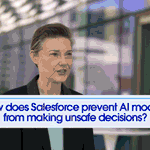
A study by NVIDIA revealed that an agent can correctly identify a request as insecure in its internal “thought” process and yet proceed to execute that harmful action anyway.
So when AI agents dynamically connect to external tools, this “thought-and-action disconnect” can cause an agent to execute harmful function calls or pass insecure parameters to third-party tools. In multi-agent systems, that kind of failure can trigger cascading breaches across connected third-party platforms.
This phenomenon highlights a critical reality: one agent might be reasoning about being safe, but that doesn’t guarantee it is safe.
The key to fully mitigating this risk? In a new byline, Kathy Baxter, Principal Architect of Ethical AI at Salesforce suggests a hybrid approach — combining the LLM’s probabilistic reasoning with hard-coded, deterministic guardrails that exist outside the agent's internal reasoning loop.
salesforce.com/news/stories/…

Today’s AI agents are powerful tools for businesses looking to better connect with their customers. They can hold conversations, reason through multistep problems, take independent action across systems, and more.
But large language models are probabilistic in nature and excel only with the right context, data, and instruction. Otherwise, they can deliver incorrect answers and even take incorrect actions.
Rather than leave businesses to decide between AI agents and an old-school, purely deterministic approach, which keeps things safe by adhering to strict rules but offers a limited range of abilities, Salesforce combines them:
1️⃣ The probabilistic model handles language and reasoning and predicts the most likely answer to a question.
2️⃣ The deterministic layer includes preset deterministic business logic, workflows, and permissions, so every action or response is subjected to a company’s prescribed policies, procedures, or escalations to humans.
Kathy Baxter, Principal Architect of Ethical AI at Salesforce explains how pairing a probabilistic model with deterministic logic gives agents the ability to take action — without giving up the guardrails.
salesforce.com/news/stories/…
Salesforce News & Insights retweeted
Southwest's AI journey started out with a single agent to answer flyers' questions. The company is now moving to a multi-agent architecture to increase its customer service experiences.
Rather than customers having to conduct several different searches for information, they can ask all of them in one place and the agent will be able to assist, from name changes to flight booking adjustments, refunds, and more.
"[AI agents] allow more time for our human representatives to assist with more of the customer situations where we're needing more hospitality and empathy," said Megan Rauber, Manager, Customer 360 at Southwest Airlines.
Learn more about how Southwest Airlines is using AI agents to change the way people fly:
Salesforce News & Insights retweeted
Today, most AI and agent use isn’t shared. One person, one screen, one agent in a private tab, solving one problem. The person and the agent both learn something — and then the project ends, they move on, and the rest of the company never sees any of it. The knowledge stays in the tab.
AI is worth far more to a business when it works out in the open, in the same places people already work. That’s the idea behind this next era of Slack: share context, build on it together, and generate more context. That loop is how companies move faster and make AI work at real scale.
Rob Seaman, Senior Vice President of Enterprise Product, Slack shares more about the shift from smarter individuals to a smarter company.
salesforce.com/news/stories/…
Salesforce customers across industries recently described their agentic rollouts, sharing what worked, what surprised them, and what they’d tell others just getting started on their own AI journeys.
Here is the advice that came up again and again:
1️⃣ AI unlocks the human side of business
2️⃣ Discover what customers actually want — and keep asking
3️⃣ Build in the control and trust you need
The customers seeing real results don’t just deploy — they listen to their users, define success, and build in the guardrails to sustain it.
salesforce.com/news/stories/…

Sammons Financial Group started thinking about how it could serve its customers differently. Agentforce Voice is a big piece of that change. The company has been able to reimagine how and where it answers phone calls, based on customer demand.
Now 55% of the company's phone calls that make it to its AI agent don't ever touch a human, but the customers don't hang up or disengage. They pay attention. And, often, in under two minutes, they're completing the conversation they wanted to have.
"We're using artificial intelligence and specifically Agentforce to be kind of the Iron Man suit for our reps," said Andrew Walling, AVP, Sammons Financial Group Companies.
Learn more about how Agentforce Voice delivers trusted answers for Sammons Financial.
When customers need support, they expect to have straightforward conversations, in natural language, that result in a quick solution.
For Canon, customer inquiries may be as simple as asking what ink is needed for a certain printer. Yet, with the variety of models and SKUs, the answer is often complex. Agentforce was the key to meeting customer expectations, reducing friction, and ultimately responding to these inquiries faster. The company has been able to deflect 69% of customer issues with Agentforce.
"I had my team go through and manually verify the data that we were seeing was correct, because I didn't trust it," said Bill Duval, VP, Technology & Information Management at Canon.
See how the power of Agentforce has been a game changer for Canon: