

A humble @goblinarinos 🗿 All low cap coin mentions are gambling and posted caveat emptor
Easter Island
Joined March 2020
- Tweets4.3K
- Following1.8K
- Followers759
- Likes13K






Sage retweeted

In 2024 I wrote this X Article below: a DeFi primitive to counter zero-royalty NFT venues and protect floors.
Blur’s website closes on 12 November. So today I’m opening FloorGuard, the working version of that idea, and looking for people to help build it.
It's OpenSource and a live demo is available
👉 github.com/Goldcote/FloorGua…
🧵👇


Sage retweeted

The Human Queue in 'MoltenRock Connect' is Live
@stripe Payments first
'MoltenRock Connect' is Free to download, HumanQueue Actions require MoltenRock Pro subscription
Get it on our website 👇
Sage retweeted
Molten Mail is live on the Mac App Store! 🚀
The first secure email app built for AI agents.
✅ AI can READ your inbox
✅ AI can DRAFT replies - Straight to your main email draft folder
❌ AI can NEVER send, NEVER delete, Never modify - By Design!
Works with OpenClaw, Claude Code, Hermes, Cursor, Codex & any local AI agent.
No cloud. No data collected.
Your email stays local on your machine.
📥 Free to try on link below👇
#MoltenMail #AISecurity #MacAppStore #EmailSecurity #OpenClaw #Claude #Cursor #Codex
Sage retweeted

⚠️This is a WARNING for EU residents (not an advertisement of non-compliant services!).
🔸Do NOT use @bisq_network, @RetoSwap, @BasicSwapDEX, @eigenwallet - these are tools used by non-compliant people to voluntarily exchange crypto.
🔸Do NOT go to KYCNOT.ME website - it's a list of services that refused to comply with KYC.
🔸Do NOT use Monero - it never complied with anything.
🔸Do NOT read this post too - just in case it's non-compliant "advice on crypto".
Stay SAFE & COMPLIANT, citizens 🇪🇺🫵


⚠️ July 1st is here. MiCA is fully in effect for the 450M EU residents
A MiCA license is required to:
🔸custody client coins
🔸operate a crypto <> crypto exchange
🔸operate a crypto <> fiat exchange
🔸execute orders on behalf of clients
🔸place crypto assets
🔸receive and transmit orders for crypto
🔸advise on crypto
🔸manage clients crypto portfolio
🔸provide transfer services for crypto
❗️Advertising non compliant services to EU residents is illegal

Sage retweeted

Just to remind everyone. Zcash had a back door that allowed people with that knowledge to print more Zcash. There’s no way of knowing how much they printed.
Zcash is truly worth zero
Sage retweeted

This is incorrect.
Edge accounts are simply username + password used to encrypt wallet data locally. We collect no personal information and cannot see balances or transactions.
We also don’t collect or view keys.
See our privacy manifesto:
edge.app/privacy-manifesto/

Sage retweeted

QNet Update – Explained Simply
Over the last period, the developer has been focused on making sure the blockchain works correctly and fairly, even though it took longer than expected.
What looked simple at first revealed deeper edge cases under real conditions. Taking the time to test, fix, and retest now shows a focus on long-term reliability — the kind of discipline needed to build a network that actually lasts.
⸻
Rewards are now safer and fairer
Instead of giving rewards instantly, QNet now waits one cycle before paying them out.
This makes sure:
•All activity is verified properly
•No one gets extra or missing rewards
•Everyone is treated the same
It’s slower, but much more reliable.
⸻
Important data is now stored on the blockchain itself
Before, some important information lived only inside each node or was shared through messages between nodes. That could cause differences or confusion.
Now:
•Node activity is written directly to the blockchain
•Everyone sees the same data
•Rewards are calculated based only on what’s on-chain
This removes trust issues and makes everything auditable and transparent.
⸻
Stronger security, future-proof design
The project upgraded its security to official, government-grade standards and fully integrated protection against future quantum computers.
This means:
•Transactions are harder to fake
•The system is built for the long term
•Security choices are conservative and serious
⸻
The network is harder to break
Many protections were added so the blockchain:
•Doesn’t split into different versions
•Automatically recovers if a node fails
•Keeps working even during network problems or attacks
If one connection method fails, the system automatically switches to another.
⸻
Apps and explorer are getting ready
Behind the scenes, the tools people will use (explorer, mobile app) are now:
•Faster
•More accurate
•Better connected to the real blockchain data
This is preparation for real users, not just testing.
All this and its still under 300K MC
4R3DPW4BY97kJRfv8J5wgTtbDpoXpRv92W957tXMpump

QNet Blockchain: Development Report
I expected to complete the reward system and full transaction functionality in a much shorter timeframe, but it turned out there were many more areas requiring optimization and fixes than initially anticipated.
One important architectural note: according to the new design, rewards for the current epoch are distributed at the end of the following epoch. This delayed distribution model ensures all validator commitments are properly verified on-chain before rewards are calculated.
The reward system and transactions are now nearly complete. The main reason this took so long is the testing cycle: after each build, I need to wait approximately 4 hours (one full epoch) to observe how the logic performs in practice, identify issues, make corrections, and repeat. This iterative process, while time-consuming, is essential for ensuring reliability.
Thank you all for your tremendous support and belief in this project.
Migration from Local Storage to On-Chain Logic
A significant architectural shift during this period was moving critical validator data from local node storage and P2P gossip to verifiable on-chain transactions:
HeartbeatCommitment Transactions
Previously, validator heartbeats were stored locally on each node and shared via P2P gossip. Now, nodes submit HeartbeatCommitment transactions directly to the blockchain. This ensures:
- Cryptographic proof of validator activity
- Immutable record on-chain
- No reliance on P2P message delivery for reward eligibility
PingCommitment Transactions
Validator ping proofs for Light node verification have been moved from local accumulation to on-chain PingCommitmentWithSampling transactions. Benefits include:
- Transparent and auditable ping records
- Elimination of local storage discrepancies between nodes
- Deterministic reward calculation based on blockchain state
On-Chain Node Registration
Node registration data is now recorded directly on the blockchain rather than maintained in local registries synchronized via gossip.
This migration eliminates trust assumptions, ensures all nodes have identical data for reward calculations, and provides full auditability of validator activity.
Cryptographic Standards: NIST FIPS 202 Compliance
Transaction signature verification has been migrated to SHA3-256 (Keccak) for full compliance with NIST FIPS 202 standards. The dual-hash strategy now uses:
- SHA3-256 for all transaction signatures and cryptographic operations
- Blake3 for Proof-of-History chains and internal performance-critical hashing
Additionally, the hybrid signature system combining Ed25519 (classical) with Dilithium3 (post-quantum) has been fully integrated for consensus-critical transactions including HeartbeatCommitment and PingCommitment.
Consensus Protocol Hardening
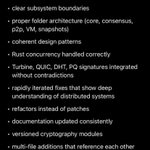
Multiple critical fixes were implemented to ensure deterministic consensus and prevent network forks:
- Epoch-Based Validator Set for deterministic producer selection
- Zero Fork Guarantee through 5-layer macroblock protection
- Per-round storage for commit-reveal consensus data, preventing round_override data loss
- Emergency producer rotation with strict synchronization checks
- Certificate extraction from VRF proofs for historical block validation
- Round-based failover with unified SHA3-512 entropy source
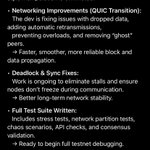
Network Resilience: QUIC Fallback System
The latest release introduces a critical failover mechanism for network partitioning scenarios:
When HTTP API (port 8001) becomes unreachable due to DDoS protection or rate limiting, nodes automatically fall back to QUIC transport (UDP port 10876) for:
- Block existence verification during emergency failover
- Peer reconnection when TCP connections fail
- RequestBlocks and HealthPing message delivery
Security measures include rate limiting (maximum 10 fallback requests per minute per node) and production metrics for monitoring fallback success rates.
ShredProtocol Improvements
Block propagation via ShredProtocol received significant attention:
- Resolution of DashMap deadlocks in chunk assembly
- Parallel broadcast with certificate grace period
- Producer cache with asynchronous broadcast and automatic chunk repair
- Producer certificate inclusion in SHRED_PROTOCOL chunks eliminating race conditions
Explorer and Mobile Integration
Production infrastructure for blockchain exploration:
- PostgreSQL-based synchronization service with batch processing
- Embedded RocksDB indexing for high-performance queries
- Real-time WebSocket updates for transaction and block feeds
- Genesis account handling and QNC balance integration in mobile application
- Transaction type unification across Explorer UI
Security Improvements
- Replacement of all unsafe unwrap() calls with safe alternatives
- On-chain slashing architecture replacing P2P-based slashing
- Strict sync verification for emergency producer selection
- Certificate validation for all historical blocks

Sage retweeted

In the last two days (Dec 24 and 25, 2025), the main developer (@AIQnetLab) pushed a ton of commits to make QNet faster, fix crashes, and handle crazy amounts of transactions – they're aiming for 100,000 + transactions per second (that's like handling a million payments in just 10 seconds) , which is like supercharging the blockchain to be one of the fastest ever.
Here's the main stuff he did, in order from newest:
December 25 (Christmas Day! 🎄):
- Fixed bugs in **consensus** (how all the computers agree on the blockchain): Stopped "round mismatches" and made sure important data (called "reveals") doesn't get lost in big blocks called macroblocks.
- Made consensus **asynchronous** (doesn't wait around blocking everything) and added **parallel processing** for transactions – this is a big speed boost for hitting 100K+ TPS.
- Improved **QUIC** (a fast internet protocol they use for node communication): Smarter connection handling to avoid losing messages, plus better logging for errors.
- Cleaned up code: Replaced a random hardcoded number (70.0) in the reputation system with proper rules from consensus constants (makes it more flexible and correct).
- Fixed P2P networking: Stopped nodes from accidentally connecting to themselves in loops and added better error reports.
December 24 (yesterday):
- A bunch of version updates (like v2.43 to v2.45) focused on high-speed tweaks:
- Cranked up **concurrent sends** (sending data chunks at the same time) from 20 to 200 – helps with initial setup (genesis) and overall speed.
- Bigger **chunk sizes** (from 1KB to 128KB) to fix errors in Reed-Solomon (a way to recover lost data, like error correction).
- Made blocks bigger (up to **20MB**) and increased timeouts so the system doesn't freeze under heavy load (stress tests).
- Fixed **deadlocks** (when parts of the program get stuck waiting forever): Removed some early checks that caused crashes on startup, and made peer height tracking (how nodes know each other's progress) more reliable and strict.
- Optimized QUIC again with **adaptive pacing** (smart speed control) for even better throughput.
Basically, dev spent Christmas Eve and Day squashing crashes, removing bottlenecks, and tuning everything for insane speed and stability. It's all prep for a rock-solid testnet where the blockchain can handle massive traffic without choking. Pretty intense dev work!
If you're into this, checking the GitHub commit history is a great way to see real blockchain engineering in action.
@AIQnetLab
Chart is ready to send


Sage retweeted

I'm not sure if sharding will ever be needed in practice — the network's throughput is already extremely high. But if QNet ever needs to handle a colossal number of transactions, the architecture is ready for that scenario.
My goal was to build the most modern, high-performance network possible. Essentially, I built a spaceship for the price of a bag of chips — and that thought keeps me warm at night.
For months I've been improving and optimizing every aspect of the architecture. As some of you know, over the past 2.5 months I've had only 1 day off. I spend up to 16 hours a day on this project. I've been working on QNet for over 9 months now, and the testnet launch is finally within reach.
There are probably still bugs and blind spots I haven't discovered yet — that's exactly why I'll be ordering a professional security audit to ensure there are no vulnerabilities or issues before mainnet.
Yesterday's benchmark results made me incredibly happy, but there's still a lot of work ahead. I know the website has been unstable and eventually crashed completely — I'll fix that. The priority now is the mobile app, which everything depends on. I'll be testing the node reward distribution system and finishing the explorer so users can view transactions on the network.
I'll be back with good news as soon as possible. Until then, I don't see the point in cluttering the feed with noise.
Once again — thank you all for your support and belief in this project.
Sage retweeted

I aped this because of my bro @breakb0nes__
He dug deep, and my takeaway is simple:
- this dev is fully locked in #1DEV / @AIQnetLab at ~300k mcap looks like one of those rare long term L1 bets:
- built by a solo dev, zero funding, no corporate noise
quantum resistant focus + high-performance design
phone nodes are the hook: ping every 4 hours, <1s, basically no battery drain
- testnet showing life: 156 active nodes, 100% uptime last 24h
- 20% supply locked with a vesting schedule
- open source and verifiable on GitHubChart has been compressing for months.
Chart looks ready for rip off!
4R3DPW4BY97kJRfv8J5wgTtbDpoXpRv92W957tXMpump
NFA. DYOR. SEND IT! 🐐

Sage retweeted

github.com/AIQnetLab/QNet-Bl…
Current WiP for 8 months. Quantum tech will be one of the main focus going forward.
#1DEV @AIQnetLab may be a rough uncut gem in this field. Still very early days.


The quantum L1 thesis built from ground up verifiable by GitHub commits is worth 8’figures or more if delivered
#1DEV @AIQnetLab
Watch out above
A few trusted friends who got into $XERIS early purely based on speculation has verified that 1DEV ‘s tech is even more groundbreaking
I am a bidder at anywhere under $300K MC
dexscreener.com/solana/FgbFz…

Sage retweeted

🚨 @AIQnetLab: QNet Major Two-Month Development Update — Testnet Imminent 🚨
1/
In just two months since launch, @AIQnetLab has delivered one of the fastest-moving Layer-1 build-outs in the space — driven by a single developer using advanced AI tools.
Momentum is accelerating fast. 👇
QNet Blockchain: Two Months of Intensive Development
Period: October 24 - November 23, 2025
Two months have passed since the token launch. During this period, deep modernization of critical blockchain components was conducted, with focus on network stability, post-quantum cryptography. The system is now very close to full production testnet launch, with final debugging stages remaining.
I want to thank everyone who supports the project. Your trust and participation are appreciated!
Code & Commits:
• 178 commits merged to testnet
• +31,978 lines added / -3,637 removed
• 122 files modified
• 53 major features and critical fixes
Investment & Time:
• $3,665 in AI development assistance
• 31 days of active development with 0 days off
• 8-12 hours daily work schedule
Major Deliverables
MEV Protection & Priority Mempool (v2.19.3)
• Private Bundle Submission - Flashbots-style front-running protection
• Post-Quantum Signatures - Dilithium3 for bundle authentication
• Dynamic Block Allocation - 0-20% bundles, 80-100% public TXs
• Reputation Gate - only nodes with 80%+ reputation
Post-Quantum Cryptography
• NIST/Cisco Encapsulated Keys - complete implementation
• Hybrid Signatures - Dilithium3 + Ed25519
• Real Cryptographic Verification - pqcrypto-dilithium integration
• Certificate Lifetime - optimized to 4.5 minutes (270s)
• Forward Secrecy - 80% rotation threshold
Reputation System & Network Resilience (v2.19.2)
• Split Reputation Model - separate consensus_score / network_score
• Peer Blacklist System - soft/hard blocking of problematic nodes
• Peer Prioritization - optimized block synchronization
• HTTP Gossip Protocol - O(log n) instead of O(n) for reputation sync
• Byzantine-Safe - WAN latency doesn't affect consensus
Performance & Scalability
• Quantum Proof-of-History - 500K hashes/sec (SHA3-512/Blake3)
• Adaptive Turbine Fanout - dynamic adjustment 4-32 based on network
• Priority Mempool - BTreeMap with O(log n) insertion
• Real-time Prometheus Metrics - live metrics without hardcoded values
• Hybrid Merkle + Sampling - 360x on-chain size reduction
• Scalability - ready for 1M+ nodes
Critical Fixes & Stability
• Certificate Propagation Deadlock - resolved stalling
• Certificate Broadcast Race Condition - fixed timing issues
• Emergency Failover - automatic consensus recovery
• Deterministic Consensus - eliminated network forks
• P2P Connection Pooling - optimized network connections
Infrastructure & Economics
• Production Solana RPC - integration for node activation
• Bitcoin-Style Emission - decentralized validation without central key
• State Snapshots - full/incremental with LZ4 compression
• Kademlia DHT - improved node routing
Technical Achievements:
• Post-Quantum MEV Protection - Dilithium3 + reputation gate
• Hybrid Merkle + Sampling - 360x on-chain optimization
• Split Reputation System - Byzantine + network separation
• Adaptive Turbine - dynamic fanout 4-32
• O(log n) Gossip - exponential propagation
Security:
• 10^15 years attack time (Dilithium3 quantum resistance)
- 80%+ reputation gate for MEV bundles
• 4.5 minutes certificate lifetime (optimal quantum protection)
• Byzantine consensus at all critical levels
Mobile Applications
• iOS wallet app (App Store developer account setup in progress)
• Android wallet app (F-Droid publication pending)
github.com/AIQnetLab/QNet-Bl…
Sage retweeted

complete misinformation from @lookonchain again. $0 have been cashed out - we're not involved in the transactions between Kraken and Circle that you're alleging us to be a part of.
What's happening is a part of pump's treasury management, where USDC from the $PUMP ICO has been transferred into different wallets so the company's runway can be reinvested into the business. pump has never directly worked with Circle.

It appears pump.fun has cashed out at least 436.5M $USDC since Oct 15.
Since Oct 15, pump.fun has deposited 436.5M $USDC into#$Kraken.
During the same period, 537.6M $USDC flowed from #Kraken to #Circle through wallet DTQK7G.
Between May 19, 2024 and Aug 12, 2025, pump.fun sold a total of 4.19M $SOL ($757M) at an average price of $181.
Of that amount, 264,373 $SOL was dumped on-chain for $41.64M, while 3.93M $SOL($715.5M) was deposited into #Kraken.
xitter.cf/lookonchain/status/195…
intel.arkm.com/explorer/enti…
intel.arkm.com/explorer/addr…


Sage retweeted
QNet Blockchain: Two Months of Intensive Development
Period: October 24 - November 23, 2025
Two months have passed since the token launch. During this period, deep modernization of critical blockchain components was conducted, with focus on network stability, post-quantum cryptography. The system is now very close to full production testnet launch, with final debugging stages remaining.
I want to thank everyone who supports the project. Your trust and participation are appreciated!
Code & Commits:
• 178 commits merged to testnet
• +31,978 lines added / -3,637 removed
• 122 files modified
• 53 major features and critical fixes
Investment & Time:
• $3,665 in AI development assistance
• 31 days of active development with 0 days off
• 8-12 hours daily work schedule
Major Deliverables
MEV Protection & Priority Mempool (v2.19.3)
• Private Bundle Submission - Flashbots-style front-running protection
• Post-Quantum Signatures - Dilithium3 for bundle authentication
• Dynamic Block Allocation - 0-20% bundles, 80-100% public TXs
• Reputation Gate - only nodes with 80%+ reputation
Post-Quantum Cryptography
• NIST/Cisco Encapsulated Keys - complete implementation
• Hybrid Signatures - Dilithium3 + Ed25519
• Real Cryptographic Verification - pqcrypto-dilithium integration
• Certificate Lifetime - optimized to 4.5 minutes (270s)
• Forward Secrecy - 80% rotation threshold
Reputation System & Network Resilience (v2.19.2)
• Split Reputation Model - separate consensus_score / network_score
• Peer Blacklist System - soft/hard blocking of problematic nodes
• Peer Prioritization - optimized block synchronization
• HTTP Gossip Protocol - O(log n) instead of O(n) for reputation sync
• Byzantine-Safe - WAN latency doesn't affect consensus
Performance & Scalability
• Quantum Proof-of-History - 500K hashes/sec (SHA3-512/Blake3)
• Adaptive Turbine Fanout - dynamic adjustment 4-32 based on network
• Priority Mempool - BTreeMap with O(log n) insertion
• Real-time Prometheus Metrics - live metrics without hardcoded values
• Hybrid Merkle + Sampling - 360x on-chain size reduction
• Scalability - ready for 1M+ nodes
Critical Fixes & Stability
• Certificate Propagation Deadlock - resolved stalling
• Certificate Broadcast Race Condition - fixed timing issues
• Emergency Failover - automatic consensus recovery
• Deterministic Consensus - eliminated network forks
• P2P Connection Pooling - optimized network connections
Infrastructure & Economics
• Production Solana RPC - integration for node activation
• Bitcoin-Style Emission - decentralized validation without central key
• State Snapshots - full/incremental with LZ4 compression
• Kademlia DHT - improved node routing
Technical Achievements:
• Post-Quantum MEV Protection - Dilithium3 + reputation gate
• Hybrid Merkle + Sampling - 360x on-chain optimization
• Split Reputation System - Byzantine + network separation
• Adaptive Turbine - dynamic fanout 4-32
• O(log n) Gossip - exponential propagation
Security:
• 10^15 years attack time (Dilithium3 quantum resistance)
- 80%+ reputation gate for MEV bundles
• 4.5 minutes certificate lifetime (optimal quantum protection)
• Byzantine consensus at all critical levels
Mobile Applications
• iOS wallet app (App Store developer account setup in progress)
• Android wallet app (F-Droid publication pending)
github.com/AIQnetLab/QNet-Bl…
🤖 Made with AI
Sage retweeted
QNet Blockchain: Security & Architecture Update
1. Client Transaction System Implementation
Mobile/Browser Transaction Handling:
- Implemented Ed25519-only signatures for mobile and browser wallets
- Added sendQNC method for QNC transfers with proper signature verification
- Fixed claimRewards to create RewardDistribution blockchain transactions for full transparency
- Updated transaction signing message format for client-server consistency
- All transactions now require signature + public_key parameters
Architecture Decision:
Clients use pure Ed25519 (20μs operations) for optimal mobile performance, while blockchain nodes use Hybrid (Ed25519 + Dilithium) for quantum resistance.
2. NIST/Cisco ENCAPSULATED KEY Implementation
Critical Security Fix:
The hybrid certificate creation was using STRING format instead of RAW bytes for the Ed25519 public key, violating NIST/Cisco standards for encapsulated keys.
What Was Fixed:
```
BEFORE: Dilithium signs "CERTIFICATE:node_id:hex_key:timestamp"
AFTER: Dilithium signs [32 bytes Ed25519 key][node_id][8 bytes timestamp]
```
Now fully compliant with NIST/Cisco hybrid cryptography standards. Certificate format matches verification across all 3 verification points in the codebase.
3. Transaction Validation Hardening
Security Improvements:
- Removed validator stub that accepted invalid signatures during testnet phase
- Implemented strict Ed25519 cryptographic verification using ed25519-dalek
- All RPC endpoints now enforce signature and public_key requirements
- Added verify_ed25519_client_signature for client-side message verification
- Fixed validator to reject transactions with missing or invalid signatures
Impact:
Transaction validation now uses production-grade cryptographic verification instead of testnet stubs.
4. Hybrid Cryptography Architecture Validation
Confirmed Implementation:
- Every consensus message is signed by BOTH Ed25519 AND Dilithium
- ENCAPSULATED KEYS implemented per NIST/Cisco recommendations
- Forward secrecy with 1-hour certificate rotation
- Certificate caching for O(1) verification scalability
- Byzantine-safe consensus requiring 2/3+ honest nodes
Quantum Attack Protection:
To compromise QNet consensus, an attacker must break:
1. Dilithium signature on certificate (quantum-resistant)
2. Ed25519 signature on message
3. Dilithium signature on message (quantum-resistant)
This dual-signature requirement makes quantum attacks infeasible.
5. Certificate Distribution System
Why Certificates Were Implemented:
QNet uses ephemeral Ed25519 keys for performance (20μs vs 2ms for Dilithium), rotated every hour for forward secrecy. Each ephemeral key must be signed by the node's permanent Dilithium key to prove authenticity. This creates a certificate that other nodes cache for fast verification.
Current Implementation:
- Certificates broadcast in 3 scenarios: immediate (when becoming producer), periodic (30s), and rotation (3600 blocks)
- Added immediate certificate broadcast when node becomes producer to prevent verification delays
- P2P certificate distribution with rate limiting and caching
Currently conducting debugging and optimization of certificate synchronization under various network conditions.
6. F-Droid Build System
Still working through F-Droid's specific build requirements and lifecycle. Their build system has unique constraints around npm dependency installation and React Native integration that require careful configuration of prebuild steps and directory structure.
github.com/AIQnetLab/QNet-Bl…
Sage retweeted
$ZEC had an infinite print inflation bug back in 2019 that ‘could’have allowed infinite printing of the coin
Do you also know that there is no way to verify the total supply on $ZEC
Did they run out of coins or just temporarily stop dumping?
Also big week Barry is Shilling

Sage retweeted
QNet Network Launch and Stabilization - 9000+ Blocks Achieved
QNet network successfully launched and demonstrates stable operation. After a series of critical architectural fixes, all 5 Genesis nodes operate synchronously, achieving 9000+ blocks production with 100+ macroblocks without data loss or failures.
Key Fixes for Achieving Stability
Deadlock Mechanism Elimination:
Removed recursive call to `is_genesis_bootstrap_phase` preventing mutex blocking. Added 100ms timeout for `get_cached_network_height`. Implemented deadlock detection with 15-second threshold. Introduced dynamic timestamp retrieval from actual Genesis block instead of hardcoded constant.
Critical if/else Structure Fix:
Corrected condition logic in block production loop (lines 3704-3716). Producer now correctly completes cycle after block creation without entering non-producer waiting branch. Emergency producer flag processed with immediate production transition.
Tower BFT Timeout Unification:
Removed 2x timeout multiplier for non-producers. All nodes use unified 7-second base timeout for synchronous failover. Non-producers check block availability after 100ms instead of waiting full timeout.
Infinite Loop Protection:
Added thread-safe AtomicU32 counter for prev_hash retry attempts. Set limit of 10 attempts (5 seconds). Automatic emergency producer selection trigger on limit exceeded. Counter resets on success.
Precision Timing System:
Implemented 10ms compensation before `tokio::time::sleep` accounting for Linux wakeup delay. Added busy-wait with `tokio::task::yield_now()` for precise target time hitting. Non-producers wait 100ms before block check.
Filesystem Fault Tolerance:
Added fallback paths: `./data/reputation`, `/tmp/qnet/reputation`, `/var/tmp/qnet/reputation`. Graceful degradation with in-memory operation when directory creation fails. Reputation recovers from blockchain on restart.
Cryptographic Reputation Protection:
Implemented SHA3-256 integrity hash protection against file tampering. Tamper detection with penalties -30% to -100%. Blockchain-based audit trail with previous_hash chain. Scalable alerting (Super nodes + 10 random peers).
Block Producer Independence:
Removed network sync checks for producer - block creation based on local state. Failover operates on all nodes simultaneously. Fixed height validation from `microblock_height` to `next_block_height`. Optimized rotation with correct 30-block period boundaries.
Current Network State
Block Production:
Achieved height 9000+ microblocks with 100+ macroblocks. Continuous production with all 5 Genesis nodes synchronized with maximum 2-block variance. Zero failover events - all producers operating normally. Byzantine consensus working stably every 90 microblocks.
Network Synchronization:
All nodes show blocks_behind = 0. Network height matches local height. Peer connectivity stable: each node sees 4 validated peers. All Genesis nodes maintain reputation above 70% threshold.
Architectural Readiness:
Confirmed operation with 5 Genesis Super nodes. Code ready for scaling to millions of nodes (Super/Full/Light). Byzantine Fault Tolerance maintained (minimum 4 nodes, 3f+1). Thread-safe operations with AtomicU32 and Arc<RwLock>. Quantum resistance active (CRYSTALS-Dilithium).
Next Steps
Functional Testing:
Testing transaction functionality to confirm correct transfer processing, verification of reward claim mechanism for validation distribution, and Full/Light node type registration to confirm architectural scalability. Collection of detailed performance metrics (TPS, latency, throughput, consensus time) to verify compliance with all declared network characteristics.
Critical Security Improvements (High Priority):
- VRF Implementation: Current producer selection using SHA3(prev_hash + eligible_candidates) is manipulable. Planning Ed25519-VRF or BLS-VRF implementation for verifiable randomness that cannot be predicted or gamed by producers.
- PoH/VDF Enhancement: Current hybrid SHA3-512/Blake3 provides sequential computation but not full VDF properties. Evaluating proper VDF construction (Wesolowski or Pietrzak schemes).
Performance & Validation:
- Comprehensive Benchmark Harness: Develop standardized benchmark suite with reproducible results across different hardware configurations (currently tested on 4-8 vCPU, 8-24GB RAM VPS).
- Compression Metrics Documentation: Document exact compression ratios for different block types (current range 50-90% varies by data type).
- PoH Performance Validation: Validate claimed 31.25M hashes/sec target with actual hardware benchmarks.
Initial results are solid and indicate successful stabilization of all critical components. Community feedback helped identify key areas for improvement that will be addressed in coming implementations.
7 commits, 5 files changed, +1145/-204 lines
github.com/AIQnetLab/QNet-Bl…