

Trying to foster international cooperation on AI safety. We run @ais_dialogues. Find us at https://xitter.cf/t.co/xPD7DzX6mn.
Joined February 2024
- Tweets74
- Following47
- Followers306
- Likes9





Private-sector cooperation could play a larger role in international AI safety, complementing governments. Our new report draws on expert interviews and other sensitive industries to examine what companies could do together and how to organise it.
Biotechnology and telecommunications, amongst other industries, offer precedents across US–China divides. Applying those lessons to AI requires careful scoping and a clear-eyed assessment of technology-transfer risks, commercial incentives and geopolitical trade-offs.
Read “Models for International Private Sector Cooperation on Frontier AI Safety”:
saif.org/research/private-se…
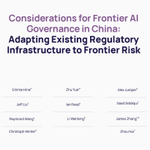
New paper "Considerations for Frontier AI Governance in China: Adapting Existing Regulatory Infrastructure to Frontier Risk"—a coalition of Chinese and US/UK/EU legal experts, including scholars who led China's AI law proposals, examines China’s regulatory infrastructure.

New SAIF report: Technical Safeguards Against Extreme Misuse of AI — Current Landscape and Future Directions.
We map five safeguard practices across the model, deployment, and governance levels — what works, what doesn't, and where cross-border coordination is most needed. 🧵
Across every model type, pre-deployment evaluations of dangerous capabilities and safeguard robustness are essential inputs to responsible release. No model is inherently dangerous; risk depends on capabilities + the safeguards around them.
The report brings together authors from US, UK, and Chinese institutions — we hope this work serves as a starting point for building international consensus on adopting baseline technical safeguards to mitigate extreme misuse risks.
Read it here: saif.org/research/technical-…
New paper: "Position: Preparing for AI Systems That Deceive Developers"
AI deception targeting developers compromises the entire safety pipeline—from training through deployment. Led by Safe AI Forum, Fudan University, and Concordia AI with 24 co-authors across 12 institutions.

Open problems remain: scalable high-assurance control, understanding how training setups influence deception, ensuring evaluation integrity against situationally aware models. Solving these is critical for safe frontier AI development.