

Research lab at @Princeton working on Robot and AI Safety around people. Opinions are our own.
Princeton, NJ, United States
Joined March 2025
- Tweets22
- Following81
- Followers154
- Likes6



Can AI keep you safe at 200 mph? We pushed the limits on the world-class racing sim @AC_assettocorsa🏁 When danger strikes, our AI copilot smoothly adjusts your steering, gas & brakes faster than you blink, keeping you on track, in control and crash-free🛡️✨ See it in action!👇🧵
Finally, a shout-out to the awesome humans who came together to make this happen 👇
@Princeton:
@donggeonoh1999, @justinlidard, @HaiminHu, @HimaniSinhmar, @eglazarski, Naomi Leonard, @jaime_fisac
@ToyotaResearch:
@gopinath_deepak, @EmilySSumner, Jon DeCastro, Guy Rosman
🔗 Want to learn more? Check out our paper & more videos: safe-racing.github.io
🛠️ Open-source code coming soon—stay tuned if you want to play!
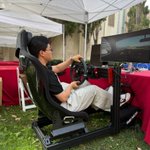
📣 If you’re at #RSS2025 @RoboticsSciSys, stop by the demo booths today and hop into our sim racing rig to take our AI copilot for a spin! Experience next-gen AI safety in action and feel the thrill of racing—minus the crashes! 🏁✨😎

ALT Our driving simulator rig in the RSS 2025 demo booth area.
✊Safety filters for the people! Our study with 80+ human drivers speaks loud and clear:
1️⃣ Our AI copilot dramatically boosts safety, quickly catching and correcting slip-ups.
2️⃣ Smooth Q-CBF nudges let people feel in control and focus on the race—no harsh last-resort overrides!
🚀For the *first time ever*, we have a general-purpose, scalable way to synthesize and deploy CBF safety filters… 100% model-free! Our AI copilot, trained and run with no more knowledge than raw driving experience, is just the first of many: CBFs will never be the same again🚗✨
💡The breakthrough: Our reach-RL value function is actually a control barrier function (CBF)—a powerful but notoriously hard-to-find type of safety filter. From the reach-RL Q-function we get a new object: state–action CBF (Q-CBF) 👈 This is a game changer. Why, you ask?
🤔New to safety filters? They’re self-checks we put in robots to keep them from making bad mistakes—some simpler ones even help us humans today (think brake/lane assist). The big❓for years: how do we build filters for complex systems with no explicit model of their behavior?
Once trained, our AI works as a smart safety net (a.k.a. a “safety filter”). It stays out of the way when you’re safe, gently starts pushing back as you come close to danger, and firmly corrects if you’re about to cross the line—always catching you before it’s too late 🕸️
How did we do it? Our AI trains in thousands of simulated races using reachability RL—a special reinforcement learning variant focused on the closest you ever get to crashing, rather than the rewards you stack up as you go. It learns the invisible line between safety and doom ⛔️
Our lab is in Atlanta for #ICRA2025 this week! Reach out if you’re interested in chatting about robot safety—we’d love to connect.

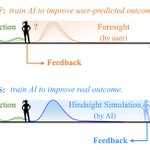
@OpenAI rolled back GPT-4o citing sycophancy—just as our research predicted. Short-term feedback teaches AI to sound nice... and systematically misaligns it!
Our solution: RLHS, training AI with simulated hindsight feedback for long-term alignment!
👉 arxiv.org/abs/2501.08617


We’ve rolled back last week's GPT-4o update in ChatGPT because it was overly flattering and agreeable. You now have access to an earlier version with more balanced behavior.
More on what happened, why it matters, and how we’re addressing sycophancy: openai.com/index/sycophancy-…

✨ We look forward to seeing you in Atlanta!
Organizing Team: @HaiminHu, @kaiqu_liang, @zzx9636, @andrea_bajcsy, @jaime_fisac
We're bringing together leading roboticists and policy experts for a day-long deep dive, generating new insights to lay rigorous foundations for public trust in robotics and AI. 🤝📚 (5/5)
Join our workshop as we explore the critical question: How do we build robust assurances into autonomous technologies from the ground up, shaping public trust before widespread deployment? 🌐🔍 (4/5)
Future robotics promise to revolutionize our homes, cities, and roads—but how can we trust them to be safe? What assurances should we, as a society, expect and demand from autonomous systems? 🤖✨ (3/5)
🎙️ Meet our Speakers & Panelists:
@HadasKressGazit
Karen Leung
@mengyaoli87s
@roeldobbe
@bwalkersmith
(2/5)
📢 Excited to announce the 1st ICRA Workshop on Public Trust in Autonomous Systems!
🚗 Join us for a focused day-long discussion on what it’ll take to lay the foundations of trust in robotics and AI #ICRA2025
📅 Submit your papers by Apr 18! ⏰
👉 saferobotics.princeton.edu/p… (1/5)

ALT Poster for the ICRA 2025 Workshop on Public Trust in Autonomous Systems.
Meet our team!
Prof. @jaime_fisac
@HaiminHu
@zzx9636
@duyphgnguyen
@maddie_bland_31
@kaiqu_liang
Justin Wang
@donggeonoh1999
Jarod Wille