

Public policy research for a more inclusive India. We use data to uplift disadvantaged groups #DataForBetterLives
Kolkata
Joined May 2024
- Tweets610
- Following153
- Followers3.2K
- Likes613






Pinned Tweet
🗳️ At Sabar Institute, we're building an independent National Repository on SIR. To carry it across the country, we need 4,000 people giving ₹500 (or 2,000 giving ₹1,000) to reach ₹20 lakh.
A vote is just a name on a list. When that name quietly disappears, a citizen loses far more than a ballot.
A boy in rural Bengal cracked NEET but lost his MBBS seat, because his parents had been struck off the rolls and no paper could fix it in time.
Struck off the roll, a father couldn't renew his passport in time and missed his own daughter's wedding.
Families are being turned away from ration shops, no name on the list, no grain for the month.
Across India, the SIR is removing lakhs of names, and no one is asking why.
We're documenting the truth, state by state.
Donate ₹500. Donate ₹1,000. Or just repost this.
A vote should never disappear in silence. 🇮🇳
👉 Scan the QR code below, or tap the link in the next tweet.
#DataForBetterLives

SABAR Institute retweeted

✨We all play a part in building a more informed and critically engaged society.✨ – at New Delhi, India

SABAR Institute retweeted

Sabirda and SABAR Institute has been doing excellent work on the West Bengal SIR (and other SIRs) using great data analysis techniques and presenting them with beautiful figures and illustrations.
Please support SABAR Institute if you can, link below.

West Bengal’s SIR is no ordinary chapter in the larger SIR controversy. The nature of voter deletions and their glaringly disproportionate impact along religious and gender lines make Bengal a case that demands urgent and special scrutiny.
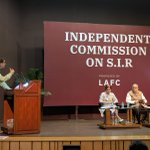
Yesterday, Sabar Institute’s Sabir Ahamed brought Bengal’s case before the Independent Commission on SIR, organised by LAFC in New Delhi.
Bengal’s story must not go unheard.
#DataForBetterLives
Our research at Sabar Institute on voter deletions during the Special Intensive Revision (SIR) has been cited by The Wall Street Journal
#DataForBetterLives


In a column for Prajatantra, journalist N. Venugopal highlights the Sabar Institute’s research on voter deletions during Telangana's Special Intensive Revision (SIR).
#DataForBetterLives

The second issue of REPRESENT: Research on Practices around Religion, Ethnicity and Society, a biannual, peer-reviewed interdisciplinary journal of the Sabar Institute, is now inviting submissions.
We welcome critical, data-driven and interdisciplinary research on religion, ethnicity, gender, representation, public policy, media and society.
📅 Autumn Issue deadline: 30 September
✓ Double-blind peer review
✓ Open access with DOI
✓ No article processing fees
Submit here: represent.co.in/

SABAR Institute retweeted

"Don't Go Viral, Be Meaningful"- Senior Journalist @rasheedkidwai on Gandhi Ji's Idea of Journalism – at Kolkata, India
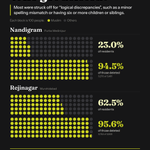
What was once framed as "missing just one election" has become two today.
As Nandigram and Rejinagar vote in bypolls today, thousands of voters who were mapped to the 2022 electoral roll and were not marked ASDD will still be unable to vote.
Around 95% of these voters are Muslims.

SABAR Institute retweeted

A sheer irresponsibility : indianexpress.com/article/in…

SABAR Institute retweeted

Over 2.01 lakh voters in Telangana got SIR notices with no reason listed in the constituency-wise anomalies data.
Analysis by Sabar Institute and Constitutional Guardians Forum: all are 35 or older (median age 52), almost entirely male, across 30,971 of 36,169 booths. The “reason for discrepancy” field is blank for every one of them.
If the official list states no charge, what are they supposed to answer? And do the notices even match the lists? The age cut-off looks like a rule applied across booths, not a random gap.
thehindu.com/news/national/t…

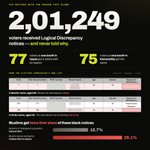
🚨 Sabar Institute exclusive: 2,01,249 voters in Telangana have been flagged and NOT ONE of them was told why.
We went through every single Logical Discrepancy list the Election Commission published for Telangana's SIR. All 36,169 booths. All 92,85,255 names.
What we found is shocking: 2,01,249 notices with the "Reason" column left completely BLANK. No mismatch. No error. No explanation. Nothing.
📍 77 voters at ONE booth in Uppal.📍 75 voters at ONE booth in Kamareddy.
And it gets worse. 25.1% of these blank notices carry Muslim names, almost DOUBLE the community's 12.7% share of Telangana's population (Census 2011).
The pattern is not random. 96.7% of these voters are men, and only 38 out of two lakh are below the age of 40. Everything indicates towards a rule being applied. ECI has simply not told anyone what that rule is
#DataForBetterLives

Sabar Institute’s study on notices issued in Telangana without citing any reason has been featured in The Hindu

Thank you, @scroll_in and @AnantGuptaAG, for citing Sabar Institute’s data in this detailed report on the status of disenfranchised voters in Nandigram and Rejinagar. The after-effects of the SIR remain largely under-discussed, even though they deserve far greater attention and public discussion
#DataForBetterLives

If you're joining the protests in Mumbai or Delhi today, please make sure to remember Bengal's deleted voters.
In the coming week, thousands of them will be denied the right to vote AGAIN, all thanks to the SIR.
scroll.in/article/1096123/as…

59,354 Delhi voters have been served SIR "logical discrepancy" notices with the reason column left BLANK. No mismatch named, no error cited, nothing.
How is anyone supposed to contest a notice when they aren't told what they're accused of? What document do they bring? What do they argue at the hearing?
And these blanks are not random:
→ 96.4% of them are men, mostly older
→ Muslims are ~12% of Delhi's population but 18.6% of those flagged without a reason
→ Every district is affected, with North East Delhi hit hardest
One name on the list stands out: a Manish Sisodia, 53, from the New Delhi assembly constituency. Is it the former Deputy CM or a namesake? We can't say for sure. But if the system can't even tell a voter why they've been flagged, nobody is safe from this.
Software that decides who gets to keep their vote cannot be a black box. ECINET's specifications must be made public, and it must face an open, public audit, not an internal review behind closed doors.
Tracking this takes a lot of resources. It means pulling and checking lakhs of records, staying vigilant through every phase of the SIR, and a dedicated team doing the work. If you want this work to continue, support us through the link in the next post. 👇
#DataForBetterLives

If you want to support this kind of public-interest data work across India, donate to us using this link or scan the QR code : donate.sabarinstitute.org

Sabar Institute’s study on SIR-related voter deletions in Manipur was cited by ThePrint and the Hindustan Times
#DataForBetterLives


We are a small, independent and wholly crowdfunded team. If you want to support this kind of public-interest data work across India, donate to us using this link or scan the QR code : donate.sabarinstitute.org
Link to the full report : sabarinstitute.org/research-…

SABAR Institute retweeted

This is another example of Sabar's highly formidable data work. Exactly what we need to work with as credible evidence
Sabar Institute’s Manipur SIR Deletion Report is here.
And the numbers reveal a striking divide.
1,58,677 names. 3,014 polling booths. 60 Assembly constituencies.
But the removals were anything but evenly distributed.
1. The 20 hill constituencies account for 66.4% of all names removed. On average, 79 names were removed per booth in the hills, compared with just 31 in the Imphal Valley. That is roughly 2.5 times as many.
2. Churachandpur alone is extraordinary. Its four constituencies account for 38,264 removals, nearly one in every four names removed across the entire state.
3. Women dominate the deletion lists too. 88,799 women were removed, nearly 56% of the total. More women than men were removed in every single one of Manipur’s 60 constituencies.
4. The concentration becomes even starker at booth level. Just 10% of Manipur’s booths account for 36% of all removals.
5. In the hill constituencies, 76 out of every 100 removals were recorded as either “Permanently Shifted” or “Untraceable/Absent”, compared with 52 out of every 100 in the valley.
6. Saikot stands at the extreme: 14,152 names removed, averaging about 168 removals per booth.
These numbers do not by themselves tell us why these disparities occurred. But they tell us exactly where closer scrutiny needs to begin.
This is why Sabar Institute is building and analysing booth-level SIR Deletion data. We want massive exercises like SIR to be examined with data, not guesswork.
Full report link in the next tweet 👇
#DataForBetterLives
We are a small, independent and wholly crowdfunded team.
If you want to support this kind of public-interest data work across India, donate to us using this link or scan the QR code :
donate.sabarinstitute.org/
Link to the full report : sabarinstitute.org/research-…
