

Head of Policy Research, Algebris Investments. Non-Resident Fellow @Bruegel_org. Adjunct Lecturer @SAISHopkins. Fellow @iep_bu.
Torino, Piemonte
Joined May 2012
- Tweets15.8K
- Following1.5K
- Followers20.6K
- Likes4.1K






La Francia tiene i mercati con il fiato sospeso. Quali sono le prospettive fiscali, pre/post elezioni? Come si stanno orientando i mercati sul rischio francese? E quali strumenti ha a disposizione la BCE? Tutto nell’ultima puntata di Algebris Podcast 🎧⬇️
youtu.be/9lUtGhKFYGo?is=UKZE…
Looking at headline deficit makes for a misleading comparison. Italy has run a primary surplus in 27 of the last 33 years back to 1992, meaning that before interest payments on legacy debt it has consistently been saving more than it spends. Not the case for the others.

The biggest, and stupidest, myth in European politics, particularly popular in France, is that Europe suffers the consequences of "austerity" and "neoliberalism". In the biggest 5 countries in Europe, more than half of the population makes its income from the state, less than half from the private sector. This is what makes the problem of reducing the welfare state so impossible: more than half of the voters are net recipients. No surprise that Italy's budget has not been balanced in 100 years, France's in 50 years (ooh la la, l'austérité!!):
-France: 30 million from the state versus 21m private sector workers. State spending is 57% of GDP, taxes more than half the economy. The budget hasn't been balanced in the lifetime of most French (since 1974).
- Germany: 35 million adults from the state, versus 34 million from the private sector. 10% of the population is registered as severely disabled. Public spending is over half of GDP. Germany has had a continuous budget deficit since 2019.
-Italy: 23 million from the state, versus 20.5 million private-sector workers. Public spending is 51% of GDP. Italy has had a budget deficit every year since 1925, for 100 years.
- Spain more people get their income from the state since 2024: 18.21 million from the public sector versus 17.9 million people working in the private sector. Since 2025, Spain also had more government employees than self-employed workers (autónomos) for the first time in history. State spending is at 45%, budget has not been balanced since 2007.
- UK: 54% of households now receive more in state benefits than they pay in taxes. State spending is 44.5% of GDP, taxes (40%) are at their highest since 1950, the budget hasn't been balanced since 2001, and 1 in 5 new cars is paid by the government through a bizarre state disability scheme (Motability).

Silvia Merler retweeted

Avete mai prestato dei #soldi allo Stato? Probabilmente sì, forse senza pensarci. È il meccanismo che si mette in moto quando compriamo dei #TitolidiStato. Ma come funzionano esattamente? Ne parliamo a “Le parole che contano” con @SMerler di #Algebris: shorturl.at/Ryx70
Silvia Merler retweeted
Come funzionano esattamente i #TitolidiStato? Qual è il meccanismo che muove i #BOT e i #BTP? E che cosa determina lo spostamento del prezzo, e quindi del #rendimento? Ne parliamo a “Le parole che contano” con @SMerler di #Algebris: shorturl.at/Ryx70
Data centres are dominating both the economic and political discourse in the US. About 19% of new proposed and permitted sites are on quiet ground, against 3% of operating ones. Our last Algebris report looks at the politics of data center noise.
algebris.com/policy-research…

Dark political clouds are gathering over Europe. Against this background, the #SOTEU26 paints an EU eager to reach outwards, while still soul-searching on internal policy dimensions. A difficult balancing exercise; but an important one.
My latest ⬇️
algebris.com/policy-research…

Europe has never entered September with this little gas in store. 2026 is no 2022, but the math of EU gas storage is getting tighter, against the background of enduring geopolitical disruptions.
Our latest ⬇️
algebris.com/policy-research…

The recently proposed overhaul of the EU Emission Trading System paints a softer ETS for what is expected to be a harder decade, but does not rid the system of policy uncertainty. As such, the signal may get lost in yet more political noise. Our latest ⬇️
algebris.com/policy-research…

Does hiking off reputational concerns now expose Lagarde to the risk of a “Trichet moment”? For sure, ECB communication around the rationale for hikes has been confused (and confusing).
bloomberg.com/news/articles/…

As Kevin Warsh takes over the Fed, he inherits an energy shock and Jerome Powell, who stays on the board. Warsh’s view of Al being structurally disinflationary is where conceptual frictions may emerge, as we learn more about AI and productivity. It will be interesting to watch.

The European Commission published its energy crisis plan (AccelerateEU) which is being discussed at the summit of EU leaders taking place on April 23/24. The fiscal response so far is crawling compared to what countries did in 2022:
instagram.com/p/DXhCOdJjLm0/…

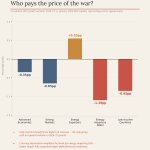
Two striking findings from the IMF World Economic Outlook just published - looking at who pays the cost of war and how big the macroeconomic impact of conflicts is.
Full slide set:
instagram.com/p/DXMUoKqDLhW/…


US March CPI recorded the largest monthly jump since June 2022 - entirely driven by energy. At the same time, consumer confidence hit a historic low and nominal wages grew at the slowest pace since May 2021. The Iran shock is squeezing real incomes.


Is this the same Commission who argued it was imperative to scale back the EU sustainability regulatory framework via the Omnibus, because green tape was supposedly killing European competitiveness?

🚨 BREAKING: The European Commission has urged people to work from home, drive and fly less, and for EU countries to urgently roll out renewables, as it warned of a prolonged energy crisis as a result of the conflict in the Gulf.
Full story: politico.eu/article/european…
A wild day in energy markets, with Brent breaking through $119 before dropping below $90 on Trump’s comments hinting at a potential offramp. So far, the conflict has pushed oil prices almost 30% above baseline - to be seen whether this reversal proves stable.

Want to know why Europe lags in innovation? Exhibit 1: less than 5% the EU Innovation Fund established in 2021 has been paid out, because companies spend up to 3’000 hours and an average 85’000€ in administrative costs to apply.
ft.com/content/07970763-ad7a…

Silvia Merler retweeted

The fifth #CERditchley panel, chaired by Yasmine Moezinia was on ‘Will Europe risk its (capital) markets taking off?’ with @agnesbq1, @SMerler, @ErikFossing and @alplekhanov


This chart *literally* shows debt to GDP on a declining path for all Eurozone countries post 2020.


Come on Robin… the 10 year BTP-Bund spread is at its lowest since 2010 and Italy in 2024 went back to a primary surplus (as it did for almost two decades consistently, before COVID). Don’t cry wolf where there isn’t one, it’s irresponsible.


