
Liberaali konservatiivi. Kieliteknologian, ohjelmoinnin ja matematiikan harrastaja. Kiinnostus talouteen, politiikkaan ja yhteiskuntaan paheena.
Helsinki
Joined January 2012
- Tweets14.3K
- Following205
- Followers860
- Likes3.2K






Sam Hardwick retweeted

As a teenager reading about the decline of the Ottoman and Habsburg empires, I couldn't understand why they mostly just let it happen. Why not reform urgently, slash the bureaucracy, race to adopt the new technologies?
Much less confused these days.
USA:n ja Kiinan syntymien suhde on suunnilleen sama kuin Suomen ja Ruotsin. Intia on niihin verrattuna kuin Hollanti, Tanska ja Norja yhteenlaskettuna.

Nobody is in great shape in this regard but it’s shocking that a country of 1.4 billion saw 7.92 million births and the U.S. (population ~340 million) saw 3.6 million. China has 4x the population but only 2.2x the births.
356
Sam Hardwick retweeted

Usual academic norm is to give credit for idea to earliest person who published on it in prestigious venue. Low prestige folks who published earlier elsewhere can be ignored. Oddly, it turns out that prestigious folks originated all ideas!
Sam Hardwick retweeted

Suppose Study A makes a claim and Study B fails to replicate the claim. Which study is more credible?
All else being equal, Study B is more credible because they didn’t get to adjust their hypothesis post hoc: Study A’s claim set the hypothesis.
On olemassa maa, jolla on yhtä suuri väestö kuin Suomella, joka on saari, jolla ei ole luonnonvaroja, ja jonka BKT on 70% korkeampi kuin Suomella. Kaikenlainen on ilmeisesti vielä maailmassa mahdollista.
1
234
Sam Hardwick retweeted

okay so serious question
do people with aphantasia not visualize sex stuff?
isn't there a study saying men visualize sex stuff at some crazy high rate?
is aphantasia topically selective?


Sam Hardwick retweeted

Smartphones simply organically dispelled the illusions people from different countries held about each other. Every country I can think of got a worse reputation, from Germany to India. While Japan and Korea maintained theirs, maybe the only country that improved its was China.

Sam Hardwick retweeted
it's amazing to me how many historians still adopt the extremely suspicious hermeneutic around ancient texts
with every passing year, we end up finding more validation of many ancient texts, not less!


Sam Hardwick retweeted

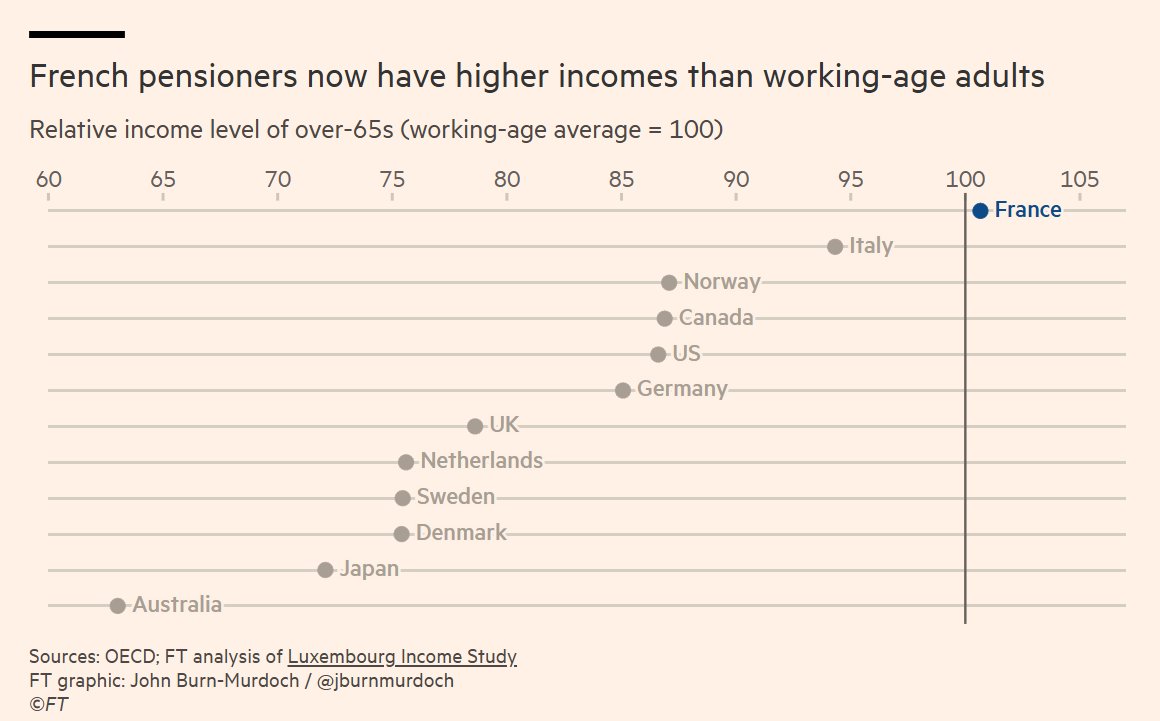
When boomers were young, everything was about youth movements, now that they're old it's all about pensions. 7 decades of boomocracy, we don't even know what else a Western democracy could even be anymore

"French pensioners now have higher incomes than working-age adults" - extraordinary
By @jburnmurdoch
Sam Hardwick retweeted

Rubisco is (arguably) the most abundant protein on Earth. (LPP surely comes close, right?) It’s an enzyme that fixes CO₂ into sugars during photosynthesis.
Unfortunately, as most people learn in school, Rubisco is inefficient. Sometimes it confuses O₂ for CO₂ and wastes energy. Plants make up for this in raw concentration; up to half the soluble protein in a leaf is Rubisco.
People have been trying to engineer better Rubiscos for many decades, but it's not easy because the proteins are big, do not fold easily (they need chaperone proteins to help out), are made from 16 subunits in land plants.
But there's a new paper in Nature Plants that looks really interesting. The TL;DR is that a group in Australia figured out how to express plant Rubiscos (and all SEVEN of their folding chaperones) using a set of 3 plasmids inside of E. coli cells. This enabled them to do "directed evolution" of Rubisco in bacterial cells, and quickly find Rubisco mutants that have higher enzymatic efficiency or that fold better.
In addition to the 3 plasmids, the researchers also coaxed E. coli to make ribulose-1,5-biphosphate, or RuBP, which is the 5-carbon sugar that Rubisco smashes into carbon dioxide to make molecules of 3-PGA for central metabolism.
Now, the clever bit is that you RANDOMLY MUTATE the three plasmids encoding the Rubisco to make millions of variants. Then, you transform those mutated plasmids into E. coli. If the E. coli do NOT make a functional Rubisco, RuBP levels build up and kill the cell; the molecule becomes toxic. But if the E. coli DO make a functional Rubisco, then they keep the RuBP levels in check and live just fine.
Using this "screening assay," the researchers found 46 fast-growing colonies of E. coli. Two of those colonies encoded really useful mutations. One mutation (M116L) makes Rubisco about 25–40% faster. The other (A242V) makes it fold and assemble much more efficiently.
They put this mutation into a "hybrid Arabidopsis–tobacco Rubisco," put that into tobacco plants, and measured growth. The plants with M116L grew 75% faster than wildtype.
No guarantees this will scale to more useful crops, like wheat and corn and soybeans etc. But it seems like a nice in vitro assay for faster prototyping!


Sam Hardwick retweeted

the problem with "normie" is that it should mean "has a mainstream memeplex set of symbolic beliefs" but people think it implies "has no rich inner life"
if you think "normies" have no inner life it means you only talk to them about symbolic issues like politics or entertainment
Sam Hardwick retweeted

If there is one institution I want to see continue its humanities programs in strength, it is the University of Chicago. This is a genuine loss. As frustrated as I so often am with universities, it is a frustration born out of conviction that getting these fields right matters.


Sam Hardwick retweeted

Had never thought of this before, but it seems straightforwardly true. It likely applies even to formal writing in addition to “posts.”


I’m joining @a16z !
After five years at Shopify, I’m moving onto my next adventure in life, and heading to Andreessen Horowitz. Shopify is an incredible place, and Tobi is one of the great founders of our era. I’ll remember those years as one of the golden chapters of my life. Now, onwards!
I’m joining a16z as Editor at Large, and I’ll be responsible for the written output of the firm. A16z has always prioritized great thinking and writing as a deliberate instrument of the firm’s purpose and power. It starts with Ben and Marc: both generationally talented high-agency thinkers, writers, and company builders. And there’s a burning new energy in the firm today, brought by @eriktorenberg - who I’ll work with closely as he takes a16z’s narrative presence to a new level of ambition.
Writing is power transfer technology
I’ve had a few different vocations over the years - I’ve been a founder, touring musician, venture associate, worked at Shopify - but most people on the internet know me from my writing online. I’ve been blogging since my early twenties, and in that time I’ve seen different online content metas come and go - the golden years of VC blogs like AVC and Haystack, the Medium years, now Substack; the rise of “Go direct” and the crisis of traditional media.
What hasn’t changed is how valuable great writing can be. Something special happens when you give someone words to express an idea they always knew, but couldn’t articulate: you give them power. And it didn’t cost you anything.
“Power transfer technology” is what the business of VC is. Why does a VC firm care about content? It can’t just be to advertise the firm; or promote their partners and their theses. Those are both consequences of success, but they can’t be the actual goal.
The primary objective of a VC firm’s content, particularly their written output, should be to give founders power. The goal is to give them writing that transforms them into someone with more legitimacy, which is what power really is about.
Traditional media sometimes helps you accomplish this. A well-written op ed, thoughtfully crafted, can serve this purpose. But I think bloggers are naturally better at this craft, because bloggers have to grow their franchises under the constraint of not having built-in distribution. If you’ve mastered the craft of writing online, you know something important about how to reach and influence people, and what exactly it is you offer to an audience that gives them power.
Blogging is a trade
Winning, for bloggers, means writing the reference take on a good topic. My favourite example of this is how Byrne Hobart broke out with his piece on the 30-year mortgage. It’s kind of surprising that this kind of post had such influence - it’s wonky, it’s not written for a general audience whatsoever. But it turns out that people think and talk about their mortgages a lot, and like to feel competent when they do. Reading that piece equips them with a kind of legitimacy to speak on the topic.
One lesson hiding in plain sight here is that most of the audience of any successful post does not actually read it. They are told it by someone who did read it. There’s a primary audience who carefully reads the piece and does the cognitive work of “restructuring their consciousness” (Walter Ong coded) around good writing. And then there’s a secondary audience, who are re-told the content, either verbally (including group chats, podcasts, Youtube) or in other oral formats like Twitter.
(This is broadly true both inside and outside of organizations; e.g. a lot of work goes into writing an annual plan, which only a small number of people actually read, but a lot of people are “re-told” in some way.)
The primary audience gets something out of this sequence of events: they get power. This is the great secret of writing in public: the writer and primary audience both put in effort (to pack and unpack the idea); and they jointly reap the rewards, which is the legitimacy earned when the idea gets subsequently retold verbally to the wider secondary audience.
This is why, paradoxically, to reach the widest audience, you write to the narrow audience. Your objective as a writer is to give your primary audience material they’ll want to re-tell. They do the work of translating it to wider audiences in specific contexts; you do the general articulation in rich detail.
The secret of magic is to transform the magician
Today, there’s an amazing idea-sharing format that’s swallowed a lot of the “smart people discourse” on the internet, which is podcasting. The rise of podcasts has been astounding to watch, in the six years since I wrote The Audio Revolution. And a16z has both a great past and a great future in this media format, especially with Erik at the helm and seeing the caliber of talent he’s bringing on board his New Media team.
But podcasts are not enough on their own. Great writing, which has gone through the crucible of thinking and editing, transfers something into the reader, and transforms something within the reader, that talking does not.
I know a lot of smart people who correctly intuit that blogging is powerful, but can’t justify it on a return-on-effort basis compared to other ways of getting their message out. This is a mistake. Writing matters.
It takes more effort to read something than to listen to it. (And much more to write something than to talk about it.) The cognitive work of writing and reading is a real cost, but the benefit is that you get “restructured consciousness” from factoring and negotiating with the idea in written form. When you read an important idea and put in the work to understand it, you gain the subconscious competence and legitimacy to talk about it: you are transformed into someone with more power. Whereas, when you hear an idea, you can usually repeat the idea but not with the same authority. The deep competency is not transferred to the same degree.
This is an important idea to understand in a world where most of our information diet is shifting towards oral communication in various forms - “the internet village.” Now, people have been complaining that “nobody reads anymore” for decades - the point here is, the benefits of reading have never been more disproportionate, nor less obvious.
The farther we move towards being a default-verbal information culture, the more powerful the trade between writer and primary reader, but the less obvious it is to do. (Why write things if people would rather watch or listen?) If your goal is “I want to maximize the number of people who receive my message” then oral formats like podcasts, Youtube, and Twitter will appear like the obvious choice. But if you articulate the goal as “I want to give people power” then clearly you’ve got to write something down.
Founders are customers for legitimacy
I remember some days when I was a founder and no one would take me seriously, except for when I could produce a blog post from someone like Paul Graham or Semil Shah and speak to that idea. Something incredible would happen in those moments - people would actually listen to me, as if I’d suddenly become magic. Magic works because it is communication. The founder equipped with the VC’s writing should communicate something higher-signal than the founder alone. Ask, “what must be true of the content for this statement to become real?” and you’ve got a good guide for what kinds of things to write.
This relationship between VC and founder scales all the way up to real power-politics: the job of the VC firm is to be the “legitimacy bank” where founders (and other high-agency people) can go to take out legitimacy on credit, or make a legitimacy deposit. I find this to be a wonderful way to frame the founder-VC relationship because it does NOT imply the VCs are the “grownups” in some patronizing sense: it celebrates legitimacy as a thing that VCs and founders incept together, just like how blogging is thing that the writers and their primary readers incept together.
This is why VC blogs were such a good product in their heyday. As the “free tier” of the VC, it naturally frames the relationship as one where legitimacy is jointly incepted (by the writer and primary reader), not as one that’s benevolently bestowed.
The meta is different now, but the purpose is the same, and I think a16z is probably the best spot in the world to pursue that craft and that thesis. I’m incredibly fortunate to get to join this group of talented investors and company builders, towards a mission that’s never been more important: giving the world’s founders the power they need to build a bright future.
Let’s go!

Sam Hardwick retweeted

So basically you're free to say anything you're not forbidden to say. Right.

#DemocracyNotAlgocracy | 🇪🇺🇫🇷In Europe, one is free to speak, not to spread illegal content.
#EuropeProtects
#DSAProtects

Sam Hardwick retweeted

Here’s a wow, uncovered by one of substack’s best uncoverers of long lost treasures substack.com/@lonepilgrim/no…
Sam Hardwick retweeted

A few theses:
1. Gender norms are good for society. I repeat: gender norms are good for society.
2. Gender norms are (a) socially constructed, to be sure, but (b) they are socially constructed *as a response to a BIOLOGICAL REALITY* which is ineradicable and cannot be denied, or else at the price of unfathomable human misery.
3. The gender norms of the pre-1960s West, in particular, are very good because they tend to make most men and most women happier, and tend to promote them coupling happily, staying coupled, having children, and raising them in a healthy environment.
4. Speaking of: gender norms are particularly important for CHILDREN and TEENAGERS since they are at critical stages of their development, and they are not blank slates.
5. Some gender norms are bad! For example, I think it's bad to burn widows on their husband's funeral pyre. As progressives love to point out, every society is constantly re-negotiating and re-evaluating its gender norms; that is NOT, however, an argument for abolishing them, viewing them as evil, or thinking we can arbitrarily rewrite them; it is, at best, an argument for reforming them, carefully, keeping Chesterton's Fence in mind.
6. Some people feel like they don't fit in their society's gender norms, and as a result feel unhappy or alienated. Sometimes it's because they're a unique snowflake and they will thrive better if they just forge their own path. (Hello, St Joan of Arc.) HOWEVER, sometimes, probably most of the time, it's because they're expressing some other or deeper psychological hurt, or just going through a phase in life, and the best thing for them over the long run is, in fact, to make an effort to accept and follow the gender norms.
7. From all of this it follows that, on balance, and being understood that no society is perfect, and with all other caveats, nevertheless, it is still true that a certain amount of SOCIAL and even LEGAL PRESSURE to follow gender norms is good for society.
8. One final point about "eccentrics" and all those who "don't fit in," who are, in a deep sense, my people. My sense is that, at least in the West, those societies that are more traditional, religious, and authoritarian, actually leave more room for eccentrics to be, because they are confident in their own beliefs and values and don't feel threatened by isolated individuals; meanwhile in liberal societies, since all norms are at least potentially up for debate and revision, the dominant norms must be jealously and zealously guarded against any dissidence. Medieval Europe (which had LOTS of weirdoes, and celebrated them!), Renaissance France and Italy, Edwardian/Victorian England, would all be examples. I also believe this is deeply connected to aristocratic values, which are historically more tolerant of eccentrics.
9. Being an eccentric and living one's life according to unconventional rules does not, in fact, require morally blackmailing society into rewriting ITS rules to suit you and engaging in performative acts of celebration of whatever it is about you that's eccentric.
Sam Hardwick retweeted

“Education is in many ways not an equalizer, but a divider—the more people learn, the more those who are faster will outstrip the rest, with some reaching heights of stunning—inspiring—inequality.”
Sentences I wish I had written.

Contra Freddie deBoer on Expertise
When I criticized one of Freddie deBoer's articles yesterday, several people assumed he and I basically agree.
Freddie's response (shared with permission) should underscore that, at least as far as he is concerned, we do not.
Where do we disagree, and why?
I should start with where I suspect we do not disagree, and where both of us disagree with what the prevailing default in education policy: people, including kids, have different aptitudes—in mostly immutable ways. "Grade level" reading or math is a polite fiction. There is no one level all kids of a certain age should be expected to reach in a given skill, nor is there some minimum below which a kid's education is clearly failing them. No Child Left Behind, for example, was terrible policy in large part because it tried to impose this fiction on schools by fiat, punishing schools for working with disadvantaged kids. People unmistakably have different aptitude levels, both on a subject-by-subject and a more general sense. IQ remains the best measure we have of this, but the measures should not be confused with the underlying aptitudes. Education is in many ways not an equalizer, but a divider—the more people learn, the more those who are faster will outstrip the rest, with some reaching heights of stunning—inspiring—inequality.
Is Freddie correct that some people cannot learn some things? Yes. Trivially, if you are reading this, you have lost the capacity to ever match Magnus Carlsen in chess. More, most of you never had the capacity to begin with. This holds true for much more basic tasks. Some people will struggle much more with others at, say, algebra, and I do not take it as a given that people should be dragged through classes they do not enjoy, are weak at, and will not use. All of that is true, and all of that has real implications for education systems, implications Freddie has spent immense effort drilling into.
What, then, is left? Everything.
IQ was designed to measure how far someone's aptitude deviates from average. It follows a normal distribution, such that an equal amount are above and below. Many cognitive tests also aim to measure more domain-specific aptitudes. It measures something real, if hard to pin down.
But skills don't follow a normal distribution. They follow something closer to a power law: the vast majority of people are indescribably worse at chess than grandmasters. If you measure everyone's chess skill, almost everyone clusters at the base. Every once in a while, some hotshot will claim to be a "super learner" and will try to ascend the skill ladder very, very quickly—memorably, Max Deutsch, who humiliated himself against Magnus Carlsen. They invariably fail as he did. No matter your aptitude, the process to build chess expertise takes a very, very long time.
It's shorter for some than for others! 8-year-old Roman Shogdzhiev is already competing with the best in the world. But as soon as you start building a serious skill, aptitude isn't the only thing that matters. People learn faster when they're taught things directly than when they have to reinvent the wheel, they learn faster with coaches and tutors than on their own, and they learn faster when they practice in difficult, effortful, constructive ways rather than mindlessly repeating the same steps. Even at the top of domains, having someone come along and show what more can be done can lead to quick improvements, as Go players are currently experiencing.
Freddie argues that education policy can never move quantitative metrics. When it comes to full-scale IQ, or flattening the rank order between kids, he's not wrong. In every imaginable system, some will progress more than others. But narrow, domain-specific expertise does not arise by chance. It does not arise ex nihilo. It takes concerted, focused practice, ideally paired with concerted, focused instruction. And in those domains, there are techniques that work better and techniques that work worse—for the faster kids, for the slower kids, for everyone in between.
Critically—and we are sadly clueless towards many of the specifics here—there are also better and worse times to learn certain things. Absolute pitch is reputed to be a mixed blessing, but it is learnable early and mostly unattainable past a certain age. No adult has progressed in chess the way Shogdzhiev is progressing. Languages are easier for children to pick up than adults. Certain moves in sports or dance, like the turnout in ballet, are reputed to be impossible for adults to develop to the same extent as kids. In a better world, we would know exactly what kids are better than adults at learning, but we do not yet live in that world. You can always train narrow skills to some extent, but Nature is cruel and unforgiving, and some doors stay closed.
Because expertise follows a power-law distribution and not a normal one, everyone who is reading this is capable at becoming better than most people in specific, narrow domains. You may not be able to reach the absolute peak. You will hit slowdowns and, perhaps, hard limits. But you can learn. You can learn languages, you can learn math, you can learn chess, you can learn the law. You can specialize, you can drill into specific topics, and you can outperform the great majority of people within them. Your kids, too, can do this, much earlier and much more than the default path will give them the chance to demonstrate.
Schools are generally very, very bad at teaching for expertise. They are simply not in the learning maximization business, caught as they are between a thousand different priorities. Education policy is a frustrating morass, and translating policy to improvements for any given kid is a struggle in the best of circumstances. But make no mistake: there are better and worse ways to teach, better and worse ways to learn, and concrete ways education in narrow fields can make a difference for people. We understand much of this, but it clashes with our instincts, and we are slow to implement the best tools.
Where, then, do I disagree with deBoer? He asks people to accept that schools cannot change people's rank order in the intelligence distribution and encourages people to focus on other benefits, holds that things will more or less work out. I ask people to accept that schools cannot change the same rank order, but pair it with a demand: Pursue excellence. Train what you can train, how you can train it. Yes, by all means, focus on your strengths and your interests, but worry less about where you are in the normal distribution of aptitude and worry a great deal more about where you can climb to in the power-law distribution of expertise.
There is so much we can yet become, individually and collectively, and we have only started to scratch the surface. Learning matters. Practice matters. No matter what your aptitude, you must scratch and claw and fight your way up if you want to become excellent. Do not accept the default-mediocrity. Do not shrug and resign yourself to Nature's limits. Put in the work to understand exactly what those limits are, push towards them, and perhaps one day we can overcome them.
As for education policy not moving the needle on quantitative measures?
Simply put, it's a skill issue.
Become better.


Sam Hardwick retweeted

Alex Tabarrok @ATabarrok still has the best review of Parasite: marginalrevolution.com/margi…
