



Pinned Tweet
McDonald's Training video "Clean It" from the 80's featuring a Michael Jackson lookalike
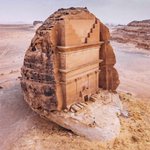
The Qasr al-Farid, known as 'The Lonely Castle,' holds distinction as the largest rock-cut tomb within the archaeological marvel of Hegra, situated in Saudi Arabia during the 1st century CE, under the dominion of the Nabataean Kingdom. This ancient realm's dominion extended from the Levant to northern Arabia, granting them control over the pivotal Incense Route traversing the Arabian Peninsula. The Nabataeans, enriched by trade, established opulent cities like Petra and monuments such as the Qasr al-Farid.
Found within the archaeological site of Madâin Sâlih in northern Saudi Arabia, the Qasr al-Farid is an intriguing structure. Despite its 'castle' designation, it was actually a tomb, constructed around the 1st century AD. The tomb stands as one among the 111 monumental tombs scattered throughout the Madâin Sâlih landscape. Notably, UNESCO recognized this site as a World Heritage site in 2008. What sets the Qasr al-Farid apart is its isolation; unlike most monumental tombs in Madâin Sâlih, which were constructed in groups, this tomb stands alone.
Curiously, historical records reveal that the Qasr al-Farid was never brought to completion. Unfortunately, the reasons for this, as well as the identity of its intended occupant, remain shrouded in mystery. Whether it was abandoned by its owner or its workmen, the answers are lost to time.
As the 3rd century A.D. dawned, the once-thriving Incense Route began to wane due to the turmoil faced by the Roman Empire. This decline in political and economic stability had a far-reaching impact, leading to the deterioration of trade along the route. Towns lining the path suffered as a result, marking the end of an era.

1
325
Oppenheimer's famous phrase, "Now I am become Death, the destroyer of worlds," is a reference to a verse from the Hindu scripture Bhagavad Gita. The verse in question is from Chapter 11, Verse 32, in which the deity Krishna reveals his divine form to the warrior Arjuna. Witnessing the terrifying sight of Krishna's cosmic form, Arjuna is overwhelmed with awe and fear.
Oppenheimer, who was well-versed in various philosophical and religious texts, including the Bhagavad Gita, reportedly recited this verse upon witnessing the first successful detonation of an atomic bomb during the Trinity test. The quote has since become closely associated with Oppenheimer and his reflections on the destructive power of the atomic bomb.

The Great Wall of China, a monumental accomplishment in engineering and an emblematic edifice recognized globally, is steeped in fascinating history. Contrary to popular belief, this extraordinary structure was never completely deserted throughout its extensive history. Indeed, numerous Chinese dynasties oversaw the wall's construction and upkeep for hundreds of years.
Work on the Great Wall dates back to as early as the 7th century BC, a tumultuous era known as the Warring States period in China's ancient past. The first expansive wall came into existence during the Qin Dynasty (221-206 BC), primarily as a safeguard against northern invaders. This early version of the wall was the foundation for future constructions under successive dynasties.
The sections of the Great Wall that we most commonly associate with today, and which draw in hordes of tourists each year, were primarily erected during the Ming Dynasty (1368-1644 AD). These sections were strengthened to ward off Mongol invasions. However, the Ming Dynasty didn't simply abandon the wall; they were diligent in maintaining and augmenting it throughout their rule.
Though the building of the Great Wall required an extraordinary commitment of resources, it was never fully deserted. Its significance and role transformed over time with the ebb and flow of different dynasties. The wall wasn't merely a military barrier; it symbolized Chinese unity and national identity.
As time wore on, parts of the Great Wall suffered from neglect, natural weathering, and human activities, leading to deterioration. However, concerted efforts in the last few decades have aimed at conserving and refurbishing the wall, with particular attention paid to the sections from the Ming era. These restoration initiatives preserve the wall as a living testament to China's rich historical legacy and cultural traditions. Today, the Great Wall of China stands as a UNESCO World Heritage Site and a prime attraction for travelers worldwide.


4
353

Situated in the town of Coca in Spain's Segovia province, the magnificent Coca Castle, often referred to as the Castillo de Coca, stands as a stunning representation of Spanish Mudéjar Gothic artistry. Its captivating allure draws enthusiasts and admirers from all corners of the globe.
The inception of this breathtaking castle dates back to 1453, initiated under the auspices of the notable Bishop of Avila, Don Alonso de Fonseca. Its design can be attributed to the creative genius of the architect, Ali Caro, who oversaw the castle's early construction phases. After Don Alonso de Fonseca passed away, the mantle of completion fell to his brother. In 1462, a mint was set up within the castle grounds to mint Castilian and Portuguese currency, funding the workers who were instrumental in its creation.
Distinctive in its design, the Coca Castle isn't perched on a hilltop, like many of its counterparts. Instead, it gracefully stands at the edge of a broad, deep gorge, cleverly utilizing the natural landscape to its defensive advantage. This ingenious architectural strategy greatly contributes to the castle's mystique and intrigue, making it an interesting sight to experience.
Inside the castle, visitors are greeted by an extraordinary display of beauty. The interiors feature rooms decorated with complex Mudéjar geometric designs rendered in stucco, offering a bewitching showcase of skill and artistry. Enthralling paintings further accentuate the castle walls, adding to the rich artistic lineage of the structure. The Castillo de Coca, through every brick and corner, presents a unique and inventive architectural combination, leaving a memorable mark on all who venture through.
Moreover, the castle boasts a fascinating history that enhances its allure. One well-known narrative is the romantic liaison involving Marquis Senetti, adding an element of romance and intrigue to the already captivating fortress. This story fuels the imagination of visitors and allows them to immerse themselves further in its deep-rooted history.
The Castillo de Coca symbolizes the architectural brilliance and innovation of its creators. The rare blend of Mudéjar and Gothic influences, coupled with its strategic geographical position, renders it an architectural masterpiece that never fails to captivate its visitors. The Coca Castle, with its historical significance, artistic magnificence, and captivating lore, is a compelling destination for those interested in exploring Spain's rich cultural heritage.


4
214
Welcome to the strange world of quantum mechanics!
Did you know that particles can be instantly connected, no matter how far apart they are? This phenomenon, known as quantum entanglement, has been described by Albert Einstein as "spooky action at a distance."
In quantum entanglement, a pair of particles are linked in such a way that the state of one instantly influences the state of the other, regardless of the distance between them. This connection persists whether the particles are next to each other or galaxies apart.
Quantum entanglement defies our everyday understanding of the world and has profound implications for the future of technology, potentially revolutionizing fields like computing and cryptography.
As we delve into the mysteries of quantum physics, we invite you to share your thoughts. What do you find most fascinating about the quantum world? #ScienceFacts
The mystery of D.B. Cooper.
On the eve of Thanksgiving in 1971, a man using the alias Dan Cooper boarded Northwest Orient Airlines Flight 305 from Portland to Seattle. Dressed in a business suit and appearing as just another passenger, Cooper was anything but ordinary.
Mid-flight, he handed a note to a flight attendant, revealing that he had a bomb in his briefcase and was hijacking the plane. After landing in Seattle, Cooper demanded $200,000 in ransom (equivalent to over $1.2 million today) and four parachutes. The passengers were released, and once his demands were met, he ordered the plane to fly towards Mexico City.
But Cooper had a daring plan. Somewhere over the dense forests of southwestern Washington, he lowered the plane's rear stairs and did the unthinkable - he jumped into the frigid, stormy night, with the ransom money strapped to his body.
Despite one of the most extensive manhunts in U.S. history and years of investigation, the FBI never conclusively identified D.B. Cooper or recovered the bulk of the ransom money. His audacious escape has inspired countless theories and remains the only unsolved case of air piracy in commercial aviation history.
As we delve into the D.B. Cooper mystery, we invite you to share your thoughts. Who was D.B. Cooper, and what do you think happened to him after he vanished into the night? #HistoryMysteries #DBCooper

ALT D. B. Cooper
Delving into the mysteries of Easter Island!
These iconic statues, known as Moai, are a testament to the ingenuity of the ancient Rapa Nui people. Carved from solid basalt between 1250 and 1500 AD, each of these statues represents the deceased ancestors of the tribe.
The Rapa Nui believed that these ancestral statues watched over the island, protecting it and ensuring prosperity. The Moai were placed on ceremonial platforms called ahu, facing inland to watch over the community.
Despite their cultural significance, many questions remain. How were the Rapa Nui able to move these massive statues, some weighing up to 82 tons, across the island? Theories range from sleds and ramps to extraterrestrial intervention!
#historymysteries #easterisland

ALT Muai statue

ALT Muai statue
All the facts retweeted

Ronaldo Messi
5 Balon D'Ors 7 Balon D'Ors
815 goals 769 goals
5 UCL titles 4 UCL titles
1 Int'l title 2 Int'l title
He may not be the best player in the world right now but MESSI is definitely the greatest player of all time.
