

Tech CEO – Leading innovation, change & growth revolutions!
Atlanta, Georiga, USA
Joined February 2009
- Tweets792
- Following336
- Followers263
- Likes379




Steve Schilling retweeted

A retired NASA engineer who had worked on the Space Shuttle program for 25 years was hired by SpaceX at age 62. He described the first week as the most disorienting experience of his professional life.
At NASA, a design change required 3 meetings, 2 committees, a review board, and 6 to 18 months of documentation. At SpaceX, his new supervisor said "if it works, build it. If it doesn't, change it by Friday."
He sat at his desk after the first day and called his wife. He told her he felt like a man who had been swimming with ankle weights for 25 years and someone just cut them off. He could move. He could decide. He could build something in the morning and test it in the afternoon. The constraint that he had accepted as the nature of aerospace engineering turned out to be the nature of bureaucracy.
Within 6 months he had contributed to more design iterations than he had completed in his last 5 years at NASA. Not because he was working harder. Because the time between having an idea and testing the idea collapsed from months to hours. The same brain. The same knowledge. A different operating system.
He described a specific moment where he proposed a modification to a Raptor engine component. At NASA, the proposal would have entered a queue. At SpaceX, the modification was machined by the end of the day and tested by the following morning. He watched his idea become a physical object in 18 hours. At NASA, 18 hours would not have been enough to schedule the first meeting to discuss whether to schedule a meeting.
He told an interviewer: "I didn't get smarter when I went to SpaceX. I got faster. The intelligence was always there. The system was in the way."
The difference between SpaceX and NASA is not talent. NASA has extraordinary talent. The difference is the time between a thought and a test. SpaceX compresses it. NASA elongates it. The same engineer produces 10x more at SpaceX than at NASA because the bottleneck was never the engineer. It was the meetings about the meetings about the work.
Steve Schilling retweeted

Every year, fewer drugs are created. Paradoxical: science advances, yet bureaucracy suffocates it.
We are entering a new pharmaceutical dark age in the very era of knowledge — not from a lack of science, but from an excess of barriers.
That's all.

ALT S. Wickramasekara, 2020
It’s a shame that @Xfinity can't just call and say, 'Hey, we've lowered our rates and want to upgrade you to double the speed at the same price.' Instead, they disguise it as a 'new deal'—because they’ve been overcharging us and want to lock us in before we catch on. #upgradescam
Steve Schilling retweeted

🚨APPLE IS SLEEPING WITH THE ENEMY AND FEEDING THE AI BEAST
Did anyone realize that by integrating / partnering with OpenAI, a company heavily invested in by Microsoft, Apple is literally now bed buddies with their biggest and longest competitors?
It’s not like buying chips from the same manufacturer.
AI is a living, breathing, growing thing - and OpenAI now has access to basically every Microsoft and Apple device in the world.
Think on that for a moment.
Source: Reuters


Steve Schilling retweeted

We pay tribute to those who made the ultimate sacrifice this Memorial Day, including the 498 Clemson alumni recognized at the Scroll of Honor.

ALT American flags in the grass on Bowman Field with Tillman in the background.
Steve Schilling retweeted

What I Read This Week...
President Biden has decided not to take a cognitive test as part of his upcoming physical exam.
White House press secretary Karine Jean-Pierre explained to reporters on Monday that the President’s physician does not believe a cognitive test is necessary, and that the President proves his cognitive ability “every day in how he operates and thinks”.
At 81, Biden is already the oldest sitting President, and recent surveys indicate that ~86% of Americans consider him too old for re-election.
Steve Schilling retweeted

Watch Falcon Heavy launch the USSF-52 mission to orbit xitter.cf/i/broadcasts/1ynKOyeDm…
Amazing progress… things are about to get interesting!

Tesla's FSD v12 is a REALLY big deal.
Last night @elonmusk livestreamed a ~45-minute video of a Model S driving itself around using Tesla's latest self-driving software, FSD v12.
Self-driving is something the company has been trying to solve since Tesla Autopilot was released in 2015. Since then, Tesla has made steady progress improving the code to handle all kinds of road situations, has added cameras around the car, and removed sensors, all the while rewriting the code multiple times to solve for things the car couldn’t handle.
And even though Tesla cars can drive themselves in many situations, the biggest challenge with self-driving cars is the thousands (or millions) of situations drivers face on a daily basis that are completely unexpected or difficult to solve for, like other drivers acting irrationally, inclement weather, debris on the road, weird (or lack of) lane markings, etc.
Up to this point, Tesla and other companies have to spend a large amount of time running through simulated scenarios to generate code that would teach the system how to handle these situations. This code is oftentimes written by a human and needs to account for every variation of something happening on the road. And even then, there are thousands (or millions) of situations that a simulation won’t come with, since real life is so damn complicated and complex.
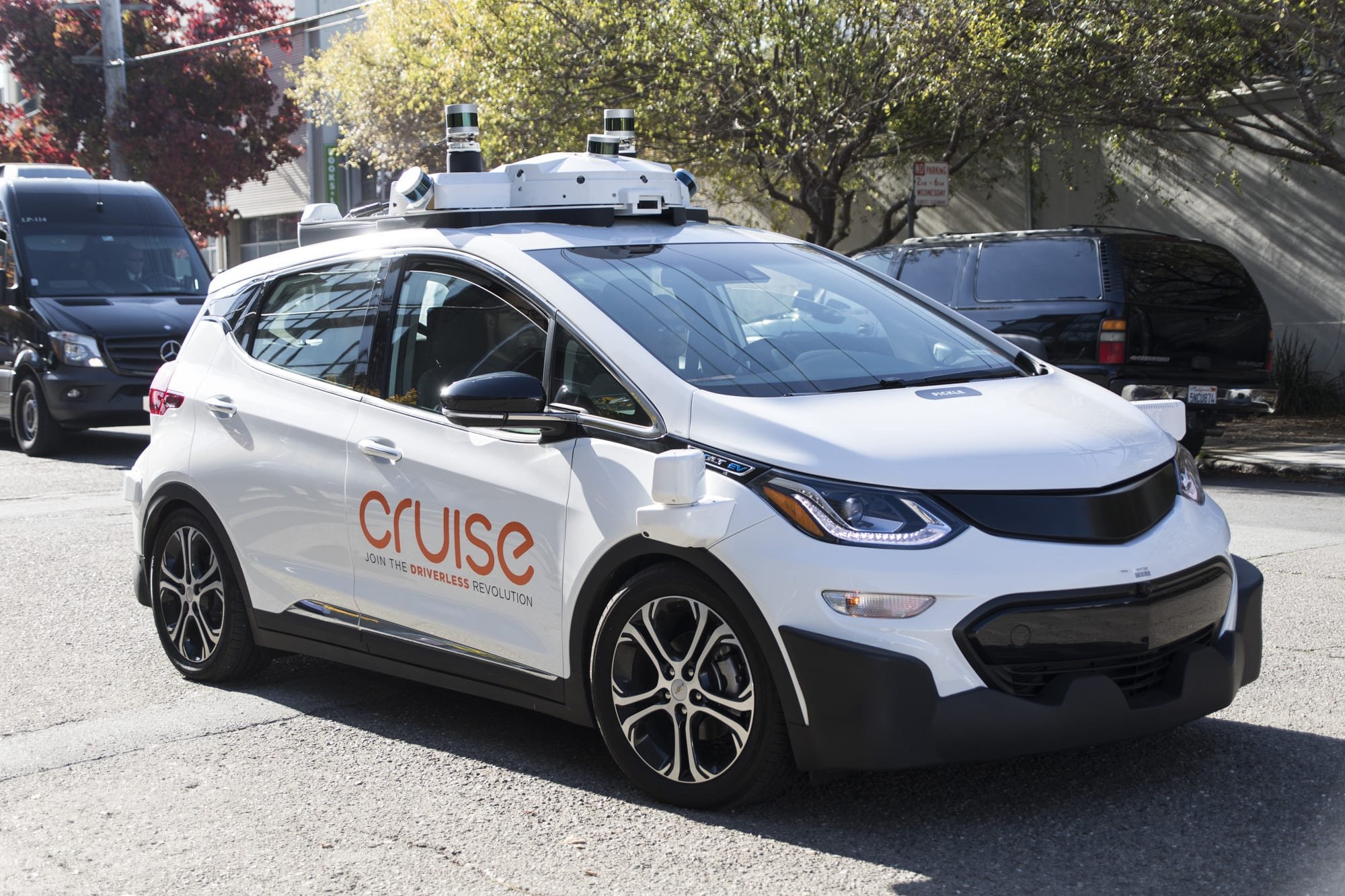
The approach many have taken to try and solve this problem is by overfitting their self-driving cars with a ton of different sensors like LIDAR, radar, ultrasonics, cameras, and other sensors in addition to generating High-Definition maps of the areas where the cars are meant to be driven in. They’ve done this in hopes that there’s a combination of sensors and map data that would allow them to solve for the most unexpected situations. Here’s a picture of a GM Cruise vehicle that uses this approach.
However, yesterday’s video has demonstrated a breakthrough in how self-driving cars can operate.
Instead of using many sensors and hardware on their cars to process the world, Tesla is using 8 cameras and a computer that’s specifically built to process video data. That’s 9 total parts vs everyone else’s 30, 40, 50+ parts to process the world.
Using only vision to process the world and not needing things like LIDAR, radar, and other sensors to interpret the physical objects around the car is impressive enough, but HOW the car learns to do this is what the real breakthrough is.
With FSD v12, Tesla takes the video data that is collected by its fleet of ~4 million cars and runs it through an AI that is built using Neural-Nets (like ChatGPT but for the real world), and then the AI figures out what the car should do based on what it sees.
What’s important to highlight here is that Tesla has done 0 work in telling the car how it should interpret the world. That means that the AI doesn’t explicitly know what a lane is, what a traffic light is, what a stop sign is, what a cone is, what a pothole is, what rain is, etc.
What Tesla does is it shows the AI a metric-ton of video of a car driving around using the 8 cameras that are outfitted around the car, and the AI learns how to do the same. The more video Tesla feeds it, the better the system gets. The more unique situations that are collected from the fleet of Teslas, the better the system gets at accounting for those situations.
This “AI code” will then be beamed to every Tesla in the world, and the on-board computer will be able to process its surroundings without the need to connect to Tesla’s AI server. It’s no different than you or I getting into a car and driving it. Instead of our 2 eyes collecting video around us and using our brain to process the info, the 8 camera system will collect the video and Tesla’s on-board computer will process it using the “AI code”.
In other words, Tesla has moved away from humans figuring out how to write code that tells the car what to do, and instead feeds video to an AI, and the AI figures out the best way to account for every situation.
The only thing Tesla needs moving forward is more video and more compute power (chips) to process videos.
That’s it.
This is profound. Everything that is captured on video with the 8 camera system is something the AI will be able to figure out how to navigate through. Snow. Potholes. Deer. Cyclists. Aliens. You name it. And this “code” that is generated by the AI will get better and better as Tesla’s compute capabilities grow with their purchases of NVIDIA’s H100 chips and the build-out of their in-house DOJO compute system. Not to mention the growing fleet of Teslas that will capture more and more video data around the world. Every Model S, 3, X, and Y that is sold today is a video-capturing robot that feeds the AI. And every Cybertruck and Compact Car will be the same.
And believe it or not, it gets even crazier.
Now that Tesla has come up with a real-world data collection and processing system with its cameras and on-board computer, this same system can be used on other physical products that can learn how to move around its surroundings.
This is where Tesla’s Optimus Bot comes into play. Tesla will be able to use its 8 camera system on the Tesla Bot to collect video of its surroundings, beam it back to the AI, the AI figures out how to best do that thing that it’s collecting video for, and then beam back the “AI code” for the Bot to process with its on-board compute.
We are not far away from a world where a humanoid robot watches you do the dishes, sends back the data to the mothership to process it, and then the next morning the Bot has learned how to do the dishes - not only using the video it gathered from you doing it, but from every other person in the world washing dishes.
Do this process with literally anything.
ChatGPT showed the masses what the potential of AI can be. NVIDIA showed the masses just how much demand there is for hardware that is used by AI systems.
And now, Tesla just showed the masses what AI means for real-world physical applications.
The world has changed - again.


Steve Schilling retweeted

The second good news of the year. wired.com/story/cheese-actua…
If you want more early voting and to increase participation just create the ability to turn off the political ads once you have voted… and watch record turnout ensue! #vote
I wish the news would pick this up and educate people. Where’s @60Minutes or @NBCNews

Steve Schilling retweeted

If the US was more competently run, it would be spending a huge amount of effort figuring out how to help Russian and Chinese talent to flee with their wealth and their families to the free world.
Steve Schilling retweeted
Here you go:
zeihan.com/wp-content/upload…
This Post is from a suspended account. Learn more


Steve Schilling retweeted

“If we didn’t do the iPod, the iPhone wouldn’t have come out. The iPod brought us confidence. It brought Steve confidence that we could do something outside of the map and that we could actually continue to innovate in new areas.” - @tfadell on.wsj.com/3L3gW3h

Steve Schilling retweeted

I’ve always respected @Trevornoah so much but this closing speech from the White House correspondents’ dinner is particularly spectacular.

Steve Schilling retweeted

Register to watch a great virtual public debate at @OxfordUnion about the human settlement of the Red Planet this Thursday. #humanstomars


Oxford debate on Mars Settlement.
Thurs. 3 Feb. 8:30PM UK / 3:30PM ET / 12:30 PT
Register:us02web.zoom.us/webinar/regi…
#Mars @SpaceX @MarsSocietyUK @TheMarsSociety @nss @InterstellarLA @elonmusk
