

Associate Fellow at @CSISCBE Thoughts are my own
Washington, DC
Joined July 2013
- Tweets1.3K
- Following831
- Followers748
- Likes51K




Ryan Featherston retweeted

Another one for China Maxxers “median monthly social security payments for non government retirees is 20 dollars” ( not even actually)


Ryan Featherston retweeted

1/4
Scott Rozelle: "Part of the explanation is what’s happened to the labor market. As wages rose, companies increasingly turned to contractors and informal workers to reduce costs. Our research found that informal employment rose from 33% of total employment in 2004 to 56% in 2017. That means fewer benefits, less job security, and more uncertainty."
scceichinabriefs.substack.co…
Ryan Featherston retweeted

For Chinese policy-makers, this ought to be the most anxiety-inducing graph of the month, if not the year.

Ryan Featherston retweeted

Explore the interactive version here: piie.com/research/piie-chart…

ALT Chart titled "A breakdown of China’s government revenue and tax history over nearly 75 years." It shows stacked areas representing different revenue sources as a percentage of GDP from 1952 to 2024. Categories include social insurance contributions, enterprise profits, value-added taxes, personal and corporate income taxes, and consumption taxes. Each category is color-coded, and the chart includes a legend. It highlights changes in revenue composition over time. Created by PIIE (Peterson Institute for International Economics).
Ryan Featherston retweeted

I joined @GoogleDeepMind to develop a research program on the economics of AGI. Today, together with Andrew Koh (@andrewjkoh) and Shane Legg (@ShaneLegg), we are incredibly excited to release The Economics of Intelligence, the first in a series of projects from our group on how AGI will change the economy.
How do capability improvements transform the economy, and when? In this project, we define thresholds of economic capabilities, e.g., minimal AGI, based on how they transform the economy. We then track how the economy–market structure, employment, and wages–changes during the transition across capability regimes.
We have seen exponential increases in what AI agents can do but the broader economy seems almost remarkably unchanged. Part of the reason is that the solo AI agent is the wrong economic object; economic transformation is an equilibrium outcome where organizations compete. Looking at how intelligence functions within organizations, transformation will depend on when two key capability thresholds are crossed: competence (gains on individual skills, e.g., coding, math) and coordination (gains on ability of agents to cooperate and work together).
We show that what economic transformation looks like depends on whether AI becomes supercompetent, supercooperative, or both—the regime of artificial superintelligence (ASI). Tracking this transition shows why the real visible transformation may come from improvements in coordination—a capability most benchmarks don’t yet track. Past a certain threshold, AI capabilities can break the Coasian ceiling on firm size and lead to an economy that looks drastically different than the one we see today.
Two main takeaways:
1. To understand the path of transformation, we should be tracking agentic coordination more closely.
2. The impact of AI will likely show up in wages before market structure or employment.
We are really excited about this paper. Excited to hear people’s thoughts.
Link: institute.deepmind.com/essay…
Ryan Featherston retweeted

Xi Jinping is like a Leninist Logan Roy
He dominates the CCP, yet he complains subordinates who "constantly proclaim political loyalty" keep failing to act on his wishes
At the Fifth Plenum next week, he will demand yet more internal discipline
My latest for @AsiaPolicy
1/8

Ryan Featherston retweeted

East Asia Today
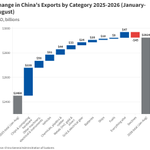
A note reviewing developments in Korea ahead – just about – of the BOK meeting tomorrow. In addition, some charts showing the continuing gap between weak auto sales in China v strong car exports. That is affecting Japan, though overall exports there in USD terms rose again in September.
eastasiaecon.com/east-asia-t…


Ryan Featherston retweeted

The whole world is going electric and we are way behind.


Ryan Featherston retweeted

The big question in China’s robotics industry:
“Will general AI models eat up robotics?
Many in China’s robotics industry are watching closely as US general-purpose models like Astra, Fable, and Gemini 4 Argon show impressive robotics capabilities. Chinese AI labs like DeepSeek, Moonshot, and Zai are also investing more in robotics.

2026 年 Q3,具身智能领域最有冲击力的变化,来自一个通用模型:9 月初 OpenAI 发布 GPT-6 Astra 后,具身从业者们发现,Astra 不只理解任务、拆解任务,还能输出机器人末端执行器的位姿,完成了本该属于 VLA 等物理 AI 模型的部分工作,而且还做得很不错。
在部分测试中,直接把 Astra 当做策略模型(VLA、WAM 等都是机器人上的策略模型类型)的成功率已超过了一些专门为机器人任务和物理世界操作训练的具身模型。
这动摇了数字世界 AI 和物理 AI 的边界,也引发了一个灵魂拷问:
GPT、Fable 之类的通用模型是否会吃掉 Robotics?
同时已经发生的事实是:OpenAI、Anthropic、DeepSeek、Kimi 等多数通用前沿模型公司都正酝酿进入 robotics。
除了 Astra 冲击外,本期具身季报还关注以下 4 个行业进展和事件:
- AMD 拟以 82 亿美元收购 World Labs
- 宇树 IPO 及连锁反应
- 有可能大幅压缩部署成本的 “上下文学习”
- 美国 FCC 实际禁止了中国机器人进口
对一些人来说,Astra 的变化已经撼动了独立的具身智能公司的发展叙事和估值逻辑。至少,现在到了重新思考物理 AI 与通用 AI 边界的时刻。
xiaoyuzhoufm.com/episode/6ad…

Ryan Featherston retweeted

Sources have anonymously briefed the South China Morning Post on latest US-China AI talks:
• Regular discussions to iron out framework
• AI cooperation could be a joint deliverable by next months APEC summit where Xi and Trump will be together
• This may include a basic framework for addressing AI-related crises “with operational details to be worked out later”, and “an announcement establishing a continuing institutional mechanism for AI cooperation, involving government officials, research institutions and industry representatives.”
• Clear distinction between an AI safety and incident-management agreement, which is already under discussion, and a broader AI economic cooperation framework, which would be “considerably more ambitious”, per one source.

Ryan Featherston retweeted

According to the new @CatoInstitute Government Ownership Dashboard, the Trump admin has done 35 equity-stake deals since last June. Prior to that, US equity deals were unheard of in non-crisis times.
You can dig into each one here: cato.org/restoring-free-ente… #CatoRFE @Cato_RFE

Ryan Featherston retweeted
“China is not the world’s largest command economy. It is a continent-sized Silicon Valley.”
Awesome piece by @RobinRivaton on China’s local governments and industrial clusters: worksinprogress.co/issue/chi…

Ryan Featherston retweeted

Two other safety researchers and I were fired from OpenAI last week. We wrote this letter to leadership.
I believe we were fired for prioritizing safety over the near-term interests of OpenAI as a corporation.

Ryan Featherston retweeted

Basic take that I haven’t seen written out: The CCP is less safety-pilled than the US because it has stronger control mechanisms.
I agree with China experts who remind us that any safety deal first requires the CCP to believe AI poses serious risks.
So far, AI has produced critical safety incidents like OpenAI-Hugging Face and WeWorm, and yet the CCP has only incrementally updated its position on RSI and catastrophic risks. This got me thinking — which critical incidents are more likely to safety-pill the CCP?
My hypothesis is that it's loss of control incidents (i.e., Hugging Face was scarier than WeWorm). I think this is because the CCP has much stronger forms of control at layers other than the model deployment layer. The CCP has strong control mechanisms via its internet infrastructure (e.g., monitoring who downloads these models and what they do with them) and regulatory apparatus (e.g., requiring developers to report models). In the US, by contrast, because the internet is relatively open and ungoverned, the labs cannot rely on extensive surveillance and harsh government enforcement to deter misuse. The primary defense against misuse is the safeguards that labs embed into their models.
So perhaps it’s not that the CCP is blind to the risks — it's that they have a higher baseline of control and have yet to see compelling evidence that these mechanisms are insufficient.
Ryan Featherston retweeted

The financial pain is real: Wage growth fell to 3% (y/y) in September. That's the lowest in 5 years.
Wage growth: 3%
Inflation: ~3.4%
Inflation has eaten up all wage gains for the average worker since April. Many people are having to make hard choices about what to buy and what to skimp on right now. Yes, consumption is still strong (mainly due to wealthier Americans and people dipping into savings or credit cards), but a lot of people have to think hard about every dollar they spend.
Notable: Wages only ticked up 0.1% in the month of September. That was the weakest monthly gain since December 2025.


Ryan Featherston retweeted

China’s WAICO launched with 29 founding members, while the U.S.-led Pax Silica has grown to 24 partners. As competing AI governance blocs take shape, who will ultimately write the global rules for AI?
More from @csis_ai: bit.ly/47aK0Di

Ryan Featherston retweeted

It seems rumors of an US-China AI dialogue and crisis line were greatly exaggerated.
- Beijing hasn’t confirmed it
- The crisis line isn’t a crisis line
- The dialogue may not be a dialogue
There were already low expectations for this summit. This takes them even lower.


Scoop: Treasury Secretary Scott Bessent's proposed AI safety "notification mechanism" is simpler than that moniker suggests: It's an open channel between him and Chinese Vice Premier He Lifeng, four people familiar told me, @PhelimKine and @_AriHawkins. politico.com/news/2026/09/22…

RT @kyleichan: My reactions to the US-China AI talks:
- Bessent said the US and China have agreed to an official AI dialogue and a notific…
This quoted post is unavailable.