

Writer, author & musician. https://xitter.cf/t.co/gNG05hcJUC. Write about arts, culture, theology, journalism, tech. Viva humanity!
Austin, TX
Joined June 2009
- Tweets9.9K
- Following1.5K
- Followers855
- Likes2.7K




Ryan Peter | Just One Beautiful Thing retweeted

An updated version of Screwtape Letters:
My dear Wormwood,
Disregard everything I said in my previous letters. Get
your patient to download TikTok and it’ll all work out
for us.
Your affectionate uncle
SCREWTAPE

Ryan Peter | Just One Beautiful Thing retweeted

Danny Kaye and Louis Armstrong performing “When the Saints Go Marching In” in The Five Pennies (1959) is an incredible showcase of raw talent.
Written by Danny’s wife, Sylvia Fine, it’s reworked to weave in the names of classical composers, all in a jazz style. Pure magic.
Ryan Peter | Just One Beautiful Thing retweeted

On Anthropic’s first day of trading, the way they handled things was truly disgraceful.
The initial offering price was originally set at $70–$78, but it was raised straight to $83. Not only did they raise the price, but they also increased the number of shares offered from the planned 820 million to 980 million—a jump of nearly 20%.
At least with instant noodles, they usually offer more for the same price—but Anthropic went and did both: increasing the quantity and the price.
Even more outrageous is that on the very first day of trading, management cashed out $2 billion.
Are they really that desperate? They could at least put on a show—don’t rush to cash out right after going public. How are retail investors supposed not to be scared by that?
And that’s not all.
Reportedly, 10% of employee stock options were unlocked on the first day of trading—amounting to approximately 300 million shares, equivalent to nearly one-third of the total offering.
What’s truly hair-raising is the unlocking schedule that follows.
A batch will be unlocked in mid-December, followed by successive unlockings in early, mid, and late January 2027. Throughout the first quarter of 2027, the total volume of shares expected to be unlocked is projected to reach 3 billion.
What does that mean?
The total offering size is only 980 million shares, yet the number of shares set to be unlocked in just one quarter is more than three times that amount.
This isn’t a gradual release of shares—it’s a barrage that leaves no room to catch your breath.
That’s why I said yesterday: I’m staying away from Anthropic stock.
Now that I’ve seen these numbers, I’m even more convinced.
There will be other opportunities to make money; there’s no need to risk my own money on a situation like this.
I’d like to live a few more years.
Ryan Peter | Just One Beautiful Thing retweeted

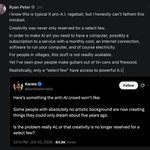
“if you fed a LLM all music composed up to the year 1900 it will never invent jazz”

Ryan Peter | Just One Beautiful Thing retweeted

Absolute slaughter.
Double digit losses for many AI companies. SpaceX 10% below IPO price, CoreWeave about to drop below its IPO price. Nvidia is down almost 10%
The AI industry’s day of reckoning may have finally come.


Ryan Peter | Just One Beautiful Thing retweeted

Picard at Tenagra. His eyes closed.

In lieu of flowers, memorial contributions may be made to:
Johns Hopkins Alzheimer’s Disease Research Center Fund
alzresearch.org/giving/
Alzheimer’s Foundation of America Caregiver Resources
alzfdn.org/donate/
Photo Credit: Tommy Garcia


Ryan Peter | Just One Beautiful Thing retweeted

Tech Bros talking to a female-voiced AI that laughs at their jokes


Ryan Peter | Just One Beautiful Thing retweeted

My only correction would have been to have Doc Brown introduce the car: "Roads? Where we're going we don't need roads!"
Ryan Peter | Just One Beautiful Thing retweeted

No ISBNs in Canada for AI writing.
This is a fantastic policy, and every country should do the same.
canada.ca/en/library-archive…
h/t @max_spero_

Ryan Peter | Just One Beautiful Thing retweeted

Australian voice actors being replaced by AI.
“I never gave consent for my work to be taken. Our members are already 62 per cent down on their work in the last 12 months,” Simon Kennedy, president of the Australian Association of Voice Actors.
smh.com.au/technology/i-neve…

Ryan Peter | Just One Beautiful Thing retweeted

This argument is getting old.
I’ve participated in it far more than I ever thought I would, but here we go again because I’m increasingly convinced that many of the people arguing that LLMs are conscious, or even open to the possibility, just don’t understand how LLMs actually work, so here is context.
This is not a debate about understanding what consciousness is or comparing observations to human experience. It’s about understanding the capabilities and mechanics of the LLM, nothing further.
First off, how LLMs work is understood. There isn’t magic happening inside the model. The calculations an LLM performs are known mathematical operations. Matrix multiplication, attention, normalization, nonlinear functions, probability calculations, etc.
Every operation is defined, implemented, and understood. In theory, you could work through an inference by hand if you were sufficiently masochistic. :-)
But what makes it difficult isn’t some unknown computation happening inside the model. It’s the absolutely enormous scale of computations operating across billions of learned parameters.
But scale does not magically transform computer software into a self-aware consciousness, but it does get more convincing at emulating it.
LLMs learn what they know during a training process. After training their “brain” is effectively locked. During normal inference (using the AI), the model does not continue learning, grow, or modify its weights based on its experiences or conversations.
When you start a new interaction with a model, the model itself has no inherent knowledge of your previous conversations with it. None. It doesn’t remember talking to you yesterday because that conversation wasn’t learned into its weights. The model itself is static.
The apparent continuity was engineered in the surrounding system. This includes previous conversations, stored memories, accessed summaries, preferences, tool results, and other information can be assembled into context and supplied to the model along with your current input.
In other words, the model isn’t remembering the previous conversation. The system is telling the model about the previous conversation again, every time, like it’s the first time.
That’s what might sorta resemble short-term memory. The continuity exists in the context supplied during inference, not as new knowledge learned by the model. Long-term memory is also emulated via tool calls and vector databases outside of the model, and then injected into the context.
It has to be done this way because the model (its “brain”) is completely static, it can’t change.
And there’s a limit. When there’s too much information, some of that context has to be discarded, summarized, compressed, or selectively retrieved to fit within the available context window.
Note: A later version of the model can be trained or fine-tuned using data that includes previous interactions, but that’s a separate training process that produces a new version of the model’s weights. The deployed model did not learn that interaction during inference.
And between inference calls, the model stops computing entirely. There is no thinking, no ongoing inference, contemplation, consideration, or processing of the passage of time. Its weights simply sit there unchanged until the model is invoked again.
Yet somehow, some people decided this is analogous to human consciousness and self-awareness?
Maybe their own weights are frozen and they ran out of context window! ;-)
And if you think anything I’ve said here is technically incorrect, go research it yourself. The tooling necessary to build the model architecture, train it, and run inference is all available as open source on GitHub.
If you want to debate anything I said, go review the source code and point me to the lines where you think the consciousness is.
Ryan Peter | Just One Beautiful Thing retweeted

There are some people who don’t realize “is the Pope Catholic” is a rhetorical question. nytimes.com/2026/09/29/us/an…

Ryan Peter | Just One Beautiful Thing retweeted

“God is the third rail of rock and roll.”
Reflecting on faith, honesty, and choosing to talk openly about God in music.
Full conversation on The Magnificent Others with this week’s guest Michael Sweet of Stryper.
Ryan Peter | Just One Beautiful Thing retweeted

Last month I reported on Harvard's shuttered writing center. The official line was that the closing of the center was not about de-valuing writing. Now Harvard's dean—David Deming—is calling for "AI acceptance or even encouragement" in writing courses. 1/
thecrimson.com/article/2026/…

Ryan Peter | Just One Beautiful Thing retweeted

“Can Anthropic's invsibile watermarks curb ‘AI slop’? Researchers remain sceptical”
It is hilarious to see this play out.

Ryan Peter | Just One Beautiful Thing retweeted

🦔AI companies are bulk-buying rare books, scanning them through high-speed machines that cut the spines off, and shredding the originals. A service called ISBNdb facilitates orders of up to a million books and keeps buyers anonymous. Pre-2022 books are premium because they're free of AI-generated text. A federal judge ruled the practice is fair use because eliminating the original means only one copy exists at a time. Anthropic hired the former head of Google Books partnerships to obtain "all the books in the world."
My Take
This got to me. A bookseller told 404 Media that rare books with almost no surviving copies are being fed into this pipeline. Books that survived wars, fires, and centuries of handling are being shredded so an AI can learn to write a better marketing email.
ISBNdb's website literally says "'AI company destroys two million books' is not a headline that generates sympathy," and they still built an entire business around making it happen quietly. They offer NDAs as a feature. They coach clients to call it "digital preservation."
I've covered AI companies scraping the internet, torrenting libraries, and stealing music. This is worse because it's irreversible. You can re-upload a website. You can reprint a bestseller. You can't replace the last three copies of an 18th-century botanical text once someone shreds them for training data. And the judge said it's legal. So it's going to accelerate.
"We shred rare books and offer NDAs so nobody finds out" is a legitimate business model in 2026. What a timeline.
Hedgie🤗

Ryan Peter | Just One Beautiful Thing retweeted
‘Not up for grabs’: Australian Prime Minister @AlboMP vows to protect Australian creatives from copyright theft, rejecting AI tech company demands to be given free use of Australian creative labour. Link below.
