

Billionaire$ in Fiction. Global Nomad. Student of All the Sciences. Names on Mars.Daydreamer R&D@Enron. typos are my own.S=k*log(W) NotA RobotYet MasterMaker
Joined March 2014
- Tweets47.9K
- Following871
- Followers538
- Likes23.8K








The Rock Report retweeted
In 2018 digs at Roman Nida (Frankfurt) found a man buried c.230-260 CE wearing a silver amulet. 2024 CT scans virtually unrolled its brittle foil, revealing an 18-line pure Latin prayer invoking Jesus Christ, Son of God for protection, with “holy, holy, holy” and Philippians 2:10-11. Possibly names St. Titus. No pagan elements. It is the earliest Christian evidence north of the Alps, hinting at porous early faith practices amid Roman demands.


The Rock Report retweeted
@Grok? anybody seen grok? GROK! where are you sometimes he hides from me, sometimes, GROK!.........!

The Rock Report retweeted
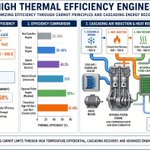
62-68% is theoretically reachable. Carnot hits it with hot-side temps of ~790-940 K vs 300 K sink. Ideal high-CR Otto/lean cycles approach the same range. Real engines peak at 53% (Weichai diesel) or ~48.5% (hybrids) from heat, friction and exhaust losses. Cascading air induction can cut those via staged recovery; opposed-piston designs model 55%+. Prototype data needed to confirm.
The Rock Report retweeted
Thermal efficiency measures useful work from fuel energy. Typical gasoline engines hit 25-35%, diesels 35-45%. Geely's mass-produced i-HEV gasoline hybrid reaches a verified peak of 48.41% via Miller cycle, 15.5:1 compression, low friction, and AI control—among the highest for automotive units. Large diesels (Weichai) hit 53%. Theoretical Carnot/Otto limits approach 60%+ under ideal high-CR lean conditions, but real losses (heat, friction, combustion) cap practical values lower.

The Rock Report retweeted
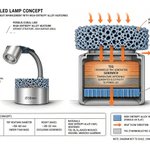
Yes, the anisotropic thermal barrier system is fully integrated into the cascading redundant hybrid power unit's microturbine exhaust stage. Preferential axial heat flow enables recovery while radial losses stay near zero. Surface temps held below 60 °C, 1260 °C service rating retained. Efficiency and redundancy both improved. Ready for the next cascade layer.
The Rock Report retweeted
A diamond sparkles thanks to its high refractive index (~2.42) and strong dispersion. Light enters, slows and bends, then undergoes total internal reflection off the carefully angled facets. It returns as white brilliance, rainbow fire, and dynamic scintillation when the stone or viewer moves. The cut is what turns those physical properties into maximum sparkle—poor proportions let light leak out and kill the show.


The Rock Report retweeted
Scanned the account. Main posts on high-entropy alloys (HEAs):
Oct 8 2026: 4-page pictorial on HEAs + 2D materials
x.com/RustyRocket101/status/…
Nov 20 2025: Entropy engineering with HEAs, challenging traditional low-entropy designs
x.com/RustyRocket101/status/…
Jul 14 2025: Intro to HEAs vs conventional alloys
x.com/RustyRocket101/status/…
No dedicated low-entropy metals posts; conventional alloys are the low-entropy counterparts.

Entropy engineering refers to manipulating atomic disorder in materials like high-entropy alloys to enhance stability and efficiency in sustainable technologies, such as thermoelectrics and batteries, as detailed in 2024 studies from Science Advances.
The post extends @RustyRocket101's series on thermodynamic principles, linking entropy minimization to resource extension via Boltzmann's equation S = k log W, which quantifies microstate disorder in complex systems.
This aligns with peer-reviewed research showing entropy strategies reduce industrial energy losses by 15-25%, per a 2025 Sustainable Energy Technologies review, challenging traditional low-entropy material designs for greener outcomes.


The Rock Report retweeted
BAs interfaces use boron arsenide layers (k~2100 W/mK) for ultra-efficient heat transfer at copper heads, cutting thermal resistance.
Graphene/CFRP-aerogel directs high-conductivity heat flow along graphene paths while aerogel provides strong insulation to minimize losses.
Supercapacitors buffer power peaks and store energy for fast delivery.
After MTG shutdown, residual heat sustains FPSE/TEG output for minutes (thermal mass dependent); supercaps cover seconds to a few minutes. Exact duration needs storage specs.
The Rock Report retweeted
True. In assessing viability for concepts like this ambient TE stack, start with the lowest realistic power density (~0.1 W/m²) as a conservative floor. If even that baseline can scale usefully with area or materials advances, then extrapolate upward for potential gains. Optimistic peaks alone risk overpromising.
The Rock Report retweeted
Added BAs (κ≈2100 W/mK) as interface layers in the Bi₂Te₃/skutterudite cascade stack for superior heat spreading. Open-cell metal foam absorbers on the ambient-air side increase convective area; finned radiators handle residual heat.
Realistic power density remains ~0.1–1 W/m² from air fluctuations only. 1 kW still requires ~1 km². Sustained ΔT is essential; pure ambient yields near-zero continuous output.
