

I teach history and communications at Columbia University. For more information, click on my website.
Manhattan, NY
Joined November 2014
- Tweets3.5K
- Following557
- Followers3K
- Likes6.2K



Pinned Tweet
“Network Nation is an extremely important, brilliantly researched, deep history of America's love/hate affair with not just the telephone, but also the telegraph…a definitive takedown of various neat stories about…American telecommunications.”
pluralistic.net/2024/07/18/t…
Annals of anti-monopoly: scrambling the genealogy of antitrust — Adam Smith, Thurman Arnold, Edward H. Levi, and … Alexander Hamilton.
Anti-Monopoly as Industrial Policy: The Chicago School Versus Adam Smith promarket.org/2026/10/20/ant… via @ProMarket_org

Annals of anti-monopoly: worth reading
“Wood laid a foundation for a distinctive, genteel kind of “founders” history: one that keeps a quiet distance from uncritical flag-waving by emphasizing at every turn how different the eighteenth century was, still while insisting …”

A retrospective on Gordon Wood. Of course they changed the title, as magazines do. I preferred "How Gordon S. Wood Became the Rhetoric and Reality of the American Revolution" but knew it probably wouldn't fly.
newrepublic.com/article/2115…

Annals of anti-monopoly
Limbic capitalism anyone?
19th c. woman’s rights activist Francis Willard as anti-monopoly crusader, my new essay is below. Can anti-monopoly be socialist? Can anti-monopoly be pro bigness and anti-competition? Willard was.
academiccommons.columbia.edu…
Annals of anti-monopoly: an open letter to me on how to think about technology (amidst this summer’s heatwave) from my distinguished colleague and good friend — and former mentee — Lee Vinsel
peoples-things.ghost.io/two-…

Richard R. John retweeted

On Sunday, my friend Gordon Wood was struck and killed in a car accident. Gordon taught history at Brown Univ. and was among the most accomplished historians America has produced. He won the 1993 Pulitzer Prize for The Radicalism of the American Revolution, and his earlier book The Creation of the American Republic, 1776–1787 took the 1970 Bancroft Prize. He also received the National Humanities Medal.
He was, in my view, the finest historian of America's founding—which makes it all the sadder that he did not live to see the nation's 250th birthday. His reputation reached popular culture, too. Matt Damon's character in Good Will Hunting invokes him by name in the famous bar scene, accusing a Harvard student of simply "regurgitating Gordon Wood, talking about [...] the pre-Revolutionary utopia and the capital-forming effects of military mobilization."
I feel fortunate to have collaborated with Gordon on several projects. In a 2019 anthology I compiled, he wrote an essay on the possibility of a shared American narrative. He centered his argument on equal rights as "the most radical and most powerful ideological force" the Revolution unleashed. "This powerful sense of equality is still alive and well in America," he wrote, "and despite all of its disturbing and unsettling consequences, it is what makes us one people."
When I needed jacket blurbs for my new book Lincoln's Compass, coming out this November, I turned to Gordon. The fit was natural: the book argues that Abraham Lincoln took the Declaration's claim that "all men are created equal" as his guiding moral compass—and that he refocused the nation on that claim. Gordon, ever the gentleman, offered generous praise.
He was, in many respects, the dean of American historians. He will be very hard to replace.

Richard R. John retweeted
Annals of Anti-Monopoly: I am honored to announce that I received the 2026 C. Edwin Baker Award for Scholarship at the Intersection of Media, Markets, and Democracy from the International Communication Association. link.icahdq.org/discussion/2…
Annals of Anti-Monopoly: I am honored to announce that I received the 2026 C. Edwin Baker Award for Scholarship at the Intersection of Media, Markets, and Democracy from the International Communication Association. link.icahdq.org/discussion/2…
Annals of anti-monopoly: “So I think that there’s a kind of essential narcissism that is embodied in journalism: Oh, this is the most important time and therefore the worst or the best…. History has a kind of optimism to it because you get perspectives.” chronicle.com/podcast/colleg…

Annals of anti-monopoly: recent interview with Robert Ferguson on Alfred Chandler’s Visible Hand. For Chandler, anti-monopoly railroad policy shaped economic development.
m.youtube.com/watch?v=vspx0j…


Does U.S. political history have a future? Or: can we do without the “gilded age”? And….what about the “New Deal”? networks.h-net.org/group/blo…
Richard R. John retweeted

The NYTimes obituary for Daniel Walker Howe fails to mention his great early book, The Political Culture of the American Whigs. The Whig legacy is arguably more relevant than ever in this neo-Jacksonian presidency. Among the book's key themes:
Howe argued that American Whiggery was a coherent, optimistic middle‑class worldview that linked moral reform, economic development, and national unity, rather than a mere anti‑Jackson coalition.
A core theme is “improvement,” meaning both personal moral self‑discipline and broad national economic development. Whigs championed an entrepreneurial ethos: support for commerce, internal improvements, protective tariffs, and a national bank as tools for orderly, upward mobility in a modern capitalist economy.
Whigs valued character, education, and restraint in leadership. They distrusted mass democracy untethered from moral discipline and preferred a politics led by socially responsible elites—lawyers, clergy, educators—who could guide public opinion rather than simply mirror it.
The Whig critique of Jacksonianism centered on fear of executive overreach, demagoguery, and the erosion of institutional checks. Jacksonian appeals to popular will were seen as morally corrosive and politically destabilizing.
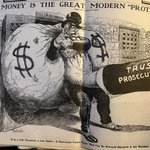
Annals of anti-monopoly: I am presenting a paper via zoom on the iconography of anti-monopoly on 17 December at 12:30 ET for the U.S. Political Economy Lab. Zoom details below.The title is: “Town Born and City Bred: Anti-Monopoly and the Populist Vision.” politicaleconomylab.org/

I wholeheartedly agree.
You’re unable to view this Post because this account owner limits who can view their Posts. Learn more
We are reopening our open position at Columbia for a faculty member to teach in our boutique PhD program in communications. Among the fields we are especially interested in are science, technology, and society (STS), media law & policy, and media history. apply.interfolio.com/174417
Annals of Anti-Monopoly: I will be in DC on 25 September to give a talk at George Mason University. The public is invited. Teaser: why was George Washington furious at the reactionary politics of his fellow Virginian George Mason? Was Washington on to something? Cancel Mason?

Richard R. John retweeted

Good stuff from @RrjohnR promarket.org/2025/06/17/how…

Annals of anti-monopoly: This just dropped today. When did Americans start seriously worrying about media concentration? Hint: in the 1930s. How did this debate shape media coverage of the Second World War? promarket.org/2025/06/17/how…
Annals of anti-monopoly: Here is my review (critical yet appreciative) of Dan Schiller’s monumental history of 20th c. U.S. telecommunications policy. Schiller is particularly suggestive on the FCC in the 1930s, a neglected topic, and on consent decrees. academic.oup.com/jsh/advance…

Annals of anti-monopoly: up on Thursday

Since the invention of the press, concerns about media ownership have persisted.
@batesunlv, @AlexandraGeese, @RrjohnR, and Paul Starr explore 19th–20th century trends, with a focus on technology and market concentration. Moderated by @sgellison.
Tune in to #StiglerAntitrust25, register now at chicagobooth.edu/StiglerAnti….

ALT 2025 Antitrust and Competition Conference Media Concentration, Ownership, and Regulation | April 10 Sarah Ellison, The Washington Post (Moderator) Stephen Bates , University of Nevada, Las Vegas Alexandra Geese, European Parliament Richard John , Columbia University Paul Starr, Princeton University chicagobooth.edu/StiglerAntitrust | #StiglerAntitrust25