

Genetic Technologies and New Gene Design for Curative Therapies @Stanford - @parkerici - @arcinstitute
Stanford, CA
Joined November 2025
- Tweets47
- Following21
- Followers784
- Likes6




Roth_Lab retweeted

In the latest issue! Synthetic transcription factors designed by domain recombination enhance CAR T cell antitumor function dlvr.it/TVdDXq

This has been a huge effort from Oliver, everyone in the Roth Lab and the Satpathy Lab, and an amazing group of collaborators. None of this type of work is possible without high risk-high reward funding, especially from the @arcinstitute, the @NIH Director ‘s New Innovator Award, and @PICI, @Burroughs Wellcome, and the @Weill Foundation
Much more functional and mechanistic details about individual top DESynR AP-1 TFs in the full manuscript! But it is exciting to propose that the human genomes natural set of 20,000 genes may not be the only “human” genes that can be productively manipulated when studying human biology, building cellular therapies, or predictively designing optimal genetic perturbations for desired tasks. (9/10)
xitter.cf/Satpathology/status/20…

Human protein-coding genes evolved from old parts - reconfigured domains from ancestral genes. We can screen short-sequence evolution at scale using mutagenesis, CRISPR, etc, but we had no way to do the same for domain-level evolution.
Happy to share our work developing DESynR genes today in @CellCellPress: scalable synthesis and functional screening of thousands of new human genes, built from old parts. DESynR transcription factors outperform native factors and dramatically improve CAR T cell function.
A team effort led by the incredible Oliver Takacsi-Nagy! @parkerici @CancerResearch @TheMarkFdn
cell.com/cell/fulltext/S0092…
Importantly, it was the unique combination of existing natural domains into a new combined DESynR human AP-1 TF, rather than overexpression of each domain individually or each contributing natural AP-1 TF individually, that programmed the full extent of improved functional behavior. (8/10)

Excitingly, to some extent top DESynR AP-1 TFs appeared to access these unique functional patterns by programming new transcriptional states not seen in base CAR T cells or with natural TF overexpression. (7/10)

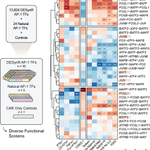
Across a much wider array of functional assays in primary human T cells, DESynR AP-1 TFs showed unique and potentially improved patterns of functional behavior compared to natural AP-1 TFs or otherwise unmodified CAR T cells. (6/10)

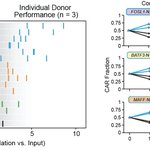
For instance, a synthetic combination of BATF3’s N terminal effector domain, ATF3’s b-zip DNA binding domain, and BATF2’s C terminal effector domain, drove much greater proliferation in a long term repetitive stimulation assay than any natural AP-1 TF. (5/10)

Functional screening of these DESynR AP-1 TFs revealed numerous new human AP-1 TFs that outperformed overexpression of any natural AP-1 TF. (4/10)

We focused on the AP-1 family of basic lucine zipper TFs - they are both some of the most highly expressed in the genome (think Jun, Fos), as well as enriched in previous knockout and overexpression hits from prior natural gene screening in human T cell models. There are 24 natural human AP-1 TFs. We built over 13,000 new “DESynR” AP-1 TFs that the human genome could have constructed from existing AP1 TF domains. (3/10)

Eukaryotic genomes most commonly acquire new genes through duplication of existing genes followed by recombination. We set out to experimentally mimic and accelerate this process, building, integrating into a primary human T cell’s genome, and functionally testing over 10,000 new human transcription factors in a single experiment. (2/10)

Transcription Factors are central to cellular identity and function. The human genome currently contains ~1600 of them. But could there be productive human transcription factors that have not evolved? Out today in Cell, a tremendously talented graduate student Oliver Takacsi-Nagy @Oli_TN, together with the @Satpathology Lab, determined to find out. (1/10)
authors.elsevier.com/sd/arti…

Roth_Lab retweeted

Congratulations to the AACR Trailblazer Cancer Research Grants recipients, supported by @pfizer. AACR’s largest-ever grant program has awarded 15 early-stage and mid-career investigators $1million each to establish novel, highly creative research projects. brnw.ch/21x1JQA

Roth_Lab retweeted

6/6 Thanks to everyone who helped out with this project, particularly @Roth_Lab, @Satpathology, @satijalab, and John Blair as well as everyone who has helped run big Perturb-seq experiments and make them publicly accessible. There’s more in the preprint
biorxiv.org/content/10.64898…
Rapid and huge effort from Austin, see his writeup for more details, and our collaborators, @Satpathology and @satijalab.
xitter.cf/AustinMHartman/status/…

6/6 Thanks to everyone who helped out with this project, particularly @Roth_Lab, @Satpathology, @satijalab, and John Blair as well as everyone who has helped run big Perturb-seq experiments and make them publicly accessible. There’s more in the preprint
biorxiv.org/content/10.64898…
Our systematic analysis uncovered known off-targets in previous genome-wide perturb seq exps, as well as strongly suggests some proposed new pathway members, such as within TCR signaling, are driven by seed-driven off-target binding of known regulators rather than new biology. (2 of 3)
Genome wide perturb seq creates powerful perturbations x transcripts datasets. This unveils new biology - but also reveals new off-target effects. New work from @AustinMHartman, a massively talented PhD student in our lab, systematically identifies seed driven off-target effects in genome-wide perturb seq exps. (1 of 3) biorxiv.org/content/10.64898…
Roth_Lab retweeted

Congratulations to Arc Innovation Investigator Theo Roth (@Roth_Lab) on receiving a 2026 @MichelsonMedRF Next Generation Grant.
Theo's team is using combinatorial genetic engineering to create immune cell states not found in nature.
michelsonmedicalresearch.org…

Hi Orry- of course, we're excited to share annotated sequences for anything we've built! Just sent to your email.
Thank you to @StanfordPath, @arcinstitute, @parkerici, @BWFUND, and @theNCI for supporting the work in our new lab! This project was led by an extraordinary graduate student, @AustinMHartman, and grew out of work together with @Satpathology
CRISPR-All unifies disparate genetic discovery technologies to enable defined genetic changes to be made arbitrarily, combinatorially, and scalably in human cells, mirroring natural evolution’s exploratory potential to discover new cellular functions and states. We hope it may be useful for you too!
