
Life, Liberty, and the Pursuit of Happiness. Fast cars & Freedom!
Justin, TX
Joined January 2025
- Tweets2.2K
- Following565
- Followers412
- Likes11.3K




Ron Calhoun retweeted

🚨THEY BURIED THIS FOR A REASON:
Hydroxychloroquine doesn’t just block viruses — it reprograms them into cancer hunters that zero in on tumor cells while leaving healthy ones untouched.
One of America's Frontline Doctors, Dr. Richard Urso exposes the truth. The real question: why was every trace of this research suppressed and ridiculed?
A dirt-cheap, decades-old drug that could selectively destroy cancer would obliterate the multi-trillion-dollar oncology cash machine overnight.
They don’t want cures. They want lifetime customers paying for toxic chemo, radiation, and “new” drugs that cost hundreds of thousands.
This information was deliberately buried.
The truth is leaking out again.
Ron Calhoun retweeted

BREAKING: A New York City watchdog group organized by Citizen Journalist Nick Shirley has uncovered a "free grocery store" scam that is raking in millions for the Mamdani family.
According to the group, Mamdani's brother, Eli Mohammed Mamdani, has been buying decrepit old buildings from the city for next to nothing.
"The plan was simple," said local Shirley Watchdog Chapter leader Joseph Barron, "The mayor's brother buys condemned property from the city for pennies on the dollar, then he sells it right back for the 'free grocery store' program at market value."
Once the city has the property it already owned, Mamdani hires his cousin Rufus Theodore Mamdani's construction company to bring it up to code.
"All told, each store could rake in as much as $5 million for the Mamdani family."
That's how communism works.
What's your response to this......??👀
MAKE THIS GO VIRAL ON X. LET’S GO 👏

Ron Calhoun retweeted

(2.21 secs) of why Kari Lake is rising among the MAGA faithful as the next Press Sec
@realDonaldTrump she's the one we want
Enjoy this folks 👇
Ron Calhoun retweeted

The American Academy of Pediatrics was just SLAMMED with a federal RICO lawsuit for running a vaccine racketeering enterprise.
America's most influential pediatric vaccine organization illegally deceived parents for DECADES into giving their children large batteries of untested vaccines.
The AAP takes in cash from Merck, Pfizer, and Moderna to issue FRAUDULENT vaccine recommendations for MAXIMUM profit, despite ZERO safety data on injecting 72 vaccine doses by age 18.
Ron Calhoun retweeted

This is why we founded @OldGloryBank If you think this won't happen again, you're living in fantasyland. We can't just bitch and moan, we have to DO something about it, so we did. Visit: OldGloryBank.com and speak to an American citizen who will help you open an account.

Major banks closed accounts of MAGA, pro-life and other conservative groups disfavored by Biden admin: bombshell report trib.al/Ttt6eY9


Ron Calhoun retweeted

The NFA is not dead ... but it is on life support.
Be sure to keep up with all the details of the recent ATF announcement regarding SBRs, SBSs, and suppressors here 🔗👇:
guns.com/news/2026/10/09/atf…

Ron Calhoun retweeted

🚨🚨🚨 If you still don’t understand why this can send $XRP into a completely different institutional phase, stay with me.
This is a long read, but every piece matters.
I want you to picture a hedge fund with millions of dollars sitting at Standard Chartered.
The fund wants exposure to professional trading markets through LMAX Group.
It also wants to keep its assets inside a regulated banking environment.
Normally, moving collateral between a custodian and a trading venue creates friction.
Assets move.
Operational risk increases.
Capital becomes less flexible.
Now put RLUSD issued on XRPL inside that workflow.
Standard Chartered has launched custody for RLUSD through its DIFC branch, regulated by the Dubai Financial Services Authority.
The next planned phase allows eligible clients to keep RLUSD at Standard Chartered while the collateral value is mirrored to LMAX for agreed trading products.
The bank keeps custody.
LMAX recognizes the collateral.
The institution trades.
That may sound technical.
To me, it is one of the clearest examples yet of Ripple infrastructure entering the same operating model used by professional finance.
And I’m looking well beyond RLUSD itself.
Because every institutional market has layers.
Cash.
Collateral.
Liquidity.
Execution.
Settlement.
Market making.
Financing.
Custody.
When Ripple starts placing XRPL-issued assets into those layers, XRP gets closer to the type of activity capable of creating recurring professional demand.
The road to this moment did not begin in October.
Standard Chartered had already built an off-exchange collateral mirroring system with OKX in April 2025.
Franklin Templeton was involved.
Brevan Howard Digital was an institutional participant.
That model gave clients a way to keep assets with a bank while using their collateral value in trading.
Then Ripple and LMAX Group announced their agreement in January 2026.
Ripple committed $150 million.
LMAX planned RLUSD across spot crypto, perpetual futures, CFDs, foreign exchange and institutional prime brokerage.
RLUSD could serve as settlement, margin funding, collateral and digital-dollar liquidity.
And LMAX was already operating serious financial markets.
Its businesses reported approximately $8.2 trillion of institutional exchange trading volume during 2025.
That puts Ripple beside a venue where professional liquidity already exists.
The institutional market does not need to be invented.
Ripple is entering one that already moves trillions.
Then July 2026 arrived.
Standard Chartered and LMAX completed their first live digital-asset prime-brokerage trades.
Then in September, LMAX appointed Standard Chartered as custodian across DIFC and Luxembourg, with the Luxembourg platform operating under MiCA authorization.
Then October brought RLUSD custody and the planned collateral integration.
Follow that progression carefully.
Banking infrastructure.
Prime brokerage.
Digital-asset custody.
Trading.
Then XRPL-issued collateral.
Every stage adds another piece institutions need before they deploy serious capital.
Now bring Brevan Howard back into the picture.
It already participated through Brevan Howard Digital in Standard Chartered’s earlier collateral-mirroring model.
Then Ripple expanded its own relationship with Brevan Howard on October 6, 2026.
Ripple Prime will provide Brevan Howard funds with multi-asset brokerage, clearing and financing.
So one major investment manager now has confirmed relationships with both sides of the infrastructure being assembled.
Standard Chartered around collateral.
Ripple Prime around brokerage, financing and clearing.
I think that tells us a lot about the market Ripple wants to serve.
The target is increasingly institutional finance.
Hedge funds.
Professional trading firms.
Asset managers.
Treasury desks.
Market makers.
Clients that care about deep liquidity and financing capacity.
And I believe XRP becomes much more interesting once those clients need liquid assets to move between the products they trade.
Now look at RLUSD.
About $2.409 billion was reported in circulation on September 24.
About $2.532 billion sat in reported reserves.
Billions.
That gives Ripple a real pool of regulated digital dollars to work with.
The next phase is putting those dollars to work.
A stablecoin becomes more useful when institutions can use it as:
Trading collateral.
Settlement money.
Liquidity.
Margin funding.
Treasury cash.
A conversion asset.
And each new function increases the financial activity surrounding it.
That activity matters to XRP because XRPL already gives institutions a native market structure where XRP and RLUSD can trade directly.
The pair can live inside native order books.
It can live inside AMM pools.
Professional liquidity providers can hold both assets and earn from facilitating flows.
As the volume grows, the inventory required to service that market can grow too.
I think people underestimate how important inventory is.
A market maker cannot provide deep XRP liquidity by owning zero XRP.
A professional desk servicing institutional conversions needs assets ready.
If a fund suddenly needs $10 million of XRP liquidity, somebody has to stand on the other side.
If many funds begin doing that repeatedly, the market maker cannot constantly start from zero.
It maintains working balances.
That can create XRP demand that sticks around much longer than a single transaction.
Now add XRPL auto-bridging.
XRP can serve as an intermediary between issued assets when XRP markets offer the efficient route.
RLUSD can enter.
XRP can bridge.
Another asset or currency can leave.
As more digital currencies and financial assets appear on XRPL, the number of possible routes expands.
And I believe XRP becomes increasingly useful as common liquidity between markets that would otherwise need separate direct pairs.
That role matters enormously in finance.
Because fragmented markets are expensive.
Common liquidity makes them easier to connect.
Then I think about the next logical step:
XRP collateral.
Today’s Standard Chartered announcement centers on RLUSD.
I’m looking several stages ahead.
Standard Chartered already operates a collateral model that supports different digital assets and tokenized money-market funds.
So I see a believable path toward additional eligible assets over time.
My bullish prediction is that XRP eventually becomes one of those assets in institutional financing arrangements.
A fund holds XRP.
The XRP remains with a regulated custodian.
Its value supports a trading or financing position.
That creates direct balance-sheet demand.
The institution needs XRP because XRP is serving a capital function.
Now we are talking about a completely different economic relationship with the asset.
An XRP balance can support liquidity.
Trading.
Financing.
Collateral.
Settlement.
Treasury activity.
That is the version of XRP adoption I care about most.
XRPL also has native operating requirements that matter as usage expands.
The standard account reserve is 1 XRP.
Most additional owner-reserve objects require 0.2 XRP.
Transaction fees are paid in XRP and burned.
Every institutional account.
Every liquidity position.
Every issued asset.
Every application.
Every transaction.
They all deepen activity on the ledger.
I see these native requirements as the foundation.
The larger potential comes from professional holdings.
An institutional account might need only a small amount for ledger mechanics.
A liquidity provider serving millions or billions in financial flow may need a completely different level of XRP inventory.
That is the demand scale I want to see develop.
And then there is Ripple Prime.
LMAX Digital acts as a price-discovery venue available to Ripple Prime clients.
Ripple Prime gives institutions brokerage, financing and clearing.
LMAX gives them execution and market access.
Standard Chartered gives them bank custody.
RLUSD gives them digital-dollar liquidity.
XRPL gives them a settlement and asset environment.
XRP gives that environment a native liquid asset.
Look at how those functions fit together.
Institution enters through a familiar financial service provider.
Capital remains under regulated custody.
Trading happens through institutional infrastructure.
Settlement can involve digital assets.
Liquidity providers connect the markets.
That looks much closer to the future institutional market I have been expecting than the crypto exchange model people still associate with digital assets.
Now I want to put numbers around the liquidity idea.
Assume $100 million in daily transactions actually routes through XRP.
Assume the same professional inventory turns over five times per day.
That produces an illustrative average working liquidity requirement of $20 million.
Now imagine this infrastructure grows.
$100 million becomes $250 million.
Then $500 million.
Then several currencies and products share the same liquidity system.
Market makers reuse XRP throughout the day, but they still need working inventory.
And if institutions begin using XRP as collateral as well, another portion can be committed outside immediate trading liquidity.
That creates several demand channels interacting at once:
Market making.
Collateral.
Settlement.
Investment demand.
Liquidity pools.
Institutional inventories.
I expect that combination to matter far more for long-term XRP valuation than tiny transaction fees ever could.
Now widen the lens.
BNY handles RLUSD reserve custody.
DBS and Franklin Templeton are connected to tokenized money-market funds and planned lending using RLUSD.
Ondo Finance OUSG is live on XRPL with RLUSD minting and redemption.
Securitize connects RLUSD with eligible holders of BlackRock’s BUIDL and VanEck’s VBILL.
Ripple invested in ZILO and Licuido, adding transfer-agency and digital-collateral capabilities.
Then we have:
Standard Chartered.
LMAX Group.
Brevan Howard.
Ripple Prime.
These relationships cover almost every part of institutional financial activity I keep studying.
Digital cash.
Fund assets.
Treasuries.
Custody.
Brokerage.
Clearing.
Financing.
Trading.
Collateral.
Settlement.
Liquidity.
And XRP sits as the native asset of the ledger around which more of this infrastructure is being built.
The next milestone I care about is seeing RLUSD collateral at LMAX actually go live for clients.
After that, I want to see measurable XRP/RLUSD market depth.
Professional market makers.
Growing liquidity pools.
More institutional trading.
Then I want to see XRP move into more financing and collateral relationships.
That final step would be extremely important to me.
Because once XRP balances become useful for financing real positions, institutions gain a reason to hold XRP that has nothing to do with waiting for a price pump.
They need the asset because it gives them access to a financial function.
That is durable utility.
My long-term sequence looks like this.
2027
RLUSD becomes increasingly normal inside institutional trading.
Standard Chartered custody gives institutions comfort.
LMAX gives them execution.
Ripple Prime brings brokerage, clearing and financing.
XRP/RLUSD liquidity deepens.
Professional desks begin carrying larger XRP inventories to service activity.
2028
Collateral systems expand across more digital assets and tokenized investment products.
XRP earns a larger role around liquidity and selected financing activity.
Institutions interact with XRPL through more than one product.
2029–2030
24/7 tokenized financial markets become normal.
Institutions continuously exchange digital cash, tokenized assets and other currencies.
XRP operates inside those markets as liquid inventory, a bridge asset, settlement liquidity and potentially collateral.
That is the XRP future I am preparing for.
And I think the market is still focused on the wrong part.
People see:
“Standard Chartered now custodies RLUSD.”
I see a regulated bank connecting an XRPL-issued asset to professional collateral infrastructure.
I see LMAX, which already handles trillions in institutional trading.
I see Ripple putting $150 million behind that relationship.
I see Standard Chartered’s previous collateral work with OKX, Franklin Templeton and Brevan Howard Digital.
I see Brevan Howard now connected to Ripple Prime.
I see BNY supporting RLUSD reserves.
DBS and Franklin Templeton around tokenized funds.
Ondo Finance.
Securitize.
BlackRock BUIDL.
VanEck VBILL.
ZILO.
Licuido.
This is becoming a network of institutions around digital cash, liquidity, tokenized assets and financing.
And I believe XRP will increasingly become part of the capital moving between them.
The biggest shift I’m waiting for is simple:
Professional institutions begin maintaining XRP because they need XRP.
Need it for liquidity.
Need it for market making.
Need it for settlement routes.
Need it for collateral.
Need it to service clients using XRPL markets.
Once that demand appears consistently, the discussion around XRP price becomes very different.
The market will no longer be trying to value XRP only on retail speculation.
It will have to start pricing the capital requirements of an institutional liquidity network.
That is why I am extremely bullish on this development.
I think the coming months and years will show why these infrastructure agreements matter far more than most people realize today.
slowly... then all at ONCE!

Have you watched this yet $XRP holders?
What stayed with me after listening to the Swift executive’s interview with Finextra Research at Sibos 2026 was not one company name or one blockchain.
It was the kind of banking system he was describing.
A bank issues tokenized deposits.
Another bank issues its own digital money.
Asset managers tokenize funds.
Securities become programmable.
Institutions want to trade them outside normal banking hours.
Currencies need to exchange instantly.
Cash and securities need to settle together.
And eventually all of these networks need a way to communicate.
We are moving toward an environment with more forms of money, more digital assets and more financial networks operating at the same time.
When I think about $XRP in that environment, I stop asking the old question:
“Which payment system wins?”
I start asking:
What provides liquidity between all of these systems?
That question is much more important to me.
Swift is already building the banking side of this transition.
Its blockchain-based shared ledger started as an announced initiative in September 2025 with more than 30 financial institutions and Consensys.
By March 2026, implementation was underway.
By July 2026, 17 banks across six continents were preparing for initial tokenized-deposit payment pilots.
The group includes ANZ, BNP Paribas, BNY, Citi, DBS, FAB, FirstRand, HSBC, Itaú, Lloyds, Mashreq, MUFG, OCBC, Standard Chartered, UBS, UOB and Wells Fargo.
Then at Sibos in September, Swift was already discussing interoperability between conventional financial rails and tokenized infrastructure.
Think about the scale represented by those names.
Now pay attention to the overlap.
Standard Chartered sits inside that Swift group.
It also just launched institutional custody of Ripple USD, RLUSD, on the XRP Ledger.
It is working with Ripple and LMAX Group on planned collateral integration for RLUSD.
So Standard Chartered is building experience around tokenized commercial-bank infrastructure and regulated stablecoin infrastructure at the same time.
That fascinates me.
Because a bank learning how to move tokenized deposits, custody digital dollars and manage digital collateral is preparing for a very different financial system than the one we had ten years ago.
DBS creates another overlap.
DBS appears in Swift’s tokenized-deposit group.
DBS also has a formal relationship with Ripple and Franklin Templeton around tokenized money-market funds and RLUSD.
They plan RLUSD/sgBENJI trading on DBS Digital Exchange.
Another phase explores financing using tokenized fund shares as collateral.
Franklin Templeton also planned to issue sgBENJI on XRPL.
So now we have tokenized deposits, tokenized funds, stablecoin cash and collateralized financing appearing around the same bank.
BNY is another one.
BNY participates in Swift’s ledger initiative.
BNY is Ripple’s primary RLUSD reserve custodian and provides transaction-banking infrastructure supporting Ripple’s operations.
Stablecoins need real reserve custody, real banking relationships and real operational controls.
BNY gives RLUSD that connection into established finance.
Then HSBC.
HSBC is connecting its Tokenised Deposit Service to Swift’s ledger.
Ripple has separately identified HSBC as a Ripple Custody customer.
HSBC also appeared with Ripple discussing institutional digital-asset custody and tokenization.
Same bank.
Multiple rails.
Multiple digital-asset functions.
One increasingly connected financial environment.
I think people are making a mistake when they imagine institutional blockchain adoption as one giant network replacing everything.
The direction described here looks much more like coexistence.
Banks keep their own systems.
Swift provides banking connectivity.
Stablecoins provide regulated digital cash.
Blockchains provide asset issuance and settlement.
Asset managers tokenize funds.
Liquidity providers connect currencies and markets.
Interoperability tools coordinate activity across them.
And that environment gives $XRP a very specific opportunity.
If Bank A issues a tokenized dollar deposit and Bank B issues a tokenized euro deposit, the market needs a way to exchange them.
If there is deep direct USD-token/EUR-token liquidity, great.
But eventually there can be thousands of combinations.
Different currencies.
Different issuers.
Different stablecoins.
Different securities.
Different funds.
Different banking networks.
XRPL already supports cross-currency payments and native routing.
Its DEX can use XRP as the intermediary when the XRP route gives the transaction a better result.
That lets XRP serve as independent liquidity between assets that otherwise may not have deep direct markets.
I want people to understand the importance of XRP being issuer-neutral.
A commercial bank’s tokenized deposit represents that bank’s liability.
XRP does not belong to one commercial bank.
It can trade against many currencies and assets.
So in a world filled with institution-issued money, an independent liquid asset can have a useful role without needing to replace the bank-issued money itself.
We already have proof that XRP can perform real cross-border settlement.
Bitso uses XRP alongside RLUSD and Ripple Payments.
Then Ripple and Bitso expanded their relationship in June.
Bitso is bringing MXNB, its Mexican-peso stablecoin, onto XRPL.
MXNB is being integrated alongside RLUSD into Ripple’s Payments on DEX infrastructure, with enterprise settlement between the United States and Mexico among the focus areas.
That gives us a very simple example.
Digital dollars.
Digital pesos.
XRPL liquidity.
Potential XRP routing.
Local payout infrastructure.
Real commercial corridors.
Now add securities.
The Swift executive talked about Delivery-versus-Payment.
If an institution buys a tokenized bond, the money and the bond should settle together.
Nobody wants one side to move without the other.
XRPL supports atomic cross-currency payments.
Batch Transactions can coordinate operations under an all-or-nothing mode.
So if institutions increasingly demand programmable securities settlement, XRPL already has useful primitives for coordinating those transactions.
Ripple has also been adding the pieces around that.
Its investments in ZILO and Licuido add transfer agency, issuance, tokenized collateral and financial-market liquidity capabilities.
RLUSD can provide a digital cash leg.
XRPL can provide the settlement environment.
ZILO and Licuido add more of the institutional machinery needed around ownership, issuance and administration.
Then CSD BR and BTG Pactual show how this can begin inside an existing regulated securities system.
CSD BR reported more than BRL 22 trillion of registered assets across its infrastructure.
The initial Ripple deployment mirrors ownership information for BTG Pactual fund shares through XRPL Multi-Purpose Tokens.
Future scope includes native issuance and trading between authorized participants.
I love this model because it shows institutions can introduce blockchain functionality gradually.
Existing legal infrastructure stays in place.
XRPL adds digital capabilities.
Usage can expand as confidence and operational experience grow.
Now look at how many actual investment products are moving onto XRPL.
Ondo Finance OUSG is live there.
Eligible investors can subscribe and redeem around the clock using RLUSD.
OUSG’s investment structure includes exposure to BlackRock BUIDL.
Franklin Templeton sgBENJI is connected to DBS and Ripple’s planned trading and financing framework.
Archax brought tokenized exposure to an abrdn/Aberdeen money-market fund onto XRPL.
Ripple allocated $5 million into those fund tokens.
Aviva Investors also announced plans with Ripple to bring tokenized traditional investment funds to XRPL.
When I see all of these names together, I think about market structure.
A tokenized fund alone is interesting.
A stablecoin alone is useful.
A tokenized bank deposit alone is another product.
Put all of them into an interoperable financial market and suddenly liquidity becomes the center of the conversation.
How does a tokenized fund exchange into cash?
How does one form of digital cash exchange into another?
How does a European fund settle against a dollar stablecoin?
How does a corporate treasury move from a money-market token into a payment asset?
How does collateral move without disrupting the institution’s broader portfolio?
These are liquidity questions.
Liquidity can create XRP demand when XRP is actually used as the common route.
Then there is Payment-versus-Payment.
Foreign exchange is enormous because institutions constantly need one currency while holding another.
If digital currencies increasingly settle around the clock, PvP systems need to coordinate both sides of the trade.
XRP can potentially act between those currencies whenever XRP liquidity provides the most efficient route.
The version I care about most is repeated institutional flow.
Professional liquidity providers buying, selling and holding XRP inventory because their business needs it.
That is a much deeper economic relationship with the token than somebody simply speculating on price.
And Ripple is expanding further into the operating systems companies use to manage money.
Ripple Payments now lets businesses collect, hold, exchange and pay out using fiat and stablecoins through one platform.
Technology from Palisade and Rail supports that expansion.
Ripple Treasury introduced native digital-asset capabilities so finance teams can see conventional and digital liquidity together.
Ripple says its payment network has already processed more than $100B cumulative volume with payout coverage across over 60 markets.
Imagine this becoming normal corporate finance.
A treasury team opens one interface.
They see fiat.
Stablecoins.
Tokenized funds.
Payment obligations.
Currency exposures.
Collateral.
Then the system determines the best route to exchange and move value.
If XRP becomes one of the liquid routes inside that workflow, every additional corporate user expands the potential transaction base.
I also keep looking at Chainlink’s connection to Swift.
Chainlink announced a method for financial institutions to access Swift’s blockchain ledger through its Runtime Environment while keeping control of their own signing keys.
Again, this points toward a multi-system financial market.
Banks are not being forced onto one universal blockchain.
Systems are being designed to communicate.
And I think a multi-network environment creates more potential value for independent liquidity than a closed network ever could.
Now bring it back to $XRP itself.
Where can direct demand actually come from?
Cross-currency bridging when XRP is used.
FX markets quoted through XRP.
XRP used as collateral.
XRP lending and borrowing.
Institutional treasury accumulation.
XRPL reserves.
Transaction fees.
And, most importantly to me, XRP inventories held by market makers.
Suppose the future system processes $10B per day.
Use a simple hypothetical.
10% routes through XRP.
That gives $1B daily XRP-routed volume.
If liquidity inventory turns over ten times a day, around $100M of working XRP inventory could service that level of flow.
This is why velocity does not destroy the XRP thesis for me.
Liquidity can be reused.
But liquidity still has to exist.
Somebody still has to provide the XRP.
Somebody still has to maintain the market.
Somebody still needs enough inventory to execute large transactions without huge slippage.
XRPL’s base mechanics add more direct usage.
Accounts maintain a 1 XRP base reserve.
Ledger objects generally add 0.2 XRP owner reserves.
Fees are paid in XRP and burned.
Every additional institution, tokenized asset and on-ledger application can increase those operating requirements.
The catalysts I care about most now are very practical.
More XRP-mediated institutional FX.
More bank tokenized deposits connecting internationally.
Standard Chartered expanding RLUSD custody and collateral use.
DBS and Franklin Templeton moving deeper into tokenized fund financing.
Bitso scaling MXNB and RLUSD settlement.
DvP and PvP getting used more widely.
CSD BR expanding beyond record mirroring.
Ripple Treasury reaching more companies.
More institutional market makers holding XRP.
And interoperability infrastructure opening access to more settlement networks.
Then my timeline starts to become clearer.
2027: tokenized deposits begin moving beyond isolated bank systems.
More institutions gain access to 24/7 digital liquidity.
Ripple expands payments, custody and treasury infrastructure.
I want to see additional regulated currency pairs using XRP as the bridge.
2028: tokenized assets get used more actively.
Funds become collateral.
Securities settle against digital cash.
Lending markets grow.
Asset managers and banks need liquidity between those instruments.
If XRP participates, native liquidity becomes much more economically important.
2029–2030: interoperability becomes normal.
A company may hold bank deposits, stablecoins and tokenized assets spread across different networks.
A bank may use Swift and additional blockchain settlement infrastructure.
A market maker may continuously exchange value between those systems.
XRP’s opportunity is sitting right in the middle of that complexity as independent liquidity.
And this is already moving from theory into infrastructure.
Swift: 17 initial banks working on tokenized-deposit connectivity.
Standard Chartered: Swift plus live RLUSD custody.
DBS: Swift plus Ripple and Franklin Templeton.
BNY: Swift plus RLUSD reserve custody.
HSBC: Swift tokenized deposits plus Ripple Custody.
Bitso: XRP and RLUSD cross-border settlement.
CSD BR: XRPL records with BTG Pactual.
Ondo: OUSG on XRPL.
Archax and Aberdeen: tokenized fund exposure.
Aviva Investors: planned tokenized funds.
Ripple: payments, treasury, custody, stablecoins, settlement and tokenized capital markets.
I keep asking myself what happens when all of this moves from separate initiatives into normal financial operations.
My answer keeps coming back to liquidity.
The world can create thousands of tokenized assets.
It can issue hundreds of forms of digital money.
It can connect banks 24/7.
Somebody still has to exchange value between them.
If XRP earns even a meaningful share of that job, I think the long-term conversation around $XRP becomes completely different from the conversation people are having today.
I want to see the receipts in transaction volume.
XRP-routed FX.
Institutional inventory.
Collateral.
Financing.
Settlement.
Those numbers will tell us how far the thesis is really progressing.
But when I listen to a Swift executive describe the financial system banks are actively trying to build, then look at Ripple’s institutional network and XRPL’s existing capabilities, I understand why I remain so bullish on $XRP.
You’re not bullish enough
Ron Calhoun retweeted

History raises an uncomfortable question.
🇩🇪 Germany — Devastated by US forces in WWII. Now an ally.
🇯🇵 Japan — Firebombed. Two atomic bombs. Now an ally.
🇻🇳 Vietnam — Years of US bombing and warfare. Now a US strategic partner.
Meanwhile…
🇸🇦 Saudi Arabia — Never invaded or bombed by the US. Birthplace of Osama bin Laden. 15 of the 19 hijackers on 9/11 were Saudis.
🇪🇬 Egypt — Never subjected to a US bombing campaign. Birthplace of al-Qaeda leader Ayman al-Zawahiri.
🇮🇩 Indonesia — Never subjected to a US bombing campaign. Home to al-Qaeda-linked Jemaah Islamiyah.
The historical record establishes two things:
American military destruction does not inevitably produce anti-American terrorism.
And anti-American terrorism does not require a history of American military attacks.
So perhaps the question isn’t simply what America did.
It’s also what the terrorists believed.

Ron Calhoun retweeted
🚨 DTCC processes $4.7 quadrillion a year 🚨
Now Chainlink is being built into its future collateral infrastructure.
Are you ready for $LINK if this scales?
I want to explain why Sergey Nazarov’s Sibos interview hit differently for me.
Most people hear tokenization and picture an asset becoming a token.
I picture what happens to that asset during the next ten years.
Take a Treasury.
It gets tokenized once.
Then it gets priced thousands of times.
It can be used as collateral.
Borrowed against.
Transferred.
Repriced.
Refinanced.
Settled against cash.
Moved between institutions.
That repeated financial activity is where I think Chainlink has a much bigger opportunity than people realize.
DTCC’s decision tells me institutions are already thinking about the same problem.
On May 12, DTCC announced that its Collateral AppChain would use Chainlink Runtime Environment, Chainlink data standards and automated collateral workflows.
The platform is designed around eligibility checks, valuation, margining, optimization and settlement.
Q4 2026 was the targeted launch window.
The scale behind DTCC deserves context.
Its subsidiaries processed $4.7 quadrillion in securities transaction value during 2025.
It serviced around $114 trillion in securities issues.
Its trade repositories handled more than 25 billion messages annually.
The securities it serviced represented over 150 countries and territories.
Those figures are DTCC-wide.
They are not current Chainlink throughput.
My thesis does not need them to become Chainlink throughput.
I’m interested in a smaller question:
How valuable could Chainlink become if it earns recurring fees around even a fraction of DTCC’s future digital collateral activity?
That question becomes more powerful when you understand what Sergey is describing.
Financial institutions already have assets.
They already have customers.
They already have capital.
The friction appears when those assets sit across different networks and systems.
A tokenized $100 million Treasury portfolio still needs prices, ownership information, collateral rules, settlement instructions and connectivity to custodians, brokers and clearing infrastructure.
Chainlink’s role spans data connectivity, interoperability and transaction orchestration.
DTCC has already tested pieces of that future.
Its Great Collateral Experiment in April 2026 demonstrated blockchain-based asset movement, automated rules and settlement in seconds.
I think continuous collateral markets could become one of the biggest institutional blockchain use cases.
Banks constantly need secured financing.
Prime brokers constantly finance hedge funds.
Clearinghouses constantly manage exposures.
Asset managers and securities lenders constantly move collateral.
Those activities do not happen once.
They repeat every day.
If tokenized collateral can move 24/7, institutions can potentially use assets that currently spend too much time sitting idle.
Chainlink Fulcrum makes that idea easier to visualize.
At Sibos 2026, Chainlink and DTCC demonstrated securities financing where cash and securities can exist on different chains.
The bond can be on one network.
The digital cash can be on another.
CRE coordinates the transaction.
CCIP handles cross-network communication.
Data Streams provide prices for collateral valuation and haircuts.
Compliance infrastructure can apply the institution’s own controls.
That is very close to the type of infrastructure Sergey was describing in the interview.
And there is a multi-year relationship behind it.
Back in May 2024, DTCC’s Smart NAV pilot worked with Chainlink on mutual-fund valuation data.
J.P. Morgan participated.
BNY Mellon participated.
Franklin Templeton.
State Street.
Invesco.
U.S. Bank.
MFS Investment Management.
Edward Jones.
American Century Investments.
American Trust Custody.
Chainlink CCIP helped make that data interoperable across blockchain environments.
Then the scope expanded.
First: financial data.
Then: collateral infrastructure.
Then: cross-chain financing.
I think the next phase is where investors should be watching closely, production usage.
A financial institution does not care about blockchain because blockchain sounds innovative.
It cares if the infrastructure saves money.
Citi research cited in the Fulcrum announcement estimates about 25% of institutional collateral remains idle because of operational friction.
The estimated lost revenue can reach around $346 million annually for an average Tier 1 institution.
That is a powerful incentive.
A bank already owns the Treasury.
A clearinghouse already holds collateral.
An asset manager already owns securities.
If Chainlink technology lets those assets move more efficiently, react automatically to valuation changes, support intraday financing and settle across networks, there is a reason for institutions to pay for those services.
Now ask what happens to $LINK if that commercial activity grows.
Chainlink Payment Abstraction is the bridge I care about.
Customers can generate eligible enterprise and service revenue.
Payment Abstraction can convert eligible payments into LINK.
LINK accumulates in the Chainlink Reserve.
The Reserve was launched in August 2025, and Chainlink originally said withdrawals were not expected for multiple years.
And we already have evidence of accumulation.
Q1 2026 Reserve holdings: 3.06 million LINK.
Q2: 4.5 million LINK.
About 1.47 million LINK was added during Q1 and 1.44 million LINK during Q2.
So this is not a future whitepaper mechanism waiting to be invented.
The token-acquisition loop already exists.
I see three things happening if institutional adoption grows.
First, greater qualifying revenue can create more LINK purchases.
Second, LINK sitting in the Reserve can stay out of immediate trading circulation.
Third, the market may eventually value LINK around recurring enterprise usage and critical infrastructure rather than treating it only as exposure to oracle adoption.
And staking adds another economic layer through cryptoeconomic security.
The next milestones matter a lot to me.
I want to see the Collateral AppChain in production.
I want disclosed institutional transactions.
More asset classes.
More participating institutions.
Fulcrum inside live financing workflows.
Higher Chainlink fees.
Faster Reserve accumulation.
Then I want to see whether the model repeats.
A reusable infrastructure layer could eventually serve asset managers, custodians, prime brokers, clearinghouses and securities lenders without every institution needing to use the same blockchain.
CRE coordinates.
CCIP connects.
Data services value.
Fulcrum handles financing.
Payment Abstraction feeds eligible revenue toward LINK.
Staking helps secure the infrastructure.
My long-term $LINK thesis comes down to one idea.
Tokenization creates the asset.
Financial activity creates the business.
A security can be issued once and then spend years being valued, pledged, transferred, financed and serviced.
If Chainlink earns from those repeated actions across institutional markets, the revenue opportunity can keep growing long after the tokenization headline is forgotten.
I think that is the stage we are moving toward now.
And if recurring institutional revenue begins turning into sustained LINK accumulation at scale, I expect the market to eventually look at $LINK through a completely different valuation lens.
Still holding $LINK?
CHAINLINK $LINK IS ACCELERATING INTO THE CORE OF GLOBAL FINANCE.
The more I look at what Chainlink is doing around Sibos 2026, the more bullish I get.
Colin Cunningham’s interview made the direction very clear to me.
Financial markets moving onchain need three things working together:
Reliable data.
Assets that can move between networks.
And infrastructure that can coordinate old banking systems with new blockchain systems.
Chainlink is building across all three.
That matters because tokenizing an asset is only the first step. A bank still needs to know what the asset is worth, whether it is eligible as collateral, where the cash sits, where the security sits, and how both sides settle safely.
Chainlink is positioning itself right inside that workflow.
The strongest example right now is DTCC.
At Sibos, Chainlink and DTCC demonstrated cross-chain institutional financing and collateral management through Chainlink Fulcrum.
Think about a bank holding $100M in tokenized government securities.
Another institution has digital cash.
The first institution wants to borrow against those securities.
Fulcrum can coordinate the financing across different networks using CRE for orchestration, CCIP for communication, Data Streams for valuation and automated workflows for settlement.
DTCC’s Collateral AppChain is also expected to use Chainlink infrastructure for parts of collateral management.
That is serious territory.
Citi estimates roughly one-quarter of institutional collateral sits idle because of settlement and operational frictions, representing around $346M in forgone annual revenue for an average Tier 1 institution.
If Chainlink helps unlock even part of that activity, the commercial opportunity can become enormous.
And this is already spreading across major financial names.
Kinexys by J.P. Morgan, Ondo and Chainlink completed a delivery-versus-payment test using Ondo’s OUSG tokenized Treasury product, with Chainlink CRE coordinating settlement between Ondo Chain and Kinexys Digital Payments.
Chainlink did not need J.P. Morgan to abandon its own system.
It connected the systems.
That is the model I keep coming back to.
Then came Swift.
Chainlink is working to let financial institutions access Swift’s blockchain ledger through CRE.
Swift connects more than 11,500 financial institutions and corporates across more than 200 markets.
Seventeen first-mover institutions were beginning tokenized-deposit pilots on that ledger.
Chainlink can sit between existing banking systems and new tokenized infrastructure while banks keep control of their signing keys.
That gives Chainlink a path into the financial system without needing every bank to use the same blockchain.
UBS adds another layer.
UBS Tokenize and DigiFT completed a live tokenized-fund transaction using Chainlink’s Digital Transfer Agent standard.
The workflow combines DTA, CRE, CCIP, NAVLink and Swift integration.
Subscriptions.
Redemptions.
Fund valuation.
Interoperability.
Settlement.
One tokenized fund can generate repeated infrastructure usage through its entire lifecycle.
Then CCIP 2.0 arrived with stronger institutional controls, configurable transfer speeds, verification features and compliance capabilities.
That means one fund or security can potentially use Chainlink for data, cross-chain movement, eligibility checks, subscriptions, redemptions, valuation and settlement.
Coinbase selected Chainlink for tokenized-stock infrastructure.
The Wyoming Stable Token Commission adopted Chainlink Proof of Reserve.
DTCC, Swift, J.P. Morgan, Ondo, UBS, DigiFT, Coinbase and Wyoming are all showing different parts of the same pattern.
Now bring $LINK into the equation.
Chainlink Payment Abstraction allows customers to pay in stablecoins or conventional currencies.
Qualifying revenue can then be converted into LINK and accumulated in the Chainlink Reserve.
The Reserve was launched in 2025, and the original announcement said withdrawals were not expected for multiple years.
So enterprise activity can create LINK purchases without the bank itself needing to manually buy LINK.
Revenue comes in.
Payment Abstraction converts qualifying proceeds.
LINK gets accumulated.
That is a real value-capture loop.
Then staking adds another layer.
Chainlink v0.2 launched with 45M LINK capacity, including roughly 40.875M LINK for community staking, and the community allocation was fully occupied.
More infrastructure usage can eventually mean more need for cryptoeconomic security too.
The research even gives an illustrative example:
$100M annual Chainlink revenue.
50% converted and retained.
$20 average LINK acquisition price.
That works out to 2.5M LINK purchased annually in that scenario.
Now imagine institutional revenue growing across collateral, fund servicing, Swift connectivity, tokenized securities, data and interoperability.
I think $LINK can eventually be valued less like a normal crypto asset and more like infrastructure sitting underneath tokenized finance.
And Chainlink keeps getting closer to that role.
Ron Calhoun retweeted

OUR NEW BRIDGE: RLUSD + XRP
The United States represents only a small fraction of humanity yet produces roughly a quarter of world economic output. More importantly, the dollar is the world’s dominant currency for reserves, foreign-exchange transactions, cross-border payments and international debt. The Federal Reserve itself attributes that position partly to deep capital markets, strong property rights, rule of law and confidence in American institutions.
This represents one extraordinary starting point:
To transform our global money system, we don’t need to destroy the world’s most accepted measuring stick.
We simply need to upgrade the machinery underneath it and restore trust in it.
This is where RLUSD and XRP/XRPL become global drivers that bridge humanity to freedom.
1. RLUSD BECOMES THE DIGITAL MEASURING STICK
A functioning economy first needs agreement on what a dollar actually means.
RLUSD is designed to equal one U.S. dollar. Its reserves are held separately and consist of cash, short-term Treasuries and other highly liquid, real world assets.
Instead of institutions claiming:
“Trust our balance sheet.”
Our standard becomes:
Dollar issued → real value backs it → reserves are inspectable → independent party verifies it → digital tokens circulate → honest weights & measures become the golden standard of truth, value, ownership and rights.
The entire “money supply chain” becomes provable & trustworthy.
2. XRP DOES SOMETHING ENTIRELY DIFFERENT
XRP does not need to be “another dollar.”
That is precisely its strength.
If RLUSD answers:
“How much value?”
XRP answers:
“How do we move/exchange that value between different things?”
3. THE XRP LEDGER RECORDS HISTORY, TRUTHFULLY
The XRPL permits transactions denominated in different currencies and assets and reaches settlement through decentralized agreement. Its native, decentralized, independent exchange can trade token-to-token or token-to-XRP, while its auto-bridging mechanism can use XRP between otherwise disconnected assets when that route provides better liquidity.
This is an international “value translation engine” that focuses functions by consent of all parties and verification of compliance required from all parties.
So imagine a world containing:
dollars, euros, yen, pesos, gold, Treasuries, stocks, bonds, real estate, commodities, stablecoins and tokenized property.
You don’t necessarily want one institution owning all of them.
You need interoperability between them.
That is the deeper XRP/XRPL proposition.
XRP doesn’t have to become the world’s money.
It can become neutral connective tissue between the world’s exchange of monies and assets.
Can we clearly see why a centralized cartel might fear, hate, fight and seek to destroy a system capable of ending their world control monopoly - by allowing true power to flow back to people?
Think of it this simply:
RLUSD = Measure.
XRP = Bridge.
XRPL = Ledger.
RLUSD gives participants a familiar, trusted unit of account.
XRP supplies a native, jurisdiction-neutral digital asset capable of providing intermediary liquidity.
XRPL supplies a shared global record upon which ownership, balances, offers and transactions can be independently observed and verified.
Pure GENIUS if you ask me.
@USTreasury @Ripple @POTUS @CFTC @SECGov @BoardOfPeace

Ron Calhoun retweeted
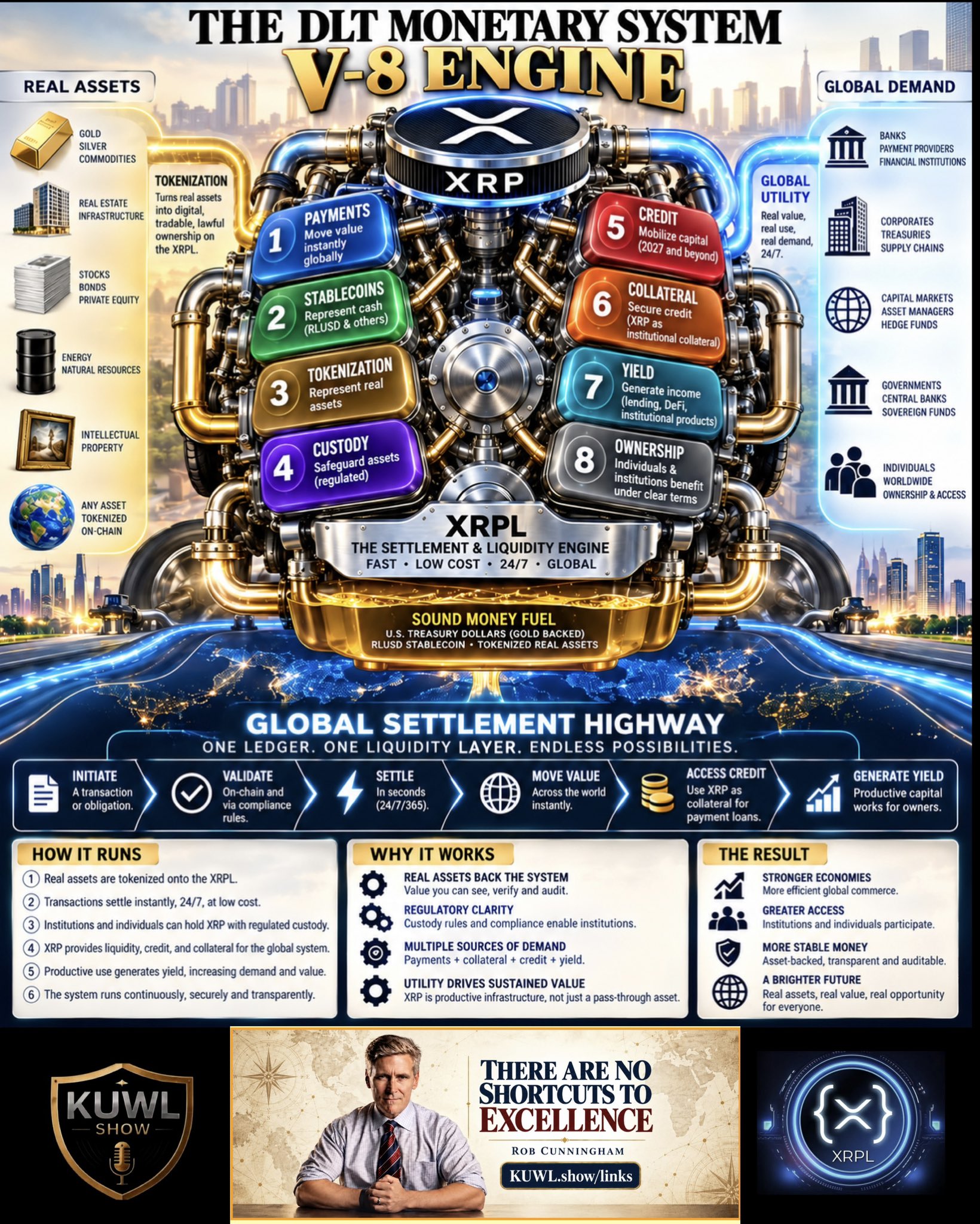
THE XRP STORY IS BECOMING MUCH BIGGER
🚦“Ladies & Gentlemen, Start Your Engines!” 🏁
See what is converging?
Not rumor.
Not one announcement.
Architecture.
For years, XRP was understood primarily through one job:
MOVE VALUE. FAST. GLOBALLY.
Now add four more:
OWN. CUSTODY. COLLATERALIZE. PRODUCE.
1. XRP → CREDIT
Ripple President Monica Long has described institutional credit as a major XRP use case, with credit activity targeting 2027.
That changes the economic equation.
XRP isn’t limited to moving liquidity. It can become part of the infrastructure that secures liquidity.
Payments move capital.
Credit mobilizes capital.
Collateral secures credit.
2. XRP → REGULATED CUSTODY
Now Washington is building another piece.
The SEC has proposed “Adviser and Regulated Fund Custody Rules; Crypto Custody Rules” - 234 pages addressing custody within regulated financial structures.
Here’s the critical distinction:
CUSTODY ≠ OWNERSHIP.
You can own an asset while an authorized institution safeguards it under defined contractual terms.
Think of the emerging model as:
PRIVATE OWNERSHIP + REGULATED CUSTODY + PRODUCTIVE UTILITY.
3. XRP → PRODUCTIVE TREASURY ASSET
Now look at Evernorth.
Its strategy isn’t simply:
BUY XRP. HOLD XRP. WAIT.
Its three stated pillars are:
1 ACCUMULATE XRP
2 INTERNATIONAL EXPANSION
3 DIVERSIFIED YIELD GENERATION
The objective is to increase XRP per share and expand XRP’s utility.
That’s important.
The model isn’t merely own the asset.
It’s:
OWN IT → SAFEGUARD IT → DEPLOY IT → PRODUCE WITH IT
4. NOW CONNECT THE ENGINE
This is where the architecture becomes easy to see:
OWNERSHIP → Who owns it?
CUSTODY → Who safeguards it?
PAYMENTS → How does value move?
SETTLEMENT → When is payment final?
CREDIT → How does capital get mobilized?
COLLATERAL → What secures that credit?
YIELD → How can productive deployment generate return?
These aren’t competing functions.
They are parts of the same financial engine.
And that changes the XRP question.
Stop asking only:
“How many XRP does a payment use?”
Start asking:
“How much XRP must be owned, accumulated, safeguarded and productively deployed to operate a global 24/7 financial system?”
That’s a fundamentally different supply-and-demand question.
An XRP briefly passing through a transaction performs one job.
An XRP held in custody, committed as collateral, deployed into authorized lending or otherwise put to productive use can perform another.
AND THE INDIVIDUAL DOESN’T DISAPPEAR.
Neither does private ownership.
Individuals can own XRP directly or through appropriate legal structures while institutional custodians safeguard assets and contractual arrangements define whether - and how - those assets can be productively deployed.
The terms matter.
The contract matters.
Ownership matters.
Custody itself doesn’t create yield.
Productive deployment does.
And the governing agreement determines who receives the economic benefit.
Now ZOOM out:
PRIVATE OWNERSHIP
↓
REGULATED CUSTODY
↓
PRODUCTIVE DEPLOYMENT
↓
CREDIT
↓
COLLATERAL
↓
GLOBAL SETTLEMENT
↓
MONETARY INFRASTRUCTURE
The timing deserves attention.
Evernorth is explicitly pursuing XRP accumulation, international expansion and diversified yield generation while the federal government is simultaneously developing proposed crypto-custody rules and Ripple is advancing institutional credit infrastructure.
OWNERSHIP → CUSTODY → PRODUCTIVITY → CREDIT → COLLATERAL → SETTLEMENT.
XRP originally answered:
“How can value move?”
The next chapter asks a much bigger question:
“How can value WORK?”
OWN IT
SAFEGUARD IT
PUT IT TO WORK
MOVE VALUE
SECURE VALUE
CREATE VALUE
XRP is becoming much more than a story about moving money.
It’s a story about the infrastructure underneath ownership, liquidity, credit, collateral and global capital itself.
@XRPLF @Interledger @Ripple @evernorthxrp @USTreasury @CFTC @SECGov @X


Ron Calhoun retweeted

Being a Protector means preparing before something goes wrong.
USCCA membership helps give you support, answers and added peace of mind when it matters most.
See more real USCCA member stories 👉 uscca.co/rY3B

Ron Calhoun retweeted
BREAKING🚨🚨🚨 The SEC’s 682-page crypto custody proposal is headed to the Federal Register.
It covers adviser self-custody, state trust custodians and tokenized-fund reporting.
The institutional crypto rulebook is getting REAL.
Who sees where this is heading? I DO!

Ron Calhoun retweeted

Here's what's been happening at GOA.
The Solicitor General told Congress that the DOJ will not appeal GOA’s NFA victory, the ATF admitted its registry has over 1.4 billion records, and the gun control industry launched an assault on GunTubers.
Watch our recap to catch up.
Ron Calhoun retweeted

SHARIA LAW:
Ban it NOW.
Prosecute it NOW.
Deport it NOW.
Cease all immigration of it NOW.
OR AMERICA WILL NEVER BE GREAT AGAIN . . .
and you’ll regret it FOREVER!🙏🇺🇸
HOW DO YOU WANT TO BE REMEMBERED?
As the Admin that brought peace to the Middle East while you allowed this “cancer” to metastasize and kill us at home? WOW!
You do realize God is using our enemies, Islam and Sharia Law, to judge us so we will repent and return to Him, right?🙏🇺🇸
.@POTUS
.@realDonaldTrump
.@JDVance
.@SpeakerJohnson
.@Franklin_Graham


Ron Calhoun retweeted

Great, when should we expect you to empty your offices, close your doors and turn yourself in??? 🤡 – at Weatherford, TX

Licensees who traffic guns to cartels will be prosecuted. "When we crush the criminal element and support lawful commerce… we stand together." — @ATFDirectorRC. Full interview: youtu.be/67nEoz0oVLk?t=6637