

Rogue designs satellite vehicles and subsystems to provide on-orbit services to satellite operators both now and well into the future.
Gilford, NH
Joined July 2020
- Tweets381
- Following139
- Followers1K
- Likes172
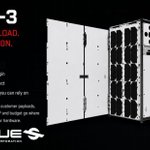






OTP-3 is a proven, affordable path to orbit, built around your hardware: usable volume on a known 16U layout, real mass margin, standard power/interfaces, and a clean data path.

The mission's SWaP and budget go where they matter most…your payload, turning capex or grant dollars into on-orbit validation, fast.
Payload headed for SSO on a Q4 2027 window? Let's see if OTP-3 is your ride: rogue.space/contact/

Rogue is moving ahead w/ OTP‑3, the next step in our on‑orbit operations roadmap.
OTP‑3 builds on what we’ve already flown, extending our autonomy & on‑orbit compute stack into more realistic operational conditions & building the ecosystem for Orbot, OrBlock, & Waypoint.

OTP-3 also offers hosted hardware + software payload opportunities. If you’re building something that could benefit from Rogue’s core infrastructure, or need a ride to space, let’s talk: rogue.space/contact/
Running our autonomy stack on the Scalable Compute Platform (SCP) on OTP‑2, we directed the satellite’s pointing behavior directly from the compute module instead of the traditional flight‑computer‑only workflow. Give the intel layer more authority & the mission profile changes.

As fleets & constellations grow, operators won’t be able to keep up w/ the decision rate. You either scale headcount or change how satellites operate. SCP shifts decisions on orbit: eval conditions, decide where to point, & execute in same window — faster responses, less manual.
Net effect: more opportunities captured before the window closes, with fewer humans in the loop. Make the most out of every pass. Learn more about SCP and onboard autonomy: rogue.space/contact/
“Space superiority is our prime imperative.” — Gen. Chance Saltzman. You don’t get there at the speed of a radio round-trip from the ground.

With SCP, the spacecraft keeps executing through degraded or denied comms: it works the mission, flags what matters, and acts on its own authority until the next window opens. In a contested environment, that’s an asset the adversary can’t switch off by killing your link.
“AI on orbit” is a feature. A satellite that scores its own image and re-captures before the next pass is a capability — and on OTP-2 we’ve flown the planning that makes it real.

One operator setting intent across the fleet beats a room of people hand-tasking it. Scale the constellation, not the headcount.
Contested comms? The decision belongs on orbit, not on the ground at light-delay. SCP keeps the mission running when the link doesn’t. rogue.space/scp
Rogue Space Systems has been selected by @NASA's Space Technology Mission Directorate under its 2025 ACO; a strong third‑party validation of our payload‑centric approach to in‑space logistics.
NASA release: nasa.gov/news-release/nasa-i…
#OnOrbitServicing #InSpaceLogistics #SpaceTech

The launch bottleneck is real, and it's brutal. Our answer is to move payloads, not platforms — upgrade, adapt, and extend satellites already on orbit instead of launching a new one every time the mission changes.
Rogue is built for this moment and accelerating fast. This collaboration helps mature Orbot, reduce program risk, and position us to scale commercial and government adoption of in‑space servicing. We’re just getting started.
It's time to Go Rogue. rogue.space/

A lot of programs still treat on‑orbit autonomy as a science experiment. We ran the experiment (in orbit, in public) and now you can spec it into a real mission.

On OTP‑2, our Scalable Compute Platform (SCP) takes a high‑level tasking goal, plans the imaging itself, and executes within‑pass commanding with an LLM in the loop. The spacecraft works out the “how” instead of waiting for a ground script.
This is a satellite that fills its own gaps between contacts. Fewer ground touches to budget, a mission that keeps producing when you can’t reach it — the difference between an asset that reports and one that acts. Want this on your next bird? Talk to us: rogue.space