

Economia UPF • Dret UOC • MSc #Competition & #MarketRegulation #Energy #Telecoms #Digital @bse_barcelona • @InstitutOstrom • #EvidenceBasedPolicy • #RStats
Restaurant més proper-BCN-MAD
Joined July 2010
- Tweets45.4K
- Following2.2K
- Followers5.6K
- Likes45.9K


Pinned Tweet
🔌⚡️Arran de l’oposició a línies d’alta tensió perquè ens arribi electricitat provinent d’Aragó, sumada a la creixent oposició a la implantació de parcs d’energia renovable a Catalunya, crec que és bon moment per posar dades a un problema pel qual se’ns va acabant el temps.👇

Els ecologistes alerten d'una "invasió" de línies d'alta tensió entre Catalunya i l'Aragó. S'afegeixen als col·lectius que han presentat al·legacions a la línia MAT projectada per Forestalia
ccma.cat/catradio/catalunya-…

Roger Medina 🌐 retweeted

"Que un economista nomenat pel PP rebi ara el suport del PSOE és una bona notícia per a la qualitat institucional"
✏️ @RogerMedina_
elmon.cat/moneconomia/opinio…

Roger Medina 🌐 retweeted

🔵 OPINIÓ | 'Un espanyol al capdavant de l’euro', per @RogerMedina_
elmon.cat/moneconomia/opinio…
Poden, si us plau, tots els partits polítics deixar de fer cartells amb IA basats en el GTA VI?
3
257
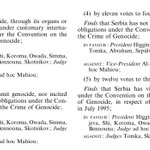
És la primera vegada a la història que el Tribunal Internacional de Justícia condemna un estat per ser responsable directe d'un genocidi.
En el cas de Sèrbia va considerar que hi va haver genocidi a Srebrenica (§297), però que Sèrbia no en va ser responsable directe, només que va incomplir les seves obligacions de prevenir-lo i castigar-lo.


Acaba de fer-se pública la sentència del Tribunal Internacional de Justícia en el cas de Myanmar i els rohingyes.
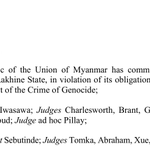
Per 9 a 6, el Tribunal Internacional de Justícia ha resolt que Myanmar va cometre un genocidi.
"The Republic of the Union of Myanmar has committed genocide against the Rohingya group in northern Rakhine State, in violation of its obligations under the Convention on the Prevention and Punishment of the Crime of Genocide".

PRESS RELEASE: The #ICJ today delivered its Judgment in the case concerning Application of the Convention on the Prevention and Punishment of the Crime of Genocide (The #Gambia v. #Myanmar: 11 States intervening).
Read more: go.icj-cij.org/4zoBITX

Roger Medina 🌐 retweeted

🚥 Hem avaluat 15 programes electorals del #29N amb les nostres 20 recomanacions en habitatge, treball, capital humà, creixement, fiscalitat, administració i energia.
Encapçalen la classificació @democracia21_ (+12), @ppopular i @upn_navarra (+11) i @JuntsXCat (+10).
A la cua hi ha @Frente_Amplio_ i @PODEMOS (−5).
* L'Institut Ostrom no dona suport a cap partit polític.
Informe complet:
institutostrom.org/laborator…

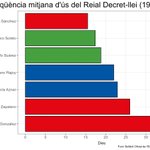
Un total de 209 Reials Decrets-llei en poc més de 100 mesos de govern. I amb els tres anys amb més RDLs durant el seu mandat: 39 el 2020, 39 el 2026 (provisionals) i 32 el 2021. Sense precedents des de l'entrada en vigor de la Constitució.
Una mitjana d'un reial decret llei cada menys de 15 dies. Pura extraordinària i urgent necessitat ex art. 86 CE.


Sentència del Tribunal Constitucional 149/2023, fonament jurídic 4 B) b):
“Con relación a la prohibición constitucional de confiscatoriedad del art. 31.1 CE, entendida en su sentido tradicional, «obliga a no agotar la riqueza imponible –sustrato, base o exigencia de toda imposición– so pretexto del deber de contribuir, lo que tendría lugar si mediante la aplicación de las diversas figuras tributarias vigentes se llegara a privar al sujeto pasivo de sus rentas y propiedades, con lo que además se estaría desconociendo, por la vía fiscal indirecta, la garantía prevista en el art. 33.1 de la Constitución [el derecho a la propiedad privada]» [SSTC 150/1990, FJ 9; 14/1998, de 22 de enero, FJ 11 B), y 233/1999, de 21 de diciembre, FJ 23, y AATC 71/2008, FJ 6; 120/2008, de 6 de mayo, FJ 1; 342/2008, de 28 de octubre, FJ 1, y 69/2018, de 20 de junio, FJ 3 c)].
Ello no obstante, ampliado su contenido en la STC 26/2017, se establece que «aunque el art. 31.1 CE haya referido el límite de la confiscatoriedad al ‘sistema tributario’, no hay que descuidar que también exige que dicho efecto no se produzca ‘en ningún caso’, lo que permite considerar que todo tributo que agotase la riqueza imponible so pretexto del deber de contribuir al sostenimiento de los gastos públicos (en sentido parecido, STC 150/1990, FJ 9) o que sometiese a gravamen una riqueza inexistente en contra del principio de capacidad económica, estaría incurriendo en un resultado obviamente confiscatorio que incidiría negativamente en aquella prohibición constitucional (art. 31.1 CE)» [SSTC 26/2017, FJ 2, 126/2019, FJ 4, y 182/2021, FJ 3 c)].”


Els italians amb la Màfia:

🔴 ÚLTIMA HORA | La justicia italiana interviene el banco digital Revolut por sospechas de blanqueo y de operaciones de clanes mafiosos social.elpais.com/tdf3b

2
637
Roger Medina 🌐 retweeted

i want to bring to the attention of people outside spain what i think is a pretty sad hijacking of a public institution, one that should serve everyone, to favour the party in government.
the CIS (centro de investigaciones sociológicas, or centre for sociological research) is spain's public polling institute. it goes back to 1963, when its predecessor was founded, and it took its current name in 1977. its president is appointed and removed by the government, but by law it must act with "objectivity and neutrality". this institution is a big provider of public goods: besides its flagship product (the monthly political barometer), it runs dozens of surveys a year on things few private firms would pay to ask about, from taxes and inequality to sexual health or love and relationships, and it makes the microdata freely available. it has resources no private pollster has, and researchers and journalists (me included) use its data all the time.
in june 2018, a few weeks after pedro sánchez became prime minister, his government appointed josé félix tezanos as president of the CIS. tezanos is a sociology professor and has been a member of the socialist party (PSOE), the party that leads the government, since 1973. when he was appointed he sat on the party's national executive (its top leadership body) as head of research and policy programmes, which put him in charge of the party's election manifestos (he left that post about ten days later, after criticism from the opposition). since then, the CIS's vote estimates have leaned systematically towards the socialists.
one can show this with a very simple exercise. for each general election, wikipedia compiles the results of every published opinion poll (for the 2026 election, they are here: en.wikipedia.org/wiki/Opinio…). using those tables, for every CIS vote estimate since 1997 i take the PSOE lead over the centre-right people's party (PP) and subtract the average lead in the private polls whose fieldwork ended within 21 days of the CIS's. i leave out polls commissioned by the parties themselves and the re-estimates that other analysts make with the CIS's own raw data. each firm counts once, even if it published several polls in the window (in that case, i take the average of its polls). from 1997 to 2018 the CIS was in line with everyone else: on average, a difference of about zero (+0.1 points). but since tezanos was appointed, the CIS has given the PSOE a lead 8.4 points larger than the average of private pollsters. in 91% of its estimates it gives the PSOE a bigger lead than every single private pollster in its window.
if i showed this chart at an economics seminar, i think most people would find it pretty convincing evidence that something changed at the CIS in 2018. but let's go through some potential objections. suppose private pollsters have drifted to the right since 2018 (it would be odd for them to jump so sharply just after tezanos was appointed, but for the sake of argument let's treat it as a real possibility). in that case, a CIS that stayed put would look more and more pro-PSOE simply because everyone else moved. or the mirror image: everyone, the CIS included, leaned to the right before 2018, and the CIS was the one that fixed it after that.
the data suggest this is not what happened. first, the gap holds no matter who you compare the CIS with. against 40dB alone, el país's pollster (el país being a centre-left newspaper), it is 7 points since march 2019, compared with 9.2 with all firms on the same dates. dropping five firms that mostly work for right-leaning outlets (sociométrica for el español, nc report for la razón, data10 for okdiario, target point for el debate and hamalgama métrica for vozpópuli), it is 7.9. second, if private pollsters had drifted right, then their final polls would miss towards the PP more often after 2018. across the 90 general, regional and european elections since 2008 for which the CIS ran a pre-election survey, that is not what we see. private final polls missed the PSOE-PP lead by 0.1 points in the PP's favour on average before 2018 and by 0.4 points in the PSOE's favour after. in both periods they erred towards the PP about half the time. the CIS's average miss, meanwhile, went from 0.8 before tezanos to 3.5 points in the PSOE's favour after. this also rules out the mirror story. before 2018 there was no right-wing bias to fix, since private polls were mostly on target, and after 2018 it is the CIS that ends up further from the results.
needless to say, the result does not depend on the time window used to pick the private polls the CIS is compared with. with 7, 15 or 30 days, or comparing with the polls of the same calendar month, the gap since 2018 stays between 8.2 and 8.4 points, and the one before 2018 stays at about zero.
so what changed? kiko llaneras (@kikollan) has looked at this in depth. since tezanos arrived, the CIS has overestimated the left in practically every election (general, regional and european). even in the two general elections where "it did well" (april 2019 and 2023), its only merit was that it overestimated the left when everyone else underestimated it (and it still missed, just in the other direction). for instance, in 2023 the PSOE and sumar (another left-wing party) won 152 seats. the polling average gave them 142, and the CIS gave them 171. that fits what i find. a large part of the bias seems to come straight from the sample, which overrepresents PSOE voters.
for example, take the CIS's huge pre-election survey for the 29 november election (45,000 interviews). among respondents who report how they voted in 2023, 41.8% say they voted PSOE, when the PSOE actually got 31.7% of the vote. PP voters, meanwhile, make up 23.6% of the sample, compared with an actual 33.1%. in other words, PSOE voters are overrepresented by 10 percentage points, and PP voters underrepresented by almost as much. until 2018 the CIS corrected this kind of imbalance in its estimate by weighting the data according to what respondents say they voted last time (you can check its own methodological notes here: cis.es/documents/d/cis/es320…). in september 2018, less than three months after tezanos arrived, it stopped doing that (compare the note on the vote estimate in july, cis.es/documents/d/cis/es321…, with the one in september, cis.es/documents/d/cis/es322…). i am not a political scientist, and i don't know what tezanos's intentions are, or whether this even helps the PSOE win votes. but missing in the same direction in almost every election for eight years looks like a deliberate choice.
i hope this reaches as many people as possible. the CIS does a lot of valuable work and it should belong to all spaniards, whoever they vote for. running a public institution this way should not be acceptable, and watching its credibility erode is genuinely sad, especially because that gives people a cheap excuse to distrust every other statistical body whose work depends on being seen as independent and reliable.

Aquesta anàlisi no se centra en els efectes de l'SMI sobre l'ocupació. El seu objectiu és posar de manifest els eventuals problemes de fer servir la moda com a eina d'estadística descriptiva. Per tant, hi ha una assumpció implícita de ceteris paribus en l'anàlisi. En cap cas és un post a favor o en contra d'augmentar l'SMI.
I al final del post ja dic que "aquesta senzilla explicació és neutral i independent de les consideracions pròpies que tingui cadascú sobre la necessitat d'augmentar l'SMI o dels seus eventuals efectes sobre l'ocupació i altres variables econòmiques."
En tot cas, fins i tot incorporant els eventuals efectes sobre l'ocupació (menor creació de llocs de treball o destrucció d'ocupació existent), això no invalida el mecanisme estadístic que descric.
Per posar-ho en context, segons l'AIReF, el percentatge d'individus que percebien l'SMI va passar del 3,5% el 2018 al 7,4% el 2023, mentre que l'elasticitat estimada de l'ocupació respecte a les variacions de l'SMI se situava entre -0,07 i -0,05, equivalent a una reducció en la creació d'ocupació d'entre 55.000 i 85.000 afiliats.
Per tant, són efectes que cal tenir en compte en una anàlisi global, però que no desvirtuen l'exemple estadístic plantejat.

Ara falta per mencionar que segurament poblacional passi de deu treballadors a set per la destrucció de treball.
O d' altra forma la societat que tindria 13 treballadors es queda aturada en deu per la pujada de smi
2
389
És molt necessari tenir coneixements d'estadística bàsica, i és un bon exemple dels problemes de fer servir la moda com a eina d'estadística descriptiva.
Això és un efecte estadístic derivat del fort augment del Salari Mínim Interprofessional (SMI) des de l'any 2018, que ha estat del 61% en termes nominals.
Un exemple senzill per entendre-ho millor:
Imaginem que tenim una petita economia amb 10 treballadors i els seus respectius salaris:
• 2 treballadors que cobren 1.000€
• 3 treballadors que cobren 1.200€.
• 4 treballadors que cobren 1.400€.
• 1 treballador que cobra 2.000€.
El salari modal, és a dir, el més freqüent, és de 1.400€, que és el que cobren 4 dels 10 treballadors de la nostra economia. D'altra banda, el salari mitjà és de 1.320€.
El Govern puja l'SMI de 1.000€ a 1.300€. Això obliga, per imperatiu legal, a apujar els salaris per sota d'aquest llindar. El resultat és que la nostra petita economia de 10 treballadors ara té la següent distribució salarial:
• 5 treballadors que cobren 1.300€.
• 4 treballadors que cobren 1.400€.
• 1 treballador que cobra 2.000€.
Ara el salari modal és de 1.300€, que és més baix que en l'escenari anterior, quan era de 1.400€. D'altra banda, el salari mitjà és ara de 1.410€
Quan s’apuja fortament l’SMI, molta gent que estava per sota o prop del mínim passa a concentrar-se en un mateix nivell salarial: el nou SMI.
Això agrupa la distribució de salaris a la part baixa i fa que el valor més freqüent sigui ara aquest nou mínim, que és el que ha anat succeïnt a Espanya. L'any 2018, molta de la gent que avui cobra l'SMI es situava per sota del salari modal.
Tot i que en realitat ningú cobra menys, i de fet el salari mitjà hem vist que augmenta, des d'un punt de vista merament estadístic el salari modal baixa perquè la moda es desplaça cap al grup més nombrós, no necessàriament perquè els salaris hagin empitjorat. En termes nominals, el salari mitjà ha augmentat un 16,8% entre 2018 i 2023.
Per descomptat, aquesta senzilla explicació és neutral i independent de les consideracions pròpies que tingui cadascú sobre la necessitat d'augmentar l'SMI o dels seus eventuals efectes sobre l'ocupació i altres variables econòmiques.

🔴 @FigaredoJoseM deja KO al gobierno de Sánchez:
"Desde que estos señores gobiernan el salario más frecuente en España ha pasado de 17.000€ a 16.000€".
"Hace falta una bajada masiva de impuestos, especialmente en la parte de la renta y en los tramos más bajos".