

GEN Ukraine Ecovillage network 🇺🇦
Ukraine
Joined April 2013
- Tweets6.3K
- Following1.8K
- Followers2.1K
- Likes2.7K




Every piece of advice on happy ecovillage living, summed up 🌾
Rise with the roosters. If there are no roosters, get some. Your neighbours will start getting up too.
Eat what you grow. If you haven’t grown anything, eat what you buy. But keep talking about permaculture.
Walk the dog every day. Even if you don’t have a dog.
Work remotely for someone who pays well. Because where you live now, you’re mostly the one paying.
Be seen at community workdays. If people only see you at shared meals, they notice that too.
Find like-minded people who actually do things. No need to look for those who only think about things. They’ll turn up for the discussion.
Reach agreements with your neighbours. If you think you’ve already agreed, write it down and ask again. You may have agreed to completely different things.
Live in harmony with nature. Remember: slugs live in harmony with nature too. And with your seedlings.
Believe in your community. If you don’t, call a circle. Talk about why you don’t believe. Schedule the next circle.
Repeat until you believe. 🤗😇
#Ecovillage #SimpleLiving

A little autumn garden therapy 🍂
Overall, I’m pleased.
First of all, I’m grateful to my body for managing the physical work. There’s a lot of it. Sometimes it feels like too much. The pace gets too high.
I walk the length of the plot, breathing until my breath and heartbeat settle and the pounding in my head stops. Then I carry on. Carrying, cutting, sawing, harvesting.
The remaining dry days give me a chance to switch from desk work to something more physical.
I’m still working on our home compost toilet project. I’ll write about that separately. Much of the time goes into preparation. Clearing the site, mostly.
It turned out that the spot was occupied by old metal mesh that had quietly grown into the ground, along with a small thicket of elderberry. Clearing it all took several sessions. From the outside, it had looked almost ready, as though it only needed a little tidying.
Now we have half a basin of charcoal to use as biochar, and a cleared base for the compost toilet.
There were also plenty of branches left from last year’s pruning. They have now become firewood. And a little sawdust, also for the toilet.
Every evening I think: that’s it, tomorrow I’ll be as stiff as those logs. But somehow I’m holding up. A little insomnia, but otherwise I seem to be doing okay.
Someone once wrote in the comments, “You’re still too young.” It made me think. Perhaps things aren’t quite as bad as they sometimes feel. I can still do certain things without outside help. Perhaps some of the recent difficulties were seasonal flare-ups of my conditions.
Social media seems to be having its own flare-ups lately. So I’m glad I can step away for a while. Stay out of the debates and keep my attention on tasks where I can have at least a little influence.
Let’s keep going.
#GardenTherapy #SimpleLiving


Thank you, Artizen 🌾
We are from Ukraine. We do not live in a world of pink ponies. So our story with Artizen is a story of gratitude, and another experience to learn from.
Yes, we had expectations too. We were counting on funding that may now only partly arrive. Behind those expectations were specific projects and people in our ecovillages.
But I want to thank the Artizen team. Even in this difficult situation, they made a small payout to support one of our projects in Ukraine. That gesture means a great deal to us. We remain in dialogue with Venus, and we may receive another portion of the funding. We do not yet know.
Our path to Artizen began with another difficult experience.
A scammer had tricked us into transferring funds from our wallets. These were remaining funds from earlier Octant rounds. When we shared what had happened in a community chat, someone suggested an Artizen round as a possible source of support.
We joined, presented our projects, and mobilised our ecovillage network to vote. We supported other projects too. We invested time and trust, hoping this would help us continue our work.
But our Artizen story cannot be reduced to the amount we expected to receive.
Through the platform, I attended Artizen Village during Value of the Commons. I met Liron, some of the team, and people building their own projects. We shared our work and listened to one another. I presented our Ukrainian communities and our experience of working during the war.
Those encounters happened. That exchange happened. They remain with us, even as the financial outcome differs from what we expected.
Regarding René, I did feel he was promising too much. But from what I saw and heard, I do not perceive him as someone who set out to deceive everyone. My impression is that the scale of the promises eventually exceeded the capacity to fulfil them.
That is my personal assessment. It does not explain every financial circumstance or erase the consequences for those who depended on the funding. At the same time, I feel for him as a person who has suffered.
I would like to stay connected with people behind platforms that could not continue. There are already many such stories in ReFi and Web3. I speak with these people and see their efforts to build a different world. Those efforts do not always succeed. Sometimes they leave losses, disappointment, and unfulfilled promises. But I do not want to erase everything that happened between us.
For us, there is another dimension to this story.
We work on the land, in specific places. The money invested here leaves tangible consequences: planted trees, shared spaces, infrastructure built by hand, and communities where people can live and support one another.
Especially near the frontline, where that support is badly needed.
Sometimes the support is financial. Sometimes it brings meaning and visibility.
When we place dots on your ReFi and Web3 maps, those dots are in Ukraine. Behind them are people planting trees during a war, restoring land, recording ecological outcomes, and experimenting with tokenising impact. They are working towards a future that is far from guaranteed.
Each platform gives us some hope that this work matters to someone. That it is seen. That it may continue.
I know a digital record cannot protect an ecovillage from war. But it can preserve evidence that we were here and did something.
Even if platforms disappear, and the war destroys what we built, some of our writing, map entries, and blockchain records may remain. Traces of people who tried to restore life.
Of course, I hope more than a digital trace survives. I hope the trees, the spaces, and the people remain.
So thank you, Artizen. For the support we received. For the connections. For the opportunity to speak about Ukraine. And for an experience we now have to carry into our work.


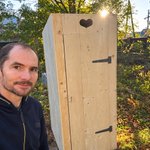
A composting toilet as a gift 🌾
They say it’s the season, and these are selling fast. The makers can barely keep up with orders.
Solidly built, nailed together from dry timber. Just UAH 6,000, delivery included. (Let me know what they cost where you live.)
I’d wanted one for a long time. Somehow, I never got around to it. Then my family gave me one as a gift.
There are already quite a few toilets in ecovillages named in my honour. Because I used to visit and volunteer to empty them.
Ah, those were the days.
I think people seriously underestimate dry composting toilets. And we’re entering interesting times. Water scarcity included. Using drinking water to flush away something that could be composted has always seemed a little strange to me.
A friend of mine moves his toilet from one pit to another. He closes one and puts the cabin over the next.
But there’s a distinction here. A hole in the ground and a composting toilet aren’t quite the same thing. Sawdust helps, but it doesn’t make the contents safe compost on its own. That takes the right conditions and time. I wouldn’t rush to dig it out and add it to the garden compost. And the location needs to be chosen carefully to avoid contaminating wells and groundwater.
Better to collect urine and solids separately.
Bogdan Popov is our go-to expert on these things. You can use interchangeable containers. While the contents of one are composting, the other is filling up.
I always miss having a toilet like this on my plot. You’re working outside, and you don’t have to go into the house every time.
I used to have one. But when the shed was dismantled, the toilet went with it. The builders promised to put together a new one, but never did.
An outdoor toilet is useful.
But I won’t try to convince anyone. People in villages often want everything to be just like it is in the city.
Well, now I’ve been given one. And I’m pleased. It still needs a protective finish and installation, of course. As long as my health allows.
One practical tip: a foam seat. Even in winter, it doesn’t feel cold. You sit down, and it’s comfortable.
How do you feel about having an outdoor composting toilet?
#CompostingToilet

The Carrier Bag Theory 🛍️
What if an ordinary bag for carrying food tells us as much about human history as all those stories of wars and victories?
At the Value of Commons gathering, I came across a small book: Ursula K. Le Guin’s The Carrier Bag Theory of Fiction. It was in German, so I used AI to help me understand it.
Le Guin writes about our habit of telling stories through a hero, a conflict and a victory. A spear has a direction, a target and a moment of impact. It makes for a compelling story.
But people also had to gather food, carry it, store it and share it. For that, they needed a bag.
I once heard an African saying: “My food is in my neighbour’s stomach.” At first it sounded strange. Now I think of the bag: what I gather can be carried to someone else.
I grew up in a fairly militarised environment. Many stories were about achievements, victories and wars. My childhood toys, of course, included weapons.
Perhaps, during Russia’s full-scale war against Ukraine, this seems like an odd subject. We have to fight to survive. But war does not suspend daily life. People still need to bring food home, care for loved ones and help those who are struggling.
And even beyond war, I keep encountering the cult of results. My disability does not show up in the figures I put on slides. People see charts and impact metrics, but rarely how many hours I can work, how little I sometimes sleep, or how much time I spend lying down because of inflammation.
I think about our ecovillages, too. Someone cooks for everyone. Someone looks after the children or notices that a neighbour needs help. In a report, all of this may become one line: “The event took place.” Often it is not recorded at all.
What if we counted not only what got done, but what made it possible for people to do it?
At that same gathering, we organised a potato party and harvested together. I noticed that many people enjoyed it more than the discussions about the commons. Everyone did what they could. The pile of potatoes grew, people talked, and no one had to compete for a chance to speak.
Sometimes harvesting potatoes together creates more community than a heated debate in which we beat each other with words to prove we are right.
Le Guin offered the bag as another way to tell a story. I wonder whether it can also change what we notice in our communities. Is there room in our structures for someone who cannot work at full capacity today? Do we see those who support others but barely appear in our reports?
Swords and victories are easy to remember. It takes more effort to see the people who grew the food, saved the seeds, fed their neighbours and cared for those who could not care for themselves.
Without them, there would be no next chapter.


On financial support for ecovillages 🌾
In an experiment with rats, some survived only minutes in water. Others swam for nearly three days. Researchers also found that rats briefly immersed and released could survive much longer in later trials.
I think about this when we look for ways to support ecovillages.
Ukraine has no municipal programmes to develop them. No decentralised funds ready to finance a new shared space. Even the idea of cooperating to live together is barely there.
What we have instead is the dream of a little clay house and a garden full of cherry trees. Everyone wants their own plot. Their own island, far from this sick world.
We are damn irrational when we design ecovillages. Everyone wants a homestead, sometimes a whole street, with no plan for what happens in five or ten years when the children start school.
But we coordinate a network of places that existed before us. We support what is already there, with all its contradictions.
During the war, the question is not how resilient their local economies should be. It is how long these communities can hold on as things around them collapse.
Financial irrigation.
Sometimes people need very little to stay afloat. Money to plant trees. Firewood for a shared space. A solar power system.
Yesterday I learned that several more active people had been mobilised. Several families had lost their homes near the front. Others are preparing for a winter without electricity, mobile signal, fuel, deliveries, internet or even a bus to the district centre.
A 1990s survivalist’s dream, in all its glory.
Yet they are still with us. We are waiting for another truck from Denmark with essential supplies and around 100 bicycles. So that, if necessary, people can ride to an evacuation point.
Ecovillages are disappearing, along with towns, villages and the infrastructure around them. People move west. Some radically change their lives or erase their alternative past.
With them, we lose stories, institutional memory and the history of connections.
We record activities in a blockchain registry. We have created community work pools that reward people for documenting what they do. We publish reports and monthly digests through European and international channels.
Even if our network disappears, there should be a record of how it happened, why, and how long we held on.
We seek funding for ecological and community work so this movement can continue.
I do not believe the war will end in the next three to five years. We are not one happy team without conflict or burnout, either.
We are swimming in deep water, with no solid ground in sight. No compass. Only faint points of reference, often misleading ones.
Sometimes it seems everything is going well. Sometimes I think we do this for whoever comes after us. So they can study our history and understand why things happened as they did.
Thank you to the visionaries and donors who find a reason to support us. To the activists who still find the strength to continue. And to my colleagues who put up with us.
#Ecovillages #CommunitySupport

Today, GEN Ukraine turns eight 🌾
I was moved to tears.
We planned a short celebratory call but ended up talking for almost three hours.
Around 37 connections were online, but more people were present. Some joined from their ecovillages, gardens, workplaces, abroad, or even from a military unit during an air-raid alert.
People I had not seen for years joined us. Each shared their story: how they found GEN Ukraine, whom they met, what they learned, and which projects grew from those encounters.
We remembered gatherings and courses, journeys through Ukrainian and ecovillages, the Green Road, support for displaced people, bicycle workshops, solar stations, festivals, and educational programmes.
But the longer I listened, the clearer it became: the main outcome of these eight years is not the projects.
It is the people — and the connections between them.
Some met through our network and began building communities. Others found partners, joined exchanges, or created projects. Some hosted displaced families or distributed bicycles, laptops, greenhouses, and solar equipment. Some stepped away for years and later returned.
Today, some live abroad. Some serve in the military. Others continue building ecovillages and community spaces in Ukraine during the war.
But the connections remain.
Reports can count funding, equipment, events, and participants. But it is much harder to measure the encounters that changed lives, the communities that grew from our gatherings, or the people who still call one another years later and create something together.
GEN Ukraine has never been homogeneous. It brings together many kinds of ecovillages, communities, educational spaces, and rural initiatives.
We are very different. We have experienced conflicts, hurt, and periods of distance. The war has exposed those differences even more sharply.
And yet the network did not fall apart.
It proved larger than one organisation, a few coordinators, grants, or projects. It lives horizontally — through visits, collective work, friendships, mutual support, and initiatives that emerge without our direct involvement.
One thought came up several times: an ecovillage is not only about ecological buildings, solar panels, or living on the land.
Above all, it is about the ecology of relationships — how we communicate, make decisions, move through conflict, and relate to the outside world.
I often travel to international gatherings and try to be the voice of our communities. Today, I felt again exactly whom I represent.
People who have spent years building ecovillages and community spaces. Who plant trees, welcome others, educate children, create workshops, regenerate land, and continue doing all of this during the war.
People who do not merely talk about another way of living, but try to create it every day.
I am especially grateful to everyone who joined and shared their story.
Because we are @gen_ukraine.
Together, We Are Strong.
Global Ecovillage Network Ukraine

Data is not reality itself. It is only the part of reality that the system has learned to see. 🌾
Our network includes more than 60 ecovillages and community spaces. And almost everywhere, resources are scarce.
One community needs to repair a roof. Another needs additional solar panels, better insulation for a shared space, or tools for a community bike workshop.
To support this work, we create shared funding pools. For now, the mechanism is very simple: a community organizes a volunteer workday, publishes a report, and receives 10 USDC.
But when we put all these reports into one table and visualized them, something more interesting than the distribution of money became visible.
Some communities report regularly and receive a significant share of the support. Others are barely represented.
At first glance, you might conclude that the first group is simply more active.
But that is not necessarily true.
Communities may organize volunteer workdays regularly without publishing reports. People may lack the time, energy, digital skills, or capacity to understand how the pool works and properly document what they have done.
So funding does not necessarily flow to those who do the most work.
It flows more easily to those whose work has become visible to the system.
And this creates an interesting systemic problem.
If rewards depend on reporting, while the ability to report depends on organizational capacity, the system may gradually reinforce communities that are already stronger.
They document more → receive more resources → increase their capacity → document even more.
Meanwhile, less organized communities can remain invisible even when a lot of real work is happening on the ground.
This is no longer only a question of funding allocation.
It is a question of institutional memory.
What does our network actually remember about the work being done?
Which actions become part of our shared history — and which disappear simply because nobody had the capacity to document them?
And what can such a simple visualization tell us about weaknesses in the capacity of our communities?
Perhaps the next round of support should go where organizational capacity is lower. Perhaps some communities need help documenting work they have already done. Or perhaps the reporting mechanism itself needs to become much simpler.
And we don’t necessarily need complex accounting systems, blockchains, or dashboards spread across three monitors to see these patterns.
Sometimes a spreadsheet, a pencil and a sheet of paper are enough. You could even visualize the distribution with stones on the ground.
Accounting preserves the memory of what happened.
But only of what was recorded.
A good system should therefore do more than show us what it can see.
It should also help us understand who — and what — remains invisible.
Thank Will Ridduck and @grassEcon


Our Summer 2026 Highlights

Summer 2026 Highlights: Regeneration, Resilience, and International Solidarity in Action
Key Highlights:
🔹 European Ecovillage Gathering 2026 (Germany)
Represented by Tatyana Chub, Maksym Zalevskyi, and Anastasiya Volkova, the delegation presented Ukraine’s experience in building resilient communities. Key sessions focused on Digital & Solarpunk Regeneration, dMRV, and Web3 applications for local impact.
🔹 International Strategy Week (Yemelyanivka)
In collaboration with Danish partners (LØS) and GEN Europe, activists evaluated 11 new ecovillage project proposals, focusing on trust, community dynamics, and non-monetary value exchange.
🔹 Cultural Peace Tours & Traveling Festivals
MaistryMy Festival: Itinerant craft event connecting 4 ecovillages live (and a 5th virtually with Ukrainians abroad).
Ukraine Peace Tour: Emotional support circles and music sessions led by Phoenix Maria across 4 eco-communities.
Bishkin Trail 2026: 4th sports and cultural event in Kharkiv region supporting local youth and sports.
🔹 Local Regeneration & Grassroots Economics
Bushanska Toloka & Prostir Lyubovi: Over 300 trees planted, active defense of the "Hora Lyskivka" reserve, and ongoing operations of the EcoHouse shelter for displaced families and veterans.
Grassroots Economics Adaptation: Integration of non-monetary exchange principles based on William O. Ruddick’s methodology.
National Recognition: Inclusion of GEN Ukraine in the official Catalogue of Pro-Climate Organizations by the Ukrainian Climate Network (UCM).
Full report:
gen-europe.org/summer-highli…
Thanks for everyone who support us!
#ecovillages

Happy Independence Day, Ukraine! 🇺🇦
We are all building our Ukraine, however grand that may sound. We build it every day through what we do.
And yes, things rarely go according to plan. Today, the price of building this country is unbearably and unjustly high.
Honor to everyone who has died. And to everyone defending Ukraine today — with weapons and without them.
And also to those defending our environment, nature, and ecosystems. This is an unequal struggle too. This resistance is often difficult and invisible. But it is also a struggle for what kind of country we will leave behind.
Ukraine is large, beautiful, and incredibly diverse. And we all carry it with us, even those who are far away.
At international gatherings, I often hear people introduce themselves through two countries: their country of origin and their country of residence.
I still name only one — Ukraine.
And I understand that today, this also comes with a price.
As a Ukrainian man, having the possibility to cross the border and represent Ukraine and our ecovillage network internationally is both a great privilege and a responsibility.
And wherever I go, I keep saying roughly the same thing:
At our level, we are doing enough.
No, we are not doing everything possible. We could do more. Better. More effectively. More productively.
We could.
And at the same time, I am deeply grateful to everyone around me. Because sometimes it feels like there is no energy left, yet the work keeps moving forward. Someone picks it up and continues what was started.
That gives me something solid to stand on.
We are a large country. We have enough people, intelligence, experience, and potential to endure. And we have partners and good friends who stand beside us.
I want future generations to be able to say one day: because of all these people, the country endured. And it became strong, prosperous, and safe.
I want people to come to Ukraine to learn, to work, and to exchange experience.
I want Ukraine to be seen not only as a country that survived a terrible war, but as a country that afterwards managed to build strong institutions, a vibrant civil society, a modern economy — and regenerate its land.
Despite everything, I believe in our potential.
No matter how much I sometimes complain that everything is falling apart, I remain an incurable Ukrainian patriot and optimist.
I believe we can build institutions that genuinely represent the interests of civil society.
And I want to believe that eventually we will build a mature, liberal, and safe society for the generations that come after us.
A society where people can think not only about survival, but about creating a flourishing, modern, technological future.
Let it be our own version. Let it not follow the script.
But one day, it will happen.
And I want our neighbours to be able to look at Ukraine and simply say:
Yes. They did it.
They endured.
And they are our friends.
Happy Independence Day, Ukraine. 🇺🇦
#UkraineIndependenceDay #Ukraine #CivilSociety #Regeneration


With Ukrainian Independence Day on Monday, we'd like to celebrate Ukraine's resilience 🇺🇦
In Ep 264, we explore how crypto & blockchain have helped Ukraine persevere: $225M in rapid donations, new humanitarian rails, stablecoin aid & more 🌐💛
🎧Listen: cryptoaltruists.com/blog/cry…
We discuss:
💸 How the crypto community mobilized over $100M for Ukraine in a matter of days, eventually reaching over $225M
⏩ Why speed, borderlessness, and transparency make crypto uniquely suited for crisis response
🏛️ How the story matured from viral donations into lasting infrastructure, including the UNHCR's blockchain-based aid delivery on Stellar
⚖️ A look at the limitations and risks, and the enduring lessons Ukraine offers the crypto-for-good movement

Everything what we do, we write in blockchain. It is our new public story...
In a war, a community can lose its people and its land almost overnight.
@RodovidMe of @gen_ukraine on why his network of Ukrainian ecovillages puts its solar, tree planting, and land regeneration onchain, so the record survives whatever comes next. 🌱
cryptoaltruists.com/blog/cry…

Should everything destroyed by war be rebuilt? 🌾
🇬🇪 This is Kekhvi, a Georgian village in South Ossetia — internationally recognized as part of Georgia.
After the 2008 war, the village was largely destroyed. Human Rights Watch documented systematic looting and burning of Georgian villages after the fighting. Satellite imagery identified 109 destroyed and 44 severely damaged buildings in Kekhvi.
Twelve years later, forest was gradually returning where the village once stood.
Ukraine will face a similar question on a much larger scale.
Destroyed villages. Mined fields. Degraded farmland. Floodplains and abandoned territories.
Do we automatically rebuild everything as it was — and return every hectare of black soil to agriculture?
Or can some territories follow a third path between abandonment and intensive cultivation: ecosystem regeneration?
I believe this could become part of Ukraine’s reconstruction model.
Some destroyed territories could host new forms of regenerative communities and ecovillages — places whose economic function includes restoring landscapes rather than simply extracting value from them.
Restoring steppes, forests, wetlands, soils and biodiversity. Retaining water. Creating ecological corridors and protected areas.
Today, digital monitoring can increasingly measure these outcomes: vegetation, soil conditions, biodiversity and carbon sequestration.
And measurable regeneration can create an economy of its own: carbon markets, biodiversity finance, payments for ecosystem services, climate funds and eventually compensation for environmental damage caused by war.
There is already a historical precedent.
After Iraq’s invasion of Kuwait, the UN established a compensation mechanism through which Iraq eventually paid $52.4 billion. Environmental damage and depletion of natural resources were recognized as a separate category, with substantial funding directed toward ecosystem restoration.
Ukraine should think in the same category.
Not only: How much will it cost to rebuild this village, farm or grain terminal?
But also: How much will it cost to restore this ecosystem?
Ukraine does not necessarily need to return every hectare to grain production simply because we have some of the world’s richest soils. Global grain markets were severely disrupted after Ukrainian ports were blocked, but they adapted through new suppliers, production and trade routes.
Ukrainian grain remains important. But global food security does not depend on cultivating every abandoned field or ravine.
Some war-damaged territories could develop a different economic specialization: the economy of regeneration.
An economy where people are paid not only for what they extract, grow and sell, but also for measurable ecological recovery.
Where, twenty years later, a degraded field has once again become steppe, wetland or forest — with biodiversity, water and a living community around it.
Perhaps this is also one possible model for rebuilding Ukraine.
And perhaps we do not need to wait until the war ends to start designing it.
#Ukraine #Reconstruction #Regeneration #EcosystemRestoration #ReFi #Ecovillages #ClimateFinance

What’s happening across our ecovillage network this summer 🌿
The MaistryMy makers’ caravan reached Kharkiv region and even connected Byshkyn with Andorra — linking our communities in Ukraine with those abroad.
Austrian musician Phoenix Maria is touring Ukraine again with healing concerts. I joke that he has become our main summer ambassador.
Children’s forest camps are happening across the network: in the Carpathians, Pokuttia, Kupelia, VeloSelo Salyntsi and other places. Forests, rivers, rafting and community life instead of another summer in front of screens.
Volunteer camps continue, while Tepla Hora runs the Kolo recovery programme. Zeleni Kruchi hosts weekly activities for veterans’ families, and several other communities offer smaller recovery practices. Soon, Tepla Hora will also host Stezhka — a creative camp for adults.
We’re also finishing the distribution of Danish bicycles to rural communities where a few kilometres can make a real difference.
Meanwhile, I barely leave home — we keep searching for resources for new projects. Some work, some don’t, and some we simply decline because our capacity has limits.
What didn’t happen? We hoped to expand biodiversity monitoring and mapping this season. We managed only a few local actions. Maybe next season.
This is what our network increasingly looks like: not one big central project, but many small grassroots processes — and an infrastructure helping people and communities find each other and make things happen.
Global Ecovillage Network Ukraine
#Ecovillages #Ukraine #Regeneration
🤖 Made with AI

A few thoughts on bicycles. Or how we solve mobility in rural ecovillages. 🚲
For us, bicycles are not primarily about transport. They are about freeing up time.
In our ecovillages, productive time—especially women’s time—is one of our most valuable resources. Women often hold together families, communities, volunteering, and new local initiatives.
Rural life means distances: 1–5 km to a shared community space, 10–12 km to school, the market, or the nearest town. Every trip takes time and money.
With support from our partners in Denmark and the Netherlands, we have distributed more than 250 bicycles, established around 10 community bike workshops, and converted dozens of bikes into e-bikes. Almost all of this was built by volunteers.
This is not just about sustainable mobility.
It is about giving people back hours of their lives.
Hours that can be spent with children, launching a retreat, organizing a workshop, supporting neighbors, or simply taking a walk in the forest.
I recently read a famous text claiming cyclists are “bad for the economy” because they buy less fuel, fewer cars, and less fast food.
Our experience suggests the opposite.
In ecovillages, a person on a bicycle is not a cost—they are an investment. Every hour saved becomes community care, local resilience, and new initiatives.
Sometimes, a bicycle doesn’t just shorten a journey. It creates the time needed to build a stronger community.
#Cycling #Ecovillages #RuralMobility #CommunityDevelopment #Regeneration #WomenLeadership


Kyiv 05.08.2026
Never stop speak about Ukraine 🇺🇦
Not only Palestyne.
#StandWithUkraine

My garden therapy looks like this. What does yours look like? 🥒🌿
For me, gardening is no longer about maximizing harvests. It’s about protecting my mental health.
I grow just a few beds of cucumbers, some blueberries, and a handful of apple trees. The harvest is modest—and that’s exactly what I want.
A large harvest also means more work: processing, preserving, storing. Right now, my life is focused on other responsibilities, and I don’t need another source of pressure.
Many friends of mine are committed to producing as much of their own food as possible, and I truly admire that. My path is different.
I practice what I call interval garden therapy.
I don’t serve the garden on a fixed schedule. I go there only when I have the time, energy, and desire. The garden adapts to my rhythm, not the other way around.
In a world filled with constant stress, information overload, and uncertainty, working with soil has become one of my ways to regain clarity and balance.
The greatest value of my garden is not measured in kilograms of vegetables. It’s measured in peace of mind.
Perhaps the hardest lesson is accepting that we don’t always need more. Sometimes we simply need enough.
How do you restore your mental balance? Do you have your own version of “garden therapy”?
#MentalHealth #Gardening #Wellbeing #Regeneration #SimpleLiving

🌱 Ukrainian Climate Network Gathering
It took us quite a while to get here as GEN Ukraine: voting, interviews, and a values alignment process. And now our ecovillage network has become part of the Ukrainian Climate Network — a community of 42 environmental organizations.
This weekend was incredibly intense. We talked about organizational development, mapping networks, cooperation, communities, technology, climate trends and the future of the environmental movement.
I found myself in a room where I was far from the most competent person — and I really enjoyed listening to colleagues with much deeper experience.
Some say the environmental movement is getting older. I disagree. I saw many young, energetic faces with ideas and ambitions. I felt among my people.
We discussed a solarpunk future, working with communities and government, resisting neocolonial approaches, entering the international arena as equals, and promoting our own Ukrainian expertise.
For me, this was a perfect continuation of the European Ecovillage Gathering: first the European context, then a deep dive back into our Ukrainian reality.
Many environmental leaders are now at the frontline, volunteering, or abroad. Climate may seem “not the priority” during the war — yet a lot is happening beneath the surface.
@gen_ukraine is part of this movement too.
Thank you to everyone who keeps this work alive — and to Tepla Hora for the warm welcome. 🌾
#ClimateAction #Ukraine #Ecovillages #GENUkraine #Solarpunk


What if we redesigned open-source wind turbines for the realities of 2026 — and wartime Ukraine? 🌬️🌱
At the GEN Gathering Expo I discovered the classic Hugh Piggott open-source wind turbine. Its complete engineering manual—with drawings, blade templates and construction guidelines—remains one of the best examples of open-source hardware for community energy. (Engineering For Change)
But it made me realize something.
The challenge today is no longer the turbine itself.
Fifteen years ago, many ecovillages had large communities, workshops and volunteers who could spend days hand-winding generators and building every component from scratch.
Most Ukrainian ecovillages don’t.
Because today we are living in wartime conditions. Many people have left, others are serving, and communities simply don’t have enough hands or time to build complex systems from zero.
Today we need modular, repairable systems that can be assembled by a small team using ready-made generators, LiFePO₄ batteries, hybrid inverters and smart controllers.
But the real innovation is digital.
Imagine every turbine connected to smart meters, an Impact Dashboard, and ReFi infrastructure. Energy production, CO₂ reductions and ecosystem impact would be verified automatically, aggregated across the entire network and used to support tokenization, climate reporting and regenerative funding.
Instead of building a single turbine, we could create an open GEN Turbine Kit—a shared standard that combines open engineering, digital monitoring and regenerative finance.
Sometimes innovation isn’t about inventing something new.
It’s about adapting the best open-source ideas to the realities communities face today.


