

telling stories @Zander_Media 🎥 • curating @Responsive_Con 🌎 • sold @robinscafesf • handstands 🤸
Read the Snafu newsletter 👉
Joined April 2009
- Tweets5.6K
- Following1.7K
- Followers1K
- Likes6.1K




Robin P. Zander 🤸 retweeted

HIRING: I'm looking for an AI SEO Lead for the Sunflower Clinic that's going to work IRL in Buenos Aires directly working with me. 🌻
At Rupa we executed a 0 - 500k clicks/mo SEO strategy that propelled us from $5M - $75M/yr rev
This will change your life. Join us.

ALT Rupa Health organic traffic
I'm going on my honeymoon in Japan – and I’m looking for advice!
What are your dos and don’ts for a first-timer visiting Japan?
We’re going to spend time in Kyoto and Tokyo, but don’t limit yourself to those two cities. This is my first trip to Japan and I don’t expect it to be my last.
What’s everything I should know about Japan?
Where should we go? What should we eat? What did you wish someone had told you before your first trip?
Everyone always says, “Are you going to take some time off?” immediately after Responsive Conference.
As every event organizer knows, there’s always too much to do in the week immediately after.
But I did manage to get away for a few days this last weekend, and caught the Eastern Sierra aspen.
Came back home and cranked all day Monday, completely refreshed. Amazing what a short break will do.
If you’ve never had a chance to see the Eastern Sierra color change – it’s not too late.


Last year, I taught a workshop for Ha Nguyen and the Sidebar community for more than 100 tech leaders.
The workshop was titled "How to Sell Yourself," which is a phrase that already makes a lot of us tense up. We associate selling with posturing, pitching, or pretending to be someone we’re not.
Early in the session, I told a story about my first “business.” I was five.
My dad had me plant pumpkin seeds in a patch of cleared land near our house. All summer, I watered them and pulled weeds. In October, my dad helped me set up a little roadside stand with a hand-drawn sign that said, “Robin’s Pumpkin Patch.”
Some friends and I dressed up as scarecrows – full costumes, hay sticking out of gloves and boots – and stood completely still until cars passed by. When they did, we’d move just enough to confuse people.
Then I’d run over and say, “Hi! I’m Robin. Would you like to buy your Halloween pumpkins?”
What I remember most about that first business was the delight.
I wasn’t self-conscious. I wasn’t worried about being annoying. I was proud of what I’d grown and genuinely excited to share it.
That’s the version of self-promotion we tend to lose as adults.
📹 We recorded the full workshop here if you want to watch:
youtube.com/watch?v=Yy_oz-A8…

Will AI make our words meaningless – or make strong writing matter even more?
In a podcast, Rebecca Hinds, PhD tackled the future of writing in an AI-driven world. She acknowledged that AI can produce polished, typo-free text – but often at the cost of nuance, personality, and the subtle turns of phrase that make human communication memorable. That’s why she believes strong writing, especially when paired with oral communication, remains one of the most future-proof skills.
Rebecca highlighted that physical relationships and real-world experiences are regaining importance. Even as AI-generated text floods social media, human voices stand out. AI may replicate words, but it cannot replicate authenticity, or the power of storytelling.
The little things are rarely little.
I was filming with a client in Silicon Valley, and when they ordered lunch for their team, they included our crew on the order.
It's such a small thing, but it's also the kind of thing I remember. They didn't have to do it; they thought of us.
It reminded me of something we try to do at Responsive Conference. We intentionally build in moments of surprise and delight throughout the experience.
Safari animals wandering the venue.
Popsicles on a hot afternoon.
A local bookstore selling books written by our speakers.
None of those things is essential to the conference itself, but they're often the moments people talk about afterward because they define the experience.
In a world where products, services, and content are becoming easier to replicate, those small moments matter more than ever.
What small thing could you do today that someone wouldn't expect, but wouldn't forget?
As AI continues to reshape the workplace, many organizations are focused on technology. But an equally important question remains: what happens to talent, leadership, and human development when the nature of work has changed?
Michelle Vitus is the founder and CEO of Slate, where she advises organizations on leadership, culture, and talent strategy. At Responsive Conference, Michelle is hosting “AI & Talent: An Unfiltered Fishbowl,” a candid conversation exploring how artificial intelligence is reshaping talent strategy, leadership, and organizational capability.
Alongside Michelle Wagner, Lucia Guillory, PhD, and Brandon Sammut, these speakers will discuss how organizations are preparing employees for new ways of working, how leadership expectations are changing, and what companies must do to support both performance and human development in an AI-enabled workplace.
And because it's a fishbowl, the conversation isn't limited to the speakers. An open seat at the table invites attendees to jump in, challenge assumptions, share their own experiences, and become part of the discussion.

Selling things on Marketplace turned out to be about much more than getting rid of clutter.
Over the past few months, I've sold thousands of dollars' worth of items that had been sitting around my house. Along the way, I realized I was practicing skills that show up everywhere else in life.
Selling teaches you that value is subjective. Something collecting dust in your garage might be exactly what someone else has been looking for. It reminds you that almost everything is negotiable if you're willing to ask.
It's also a surprisingly good way to practice communication. Writing a compelling listing, taking better photos, and understanding what makes someone click "Message Seller" are all exercises in copywriting and storytelling.
If you've been meaning to clean out the garage, closet, or office, consider listing a few things instead of donating everything. You might make some extra money, sharpen a valuable skill, and discover that letting go is easier than you expected.

I use AI to draft Responsive Conference copy and Facebook Marketplace listings because that work isn't supposed to sound like me.
But emails or my newsletter are different.
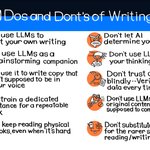
When I'm writing something that's meant to come from me, I still use AI, but in a very limited way. I'll ask Claude to catch grammatical mistakes, typos, and to help me brainstorm, but I don't want to draft original copy.
Over the past year, I've settled on a handful of principles that guide how I write with AI.
Thanks to Marker Ninja for turning them into a graphic.

Every year, we welcome people from different industries, organizations, and backgrounds, but they all share one thing in common.
A curiosity about what comes next.
Over two days, Responsive Conference becomes a place where ideas are shared freely, assumptions are challenged respectfully, and conversations often become just as valuable as the sessions themselves.
This year's theme, “Predictability is gone, what’s next?”, invites us to explore how leadership, AI, organizational design, creativity, and culture are evolving together, and what that means for the organizations we're building.
If those are the conversations you've been looking for, we hope you'll join us this September.
How much of your real self should you bring to work?
This came up in a conversation with Mandy Mooney, and I thought her answer was really honest.
A lot of people say you should “bring your full self to work.” Mandy pushed back on that – somewhat. When you’re new to the corporate world, you’re trying to figure out the language, the norms, the hierarchy, and all the subtle signals that come with working inside a large organization. It’s easy to feel like you need to become a kind of corporate robot just to fit in.
But over time, Mandy found that the key wasn’t hiding who you are so much as learning how to blend in while also standing out.
At her current company, Prologis, that moment happened in a surprisingly human way. During a planning call for a company retreat, some senior leaders were joking about starting a band but said they didn’t have a singer. Mandy spoke up and said, “I sing.” What started as a casual comment turned into something real. Today, she’s the lead singer of the company band, performing a few times a year for colleagues across the organization.
After their first performance, the CEO came up to her and told her how much he loved it. That moment sparked a genuine connection that extended well beyond music.
The lesson wasn’t “perform on stage at work,” but that you don’t have to hide the things that make you human.
The other part of the equation is the people around you. Mandy credits a lot of her growth to mentors and managers who supported her and encouraged her to step into her strengths. In fact, it was her boss who first suggested she write a book–an idea that eventually became “Corporating: Three Ways to Win at Work.”
Her takeaway is simple:
You don’t have to reveal everything all at once. But you also don’t have to hide who you are.
Sometimes the opportunities that shape your career start with a small moment of honesty.
What if you treated your own life as an experiment?
For years, I've been fascinated by the idea of testing small changes, observing what happens, and keeping what works. That curiosity eventually became a habit of running self-experiments on everything from productivity and work to learning, relationships, and everyday life.
Those experiments are collected in “This Might Work: A Collection of How-Tos,” a book that brings together some of the ideas, practices, and lessons I've found most useful over the years.
You can download the book for free or pick up a physical copy if you'd prefer something to keep on your shelf.
(And if you've already read it, I'd be incredibly grateful if you'd consider leaving a review. It helps more people discover the book and means more than you might know.)
amazon.com/This-Might-Work-C…

Can creativity help us connect in a world dominated by screens?
In a recent conversation with Adam Rosendahl, we explored how creative experiences can bring people back to what often gets lost in busy workplaces and digital environments: genuine human connection.
Adam shared how simple acts of creating together, whether through storytelling, drawing, or collaborative art, can break down barriers that normally exist between people. In those moments, job titles, hierarchy, and status take a back seat, creating space for individuals to connect as people first.
The conversation also highlighted the value of slowing down. In a world filled with constant information, notifications, and distractions, creativity can serve as an interruption to the noise, helping people reflect, engage more deeply, and build stronger relationships with those around them.
What does effective leadership look like when the answers aren't clear? In a world shaped by constant change, leaders are often expected to make important decisions without having all the information, balancing competing priorities while keeping their teams focused and moving forward.
Jennifer Turner works in organizational strategy at Alphabet, where she partners with leaders across the company's portfolio of businesses. Through coaching, mentorship, and strategic advising, she helps leaders navigate growth, complexity, and the challenges that come with leading in fast-changing environments.
At Responsive Conference, Jennifer will draw from her experience working with leaders across Alphabet in her interactive workshop, “How to Not Run Around like a Chicken with Your Head Cut Off”
She'll share frameworks for decision-making, communication, and building trust when the path ahead isn't always obvious. For anyone responsible for leading people through change, her session offers an opportunity to reflect on their own leadership approach and walk away with tools that can be applied at work.

One of the most useful things I’ve learned about sales came long before I thought of myself as a salesperson.
In my early twenties, I worked with children with autism and discovered that they responded less to what I said than to how I showed up. One thing I learned quickly is that people respond less to what you say than to how you show up.
The same is true in sales.
Most people think sales is about persuasion, but it is actually more about attitude.
The attitude that works best has three parts: loving, presence, and acceptance.
Loving means approaching people with genuine care and generosity.
Being present means paying attention to the person in front of you instead of thinking about what you're going to say next.
Accepting means not becoming so attached to the outcome that you stop caring about what's actually best for the other person.
Ironically, the less desperate you are for a particular outcome, the more likely people are to trust you.
Recently, I came across a quote that said:
"Jealousy is a Rorschach test."
The more I think about it, the more I believe it's true.
When someone else has a life-changing success, whether that's an IPO, a promotion, a book deal, or something else entirely, our reaction often says more about us than it does about them.
While some of my friends were getting into fast-growing technology companies a decade ago, I was training ballet 40 hours a week. At the time, that was the race I wanted to run.
Of course, I still find myself looking at other people's success and occasionally wondering, "What if?"
But then I remember the trade-offs.
I get to work out every day. I live close to my family. I get to choose much of the work I take on. I've spent the last few months focused on building a marriage that means the world to me.
Every choice closes some doors and opens others. The challenge is that when we compare our lives to someone else's, we often compare their rewards to our own sacrifices without considering the sacrifices they made too.
The older I get, the more I think the goal is not to win every race.
The goal is to be clear about which race you're actually trying to run.
When I remember that, it's much easier to celebrate other people's success and get back to my own life.
What if you stopped planning your career in decades and started planning it in much shorter chapters?
In a podcast conversation, Jeff Jaworski shared a simple framework that's guided much of his career: commit to a role for two years, learn everything you can, make a meaningful contribution, and then reassess. Not because you're looking for the next job, but because growth often comes from being intentional about what's next rather than waiting until you're forced to figure it out.
It's a refreshing alternative to the traditional career ladder and a reminder that the most successful careers aren't always the most linear. They're built through curiosity, experimentation, and a willingness to evolve over time.
If you're thinking about your next chapter, this conversation is worth a listen.
The future of work isn't coming — it's already here. AI is reshaping how organizations operate, teams are evolving faster than ever, and leaders everywhere are figuring out what it takes to build resilient workplaces in a rapidly changing world.
Responsive Conference 2026 brings together executives, people leaders, founders, and organizational designers for two immersive days of learning, connection, and practical insights. Join a community of leaders who are rethinking leadership, culture, talent, and organizational design for a new era of work.
Mark Your Calendar
📅 September 23–24, 2026
📍 Oakland Museum of California
👥 Managers, executives, founders, and people leaders
🎤 35+ speakers and 275+ attendees