

I curate the latest frontend related news and share them with you every other Sunday. https://xitter.cf/t.co/u8MBVxFpMM Staff Eng on FE Platform at @kiwicom247 He/Him
- Tweets634
- Following1.9K
- Followers660
- Likes5.7K






ALT Self-care is a leadership skill, not a luxury. Too many managers treat self-care like an afterthought—until burnout forces them to stop. I've been there (still am sometimes). Our mental state is always reflected back to us, and not just at work. We must take responsibility for it. No one needs a burned-out you. So every once in a while, I revisit these principles before exhaustion really sets in—I hope they help you too: 1. Protect my calendar 2. Set a hard stop time 3. Say no more often 4. Prioritize recovery like a deadline 5. Automate and delegate aggressively 6. Measure energy, not just output Self-care isn’t selfish

ALT Hosting a meeting is like hosting a party—you set the tone. You welcome people in, guide the flow, and make sure no one’s stuck in a corner awkwardly sipping their drink. When the energy dips, you bring it back up. When things get chaotic, you steer it back on track. Engagement isn’t automatic, it’s created. Team leaders must energize meetings to boost engagement, and here are 5 deceptively simple tactics that have helped me countless times: 1. Have An Agenda A meeting without a plan is a waste of time. Explain the goal at the start. Outline key topics, share them in advance, and stick to them. But keep the agenda open: anyone can add a topic—ensure they are prefixed with people’s names to quickly get the right person to speak when the time comes. This keeps discussions focused and sets expectations from the get-go. 2. Share Your Screen While Note-Taking Seeing key points in real time keeps people engaged. It also ensures alignment—everyone follows the same discussion flow, red


ALT When I became a manager, I set regular 1:1s with my team members because that's what you're supposed to do, right? My experience until that point was: We'd open with some small talk I could then share whatever bothered me They'd tell me they'd pass on the feedback We'd close with discussions about operational things If I needed a venting session, these sessions helped. But that was about it. It wasn't much of a discussion. I'll always remember my first 1:1 as a manager: my colleague thought we were done after 5 minutes. And then I asked about how they saw their career. We ended 30 minutes over time and they seemed fired up—I was onto something. That's when I realised something: 1:1s aren't just a checkbox—they're essential. Here are 3 must-have conversations every people manager should have regularly to turn 1:1s into a powerful leadership tool and build thriving teams: 1. Feedback session (looking back) It's hard to grow or meet expectations without feedback.


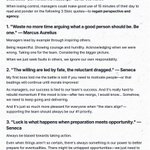
ALT 1. "Waste no more time arguing what a good person should be. Be one." — Marcus Aurelius 2. "The willing are led by fate, the reluctant dragged." — Seneca 3. "Luck is what happens when preparation meets opportunity." — Seneca Read more on https://robincsl.substack.com/p/3-stoic-quotes-for-managers-to-regain


ALT Ever notice how back-to-back meetings leave you wiped out? As a new manager, I made the mistake of putting one meeting after the next. I thought this would help me create focus time blocks at other times in the week—I still wanted my coding time. Just imagine the quality of my one-on-one's after the fourth or fifth meeting in the last 3 hours. I simply couldn't sustain my energy levels and emotional availability. But it doesn't have to be this way. Just like in web design, we need proper spacing to let things breathe. Your brain needs white space too. And it can be as simple as leaving a 15-minute gap between each meeting. That's it. It doesn't mean you will suddenly get free hours to meditate every day—though some breathing exercise can still be a good idea. You might need to get some water, have a toilet break or just open the window to let in some fresh air. Or your Slack is on fire and you need to check. At the very least, you now have some time to jot down those action ite


ALT Managing people is the ultimate test of adaptability. We all know that context-switching is bad. Yet somehow, as managers we must learn to switch hats faster if we wish to lead effectively. It takes work to get better at all these different roles—after 2 years as a manager, I'm still learning every day. I hope that acknowledging all these different roles we play as managers can help you reflect on your journey and be more intentional about which area you want to improve. The Coach Micromanaging is THE best way to achieve results, said no one ever. For the team to realise its potential, we need to guide from a higher level. Our job isn't to do the work—it's to create the conditions for others to grow and succeed. We can coach effectively by: asking thoughtful questions: "what options did you consider?", "can you explain the trade-offs?", "what would you do differently in that other context?" offering clear feedback: "your PR review was very detailed and caught some unexpec


ALT As staff engineers go through the transition to manager, they need to realize they've accepted a new job. What worked as a staff will not necessarily work as a manager. Dealing with legacy systems can be messy, but working with people is always a delicate dance. You need to develop a new set of skills. In the two years that I've been a manager, these 3 challenges have shaped me and forced me to adapt to that new reality. I hope they can reframe some of your experiences and help you navigate this transition better. Learning to delegate tasks It is such a silly thing, but when people asked me something in a private Slack message, I assumed they wanted me to solve it, personally. In reality, they were asking my team to do something about their problem. I usually didn't want to bother my team members, to protect their focus time. And so I little by little took on more than I could manage. No one seemed to appreciate the sacrifice as it was mostly invisible. When my team members would


ALT You don't have time to overthink every decision. It's easy to get caught up in analysis-paralysis: you know your decisions matter, so you need to choose wisely. You don't want your team to suffer because of you, especially if you went too fast. The truth is, we all make mistakes and no one works in a perfect environment. Great decisions come down to understanding context and managing trade-offs. Context Is Everything Decisions that work in one situation can fail in another. For example, being scrappy like a startup won't transfer well to a more mature company that must adhere to standards. Failing to account for timing, resources, or stakeholder needs only leads to poor outcomes. Understanding the context brings the necessary nuance to put best practices in perspective. Perhaps better practices is more accurate—the context decides whether to put them to good use or not. Every Decision Has Trade-Offs When you say yes, you say no. Choosing one path means giving up another. The mis
