

Entrepreneur | Investor | Mentor | Advisory Board Member | Growth Expert | Public Speaker| Innovation | Startup Ecosystems | Tech | Sustainability | PIF Saudi
Saudi Arabia
Joined August 2011
- Tweets7.7K
- Following3.3K
- Followers2.4K
- Likes5.9K







Pinned Tweet
Hi, I’m Roberto Croci. It’s been a while, and with a new year starting, it felt like a good time to reintroduce myself.
After all, it’s always nice to actually know the person behind the posts.
2003 - I completed my final degree and soon after joined DMR Consulting as a consultant, where I spent a year learning how business really works.
2004 - I moved to BravoSolution S.p.A as a Senior Manager, leading sales.
2006 - I joined PwC as a Senior Advisory Manager, focusing on project management.
2008 - Took me into the world of e-commerce with WebScience, where I worked as E-commerce Director.
2010 - It was a turning point. I joined Google as a Manager Solution Consultant and ended up staying 9 years. Over time, I grew into the Regional Head in Dubai. During this journey, we grew revenue and clients by over 5x in just 3 years, consistently beat sales targets for 11 quarters straight, and saw our product suite adopted by many of the largest advertisers across Southern & Eastern Europe, the Middle East, and Africa. More than the numbers, those years shaped my thinking, leadership, and resilience.
2019 - I joined Microsoft as Managing Director, where I built and launched a new VC fund, raised $15M from UAE and Saudi government entities, and deployed initial investments across 15 startups.
2022 - I founded Constructive Rebels to help corporates and government entities drive innovation through startups, while also working part-time as an advisor and head across several organizations.
2023 - I joined PIF as Director of Value Creation & Transformation
2025 - I was promoted to Senior Director.
Outside of work, I’m usually:
- Reading
- Traveling and trying new experiences
- Talking about leadership and startup growth
- Or simply spending time with friends and family
I started taking X more seriously only a few months ago, and I’m enjoying it here. If you like what I share, welcome to my world.
Let’s learn, build, and have meaningful conversations together.📷

In every gold rush, the steady money is made selling picks and shovels.
The same is true in AI. The apps come and go, but the compute, the data and the people underneath keep paying off for years.
Build or own the layer everyone else has to rent.
The first 100 days after buying a company decide the next five years.
It is the one window where you have full authority and nobody is defending the old way yet.
A lot of owners spend it on introductions and polite meetings, but the best ones use it to make the hard changes while change is still welcome.
A lot of companies confuse being busy with making progress.
Meetings, decks, updates, milestones hit. It all feels like movement.
But if the business is not better at the end of the quarter, none of it counts. Activity is not the same as impact.
For years you could make money in private equity without being good at it. Buy a company, add cheap debt, wait for the market to lift the price, sell for more.
That is over. Debt is expensive, buyers are careful, and nobody can count on selling for a higher multiple.
What is left is the one skill that always mattered. Making the business better while you own it. I think it is one of the healthiest things to happen to this industry in years.
I used to think hiring great people was enough, but I was clearly wrong.
I have seen rooms full of brilliant people go nowhere, and ordinary teams do extraordinary things. The difference was always the conditions around them.
Clear ownership, work that means something, people who can count on each other, and room to be themselves.
Get those right, and ordinary people will surprise you.
A busy marketing team and a growing business are not the same thing.
I spent close to 9 years at Google, and the most common mistake I saw was companies measuring the wrong thing. Clicks, impressions, likes.
Those things are easy to see, move every day, and tell you nothing about whether you made a customer.
Pick the one number tied to revenue, build everything around it, and ignore the noise.
Building a data centre is the easy part. Any country with money and power can do it.
The hard part is turning that infrastructure into something that lasts. Local companies that run these systems instead of renting them, engineers who solve the hardest problems, and skills that are still here in twenty years.
Saudi Arabia has clearly built the infrastructure and now the focus is on the latter one.
Nearly every company I meet wants an AI strategy. Very few can tell me which part of their business is actually slow.
Before you add AI, get honest about this:
→ Where do your decisions get stuck?
→ Where do you lose the most time?
→ Which of these is really a process problem in disguise?
AI makes a good process faster, but it also makes a broken one break faster.
Fix the process first.
Writing the cheque is the easiest thing an investor does. It is also the least important.
Anyone with money can buy a stake in a company. What decides the outcome is what happens after the money goes in. The right hire you help make. The customer whose door you open. The hard conversation you sit through.
That part never makes the headline. It shows up two years later, in a company that is stronger than money alone could have made it.
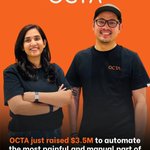
OCTA has recently raised $3.5 million to help small businesses get paid faster.
And I love the work @jonsantillan and his team are doing.
I have spent more than two decades close to founders. In early startups, inside giants like @Google and @MSFTResearch, and now across a national portfolio at @PIF_en .
And when you have spent that much time around people building things, you usually look at how the founder thinks, sometimes even more than the idea.
The ones I would back myself usually do a few of the same things:
→ They pick problems that people will actually pay to solve, rather than problems that sound impressive on a stage. Getting a small business paid on time will never trend, and it keeps that business alive.
→ They focus and try to win one kind of customer completely before they let themselves think about the next.
→ They keep talking to customers, people in the market, and the team that’s building it themselves to be aware of what's going on in the market they’re into.
→ They know very clearly how many months of runway they have down to the week, and it shapes every decision.
→ When they see something is not working, they change it within days rather than waiting for the next quarter.
None of this is glamorous, and it rarely makes the headlines, but this is what separates the companies that survive and raise well from the ones that don’t.

Got a chance to attend The Economic Forum by Servcorp in Riyadh.
Around 150 leaders from government, investment, and business spent the day together, across six sessions on geoeconomics, AI, energy, capital, trade, and the future of work.
A few years ago you could treat these as different files on different desks. That is no longer true. Where you build, how you source, what you invest in, and who you partner with all pull on each other now.
That makes this a harder moment to operate in, but it also makes it a more interesting one.
The view I heard most in the room was that all this uncertainty is no reason to wait. Periods like this are exactly when the people willing to commit for the long term end up ahead.
And the best part of a day like this is the people, the depth of experience in that room, and how openly people shared it.
Special thanks to Trevor McFarlane, CEO of EMIR, for chairing the day, and to Dr Martyn Davies, Head of City Excellence, Cassidy Lyon, Partner & Managing Director at Emir KSA and David Godchaux, CEO Middle East, Europe & America at Servcorp, for the conversations that gave it some of its sharpest moments.
Thank you to Servcorp and the team at EMIR for bringing everyone together.


Since 2015, around 61% of all private-capital funds closed in the Middle East were based in Saudi Arabia.
359 of 590, as per @BlackRock.
The money is one thing, but the machinery around it is harder: the funds, the managers, the track records, the local knowledge that decides where capital goes.
You cannot import that overnight. It takes years.
Saudi Arabia is building it in a fraction of the time.
@PIF_en is now one of the largest investors on earth, and a whole layer of local funds is forming around it.
PIF alone has grown into one of the largest investors in the world, and around it a whole layer of local funds, managers and institutions is forming.
The support Saudi Arabia gives its startups, I don't think any country matches right now.
Most founders outside the region have no idea. A few examples:
→ Sovereign co-investment: Jada and SVC put money in alongside private investors, lowering the risk on early bets.
→ Relocate Initiative: grants to move here, up to half the salary of local tech talent covered, fast-tracked residency.
→ 100% foreign ownership in most sectors, plus sandboxes to test before you scale.
→ Biggest one: the state becomes your customer. Plug straight into NEOM and the virtual hospital.
For years people blamed capital for holding startups back here. Wrong problem.
The hard part was access. To customers, to contracts, to a market that would buy from a young company.
That is the part being solved now.
PIF launched Tawrid, a digital platform for supply-chain financing in Saudi Arabia.
Might sound technical, but it fixes a serious problem.
A small supplier wins a contract, then waits 90+ days to get paid while still covering salaries, materials and rent today.
Plenty of healthy businesses die right there.
Tawrid lets them get paid early against approved invoices. Money they already earned, reaching them sooner.
Already live, with GIB, SNB, Banque Saudi Fransi, ROSHN and Nesma on board.
An economy is really just a question of whether a small supplier survives long enough to become a big one.
That is what PIF is solving.
Congratulations to Sophie Smith and the whole NABTA Health team on being ranked among the world's best in healthtech.
NABTA works on women's health, an area the industry has overlooked and underfunded for years.Building a real business in this space is really hard in any year, and the past year has been a hard one for the region.
Still, through all of it, the team kept growing, running their clinics, and caring for the women who rely on them.
I have known Sophie for a long time. She believed in this mission when almost no one was paying attention, and she has not eased off since. The credit belongs to her and the whole team behind her.
Long way to go, and knowing this team, they are well on their way.
Congratulations again.

Big news out of Saudi Arabia: Crown Prince Mohammed bin Salman launched EXOBOT, the first cars from Ceer, the Kingdom's own national auto brand.
For 100 years, this economy sold energy straight out of the ground. Building a car brand from scratch is a completely different skill. Supply chains, software, batteries, manufacturing, all working as one.
A country that can go from oil wells to its own car brand this fast is telling you what it plans to build next.
I would take that seriously.

Happy 96th National Day, Saudi Arabia.
In 1932, this was desert and not much else. Today it is opening cities to the world, building its own cars, and laying the AI infrastructure the next economy will run on.
The projects are big, but what gets me is the pace.
A generation that grew up being told what their country couldn't do now spends its days proving the opposite.
Proud to be building here.
🇸🇦 كل عام والوطن بخير
Working at a national scale changed my sense of time.
In a startup, you think in quarters but when you are working across a country's portfolio, the outcomes that matter play out over decades.
It forces a strange discipline to spend the strongest years on things you may never see finished.
The market rewards what is visible this quarter. But roads, institutions, and talent are built by people who accept they will not be there for the harvest.
I have worked inside both Google and Microsoft.
Two very different cultures, same lesson:
→ At scale, what slows you down is the number of people who have to say yes, not the market.
→ Every approval feels responsible on its own. Stack enough of them and the whole company goes busy, careful, and completely still.
→ Speed comes down to one thing which is how few people a good idea has to pass through before it moves.
Fewer gates, faster company. It really is that simple, and that hard.