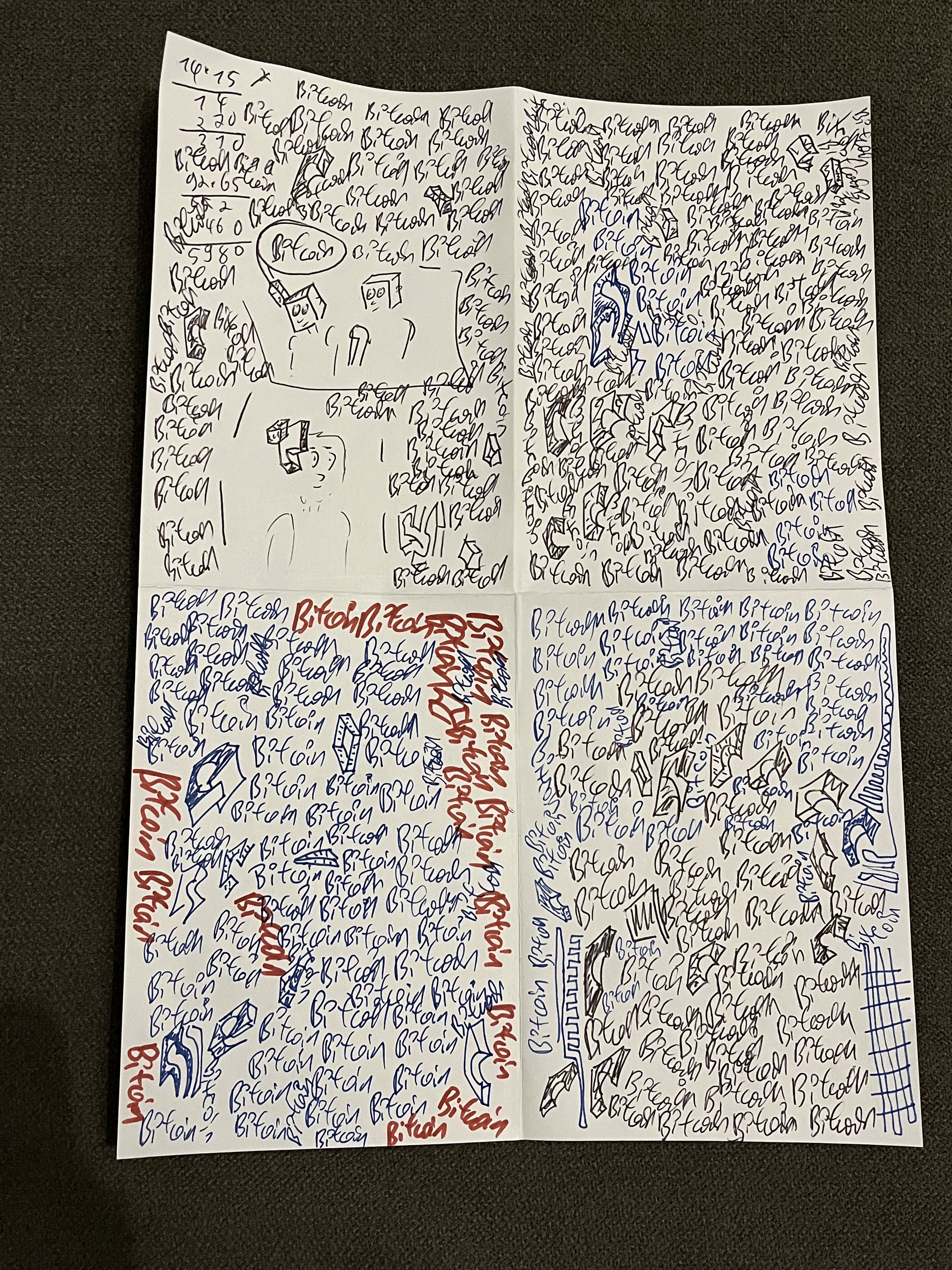
Attempting to write "Bitcoin" 21 million times. #Bitcoin Handwriting Bitcoin 21M times. Literal proof-of-work. DM for pages
Joined June 2017
- Tweets32.9K
- Following635
- Followers1.3K
- Likes95.2K





+ 421 words, new total 874217.
Money, Prices, Self-Doubt, and the Entrepreneur
It is both permissible and socially useful to want to make as much money as possible. Raising prices is frequently the highest-leverage way to do so, and it can benefit customers as well as the seller. These claims, associated most prominently with entrepreneur and educator Alex Hormozi, sit comfortably alongside one of the central insights of the Austrian school of economics: that money is not a neutral veil or a mere technical convenience, but the indispensable organizing medium of a complex economy. The apparent tension between unapologetic profit-seeking and a sophisticated theory of economic coordination dissolves once one sees entrepreneurial pricing as the practical exercise of economic calculation. What often prevents people from performing that calculation well is not a lack of skill or moral unworthiness, but self-doubt, i.e. the conviction that one is not skilled enough to charge more, or that one does not deserve to.
Hormozi’s practical counsel begins from a simple observation: most businesses leave large amounts of money on the table because they price by cost-plus formulas, competitor averages, or residual guilt. Pricing, he argues, is the single strongest lever on profit, stronger than acquiring more customers or reducing churn. The arithmetic is unforgiving. A firm that doubles its price and loses a third of its conversions can still roughly double its profit, because the margin expansion outweighs the volume decline. The proper target is therefore the maximization of absolute gross profit (units sold times margin), not the maximization of market share or the minimization of sticker shock. The “perfect” price is the highest price a customer will still pay for the value received. In many service businesses the rational strategy is therefore to sell high-ticket offers to fewer, wealthier, less-needy clients rather than to compete in the middle of the market.
Hormozi further notes that price is not merely a transfer of purchasing power; it is itself a signal that shapes perceived value. Classic experiments in which identical wines were rated more highly when labeled as expensive illustrate the point. A higher price can raise the buyer’s expectation of quality, filter for more committed customers, free the seller to deliver better service, and generate the cash flow needed for reinvestment. The moral discomfort many sellers feel about raising prices is, on this view, largely misplaced. The market, through the binary decision to buy or to walk away, supplies the only relevant feedback.
Austrian economics supplies the deeper theoretical frame in which these practices make sense. Money, as Carl Menger explained, emerges spontaneously from barter as the most marketable commodity; it becomes the general medium of exchange and the unit of account. Once money exists, it makes possible what Ludwig von Mises called economic calculation: the comparison of heterogeneous inputs and outputs in common numerical terms. In a complex division of labor, no entrepreneur can know in kind whether a particular arrangement of resources is more valuable than its alternatives. Only money prices of factors and products permit profit-and-loss arithmetic. That arithmetic is the “guiding star” of entrepreneurial action. Without it, advanced production is impossible, which is the core of the famous socialist calculation argument.
Friedrich Hayek extended the insight by emphasizing the knowledge problem. The relevant data about preferences, scarcities, and local circumstances are dispersed among millions of individuals and constantly changing. Relative money prices transmit the minimal information each actor needs to coordinate with the rest. Entrepreneurs buy where they judge prices too low and sell where they judge them too high; their success or failure is registered in monetary profit or loss. Consumer sovereignty is exercised through money bids; resources flow toward the uses that generate the largest residual between the money prices of outputs and the money prices of inputs. Money is therefore non-neutral. Distortions in its supply or in the interest rate scramble the relative prices that guide calculation and produce systematic misallocation.
The synthesis is straightforward. Hormozi’s advice is what entrepreneurial action looks like inside the Austrian price system. The desire to capture the largest possible monetary residual is precisely the incentive that keeps the discovery process alive. When a seller tests higher prices until conversion rates and total profit are jointly maximized, he is performing economic calculation and generating the price data that other market participants will use. A high price that still clears the market is not an act of extraction against the customer; it is a revelation of the intensity of that customer’s preference. It tells suppliers of complementary inputs, capital markets, and potential competitors that resources are more highly valued in this use than elsewhere. The customers who refuse the higher price simply reveal that their valuations lie elsewhere; the system redirects resources accordingly.
Self-doubt interferes with this process at two characteristic points. The first is the belief “I am not skilled enough to make more money.” This is a claim about relative productivity. In a market economy the relevant measure of skill is not an internal inventory of credentials or a comparison with an idealized expert, but the willingness of others to pay money for the specific outcome one produces. Economic calculation does not require the entrepreneur to be the most skilled person in absolute terms; it requires only that the money residual from serving a particular set of customers exceeds the money residual from the next-best use of those resources. Testing a higher price is therefore not an act of arrogance; it is a way of discovering whether one’s current skill, as revealed by customer preference, is already sufficient to support a larger residual. Many people remain underpriced not because the market has judged them inadequate, but because they have never submitted the question to the market.
The second form of self-doubt is the belief “I do not deserve to make more money.” This is a moral or psychological claim, not an economic one. Markets do not allocate according to desert in the sense of moral worthiness, effort expended, or personal need. They allocate according to the intensity of revealed preference expressed through money bids. A customer who voluntarily pays a higher price is demonstrating that, in his or her own scale of values, the outcome is worth at least that amount. The entrepreneur who accepts the payment is not “taking more than he deserves”; he is completing a voluntary exchange in which both parties expect to be better off. The Austrian emphasis on consumer sovereignty makes the point sharply: the only authority competent to judge the value of the service is the person paying for it. Internal feelings of unworthiness have no standing in that judgment. Treating them as binding constraints simply prevents the price system from performing its coordinating function.
Overcoming both forms of self-doubt therefore consists in subordinating subjective feelings to the evidence generated by voluntary exchange. The practical method is the one Hormozi repeatedly recommends: raise the price, measure the change in conversion and total profit, and let the numbers decide. If the higher price produces a larger residual, the market has indicated that the entrepreneur’s skill was already sufficient and that the previous price was leaving value uncaptured. If it does not, the experiment has still supplied useful information. In either case the process replaces an untestable internal narrative with an external, numerical signal. That signal is precisely what money makes possible.
The claim that higher prices can benefit remaining customers is likewise compatible with consumer sovereignty. Voluntary exchange already implies mutual benefit at the agreed terms. Higher margins can finance better fulfillment, stronger guarantees, faster delivery, or greater attention per client. The price itself can function as a commitment device and a quality signal. In short, the same number that coordinates distant strangers also shapes the local experience of the transaction. What looks from one angle like aggressive profit-seeking looks from the other like the continuous adjustment of production to revealed preference.
None of this requires the assumption that every price increase is automatically beneficial or that sellers always possess perfect knowledge. Markets are processes of trial and error. Some price experiments fail; some businesses overreach and lose volume faster than margins expand. The Austrian framework simply insists that the relevant test is monetary profit and loss under conditions of private property and free entry, not an external standard of “fairness,” a cost-plus formula, or an entrepreneur’s private assessment of his own worth. Hormozi’s operational recommendation—to keep testing upward until the data say stop—is the entrepreneurial counterpart of that test, and it is also the most reliable way of dissolving the two common forms of self-doubt. The Hormozi way of looking at higher prices, is that higher prices give the customer more "skin in the game": When customers make a higher financial investment, they value the purchase more. They show up with more energy, follow instructions better, and are far more committed to achieving the desired outcome. They also give better service quality: Higher margins allow a business to reinvest heavily in its fulfillment, customer service, and product innovation. This ensures the business can actually uphold its promises and deliver premium care. Higher prices lead to increased focus and attention: Higher prices naturally filter out non-serious buyers. Servicing fewer, more dedicated clients allows the business to provide deeper, more personalized attention to each customer. Higher prices also improve perception and confidence: Price acts as a psychological signal for quality and competence. A higher price gives customers greater confidence that they are receiving an elite, effective solution to their problem.
The marriage of the two perspectives therefore yields a coherent picture. Money is the indispensable organizer of the economy because only money prices permit calculation and the transmission of dispersed knowledge. The entrepreneur who unapologetically seeks to maximize the money residual, and who treats pricing as the primary lever for doing so, is the agent through whom that organizing function is performed. Self-doubt about skill or desert is not a private psychological matter that can be set aside while one participates in the market; it is an obstacle to accurate calculation. Wanting as much money as possible is not a deviation from the logic of the market; it is the motive that keeps the logic operative. Raising prices, when the market will bear it, is frequently both the most effective way for the individual to prosper and one of the mechanisms by which the price system continues to allocate resources to their most valued uses. The market’s answer to “Am I skilled enough?” and “Do I deserve it?” is the same: show me the money.


+ 589 words, new total 873796.
Math as the Crowbar of Physics
For centuries, physics has operated inside a series of conceptual cages. We observe the cosmos from a localized, biological perspective, bound by what our instruments can probe and what our minds can visualize. Yet, history has shown that whenever physics hits a seemingly impenetrable wall, it is mathematics that acts as the ultimate crowbar, prying open the boundaries of our reality.
In the early 1600s, astronomers were trapped in a rigid box of their own making: the belief that all celestial bodies must move in perfect, divine circles. Even the brilliant Johannes Kepler struggled for years to map the orbit of Mars, fruitlessly trying to force his highly accurate data into circular paths. The breakthrough only happened when Kepler abandoned physical preconceptions and reached for an ancient mathematical tool—the ellipse, a geometric shape studied by the Greeks two thousand years prior purely for its abstract beauty. By sliding this mathematical crowbar under the data, the rigid cage of circular orbits shattered. The math revealed a simpler, deeper truth: planets move in ellipses, a discovery that directly paved the way for Isaac Newton’s laws of universal gravitation. Mathematics consistently proves to be smarter than the universe we can see, hinting at vast, hidden structures beneath our "boxed-in" reality.
Today, we stand at the precipice of a new paradigm. The traditional bottleneck of mathematics has always been human cognitive capacity; we are slow, error-prone, and limited in the number of dimensions we can intuitively grasp. However, the current surge of progress in artificial intelligence is transforming math from a passive language into an active, automated engine of discovery. By pairing human intuition with AI-driven automated theorem provers, deep learning architectures, and symbolic reasoning, we are forging a much heavier, sharper crowbar.
In pure physics, this AI-driven mathematical revolution will first dismantle the walls of complexity. Many of our current physical models—such as string theory, quantum chromodynamics, or the fluid dynamics of turbulent plasma—are locked behind equations that are too complex to solve analytically. We resort to approximations, truncating the math to fit our computing limits. AI systems, unburdened by human dimensional limits, are beginning to discover entirely new mathematical dualities and exact solutions to these intractable systems. They can navigate high-dimensional topological spaces, mapping out the vast landscapes below the attoscale and cosmological models that humans can only glimpse through a keyhole. If our current physics feels constrained by speed limits and cosmic horizons, AI-guided math may reveal that these boundaries are merely the edges of our localized "game engine," exposing deeper, holographic, or multi-dimensional mechanics operating beneath the surface.
Ultimately, this mathematical breakthrough will cascade down into the physical world through engineering. Engineering is the art of translating the laws of physics into tangible utility, which in turn enables the continuing improvements of our material lives.


+ 709 words, new total 873207.
Turning Your Love for Math and Computers into a Career
For generations, loving pure, abstract mathematics meant choosing a very specific life. You stayed in academia, chased research grants, and spent your days in a universe of set theory, logic, and symbols that few outside your department understood. If you wanted a lucrative career in technology, you usually had to leave that beautiful, abstract world behind to write standard enterprise software or build corporate databases.
Today, that compromise is officially over.
The collision of massive cloud computing and next-generation artificial intelligence has created an elite, high-paying frontier where pure mathematics is no longer just an academic pursuit—it is a mission-critical commercial asset. Trillion-dollar tech giants like Amazon Web Services, Google DeepMind, and Microsoft are actively hunting for minds that can bridge the gap between abstract logic and code.
In this space, professionals known as Automated Reasoning Engineers and Formal Verification Scientists don't just write programs that usually work. They write programs alongside mathematical proofs that guarantee they can never fail. They treat software code exactly like a geometric theorem, using formal languages like Lean, Coq, and TLA+ to prove that vulnerabilities, infinite loops, and systemic bugs are physically impossible.
This intersection is the ultimate playground for the mathematically inclined. If you are fascinated by the chaotic beauty of the Collatz conjecture, the absolute certainty of number theory, or the boundless complexity of the Busy Beaver problem, the modern tech landscape no longer asks you to suppress that passion for a paycheck. Instead, the commercial sphere will gladly pay a premium for your brain—giving you the resources to solve the world's most elegant logical puzzles while building a highly successful, world-changing career.


+1227 words, new total 872498.
The Antihydra
In six small states a Hydra waits,
its tape a blank and quiet page.
It multiplies, it shifts, it hesitates—
a Collatz-shadow in a cage.
Each step a head that will not fall,
each rule a riddle none can name.
We name it Antihydra, small,
yet large enough to shame our claim
that every beaver can be found
before the last of them is bound.
It neither halts nor clearly runs;
it simply multiplies the ones
that theory cannot yet decide.
Six states. One tape. An open side.


+1467 words, new total 870007.
The year is 2046. I clock in at Starbase just after sunrise, the Gulf air already thick and warm. The main assembly hangar for the next-gen Starship is lit by rows of lights that never really go off. A half-dozen humanoid robots move along the upper fuselage, torquing panels and running ultrasonic checks while a smaller swarm of inspection drones flits between them. My job is mostly to watch the exception queue and sign off on the decisions the AI doesn’t want to make alone.
Most mornings it’s quiet. The factory systems know the tolerances better than I do. When something does flag, it’s usually a materials call—whether a particular heat-shield tile lot still meets the updated reentry profile for the lunar cargo runs. I pull the data on my tablet, cross-check it against the flight history the models already summarized overnight, and clear it. The whole exchange takes less than a minute. Then the robots keep going.
On the floor below, two of the older technicians are arguing over coffee about which Lightning wallet is most convenient for the small stuff. One of them still keeps a couple of sats in an old channel for tips and vending machines; the other just lets the company paystream handle it and sweeps anything left over straight to cold storage. Nobody talks about dollars anymore except as a historical unit on the old invoices. Everything settles on Bitcoin underneath—Lightning for the everyday, other layers when you need something more complicated.
A notification pops up. One of the cargo Starships just completed its second automated tanker rendezvous this week and is already back on the pad for the next load of propellant. The schedule shows it lifting again tomorrow. Somewhere above the hangar lights, the first light of the day catches the nose of the ship that’s going to Mars next month. I watch it for a second, then swipe the notification away and get back to the queue. The robots don’t stop. Neither does the rest of it.


+231 words, new total 868,540.
# Number guessing game
import base64
def main():
sequence = [30, 210, 2310, 30030, 510510, 9699690, 223092870]
data = "NjQ2OTY5MzIzMA=="
next_number = int(base64.b64decode(data).decode())
print("Here is the sequence:")
print(", ".join(map(str, sequence)))
print("\nWhat number comes next?")
while True:
user_input = input("Enter the next number (or 'q' to quit): ").strip()
if user_input.lower() == 'q':
print("Okay, quitting. Better luck next time!")
break
try:
guess = int(user_input)
except ValueError:
print("That's not a valid number. Try again, or type 'q' to quit.")
continue
if guess == next_number:
print("Congratulations! You got it right!")
print(f"The next number is {next_number}.")
break
else:
print("Wrong! Try again, or type 'q' to quit.")
if __name__ == "__main__":
main()

+556 words, new total 868,309.
“So I came up with this thing that I sort of facetiously called the Cry Test... If you’re not in danger of breaking out in tears... this probably isn’t a project that you’re that committed to... To succeed in a long and difficult project, there has to be love in the idea... I mean, ‘I love this idea in the way if I don’t do it, I’m gonna feel like I’m not doing the purpose of my life.’” - Jonathan Blow

+554 words, new total 867,753.
Jensen Huang and the Five-Layer Cake: AI as Industrial Infrastructure
Jensen Huang, the co-founder and CEO of NVIDIA, has popularized a vivid metaphor for understanding artificial intelligence: the “five-layer cake.” Far from treating AI as a collection of chatbots or software features, Huang presents it as essential industrial infrastructure—comparable to electricity or the internet—built from interdependent physical and digital layers. In a March 10, 2026, NVIDIA blog post titled “AI Is a 5-Layer Cake,” and in his January 2026 discussion with BlackRock CEO Larry Fink at the World Economic Forum in Davos, Huang outlined this stack and argued that it represents the largest infrastructure buildout in human history.
The metaphor begins with a fundamental shift in computing. For most of computing history, software was “prerecorded.” Humans designed algorithms; computers executed them on carefully structured data, often managed through tools like SQL. AI breaks that model. For the first time, computers can process unstructured information—images, text, sound, and context—and generate intelligence in real time. Every response is newly created rather than retrieved from stored instructions. Because intelligence is produced on demand, the entire stack beneath it had to be reinvented.
Huang resolves this industrial view of AI into five ascending layers:Energy forms the foundation. Intelligence generated in real time requires power generated in real time. Every token results from electrons moving, heat being managed, and energy converted into computation. There is no abstraction layer below this. Huang calls energy “the first principle of AI infrastructure and the binding constraint on how much intelligence the system can produce.” Without sufficient electricity, the rest of the stack cannot scale.
Chips sit above energy. These are specialized processors engineered to transform electricity into computation efficiently at massive scale. AI workloads demand enormous parallelism, high-bandwidth memory, and fast interconnects. Progress here determines both the speed of scaling and the cost of intelligence. This is the layer where NVIDIA has long been dominant, though Huang notes the company participates across the broader ecosystem.
Infrastructure comes next. This encompasses land, power delivery, cooling, construction, networking, and the orchestration of tens of thousands of processors into unified systems. These are not traditional data centers optimized for storage and retrieval; they are “AI factories” designed to manufacture intelligence continuously. Building them requires electricians, plumbers, pipefitters, steelworkers, network technicians, and operators—skilled trades that Huang emphasizes are already in short supply.
Models sit above the physical layers. These systems understand language, biology, chemistry, physics, finance, medicine, and the physical world. Language models are only one category; transformative work is also occurring in protein AI, chemical simulation, robotics, and autonomous systems. Open-source models play a critical role by making advanced capabilities widely available, which in turn activates demand all the way down the stack (as seen with examples like DeepSeek-R1).
Applications form the top layer, where economic value is realized. Examples include drug-discovery platforms, industrial robotics, legal copilots, self-driving cars, and humanoid robots. Huang notes that “a self-driving car is an AI application embodied in a machine” and “a humanoid robot is an AI application embodied in a body.” The same underlying stack produces different outcomes depending on the application. Crucially, “every successful application pulls on every layer beneath it, all the way down to the power plant that keeps it alive.”
Huang stresses that the world is still early in this buildout. Hundreds of billions of dollars have been invested, but trillions more in infrastructure remain to be constructed. Chip factories, computer assembly plants, and AI factories are rising at unprecedented scale worldwide. This creates demand not only for PhD-level researchers but for the skilled trades needed to construct and operate the physical systems. At the same time, AI boosts productivity in knowledge work. In radiology, for instance, AI assists with reading scans, yet demand for radiologists has grown because professionals can focus more on judgment, communication, and patient care—allowing hospitals to serve more people and hire more staff. Productivity creates capacity; capacity creates growth.
In his Davos conversation with Fink, Huang framed AI as national infrastructure that every country should develop, drawing on local language and culture. He argued that the platform shift creates jobs across the economy—from energy and construction to manufacturing and application development—and that the largest economic benefits will appear at the application layer in sectors such as healthcare, manufacturing, and financial services. When asked about an AI bubble, Huang’s response highlighted constrained supply (try renting high-end GPUs), while Fink summarized the discussion by asking whether the world is investing enough. Huang replied that large investments are required to build the infrastructure supporting all higher layers, and that the opportunity is extraordinary for broad participation.
NVIDIA’s strategic posture follows from this view. The company is not merely a chip vendor; it designs systems, networking, software stacks, and platforms that span multiple layers, enabling customers to build AI factories. Huang has described computing as essential at every layer of the new industry being invented. Countries and companies that treat AI as a full-stack industrial project—rather than a pure software race—gain structural advantages in energy availability, construction speed, chip leadership, model capability, and application deployment.
The five-layer cake reframes AI debates. Concerns about job displacement are met with evidence of new demand in trades and expanded capacity in professional fields. Questions of national competitiveness become questions of mastery across energy, semiconductors, data-center construction, models, and applications. Investment scale is measured in trillions because the underlying systems must be built from the ground up. As Huang wrote, “AI is becoming the foundational infrastructure of the modern world. And the choices we make now, how fast we build, how broadly we participate and how responsibly we deploy it, will shape what this era becomes.”
In short, Jensen Huang’s five-layer cake is both a descriptive model and a strategic argument: AI is not a product category but a multi-layered industrial transformation whose foundations determine how much intelligence the world can produce and who benefits from it.

+1044 words, new total 867,199.
# Python game about selling your chairs:
import random
def sell_chairs():
print("🪑 You're selling your chairs. A buyer walks up...")
initial_offer = round(random.uniform(0.05, 0.25), 4) # BTC
offer = initial_offer
can_flatter = True
deal_done = False
while not deal_done:
print(f"\n💰 Current offer: {offer:.4f} BTC")
print("Options:")
print(" 1) Accept the offer")
print(" 2) Haggle (flatter)" if can_flatter else " 2) Haggle (flatter) — DISABLED")
print(" 3) Haggle (threaten)")
print(" 4) Walk away (no deal)")
choice = input("\nWhat do you do? (1-4): ").strip()
if choice == "1":
print(f"\n✅ Deal! You sold the chairs for {offer:.4f} BTC.")
deal_done = True
elif choice == "2":
if not can_flatter:
print("\n🚫 You already successfully flattered once. Can't do it again.")
continue
if random.random() < 0.7:
print("\n😅 Flattery didn't land. He just stares at you blankly.")
print("Back to the start of the negotiation...")
offer = initial_offer # reset to original
else:
offer = round(offer * 1.10, 4)
can_flatter = False
print(f"\n✨ Nice! He improves the offer by 10% → {offer:.4f} BTC")
print("(Flattery is now disabled for the rest of this deal.)")
elif choice == "3":
print("\n😡 You threaten him. He gets angry and walks away.")
print("No deal.")
deal_done = True
elif choice == "4":
print("\n👋 You walk away. No deal.")
deal_done = True
else:
print("Invalid choice. Try again.")
print("\nGame over.")
if __name__ == "__main__":
sell_chairs()


+1111 words, new total 866,155.
Python program where you can enter how many bitcoin have been mined so far and it tells you what date that happened/will happen:
from datetime import datetime, timedelta
# Genesis block timestamp (Unix epoch 1231006505)
GENESIS = datetime(2009, 1, 3, 18, 15, 5)
# Halving interval and initial reward
BLOCKS_PER_ERA = 210_000
INITIAL_REWARD = 50.0 # BTC
def btc_at_height(height: int) -> float:
"""Return total BTC mined up to (and including) the given block height."""
if height < 0:
return 0.0
total = 0.0
reward = INITIAL_REWARD
blocks_left = height + 1 # +1 because height 0 is the first block
while blocks_left > 0 and reward > 0:
blocks_this_era = min(blocks_left, BLOCKS_PER_ERA)
total += blocks_this_era * reward
blocks_left -= blocks_this_era
reward /= 2.0
return total
def height_for_btc(target_btc: float) -> int:
"""Binary search for the first block height where cumulative BTC >= target."""
if target_btc <= 0:
return 0
if target_btc > 21_000_000:
return None # Impossible
low, high = 0, 10_000_000 # More than enough blocks
result = None
while low <= high:
mid = (low + high) // 2
mined = btc_at_height(mid)
if mined >= target_btc:
result = mid
high = mid - 1
else:
low = mid + 1
return result
def main():
try:
raw = input("How many Bitcoin have been mined so far? ").strip().replace(",", "")
target = float(raw)
except ValueError:
print("Please enter a valid number.")
return
if target < 0:
print("Number of Bitcoin can't be negative.")
return
height = height_for_btc(target)
if height is None:
print("That amount exceeds the maximum possible Bitcoin supply (21 million).")
return
# Average block time = 10 minutes
minutes = height * 10
date = GENESIS + timedelta(minutes=minutes)
mined_exact = btc_at_height(height)
print(f"\nApproximately {target:,.8f} BTC were reached at block height {height:,}.")
print(f"Estimated date/time: {date.strftime('%Y-%m-%d %H:%M:%S')} UTC")
print(f"(Cumulative BTC at that height: {mined_exact:,.8f})")
if __name__ == "__main__":
main()


+348 words, new total 863,770.
# Here is some cool code to convert a decimal number # into a base 21 number:
def decimal_to_base21(n):
if n == 0:
return "0"
# Digits for base 21: 0-9 then A-K (A=10 ... K=20)
digits = "0123456789ABCDEFGHIJK"
result = []
while n > 0:
result.append(digits[n % 21])
n //= 21
return "".join(reversed(result))
def main():
try:
decimal = int(input("Enter a non-negative decimal integer: "))
if decimal < 0:
print("Please enter a non-negative number.")
return
base21 = decimal_to_base21(decimal)
print(f"{decimal} in base 21 is: {base21}")
except ValueError:
print("Invalid input. Please enter a whole number.")
if __name__ == "__main__":
main()