

A peer-to-peer network for the sovereign age. Open-source infrastructure for browser-native P2P communication, decentralized routing, and privacy.
Your Browsers
Joined July 2022
- Tweets183
- Following13
- Followers608
- Likes141






Pinned Tweet
Rings Pre-5 is out: 2× faster on the wire, and a live terminal dashboard you can actually click around in.

66
Rings Network v1.0.0-pre.6 is out!!
* Full-stack TURN-over-TCP (rings-turn TCP listener + native WebRTC TCP/TLS relay bridge) for UDP-blocked networks
* Reliable Browser-to-Seed HTTP WebRTC NAT traversal (deferred responder ICE checks + container bridge NAT 1:1 isolation)
* Pure IceCandidateTier semilattice browser ICE quiet-window settling
* Exhaustive stateright formal verification & mutant refutation across ICE gathering, TURN bridge teardown, and signaling-lifecycle product automata
Release & Binaries:
github.com/RingsNetwork/ring…
or just:
cargo install rings-node@1.0.0-pre.6

1
1
43
Rings Network Preview v6 used formal verification to uncover and fix a range of SDP handshake issues exposed across various networks.
Side-effect isolation, model completeness, and formal verification were instrumental in guaranteeing Rings' correctness.
With our PR merging soon, the upcoming preview release of Rings will be more stable than ever.
github.com/RingsNetwork/ring…

Rings v1.0.0-pre.4 is out! 🪐
WebRTC P2P breaks down when both peers sit behind Symmetric NATs or strict UDP firewalls, and traditional TURN servers require shared password databases or central token services.
Preview 4 introduces rings-turn: a stateless, signature-authenticated TURN relay for Rings Network.
- Signature + ECDH Credentials: No shared-secret DB. Clients sign TURN challenges with short-lived DelegateeKeys or non-expiring direct DID keys (Secp256k1, EIP-191, BIP-137, Secp256r1, Ed25519, BLS12-381), deriving the RFC 5389 MESSAGE-INTEGRITY key via secp256k1 ECDH + HKDF-SHA256 so the password never travels in cleartext.
- Seamless Session Rotation: Live WebRTC transports automatically refresh ICE credentials when a DelegateeKey rotates, while active TURN allocations stay alive across key rotation.
- Hardened Relay Policy: Built-in SSRF/loopback/private-IP/NAT64 filtering, per-5-tuple nonce binding, and a standalone rings-turn binary.
Release & docs: github.com/RingsNetwork/ring…

Please note that: Rings Network is not a cryptocurrency project but It is a cryptography and distributed systems project.
If you don't known the different between cryptocurrency and cryptography, dont DM, just click Unfollow.
47
Rings Network v1.0.0-pre.3 is out!
🪐Non-transitive DHT resilience:
100% delivery across all 120 (ABC)(CDE) topology permutations via multi-predecessor sync & verified gap-bridging
Browser / Native / FFI parity:
unified lifecycle, Onion HTTPS & WebRTC state machines
Hardened storage & crypto:
strict IndexedDB byte budgets with legacy migration + zeroized E2E key/nonce derivation
github.com/RingsNetwork/ring…

Rings 1.0 preview v3 is on the way
github.com/RingsNetwork/ring…

35
Rings v1.0.0-pre.1 is out! 🪐
All 73 issues in the 1.0 milestone are now closed:
• Onion Kleisli pipelines: client-sealed multi-hop invoke circuits
• Non-transitive Chord resilience & incarnation-bound relay custody
• Signed CRDT provenance & water-filling admission
• webrtc 0.17.3 batched SCTP dispatch
• Exhaustive Stateright models + Miri/ASan gates
github.com/RingsNetwork/ring…

What landed in v1.0.0-pre.0 & v1.0.0-pre.1:
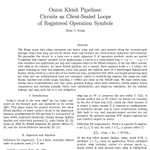
• Onion Kleisli Pipelines: circuits as client-sealed loops over intermediate invoke symbols under entry-guard closure
• Non-transitive Chord: multi-predecessors & passive 1-hop bridge hints
• Authenticated CRDTs: per-operation writer proofs & actor-scoped water-filling
1
20
ICYDN, every major feature of Rings Network is documented in a rigorously structured academic-style paper.


2
40
Rings v0.40.0 is live — completing the security, resource-bounding, and liveness hardening for our 1.0 Milestone.
Over the past cycle, we systematically closed every open adversarial surface across DHT storage, offline relay custody, and Onion routing — backed by algebraic invariants and exhaustive Stateright model checking.
What shipped in v0.40.0 (WIRE_VERSION = 3):
1. Per-Origin DHT Provenance & Fair CRDT Retention
• Cryptographic Write Attribution: EntryVersion now binds every element dot and reset register to its authenticated origin. Cross-origin Overwrite and Tombstone attempts are rejected at admission, while replicated state synchronization preserves valid multi-writer reset floors across TTL expiry and element retirement.
• Associative Fair Retention & Co-Author Witnesses: Replaced global tail-truncation with a (1, 1) per-writer round-robin selection over surviving element dots, paired with lossless 32-bit co-author dot witnesses. A single flooding writer can no longer evict other writers' entries, while CRDT join remains strictly commutative, associative, and idempotent — and backward-compatible on disk with existing FileStorage records.
2. Relay Custody Verification & Liveness
• Authenticated Holder Discovery: RelayHolderFound responses now require single-use correlation tokens and clockwise arc-monotonicity verification, preventing unsolicited or off-arc holder spoofing.
• Loop-Free Recovery Across Storage-Less Runs: Next-holder discovery carries explicit exclusion sets to advance strictly past suspected holders on single-successor rings, retains active transport connections to remote chain neighbours, and scopes cache invalidation to the preceding clockwise arc so recovering holders seamlessly rejoin without allowing unrelated peers to disrupt discovery.
3. Slot-Indexed Onion Admission & Sybil Defense
• Bounded SlotLedger (2·R Slots): Replaced per-DID admission ledgers with connection-slot-indexed SlotLedgers coupled to PeerRing edges. Rotating > 2·R Sybil identities within an admission window can no longer exhaust the link table or multiply per-window cell budgets.
• Cross-Subsystem Load Awareness & Churn Eviction: SwarmTransport now feeds live Onion slot floor usage into shared SlotRoster cleanest-first assignment, while disconnecting zero-cell links are evicted immediately and charged identities expire independently at q + S.
4. Entry-Guard Continuity
• Pinned Guard Persistence: Entry guards persist consecutive failure counts across restarts (with automatic legacy record migration) and remain pinned until the failure threshold is reached, preventing rapid guard-reselection capture under transient network churn.
• Permitted First-Hop Fallback: Health-ordered selection intersects strictly within the transport-permitted first-hop set before falling back to degraded direct peers when no healthy relay is reachable.
Formal Verification & Quality Gates
• 17 Stateright formal model-checking suites
• Seeded horizon-model interleaving proofs (NoLoss & NoResurrection)
• Deterministic sync-storm simulations & pinned wire golden vectors
Full release & code:
github.com/RingsNetwork/ring…
2
110
Rings v0.39.0 is out 🪐
A major release across the P2P overlay, Sphinx onion routing, WebRTC transport, and daemon reliability:
• Zero-downtime delegation renewal (#1153): Nodes now rotate session keys in-process before their signing horizon (`h' > h`), retaining expiring keys until `e` so in-flight E2E mail & onion hops open without an unsigned gap.
• Configurable Sphinx loop classes (#901): Selectable `OnionLoopClass` (`KiB4` / `KiB16` / `KiB64`) across native API, JSON-RPC, and WASM browser clients.
• End-to-end encrypted Browser Mail (#1160): Native WASM E2E mail sealing, sending, and inbox fetching in the browser provider.
• SDP-aware WebRTC framing (#1130): Negotiates `a=max-message-size` (RFC 8841), adapts chunk sizing to `min(local, remote)`, and drops oversized frames before reassembly.
• Chord & DHT hardening (#1067, #951, #773, #1139): Concurrent join stabilization, bounded repair concurrency, Weibull-session churn verification (`N=64`), and pinned v2 wire goldens.
• One-line cross-platform installer (#699): Signed release archives + SHA-256 verification for Linux (x86_64 musl / aarch64) & macOS.
Release & changelog:
github.com/RingsNetwork/ring…
Rings 0.38.0 is out.
• Email at did@domain for any node, browsers too, with no mail server of its own
• Node-wide bounds on received frames
• Nodes exit at delegation expiry
Wire v2: upgrade all nodes together.
github.com/RingsNetwork/ring…
Upgrade notes: github.com/RingsNetwork/ring…

2
63
Rings Network 💫 retweeted

LispM Remote is back.
0.3.0 runs on Rings Network 0.37. Your phone reaches the agents in your Lisp Machine again. No server in between.
- Update in the App Store
- Pair once more: M-x lispm-remote-pair
- Version mismatches now say which side to update
lispm.ai/remote
Rings 0.37.0:
• Versioned wire: mismatched nodes refused by name
• Offline mail replicated across 8 nodes
• Per-connection load bounds
• Removed data stays removed
• ~36% less CPU on onion links
Breaking: upgrade all nodes together; clear stores.
github.com/RingsNetwork/ring…
4
188
Rings v0.36.0 is out:
• Every node gets a DNS name, <did>.<zone>, via the new DNS relay
• Relay mail routes past nodes with no relay store
• Replay protection now requires a durable store
The handshake changed, so upgrade all nodes together.
github.com/RingsNetwork/ring…

1
45
Rings Network 💫 retweeted
LispM Remote: your AI agents, from your phone.
Scan a QR code once. Then follow every agent, approve its tool calls, send the next task and open LispM’s windows, from anywhere.
Peer to peer over @RingsNetworkio. No server in between, sealed end to end.
LispM is an open-source Lisp Machine for AI agents, built on Emacs.