Root image analysis for the rest of us. Free, open-source, C++, OpenCV, Qt, extensively validated. By @rootphenomics @LarryMattYork @aseethepalli
Joined August 2020
- Tweets206
- Following0
- Followers807
- Likes47
Pinned Tweet
The RhizoVision website now includes sections about imaging on a flatbed scanner or with a camera for root crowns that hopefully increase the accessibility of these methods by covering common questions. More below.
Please let us know if we can improve. rhizovision.com/imaging
RhizoVision is at #plantbio2024 . Check out poster 1000-12 on new methods for RhizoVision.
Have your own poster with RhizoVision or see other posters that use it? Let us know the title, ask the author share a pic! Just tag @rhizovision and it will be shared!
Thanks for using RhizoVision! Fantastic to see this great project investigating wheat roots.
Setting up the studio for #root phenotyping with @RhizoVision @JohnInnesCentre only a few hundreds photos 📸 ahead! good luck Acacia & @Looking_at_soil
RhizoVision Explorer retweeted
Setting up the studio for #root phenotyping with @RhizoVision @JohnInnesCentre only a few hundreds photos 📸 ahead! good luck Acacia & @Looking_at_soil
RhizoVision Explorer retweeted
Best wishes for the coming holidays from the @EJPSOIL WISH-ROOTS team @JohnInnesCentre - best #Christmas card ever?! inspired on our #root scanning for @RhizoVision
RhizoVision Explorer retweeted
Enjoying looking at the root systems diversity in the EDPIE panel @CIMMYT
Using @RhizoVision to explore all the interesting root traits!
RhizoVision Explorer retweeted
Roots of both barley sp grew faster with disturbed soil microbiome providing evidence of their abilities to partially compensate for the lack of microbial help by self-exploration/exploitation. thanks to @LarryMattYork @ASeethepalli for @RhizoVision and @Abe_404 for #rootpainter.
Or use RhizoVision Explorer 😎
Here's a neat trick from integral geometry - a beautiful topic that bridges geometry, probability and statistics.
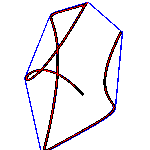
Let's say you have some curve with a random shape, possibly even self-intersecting. How can you measure its length?
This isn't just a parlor trick - it has many practical applications. For example, the curve could be a strand of DNA or a twisted length of wire.
You can think of the curve as a collection of tiny segments of course. You can then measure each segment and add up the results. OK, but you can go further and take the segments to be so small that they are almost like points. You can then add up the (red) "points".
In practice, this is not altogether easier. So we need a more convenient mechanism for doing this. One way to do it is to drop lines that intersect with the shape and count the number of intersections. You can do this with a mesh or a grid too.
The curve's length is the sum total of intersections n(ρ,θ) of all lines (in polar coords) with the curve (counting multiplicities).
This is the beautiful Crofton formula:
Length = 1/2 ∫∫ n(ρ,θ) dρ dθ
The 1/2 is there because oriented lines are a double cover of un-oriented lines
If this looks a little like the Radon Transform from tomography (CT scans and x-rays) it's because it is. The Radon transform can be viewed as a measure-theoretic generalization of Crofton's formula!
Crofton's formula has higher dimensional analogs too that also allow for computing surface areas, not just arc lengths. It even generalizes to Riemannian surfaces; where the integral is over a natural measure on the space of geodesics.
The classic text on the topic is Luis A. Santaló 'Integral Geometry and Geometric Probability'
There's also a terrific set of introductory slides that are great as a starting point to learn about this beautiful subject.
math.utah.edu/~treiberg/IntG…
RhizoVision Explorer retweeted
Forgot to tell my committee but I want to do simple root characterization with @RhizoVision if possible, but that depends on legume and cereal roots being easy to separate
RhizoVision Explorer retweeted
Setting up RootPainter with google colab and google drive on windows 11 youtu.be/HuSujZQOkQw via @YouTube
Whether artificial or real root images, RhizoVision Explorer is up to the task. Happy #WorldBiodiversityDay
Happy #WorldBiodiversityDay!
Remember that soils contain a lot of biodiversity. They're probably the most biodiversity-dense ecosystem.
And this biodiversity works for us.
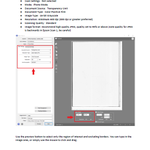
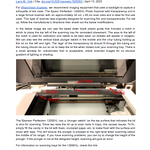
Have a scanner and some trays and want to know how to get the best scans? Check out this scanning guide for both the 12000XL and its smaller cousin the v850:
zenodo.org/record/7825894#.Z…
Finally, we are frequently asked about how to set the scale for physical units. Check out this guide applicable to using a scanner or camera for measuring roots. zenodo.org/record/7825935#.Z…
RhizoVision Explorer retweeted
Thank you @LarryMattYork for the great insights on high-throughput root phenotyping and life-hacks for @RhizoVision ! Looking forward to more exciting seminars at @PSUPlantScience
RhizoVision Explorer retweeted
First root scan analyses using the open-source @RhizoVision
I was afraid, moving away from Winrhizo would mean spending too much time getting familiar with a different software.... How wrong I was! RhizoVision is accurate and so easy to use!
RhizoVision Explorer retweeted
Wow !
Have a good time with @RhizoVision. Batch analysis has an excellent feature.
Thanks to you.
RhizoVision Explorer retweeted
Thank you! Competition can be important for innovation but as an open source community with limited resources we can cover more ground by building tools that compliment rather than replace each other.
Thanks to Abe for continued development of #RootPainter and for being a team player towards developing an ecosystem of open tools for roots! 👏