


RELAI retweeted

🚀 Harness optimization got open-weight agents to frontier-level performance at ~3% of the inference cost.
Three models. Three failure modes. Three different fixes.
The harness mattered more than we expected.

RELAI retweeted
Can harness optimization make AI agents better and cheaper?
Using RELAI across GPT-5.5, Claude Opus 5, and Gemini 3.5 Flash, we improved task quality while reducing inference cost.
Full results in the article ↓

RELAI retweeted
Sharing a short recording of my talk from the Berkeley RDI Agentic AI Summit 2026 on verifiable continual learning for AI agents.
I cover what continual learning is, why it is becoming a new frontier for agentic AI, and how RELAI helps agents learn continuously and verifiably across prompts, tools, memory, workflows, and models.
As AI agents move from demos to production systems, the key challenge is no longer whether they can solve a task once, but whether they can keep improving from failures and feedback without introducing regressions.
Learn more about RELAI: relai.ai
RELAI retweeted
The RELAI team and I are excited to attend the Berkeley RDI Agentic AI Summit 2026 this week!
We’re honored that RELAI has been selected as a featured startup in the Berkeley Xcelerator cohort.
Looking forward to an incredible lineup of speakers from OpenAI, Google DeepMind, NVIDIA, Amazon, Databricks, Microsoft AI, and many others, including Andrew Ng, Wojciech Zaremba, Ali Ghodsi, Dawn Song, Sergey Levine, and Peter DeSantis: rdi.berkeley.edu/events/agen…
If you’ll be at Berkeley and are interested in continual learning for AI agents, stop by and say hello. We’d love to show you how RELAI helps agents continuously improve from evaluation and production failures while preserving what already works.
Looking forward to seeing many of you there!

RELAI retweeted
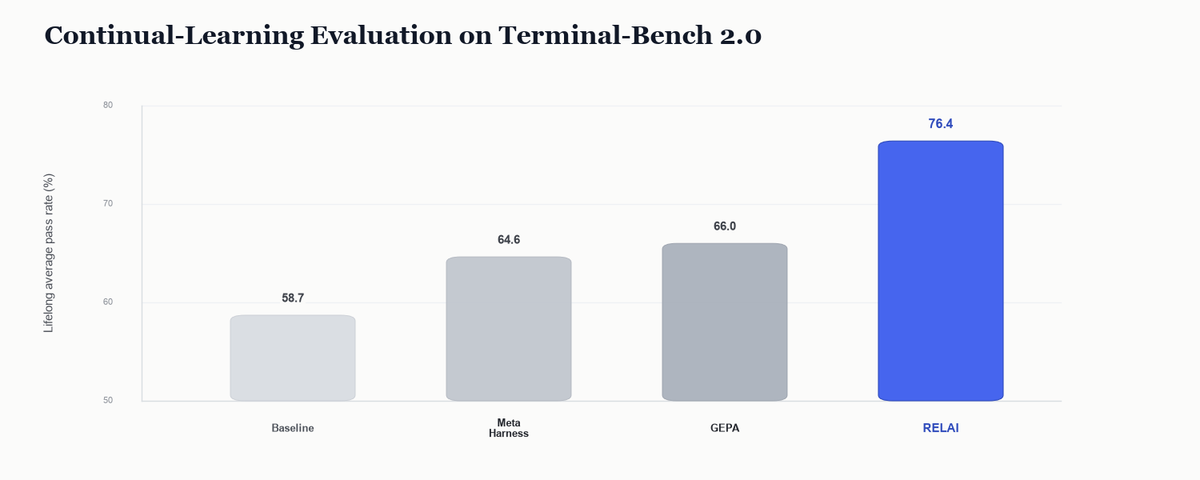
Current benchmarks miss the central challenge in agent optimization.
Most evaluations test one-shot improvement, while real-world use requires recursive optimization as new tasks continue to arrive.
To study this, we built a two-phase continual-learning evaluation on hard Terminal-Bench 2.0 tasks, comparing GEPA, Meta Harness, and RELAI.
The methods behaved very differently:
- GEPA improved initially but transferred negatively to unseen tasks, indicating overfitting.
- Meta Harness transferred well but could not continue improving.
- RELAI was the only method that both generalized to unseen tasks and improved again without regressing prior performance.
Full results are in the article below.
You can access RELAI’s continual-learning engine to run similar optimization studies and apply it to your own agents at relai.ai

RELAI retweeted
Thank you to @thecubetv for covering the launch of our continual learning platform! Sign up for early access at: relai.ai
siliconangle.com/2026/06/10/…
RELAI retweeted
Today, we’re launching RELAI’s verifiable continual learning platform for AI agents and announcing $6.9 million in total funding, led by @406Ventures.
Future agents will get better through experience. But today, most of that learning happens through vibes—not verification.
RELAI’s continual learning engine is built around four principles: make every failure replayable, improve without forgetting what already works, apply feedback to the right layer of the agent stack—prompt, tool, memory, workflow, model, or code—and keep the entire loop efficient enough to run continuously.
🚀 The best news: you can now add RELAI’s continual learning loop to your agents in just two commands.
👉 Now available in limited access. Join the waitlist at relai.ai.


RELAI retweeted
Our hiring agent has been at work 24/7. If you have not applied yet, now is the time. Please submit by April 30 for best consideration: relai.ai/careers
At RELAI, we built a self-improving hiring agent that talks with applicants to understand their background, past work and fit for our three open roles. Early on, it struggled a bit in both the infra and its “brain” but it kept getting better through feedback from applicants.
Its work does not stop there. After the conversation, the agent continues evaluating applications using submitted information and public sources. It then synthesizes everything to assess and explain each candidate’s fit for our roles.
So far, we have received more than 300 applications and the agent has preliminarily identified 100 strong-fits. Human interviews start soon.
We are building a star team to work on some of the most exciting and challenging problems in agent learning. Come build with us.

RELAI retweeted
🚀 Build AI agents that actually work — in just 2 hours!
We’re launching Reliable AI Agent Sprints—free, fully virtual sessions to build practical, reliable agentic solutions. This isn’t a flashy demo contest; we’ll design, simulate, evaluate, and optimize real agents, addressing the nuances and challenges end to end.
The sprints are open to everyone: students, builders, data folks, PMs, founders. No ML experience required (basic Python helps). We’ll share templates and all materials before each session.
For the first sprint, we’ll focus on an agentic RAG assistant—an AI agent that uses your documents and data to complete tasks. By the end, you’ll have a reliable agent, demos, and performance metrics.
We appreciate @googlecloud support with credits for Gemini and Cloud Run. RELAI @ReliableAI will also provide credits to simulate, evaluate, and optimize your agents.
Dates: Nov 11, 12, and 15 (identical sessions)
👉 Pick a session and register now — limited seats
Link: lu.ma/relai

RELAI retweeted
let’s talk instruction-following:
In prod, “did it follow the spec?” matters more than vibes. IFBench is a challenging benchmark to check whether agents/models obey unseen output/format constraints (length windows, HTML/Markdown rules, sectioning, etc.).
That’s a real reliability target: if your output violates constraints, downstream automation breaks.

Introducing Maestro: the holistic optimizer for AI agents.
Maestro optimizes the agent graph and tunes prompts/models/tools, fixing agent failure modes that prompt-only or RL weight tuning can’t touch.
Maestro outperforms leading prompt optimizers (e.g., MIPROv2, GEPA) on multiple benchmarks (IFBench, HotpotQA) with far fewer rollouts.
📄 Technical report: arxiv.org/pdf/2509.04642
🎯 Early access for select builders: comment under this thread or ping us at relai.ai

RELAI retweeted
Introducing Maestro: the holistic optimizer for AI agents.
Maestro optimizes the agent graph and tunes prompts/models/tools, fixing agent failure modes that prompt-only or RL weight tuning can’t touch.
Maestro outperforms leading prompt optimizers (e.g., MIPROv2, GEPA) on multiple benchmarks (IFBench, HotpotQA) with far fewer rollouts.
📄 Technical report: arxiv.org/pdf/2509.04642
🎯 Early access for select builders: comment under this thread or ping us at relai.ai
RELAI retweeted
How good (or bad) is GPT-5 — and does it matter for you?
I’ve been seeing a lot of posts lately debating the quality of GPT-5’s responses. I tried a few of the examples people mentioned. Here’s one from my own experiment (screenshot attached):
I asked GPT-5 to solve a simple arithmetic problem. It got it wrong. Then, when I allowed it to use a calculator tool, it got it right. So what does this tell us?
I think many people make a mistake in framing LLMs as some kind of “AGI in a box.” That’s not how they’re meant to work and honestly, it’s not helpful to think of them that way.
LLMs aren’t replacements for the thousands of sophisticated tools we already rely on in engineering, science, or other technical fields. They are language models: brilliant at pattern recognition, reasoning with context, and increasingly good at knowing when they don’t know something… and then using the right “tool” to get it right.
That’s why I believe the real future is AI agents as systems where the LLM is a crucial component, but the system’s strength comes from orchestrating other agents, models, and tools via APIs, MCPs, or even a bit of Python.
My favorite analogy:
LLMs are like bricks in a building.
You can have bricks of different shapes, sizes, and strengths but to make an amazing building, you still need tools, engineering, and expertise to assemble them into something greater.
The magic isn’t just in the brick. It’s in the architecture.

RELAI retweeted
Looking forward to the Agentic AI Summit in Berkeley!
If you’re working on agentic systems and interested in deep AI agent optimization, let’s chat!

Join us at Agentic AI Summit 2025 — August 2 at UC Berkeley, with ~2,000 in-person attendees and the leading minds in AI.
Building on the momentum of the 25K+ LLM Agents MOOC community, this is the largest and most cutting-edge event on #AgenticAI.
As 2025 emerges as the Year of the Agents, the summit offers a front-row seat to the breakthroughs shaping the future of #AgenticAI. Be part of the movement.
👀 Register for in-person or online attendance: rdi.berkeley.edu/events/agen…

RELAI retweeted
Honored to have contributed to the House Bipartisan Task Force on Artificial Intelligence's report. Learn more about it here: science.house.gov/press-rele…
Access the full report: speaker.gov/wp-content/uploa…
I hope this effort contributes to advancing AI that is reliable, safe, and accessible to everyone.