


Daphne Ezer retweeted

Harnessing within-cultivar variation to identify hidden genetic resistance using single plant-omics biorxiv.org/content/10.64898… #biorxiv_plants
Amazingly, even elite cultivars can contain hidden genetic variants that may unlock greater disease resistance: Check out this pre-print! biorxiv.org/content/10.64898…
Daphne Ezer retweeted

The new Plant Chronobiology Hub is here 🌱
Investigating diverse aspects of chronobiology, ranging from molecular genetics and transcriptional networks to mathematical modelling.
Apply now for MSc by Research starting Sept 2026
Deadline 1 May 2026
www-users.york.ac.uk/~de656/…

ALT Photo of a person in a blue lab coat in a greenhouse surrounded by plants
Variation in how plants absorb metals: from nutritious vegetables to phytomining (York YBDTP Project) at University of York on FindAPhD.com

Pushing energy-efficient urban farming to the limit using plant circadian clocks (York YBDTP Project) at University of York on FindAPhD.com
I'm pleased to announce two PhD openings in my lab: one focussed on intra-population heterogeneity and another focussed on plant circadian clocks.
Study helps urban farmers create 'light recipe' to increase crop yield phys.org/news/2025-07-urban-… via @physorg_com

Our plants can disco! We have a new protocol for effectively programming multi-channel LED lights. They have some really weird quirks you might not realise that may impact your experiment! biorxiv.org/content/10.1101/…

Daphne Ezer retweeted

Session 3 of our partnership with Daphne @RegulatoryNet from @BiologyatYork was fun. Here Class 3 are demonstrating how plants move. We are also super excited to have made (almost) new discoveries that will help scientists grow kale!

Daphne Ezer retweeted

We are excited to announce that the 4th Young Researchers' Symposium on Plant Photobiology (YRSPP) will take place from 15-18 April 2026 in Edinburgh, Scotland's beautiful capital city. 🪴🍃🏴
More details soon!
#YRSPP #YRSPP2026
#earlycareer #plantscience #photobiology

ALT YRSPP 2026 logo and 'save the date' announcement: 15-18th April 2026, Edinburgh, Scotland, UK
Take a look at our new pre-print: ELF3 controls trait heterogeneity in Arabidopsis and barley. doi.org/10.1101/2025.03.24.6…
I'm excited to be taking my MSc in Bioinformatics students (University of York) to present their work at #NorthernBug in Huddersfield. This year, they have a talk and poster! Still time to apply for next year!
How to make bioinformatics accessible for visually impaired students? Lillian made phenomenal resources for my class! blogs.york.ac.uk/digital-acc…

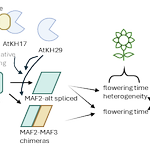
Sneak peak at my #ICAR2025 plenary: how synchronously seedlings respond to daylength changes is linked with how uniform they are at flowering, driven by GI, ELF3, prion-like domains in KH proteins and crazy chimeric MAF transcripts. biorxiv.org/content/10.1101/…

Daphne Ezer retweeted

Please share: We're hiring up to FIVE Postdocs or PhD students for a number of #plantsci #proteomics #genomics projects between my lab and that of Hervé Vanderschuren at @KU_Leuven & @UniversiteLiege!
Come join us in the land of 🍫 & 🍻 for some exciting science!

Daphne Ezer retweeted

Dear 🌱🧬 community, I am excited to share that I am recruiting PhD students for my lab at SBS, University of Auckland 🇳🇿! Our research will focus on the temperature regulation of the circadian clock in the legume M. truncatula, see comments below. Thanks for sharing!
Daphne Ezer retweeted
Please spread the word, we are still open for applications!
Find out more - bit.ly/4geU14D
#paidopportunities #GenerationResearch #summerstudentships


Our GenerationResearch Summer Studentships are LIVE!
6-12 weeks fully paid studentships available for students at the University of York and across Yorkshire (please check the projects for eligibility criteria)
Find out more: bit.ly/4geU14D
#GenerationResearch

ALT GenerationResearch Email address - generationresearch.ac.uk Photo of a female student pipetting in the lab. Green overlay boxes on the graphic.
Deadline extended for our PhD position. EPSRC Fully funded Project: Plant chrono-nutrition: Quantitative methods for improving the nutritional quality of fresh vegetables in urban farms at University of York on FindAPhD.com
American university students considering grad school: If you want to fill a year while you figure out what is going on with American science funding, I would consider the MSc in Bioinformatics at York, which is still accepting applications. (1/5)
The T4 visa enables up to 20 hours of part time work during term-time and full time work between terms. Instructors are conscientious that students often work. York is also cheaper than London. (4/5)