

Paul Burns, Pre Cinema Historian. Author, researcher and compiler of THE HISTORY OF THE DISCOVERY OF CINEMATOGRAPHY. I post daily here on X.
Toronto
Joined April 2016
- Tweets129K
- Following314
- Followers2.8K
- Likes64.3K





With 5,400 tickets sold in March alone, the math dictates 4000 cinema-goers saw his motion pictures that month.
After the Berlin performances, Anschütz set up in Carl Heckel's Concert Hall at Grossen Bleichen 32 in Hamburg.
And on and on went the moving picture presentations.


6/6
In 1898 flying man Otto Lilienthal wrote on page 148 in his book ‘Der Vogelflug als Grundlage der Fliegekunst’ (Birdflight as the Basis of Aviation); Which “art” was he talking about?
My thanks to Holger Anschütz. -30-

With 5,400 tickets sold in March alone, the math dictates 4000 cinema-goers saw his motion pictures that month.
After the Berlin performances, Anschütz set up in Carl Heckel's Concert Hall at Grossen Bleichen 32 in Hamburg.
And on and on went the moving picture presentations.

There's a new version of this post
Still, on 22 February 1895 in the 300-seat hall of the old Reichstag building at Leipziger Strasse 4, Anschütz showed 40 series of moving pictures including; two carpenters eating; skat players; and a barber soaping his customer just to name three.
The Anschütz Tachyscope pictured.


On 25 November 1894 Ottomar publicly showed life-size moving images on a 6 x 8 metre screen in the post office lecture hall at 12pm and in the afternoon to members of the Photographic Association.
This lasted until 30 November. Three frames from leap-frogging men pictured here.

Anschütz didn’t stop there. It was just the beginning. Between 19 - 21 March 1887 moving pictures were shown publicly to small groups of visitors on the darkened ground floor of the Ministry of Culture at Unter den Linden 4, in Berlin every day from 12 noon to 3 p.m.
In 1888, Ottomar Anschütz opened a photo studio in Berlin and publicly showed his moving picture Electrotachyscope in English and the Schnellseher in German--the "electric quick-viewer" or “quick-seer” as Holger Anschütz calls it.
1882-1894
OTTOMAR ANSCHÜTZ(1846-1907)
In 1882 Anschütz began fast-tracking towards moving pictures by photographing animals in motion.
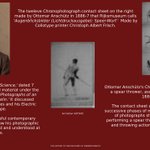
He Chronophotographed a stork according to Bernd Lukasch at the Otto Lilienthal Museum.
In a conversation I had with great grandson Guido Anschütz, he told me it was a Heron, and between 19-23 February he exhibited running horses and his flying bird in a Berlin ballroom. Animation Bernd Lukasch.
5/5
Quite interestingly the Demaria Pygmalion used on the inside of it’s inner workings, a ‘Vaucanson chain.’ Remember the Jacques de Vaucanson defecating duck?
His automaton contained that type of chain and was named after Vaucanson, pictured below.
After parting ways with his brother, Jules founded Etablissements J. Demaria in 1911 at 35 Rue de Clichy, Paris, registering the ‘JiDé’ trademark.
His company focused on professional cinema projectors and marketed some English Biokam cameras.
In 1912, he became president of the Chambre Syndicale de la Cinématographie, establishing himself as a key figure in French cinema during the 1910s and 1920s.
His firm was acquired by the Société Continentale de Photographie (Contipho) in the 1930s. -30-


Trutat continues from page 99:
“This jerky movement is given by a sort of articulated ratchet, the end of which successively pushes five pins which fit a disk, placed at the end of the cylinder shaft. The latter is hollowed out, pierced through to make it lighter and avoid as much as possible the effects of inertia in its alternating movements; it in turn carries two crowns of pins which penetrate into the holes in the film and drive it in a sudden and intermittent movement.”
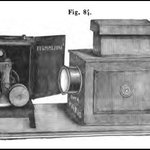
Left images are the projector and lamphouse figure 84, and the Pygmalion alone on the right figure 85, on pp 99 and 100.
THE PYGMALION
From Eugène Trutat in his book ‘La Photographie Animée’ published in 1899 and in his own words:
“An axle moved by hand a crank projecting outside the box, carries a pinned wheel which drives a Vaucanson chain.
This controls the main axle of the apparatus, an axle terminated at one of its ends by a flywheel responsible for regulating the movement, at the other by a small pulley which controls the drive axle of the reception reel.
In the middle of the shaft in question is wedged a toothed wheel which will mesh with a small diametre pinion which carries:
1. an angle wheel actuating the shutter
2. an eccentric carrying a connecting rod which gives the film drive cylinder a jerky movement, which produces the film stops during the opening time of the shutter and drives it the length of a frame during its closing.”
Image is figure 83 from page 99.
Jules Demaria became interested in cinema very early on due to his father. In 1897 he filed alongside Joseph Dubouloz [whom I have a separate series on], for a patent for "an improved device called a Zoograph, for the photography, observation and projection of animated scenes."

1893
THE PYGMALION
JULES DEMARIA (1865-1950)
Demaria was a French inventor and entrepreneur prominent in the early photography and cinema industries.
Born in 1865, he joined his father Isidore Demaria’s photographic business in Paris, which became Demaria and Fils in 1893 and later Demaria Frères (DMR) in 1897, including his brother Paul.
Jules developed an early interest in motion pictures, commercializing the Biographe Français as the Pygmalion in 1897 and patenting the Zoographe, a device for capturing and projecting moving images, with Joseph Dubouloz in 1898.
His father Isidore having worked in optics in Switzerland, brought his sons Jules and Paul to Paris and opened Demaria Frères in February. By 1897 the Pygmalion camera projector resulted.
1/1
‘The Illustrated London News’ published this as ‘Before the Curtain Falls’ in 1877. A year later it was published by Harper's Weekly on 2 February, 1878 as the caption reads ‘The end of the party. ’It’s an engraving nonetheless of a family night at home getting all excited right before bedtime. Engraved by Walter J. Morgan. -30-

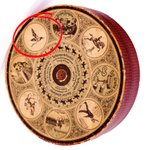
An 1867 -1868 Phenakistiscope disk published by H. G. Clarke of London. Incorporating the ‘Order of the Garter' within an original Chromotropic disk. Image the Richard Balzer Collection and the Magic Lantern Society.

Salvation Army Melbourne War Cry, 1894.
In the 1890s The Salvation Army Limelight Department was projecting Magic Lantern slides onto the sides of buildings in Melbourne to promote the Gospel Message.
The illustration from “All the world” (1 September 1894) depicts such showing in Little Collins Street one evening with slides accompanying the hymn ‘Rock of Ages’ adorning a building whilst a Salvation Army Band supports the singing by Salvationists and gathered Melbournians.
The glass-slide that is depicted in the illustration has survived 131 years having remained in The Salvation Army’s custody. The Museum holds four original slides from the ‘Rock of Ages.’

GALLOPIN' GAUCHO (1928)
Mickey, Minnie and Pegleg Pete star in this sound cartoon released August (without) and December (with sound) 1928. December release is shown.
Made for a little over $4K which most of Disney's early short animations cost. Runs 6:27


