

English teacher Proofreader
USA
Joined June 2014
- Tweets27.8K
- Following10.7K
- Followers50.6K
- Likes27.4K



Evil English 😈 retweeted
Yes, this is a common problem for English learners. Prepositions with places (especially airports, stations, schools) confuse many learners because English often uses [at] for locations rather than [in] (inside) or [to] (direction).
🧠Remember:
🔹Use “at” for dropping someone off.
🔸Use either “at” or “from” for picking someone up.
🔷Dropping someone off
Correct and most common:
“I dropped my daughter off AT the airport.”
You can also say: “I dropped her off at the curb / terminal / departures.”
“In the airport” is not natural here. “Drop off” means you take the person (usually by car) to the location and leave them there. We treat the airport as a point or destination, so we use “at.”
Saying “in” would sound like you left her inside the building in a more general sense, which isn’t how the phrasal verb works.
Examples:
▫️Can you drop me off at the airport tomorrow morning?
▫️She dropped her kids off at the airport before their flight.
(Note: Don’t say “drop off to the airport.” The preposition after “drop off” is normally at.)
🔶Picking someone up
Both are correct and very common:
“I picked up my friend AT the airport.”
“I picked up my friend FROM the airport.”
They basically mean the same thing.
[At] focuses on the location where the meeting/collection happens.
[From] slightly emphasizes that the person is coming from that place (origin).
“In the airport” is usually wrong or sounds odd for this meaning (it can literally sound like you’re lifting the person up while you’re both inside the building).
Examples:
▫️I’m going to pick my friend up at the airport at 3 p.m.
▫️Can you pick me up from the airport when I land?
✍️Note:
These are separable phrasal verbs.
When the object is a pronoun (me, her, him, us, them), put it in the middle:
drop her off
pick him up
❌(Not “drop off her” or “pick up him.”)
Practice sentences you can say:
▫️I dropped my daughter off at the airport this morning.
▫️Could you pick me up from the airport later?
▫️He dropped us off at the departures level and then drove away.
▫️My brother will pick me up at the airport when I land.

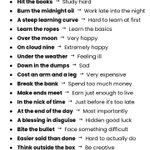
Everyday English Idioms
🔷Studying & Learning
🔹Hit the books
= Study hard (usually for a test or project).
Example: “I have a big exam tomorrow, so I’m going to hit the books tonight.”
🔹Burn the midnight oil
= Work or study late into the night.
Example: “She burned the midnight oil finishing her essay.”
(Origin: people used oil lamps late at night.)
🔹A steep learning curve
= Something that is hard to learn at the beginning.
Example: “Programming has a steep learning curve, but it gets easier.”
🔹Learn the ropes
= Learn the basic skills or how things work in a new job/situation.
Example: “It took me a month to learn the ropes at my new job.”
🔷Feelings & Emotions
🔹Over the moon
= Extremely happy.
Example: “She was over the moon when she got the scholarship.”
🔹On cloud nine
= Extremely happy (very similar to “over the moon”).
Example: “He’s been on cloud nine since he proposed.”
🔹Under the weather
= Feeling a little sick.
Example: “I’m a bit under the weather today, so I’m staying home.”
🔹Down in the dumps
= Feeling sad or depressed.
Example: “He’s been down in the dumps since he lost his job.”
🔷Money
🔹Cost an arm and a leg
= Be very expensive.
Example: “That car costs an arm and a leg!”
🔹Break the bank
= Spend so much money that you have none left (or almost none).
Example: “Don’t buy that watch — it will break the bank.”
🔹Make ends meet
= Have just enough money to pay for the things you need.
Example: “With two jobs, she can barely make ends meet.”
🔷Time & Importance
🔹In the nick of time
= At the last possible moment (just before it’s too late).
Example: “We caught the train in the nick of time.”
🔹At the end of the day
= When everything is considered; the most important point is…
Example: “At the end of the day, family is what matters most.”
🔷Challenges & Solutions
🔹A blessing in disguise
= Something that seemed bad at first but turned out to be good.
Example: “Losing that job was a blessing in disguise — I found a better one.”
🔹Bite the bullet
= Force yourself to do something difficult or unpleasant.
Example: “I hate the dentist, but I have to bite the bullet and go.”
(Old origin: soldiers used to bite a bullet during surgery without painkillers.)
🔹Easier said than done
= Something sounds simple but is actually hard to do.
Example: “Saving money is easier said than done.”
🔹Think outside the box
= Think creatively; find new or unusual solutions.
Example: “We need to think outside the box to solve this problem.”
🔹Go the extra mile
= Do more than what is expected; make extra effort.
Example: “She always goes the extra mile for her customers.”
✍️Quick Tips✍️
🔸Most of these are informal. They’re perfect for conversations, emails with friends/colleagues, and everyday speech, but avoid them in very formal academic or business writing.
🔸Many come in pairs that are almost the same (“over the moon” / “on cloud nine”). Learn one well first.
✏️Practice by making your own sentences and saying them out loud.
🔸Pay attention to articles and prepositions (“under the weather,” “on cloud nine,” “in the nick of time”).

Evil English 😈 retweeted
Polite Ways to End a Conversation With a Friendly Goodbye
Ending a conversation politely is just as important as starting one well. Instead of saying a simple “bye” or “goodbye” every time (which can sometimes feel abrupt or too formal), English speakers often use warm, friendly phrases that show care and leave a positive impression.
✍️Note: These phrases are casual ways to say goodbye to a friend or family member. You probably wouldn’t use these in formal situations.
🔹Talk to you later.
= You’ll speak again soon (it suggests the conversation isn’t finished forever).
Example:
“I have to go. Talk to you later!”
This is friendly and optimistic.
It’s perfect when you expect to chat again relatively soon (later today, tomorrow, or in the near future).
It’s more casual than “Goodbye.”
🔹Take care
= A warm, friendly goodbye that also means “look after yourself” or “be well.”
Example:
“Have a safe trip. Take care!”
This one feels caring and kind.
People often use it when someone is leaving for a trip, going home, or when you simply want to show goodwill.
It’s polite and works in both casual and slightly more formal situations.
🔹Have a good one
= Have a good day (or a good rest of your day/evening).
Example:
“See you tomorrow. Have a good one!”
This is short, upbeat, and very common in everyday American English.
“One” refers to the day or the period of time ahead. It’s relaxed and positive.
🔹Catch you later
= An informal way to say you’ll see or speak to someone again.
Example:
“I’ve got a meeting. Catch you later!”
This is quite casual and friendly (similar in feeling to “Talk to you later”).
“Catch” here means “see” or “meet.” It’s common among friends, colleagues, or people who know each other well.
✍️Extra helpful tips✍️
🔸These phrases are mostly informal to semi-formal.
🔸They’re great with friends, classmates, coworkers, or people you see regularly. With strangers, bosses, or in very formal settings, “Goodbye,” “Have a nice day,” or “It was nice talking with you” may be safer.
🔸You can combine them with a reason for leaving to sound even more natural and polite:
“I have to run, but talk to you later!”
“It was great catching up. Take care!”
“I’ve got another meeting. Catch you later!”
🔸Body language matters: A smile and a small wave (as shown in the pictures) make these phrases feel warmer.
Other useful friendly goodbyes you can add to your list:
“See you soon / See you around.”
“Have a great day / weekend.”
“Talk soon.”
“All the best.”
“Take it easy.”


Evil English 😈 retweeted
Jump the Gun
= to act too early or to do something before the right or proper time.
Simple explanation:
Imagine a race. Runners wait for the starting gun (a special pistol that fires a blank to signal “Go!”).
If someone starts running before the gun fires, they have “jumped the gun.”
In everyday English, we use this idiom when a person starts something too soon; before they have all the information, before permission is given, or before the correct moment arrives.
Origin
The phrase comes from track-and-field athletics (running races). The starting signal used to be a real gunshot. Starting early was called “jumping the gun.” The expression then spread into general English to mean any premature action.
Example sentences
🔹Don’t jump the gun and buy the tickets yet; we haven’t decided the date.
🔹She jumped the gun by announcing the winner before the judges finished counting the votes.
🔹I jumped the gun and told my friends about the surprise party. Now it’s not a surprise anymore!
✍️Useful notes✍️
🔸It is informal and very common in spoken English.
🔸The verb is usually “jump” (present), “jumped” (past), or “jumping.”
🔸Similar expressions:
“act prematurely,”
“get ahead of yourself,”
“start too soon.”


Evil English 😈 retweeted
Words Often Confused
These pairs of words look and sound similar, so they often confuse English learners.
🔹 Especially vs. Specially
🔸Especially means “particularly” or “more than usual.” Use it to single something out as special or important among others.
Example: I enjoy all fruit, especially watermelon.
🔸Specially means “for a particular purpose” or “in a special way.”
Example: This gift is specially for you. (It was made or chosen with you in mind.)
✍️Tip: If you can replace the word with “particularly,” choose especially. If it means “for a specific reason/purpose,” choose specially. Especially is much more common in everyday speech.
🔹Farther vs. Further
🔸Farther refers to physical distance (how far something is in space).
Example: The park is farther from my house.
🔸Further refers to degree, extent, or additional amount (often more abstract).
Example: Let’s discuss this further.
✍️Tip: In American English, many people use farther only for distance and further for everything else. In British English, further is very common for both. When in doubt, further is safer in most modern contexts (and you can also use it as a verb: “to further your career”).
🔹 Older vs. Elder
🔸Older is the general comparative form of “old.” It works for both people and things.
Example: My brother is older than me. / This building is older than that one.
🔸Elder is mainly used for people (especially family members or to show respect). It is less common as a pure comparative and often appears in fixed phrases.
Example: She takes care of her elderly parents. (Note: “elderly” is the common adjective form meaning “old.”)
You can also say “my elder brother,” but “my older brother” is more frequent in everyday speech.
✍️Tip: Use older in most situations. Reserve elder/elderly for people, especially when talking about age with respect or family hierarchy. You rarely say “elder” for objects.
🔹Altogether vs. All together
🔸Altogether (one word) means “completely,” “entirely,” or “in total.”
Example: Altogether, 25 students came on the trip. / I’m not altogether sure.
🔸All together (two words) means “everyone or everything in one place/group at the same time.”
Example: The team got all together for a photo.
✍️Tip: If you can replace it with “completely” or “in total,” use the one-word form. If people or things are gathered in the same place, use two words. A quick test: “All of us together” → all together.
🔹 Beside vs. Besides
🔸Beside means “next to” or “at the side of.”
Example: Please sit beside me.
🔸Besides means “in addition to” or “apart from.”
Example: Besides English, she speaks French. / I don’t want to go; besides, it’s raining.
✍️Tip: Beside = location (physical position). Besides = “also” or “except.” Notice the extra “s” changes the meaning completely.
✍️Extra advice for sounding natural✍️
▫️Practice by making your own sentences with each word.
▫️Listen for these words in podcasts, movies, or conversations; native speakers use especially, further, older, altogether, and besides very frequently.
▫️When writing, double-check: one word vs. two words (altogether / all together) and the final “s” (beside / besides).


Action Verbs
🔷Breaking / Destroying Actions
🔹Pop
= A balloon or similar object bursts suddenly with a loud sound.
Example:
The red balloon popped when it hit the nail.
✍️Note: Often used with balloons, bubbles, or corks. The noun is also “pop” (the sound).
🔹Smash
= To hit something hard so it breaks into pieces.
Example:
She smashed the piggy bank with a hammer to get the coins.
✍️Note: Stronger and more violent than “break.” We also say “smash a window” or “smash a record” (idiom).
🔹Snap
= To break something suddenly with a sharp sound, usually by bending or pulling.
Example:
He snapped the stick in half with both hands.
✍️Note: Also used for fingers (“snap your fingers”) and for losing patience (“He snapped at me”).
🔹Shatter
To break into many small pieces (especially glass or fragile objects).
Example:
The vase shattered when it fell on the floor.
✍️Note: Common with glass, dreams, or silence (“The silence was shattered”).
🔷Tools, Electricity & Holding
🔹Tighten
= To make something tighter (a bolt, screw, lid, belt, etc.).
Example:
Use the wrench to tighten the bolt so it doesn’t come loose.
✍️Opposite: loosen.
Pronunciation tip: /ˈtaɪ.tən/ (two syllables).
🔹Spark
= To produce a small flash of electricity or fire (often when wires or metal touch).
Example:
The wires sparked when they touched.
✍️Note: Can also be a noun (“a spark”) or used figuratively (“spark an idea”).
🔹Grasp
To hold something firmly with your hand.
Example:
He grasped the rope tightly so he wouldn’t fall.
✍️Note: Stronger than “hold.” Also used for understanding (“grasp an idea”).
🔷Movement & Opening
🔹Stumble
= To trip or almost fall while walking because you hit something or lose balance.
Example:
He stumbled over the rock and almost fell.
✍️Note: Can also mean to speak with difficulty (“stumble over words”).
🔹Unfold
To open something that is folded (a map, paper, cloth, etc.).
Example:
She unfolded the map to find the path.
✍️Opposite: fold.
Pronunciation tip: /ʌnˈfəʊld/.
✍️Quick Tips✍️
🔸Many of these verbs are dynamic (they describe actions that happen, not states).
🔸Several are onomatopoeic (the word sounds like the action: pop, snap, smash, spark).
✏️Practice idea:
Describe the pictures in full sentences (“The boy is stumbling over a rock”) and then change them to past tense.
🔸Common collocations:
pop a balloon, smash a window, snap a stick, shatter glass, tighten a screw, spark a fire, grasp a hand, stumble on a stone, unfold a map.

Evil English 😈 retweeted
Damaged, Imperfect, or Non-Functional State of Everyday Objects
🔹It’s stained.
A stain is a dirty mark that won’t wash out easily (coffee, oil, ink, etc.). We say a shirt, carpet, or tablecloth is stained.
🔹It’s splintered.
Wood that has broken into thin, sharp pieces is splintered. You can also say a piece of wood has splinters.
🔹It’s dead.
For batteries, phones, or devices that have no power left, we commonly say “It’s dead” (or “My phone is dead”).
🔹It’s chipped.
A small piece has broken off the edge (especially of china, glass, or pottery). A cup or plate with a missing bit is chipped.
🔹It’s creased.
Fabric or paper that has unwanted fold lines is creased. We often say clothes or bedsheets are creased after being folded or sat on.
🔹It’s faded.
The color has become lighter or duller because of sun, washing, or age. Clothes, curtains, and photographs can be faded.
🔹It’s bent.
Something that should be straight is now curved or crooked (a metal bar, a spoon, a bike frame, etc.).
🔹It’s unplugged.
The electrical cord is not connected to the power source. (Note: the picture shows a coiled extension cord that is simply not plugged in.)
✍️Extra useful information✍️
🔸Many of these words are past participles of verbs used as adjectives:
stain → stained, splinter → splintered, chip → chipped, crease → creased, fade → faded, bend → bent, plug → unplugged.
🔸Common structure
Subject + is/are + adjective
“My phone is dead.”
“These jeans are faded.”
“The bowl is chipped.”
🔸Related everyday expressions you will hear a lot:
“My battery is dead.”
“This shirt is stained — I can’t wear it.”
“Be careful, that wood is splintered.”
“Don’t sit on the bed — the sheets are all creased.”
🔸Opposite / positive versions (useful for contrast):
clean / unstained, smooth / not splintered, charged / alive (for phones), intact / not chipped, smooth / not creased, bright / not faded, straight / not bent, plugged in.

