






Ray Douglas retweeted
The value of the IPOs of SpaceX, Anthropic and OpenAI is expected to surpass $5 trillion. “Now compare that with the entire history of IPOs from 1980 to 2025. The 3,365 tech companies that went public in that period were worth a combined $4.1tn when they started trading."

Stunning stat: "Anthropic’s investors are expecting the company to reach a valuation of $2tn when it goes public in the coming weeks. Add in SpaceX, which began trading at $2tn after its IPO in June, and OpenAI, which is considering raising money privately at $1.2tn ahead of a public listing next year, and these companies alone could be worth well north of $5tn. Now compare that with the entire history of IPOs from 1980 to 2025. The 3,365 tech companies that went public in that period were worth a combined $4.1tn when they started trading."
While I've written much about AI's transformative potential across sectors, I've always been dubious about how much value hyperscalers can seize enabling that transformation. As I dissect in my recent report on "The AI Trade" (sageroadresearch.com/collect…), it's not about user acquisition. OpenAI claims to have over one billion active users across its services and two million businesses using its AI models. Anthropic has claimed to have more than 300,000 business customers. The question is not whether they can bring users to their services, but rather how much average revenue they can generate per customer relative to the price of building and maintaining their models. The cost of compute is inflating at the same time competition is depressing token pricing power. That's a precarious dynamic when so much hinges on the success of two companies.
To again quote the report:
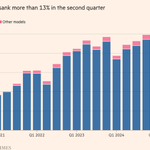
"It’s hard to overstate how much hinges on these IPOs. As mentioned in the Executive Summary, OpenAI and Anthropic will account for 13% of AWS revenue and 27% of Google Cloud revenue this year. As for Microsoft, OpenAI alone accounts for roughly 70% of its AI-specific revenue ($24.1 billion out of an estimated $34 billion total for the fiscal year ending in June 2026). OpenAI has committed to tens of billions of spending on chips from the likes of Nvidia and Broadcom. Deepening circularity concerns, tech giant earnings growth has been increasingly driven by paper gains in the private-market valuations of Anthropic and OpenAI. In Q2, Amazon, Alphabet, Nvidia, Meta, and Microsoft reported $160 billion in cumulative “other income”, trouncing the $69 billion in “other income” reported in Q1. To quote the FT: “These one-off valuation boosts, derived in large part from enthusiasm around AI, risk distorting the financial picture at a time when investors are closely scrutinizing tech earnings.” If either Anthropic or OpenAI stumble in their IPOs, it’ll hit tech giants on multiple balance-sheet fronts and likely ripple through the US and global economy. A pin-prick popping of the AI bubble may not be our base case, but if a pin is out there, it’s likely the revenue versus spending trajectories of Anthropic and OpenAI."
FT link: ft.com/content/8c4143c7-f846…

Ray Douglas retweeted

The US can't afford higher rates... Warsh knows that.
- In the next 12 months, ~$8T of USTs need to be rolled.
- The average coupon is ~3.3%.
- The US10y yield is ~5%.
Rolling that $8T at today’s US10y level would add $136B in annual interest costs, and that’s before you factor in the interest burden on an ongoing $2T annual deficit.
Volcker could crush inflation with double‑digit rates because inflation had already driven debt to GDP down from about 120% to ~30%.
Today we are back at 120%...
First you inflate the debt away, then you raise rates to kill inflation.
We are in the inflation part of the cycle... you know what that means

Ray Douglas retweeted

Stunning stat: "Anthropic’s investors are expecting the company to reach a valuation of $2tn when it goes public in the coming weeks. Add in SpaceX, which began trading at $2tn after its IPO in June, and OpenAI, which is considering raising money privately at $1.2tn ahead of a public listing next year, and these companies alone could be worth well north of $5tn. Now compare that with the entire history of IPOs from 1980 to 2025. The 3,365 tech companies that went public in that period were worth a combined $4.1tn when they started trading."
While I've written much about AI's transformative potential across sectors, I've always been dubious about how much value hyperscalers can seize enabling that transformation. As I dissect in my recent report on "The AI Trade" (sageroadresearch.com/collect…), it's not about user acquisition. OpenAI claims to have over one billion active users across its services and two million businesses using its AI models. Anthropic has claimed to have more than 300,000 business customers. The question is not whether they can bring users to their services, but rather how much average revenue they can generate per customer relative to the price of building and maintaining their models. The cost of compute is inflating at the same time competition is depressing token pricing power. That's a precarious dynamic when so much hinges on the success of two companies.
To again quote the report:
"It’s hard to overstate how much hinges on these IPOs. As mentioned in the Executive Summary, OpenAI and Anthropic will account for 13% of AWS revenue and 27% of Google Cloud revenue this year. As for Microsoft, OpenAI alone accounts for roughly 70% of its AI-specific revenue ($24.1 billion out of an estimated $34 billion total for the fiscal year ending in June 2026). OpenAI has committed to tens of billions of spending on chips from the likes of Nvidia and Broadcom. Deepening circularity concerns, tech giant earnings growth has been increasingly driven by paper gains in the private-market valuations of Anthropic and OpenAI. In Q2, Amazon, Alphabet, Nvidia, Meta, and Microsoft reported $160 billion in cumulative “other income”, trouncing the $69 billion in “other income” reported in Q1. To quote the FT: “These one-off valuation boosts, derived in large part from enthusiasm around AI, risk distorting the financial picture at a time when investors are closely scrutinizing tech earnings.” If either Anthropic or OpenAI stumble in their IPOs, it’ll hit tech giants on multiple balance-sheet fronts and likely ripple through the US and global economy. A pin-prick popping of the AI bubble may not be our base case, but if a pin is out there, it’s likely the revenue versus spending trajectories of Anthropic and OpenAI."
FT link: ft.com/content/8c4143c7-f846…


Ray Douglas retweeted

Les marchés actions sont finalement assez peu sensibles à la hausse des taux...
C'est à se demander où ils seraient si les taux n'avaient pas autant progressé ...

Ray Douglas retweeted

US small caps are stealing the spotlight.
After years of lagging behind, the Russell 2000 has surged 20% this year – putting it on track for its best performance since 2003 and comfortably outpacing both the S&P 500 and the once-unstoppable "Magnificent Seven".
What's changed? Investors are starting to question whether Big Tech's enormous AI spending will generate enough profits.
Instead, they're backing smaller companies that supply the AI boom, from semiconductor equipment makers to cloud infrastructure firms.
With US hyperscalers expected to spend roughly $725 billion on AI infrastructure this year, many smaller businesses are benefiting from the knock-on demand.
Tax cuts and rebates have also supported consumers and smaller companies, helping the US economy remain resilient despite higher energy prices.
There's also a valuation story. While mega-cap tech stocks look increasingly expensive, many profitable small caps still trade at relatively modest multiples, making them an attractive alternative for investors seeking broader market exposure.
But not everyone's convinced the rally is built to last. Critics argue much of the gains have come from speculative, loss-making companies rather than fundamentally stronger businesses.
If that's true, today's enthusiasm could prove more about AI-driven optimism than a genuine broadening of the US stock market.

⚽ Every World Cup 2026 match, live
All 12 groups, A to L | Knockout bracket on a toggle
Dark mode, fast, no ads, no bloat, just the whole tournament on one screen
Bookmark: raydouglas.co.uk/worldcup202…
#WorldCup 🇺🇸 🏴🇪🇸 🇳🇱 🇨🇦 🇵🇹 🇨🇭🇲🇦 🇵🇦 🇧🇪 🇿🇦 🇬🇭 🇯🇵

Ray Douglas retweeted

The big hyperscalers have pulled back on their stock buyback programs, but if their AI investments prove successful, they'll be back and above trend.

Ray Douglas retweeted
From John Plender's FT column:
"At the same time, Treasury funding is increasingly reliant on shorter-term securities, which means constant rollover risk. With US public debt approaching its highest ever level, this combination sounds like the very definition of a non-geopolitical financial chokepoint, with vulnerability to shocks. It also suggests there are now systemic risks in the Treasury market."
#economy #markets #bonds

Ray Douglas retweeted

One of the stated aims of US security policy is to ensure Europe becomes more right wing

Ray Douglas retweeted

Nvidia really isn’t a second Cisco. More featured on today's Chartbook Top Links in the comment below.

Ray Douglas retweeted

Chris Hohn built the world's most profitable hedge fund behind strong convictions. Yet, they're increasingly being tested ft.com/content/521d1861-82c5…

ALT Image: Chris Hohn. Credit: FT montage/Studio Grey
Ray Douglas retweeted
“Cut out and keep” for a reality check on fiscal positions and yields:
More featured on today's Chartbook Top Links in the comment below.

Ray Douglas retweeted

▫ Record low number of stocks driving Wall St bounce raises 'fears'
▫S&P up 12% since start of April
▫Five Big Tech groups propel rally
▫Analysts warn over sharp sell-off
▫Emily Herbert, @RayDouglasUK @J_Vincent_Viz
▫is.gd/oWYz2D
@FT #frontpagestoday #UK 🇬🇧

Ray Douglas retweeted
Regarding these latest charts from the Financial Times:
The question isn't whether US equity markets are better positioned than Europe to weather the impact of the war.
Between superior fundamentals and stronger technicals, the US clearly holds the edge—valuation gaps notwithstanding.
The big question IMO is whether the current levels of both markets are justifiable given the global economic outlook.
At this stage, market resilience is less about macro likelihoods and more of a bet on insulation due to big tech dominance, technical momentum, and entrenched investor conditioning.
More to follow.
#economy #markets


Ray Douglas retweeted
▫ Hedge funds ramp up wagers against European stocks as was casts shadow
▫Short positions surge
▫Region exposed to energy crisis
▫Low-cost airlines hit
▫UK an 'easy target'
▫Rachel Rees, @J_Vincent_Viz @RayDouglasUK
@FT #frontpagestoday #UK 🇬🇧

Ray Douglas retweeted

Suspicious high-volume trades before major POTUS announcements have been a disturbing pattern during the Trump admin.
Monday was no different as nearly half a billion $ in oil futures trading occurred irregularly just 15 minutes before Trump’s comments pointing to de-escalation in Iran.
CC @FT

Ray Douglas retweeted
The @FT’s @katie_martin_fx:
“It is hard, in that environment, to pick the market moves that really matter. This week’s wild ride in UK government bonds is, I think, one of them. It is an early warning sign of how a commodity shock, in oil and gas, can morph into a bond shock that hurts government finances far and wide and jacks up borrowing costs for us all.”
#economy #uk #markets #MiddleEastWar
