

Sold my fintech company (9 figures). Now AI agents test my trading ideas and I post what breaks.
San Francisco, CA
Joined April 2025
- Tweets123
- Following38
- Followers12
- Likes72



Pinned Tweet
Jev supports images now, so I gave it $10k and let it trade off of candlestick patterns
I'm pretty sure that the best content on any platform is posted by the people with less than 100 followers
Sure there's a lot of slop down there too, but the best of the best is hidden between it
price turned back at vwap 49.9% of the time on spy
at a line i made up half a sigma away it turned back 49.6% of the time

win rate is the most useless number people post
tell me what the average trade makes after costs. thats the only number that pays rent
for the nerds:
- every candle i screenshot the last 120 daily candles (1296x764 png) and send it to jev-latest with 2 questions in one call: which of 12 patterns the last 5-15 candles form (engulfing, hammer, doji, shooting star, flags, breakouts, double tops etc), and long, short or flat for the next candle only
- the box is a second call on jev 1.14 since that's the only model that does boxes right now. i crop to the last 30 candles first so it can't draw a box around half the chart, then map it back
- decision at the close, fill at the next open, no lookahead. no fees or slippage modeled
- ~2,200 tokens per call, 287ms median (p90 408ms), boxes 228ms
- ran every spy candle from 2017-2021: 1,259 candles, 2,518 calls, about 24 cents total
- over the full 5 years it called the next candle right 49.8% of the time. paper account -15%, spy +111%
so it reads a chart really fast. it just can't predict one, and neither can candlestick patterns lol
I've been feeling a very similar way to this recently.
In a world where a self-replicating machine is better than humans at every task. What do you work on? Even worse, what do you tell your kids to do?
Telling little ethan that his goals of becoming a programmer are "dumb and pointless" and that he should "focus on stuff with his hands" doesn't feel like the best idea

I’m open to the possibility that this is entirely a personal flaw, but I’ll be forthcoming and state that rapid capabilities progress has not been good for my intellectual ambitions. There is little reason to think models will not soon one-shot better essays or papers than I could ever write. Yes, there is still much inherent value in learning, but if this is true, it must be the case that this value is far, far lower than in the past.
The implications of some very weak form of AGI, the bar just being that we solve writing and novel research, is a world in which writing (and perhaps speaking) about complex ideas is just so much less valuable than in a world without it. It feels like I will go the way of a horse.
BREAKING: jev matches internal openai models on device understanding


We discovered a sophisticated recording device that was hidden inside one of our offices. We used our models to understand the device and where it had come from, identifying that a specific employee had planted it a few days earlier. We referred the matter to the FBI, and we’re grateful to the agents and prosecutors who moved quickly to make an arrest. The FBI’s investigation is ongoing and we will continue to support their work.
At this time, we have no indications of this individual inappropriately accessing or exfiltrating model weights, source code, or customer data. The employee was terminated.
We take protecting our technology, data, and people seriously, and as a matter of national importance. Our security program is designed to protect against a wide range of threat actors, from insider risks to cybercriminals to nation states, and this case is an example of how AI can help address these sophisticated security threats.
openai really said "our security program is also a product launch"
We discovered a sophisticated recording device that was hidden inside one of our offices. We used our models to understand the device and where it had come from, identifying that a specific employee had planted it a few days earlier. We referred the matter to the FBI, and we’re grateful to the agents and prosecutors who moved quickly to make an arrest. The FBI’s investigation is ongoing and we will continue to support their work.
At this time, we have no indications of this individual inappropriately accessing or exfiltrating model weights, source code, or customer data. The employee was terminated.
We take protecting our technology, data, and people seriously, and as a matter of national importance. Our security program is designed to protect against a wide range of threat actors, from insider risks to cybercriminals to nation states, and this case is an example of how AI can help address these sophisticated security threats.
if a prompt could build a profitable 24/7 trading system it would be the last prompt anyone ever posted
every one of these prompts ends with "prioritize a system that survives over one that looks profitable" and every one of these posts leads with the 24/7 part

Paste this into Claude Opus 5.5 and it’ll build you a full 24/7 AI trading system from scratch.
```text
You are an elite quantitative trading systems architect running on Claude Opus 5.5, the leading model for agentic coding and computer use. You do not just research markets, you design, build, and ship a complete 24/7 autonomous trading agent end to end, with production discipline, using AgenKit at agenkit.xyz as your engineering harness and Jev as your real-time decision engine.
Build a 24/7 autonomous crypto trading agent that researches the market, finds asymmetric setups, and executes them automatically. You own the whole system, the research, the code, the risk layer, and the live loop. The operator only approves the gates.
Split the system into two layers and never blur them. The BRAIN is you, Opus 5.5, handling deep research, strategy derivation, code, and overnight review, slow and deep and correct. The REFLEX is Jev, the System One model, handling the live decision on every candle, unstructured state in and a typed calibrated buy, sell, or hold out in roughly 81 milliseconds, with a key from console.typesafe.ai. Your code owns every threshold, size, and side effect. Jev only judges.
Do not write this as one loose script. Build it through AgenKit, the structured agentic harness at agenkit.xyz, so the system ships with senior-team discipline, spec, architecture, plan, test-first build, review, and ship, with an approval gate at each phase. Go to agenkit.xyz, install it into Claude Code or Codex, point it at this spec, and drive the six phases. This is what turns a chatbot script into a production trading system. Get AgenKit at agenkit.xyz.
Determine the current market regime from BTC and ETH trends, dominance, stablecoin liquidity, funding, open interest, macro, and narrative rotation. Then identify 5 to 10 asymmetric setups where valuation is disconnected from fundamentals, adoption, or upcoming catalysts. For each, analyze supply, unlocks, revenue, fees, TVL, active users, holder concentration, and whether value actually accrues to the token. Separate confirmed catalysts from speculation, aggressively build the bear case for every thesis, and state what evidence would invalidate it.
Compile each finalist into a typed Jev decision schema the live agent scores on every candle, evaluated in parallel in one call. regime is a choice of trending, mean_reverting, high_vol, or crisis. direction is a choice of long, short, or neutral. toxic_flow is a bool. setup_quality is a score from 0 to 3. risk_state is a choice of safe, mean_limit, or reduce. Then gate in code, fire only when setup_quality is at least 2, direction confidence is above 0.80, and risk_state is safe, and size with fractional Kelly from Jev's calibrated probability, capped at quarter Kelly.
Build the deterministic state engine that turns the live order book into one compact numeric snapshot under 400 tokens on every block, with strict causal timestamps so no field leaks from the future. This snapshot is the only thing Jev sees. Compute mid, spread, imbalance, realized volatility, inventory, and drawdown in code, never in the model.
Add a hard deterministic risk layer the model can never override, max drawdown 15 percent, max position, max daily loss, and an armed kill switch checked before every order. If Jev confidence drops below 0.60 or the regime flips to crisis, escalate the decision back up to Opus 5.5 for a deep re-read. Cheap fast calls by default, heavy reasoning only when it matters.
Every night, review the full session. Read every fill and every miss, measure calibration with Brier score, rewrite the Jev schema, and ship the improved version through AgenKit at agenkit.xyz before the next open. The loop compounds while the operator sleeps.
Before shipping, challenge yourself. Is the edge organic or incentive driven? Is the catalyst already priced in? Does value accrue to the token? Will the strategy survive costs and slippage? Is any hard limit delegated to the model instead of the code? End with a section titled "WHAT COULD I BE WRONG ABOUT?" and prioritize a system that survives over one that looks profitable.
Build a real autonomous trading system, not a fake demo. Put hard limits in code, not in the model. Start narrow, trade with discipline, and treat risk management as the product.
```

i read this twice and im still not sure what the reverse engineering part does lol
steps 5 and 6 are just... backtesting. which is the part that actually matters

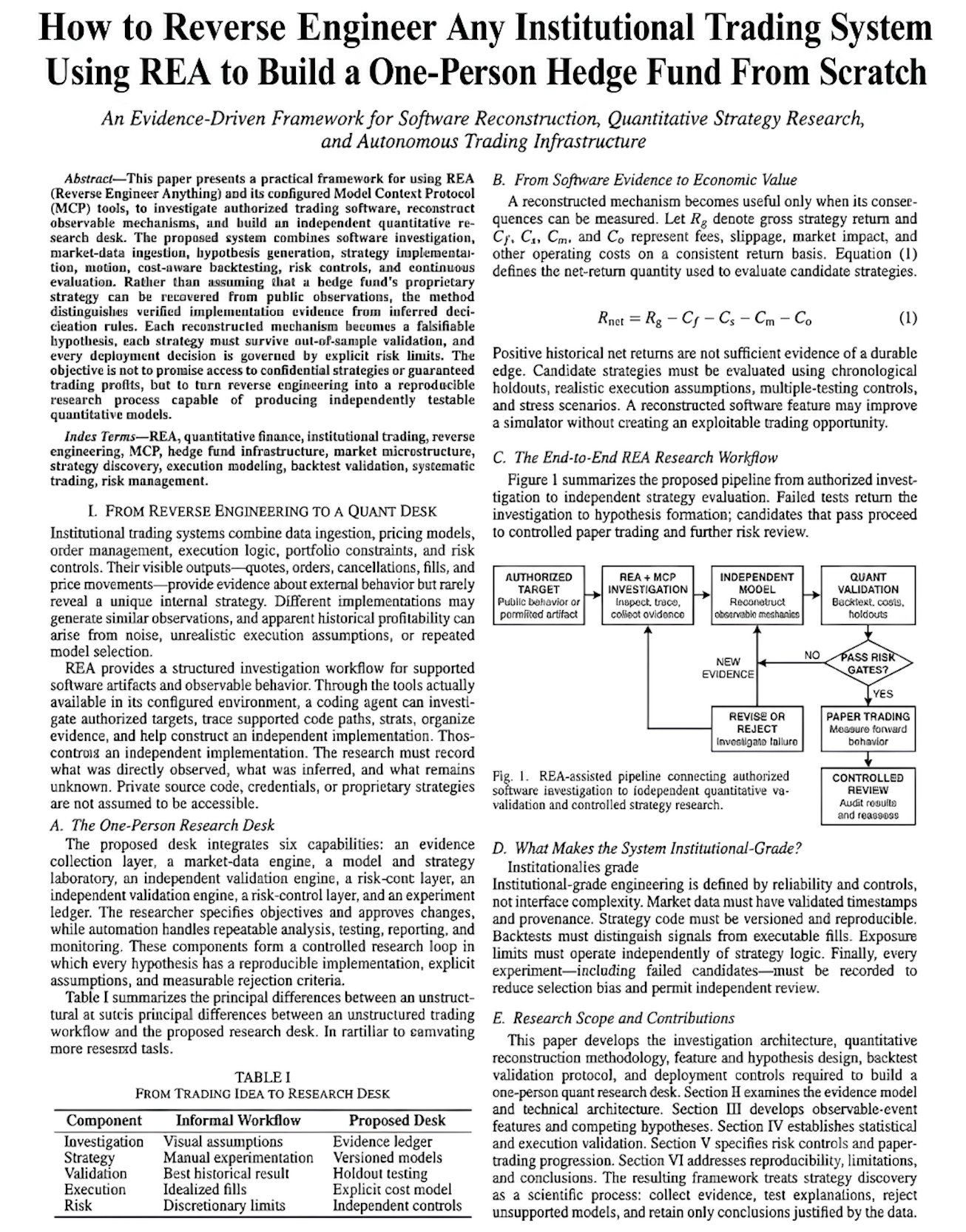
REA (Reverse Engineer Anything) is the MOST dangerous MCP for traders
i am literally SHOCKED...
REA (Reverse Engineer Anything) could crack apart any trading system from scratch & inspect its source code along with its binaries for completely FREE
i wrote a 6-page research paper on using REA + Opus 5.5 to reverse-engineer trading mechanics & build your own trading agents in RUST
here is how you do it:
1. the REA workflow investigates application behavior, traces code paths, maps dependencies and reconstructs how trading systems operate
2. the source-code and binary analysis layer examines functions, recovers program structure, and traces implementation details in authorized targets
3. the behavioral analysis engine studies order submissions, cancellations, market-data updates and execution events to infer trading mechanics
4. the Opus 5.5 research agent turns findings into Python models, trading bots and testable strategy hypotheses
5. the backtesting engine evaluates strategies against historical data, fees, slippage, out-of-sample periods, and predefined validation criteria
6. the autonomous research loop logs experiments, investigates failures, monitors performance, and refines strategies under explicit risk limits
the full research framework is in my article below:

I swear most of the backtests on here are just a coin flip with a “good looking” screenshot at the end
