

Race Reflections is a U.K. based social enterprise tackling inequality, injustice & oppression — join us in our quest to make society fairer & safer for all.
England, United Kingdom
Joined November 2020
- Tweets2.2K
- Following18
- Followers3.1K
- Likes765



My good people,
The Black Leader Power Matrix™
I have spend much time thinking about scholarly things, thesis things, metaphysics and all the rest, as I walk these last few steps to the finish line but I do not forget we exist within material and structural realities.
I want to remind you that we are here still in the real world, still operating in the clinical space, and still supporting the workplace.
To that end, I want to introduce to you to The Black Leader Power Matrix™
A programme designed to address some of racially specific experiences and challenges Black leaders navigate and the racialised structural dynamics that shape their workplace experiences and influence:
- Does your leadership programme addresses widespread resistance to Black authority/expertise and associated sabotage or envy?
- Does it recognise the ways group processes such as horizontal violence can lead to Black (and Brown) employees marginalising and being hostile to leaders who look like them?
- Does it speak to the impact of code switching and assimilation pressures on Black health and wellbeing?
- Does it make visible intergenerational stories around wealth, power & associated conflicts around community loyalty/ betrayal?
These are just a few of the issues a targeted Black Leadership Programme needs to delve into but which are still not mainstream and yet can influence career trajectories and workplace engagement.
Drawing on the RACE Matrix™, the Black Leadership Programme equips participants with greater clarity, confidence and practical strategies to lead effectively while Black within complex organisational systems.
Ultimately, the programme aims to support Black leaders in strengthening their leadership, expanding their influence and safeguarding their wellbeing, while creating the conditions for sustainable professional growth.
We’ll be planning an open day later in the week.
You can already read more about the programme here;
racereflections.co.uk/the-bl…

Reflections on Embodiment, Memory Bearers & recognition
Just met a man — likely Arab — who stopped me to say: “Any husband of mine should thank God every day he has me, for he can tell I am ‘special’.” He added: “You may think I’m crazy, but I can feel things. Protect your heart, as people will take advantage.” Then he walked away.
Remember the man who stopped me in the middle of Paris to say he could see a blue light all around me, stuttering as he tried to speak to me? Just two months ago, another stranger aggressively pursued me on public transport because “he could tell” I was gifted. Whatever is at work, it demands some attention?
Even if we take the view that this is all projection, then still: why do I ‘attract’ these kinds of projections? Projections, even in the classic psychoanalytic sense, do not happen in a psychic or intersubjective vacuum.
For context, these encounters began when I was in my mid-to-late teens, and they almost always come from people who want nothing from me, know nothing about me, and have no obvious reason to communicate this to me or think I would be interested.
For me, this line of thinking leads back to the Congo, and my spiritual understanding of the body as an archive. It also brings to mind that unsettling experience at the art market with Congolese art dealers — for those who have followed my work — where I wrote about a moment of mutual recognition. I was offered the sculpture Dancing Woman — a gesture I understood to mean: we see you; we are keeping things gentle; you have nothing to fear. I was undeniably shaken — by the weight of their gaze and the biographical relevance of their offering. When I frame this through Congolese metaphysics, it points toward a kind of energy that certain people are able to sense, perceive, and connect with.
In my framework of Afroanalytics, those who carry this kind of sensitivity are what I frame as memory bearers. I’m taking some theoretical shortcuts here, but the core idea is: memory bearers, and who I see as community knots, tend to hold this heightened perceptual capacity.
This is where it becomes fascinating intersubjectively: memory bearers and community witnesses can recognise each other perhaps through energetic attunement, a shared sensitivity to the unseen and the immaterial.
It turned out that the man who saw that blue light was a central figure in his community, I discovered, after I started interrogating the experience.
He occupied that role in a material sense. It seems he possessed that ability to perceive some things in the realm of the immaterial, something not visible to the naked eye, and indeed to all eyes. This is what Kongolese spirituality would invite us to conclude.
These ancient African conceptions we can find in the work of Carl Jung and Analytic Psychology — a connection I discovered earlier this year. Though it is not attributed to Africa, sometimes to indigenous belief systems. There is of course a point about extraction and sanitisation, which I also raised at the time. Jung did not articulate things exactly as I do, but there is a resonance in the idea that some people have a distinct, differentiated perceptual capacity to engage with the immaterial, unseen world.
So though I am not the first analytic thinker to engage with these phenomena, I may be the first to trace their genealogy through Kongolese metaphysics, and from there, to consider their function from a distinctly communal perspective — as something with a community purpose.
This thinking forms a core part of the argument I developed in my thesis, working toward a decolonial reformulation of how we understand (racial) traumatisation, inheritance and embodiment. Returning to the source, and taking seriously indigenous and indeed African, in this case Kongolese ways of understanding the world; arguably the most decolonial and radical form of knowledge production or I should say KNOWLEDGE RECLAMATION.
Intuition, transmission, and Afroanalytics
This morning, I reflected that I had not done much cultural exploration since being in Paris, so I planned to go and see some art.
My heart I wrote, was pulling me towards Africa — which brought to mind my Afroanalytic methodology.
I recalled my visit to the Musée des Cercles Africains in Pointe Noire, Congo.
I presented part of that experience during a talk at the University of Liverpool a year or two ago.
On my way to the museum, I had miscalculated the time, arrived only an hour before closing. I was having palpitations, frustrated by my own mistake and the thought I wouldn’t ‘have time’.
I knew I needed to ground myself, so I closed my eyes and told myself: calm down, then let your heart guide you.
I opened my eyes and walked straight to Thinking Man — I felt magnetically attracted to the piece of art that would become central to my thinking.
It embodies the idea that the heart is the centre of intelligence and ethical reasoning in the Kongo. I unpack the significance of this discovery in my thesis.
A point of note… I wrote art instead of heart at first, as I am still grappling with the relationship between art and the heart from an epistemological perspective.
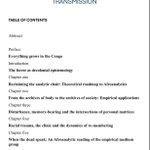
The discovery of Thinking Man was the moment that marked the beginning of my understanding that this thesis is about transmission. There is a fundamental challenge to dualism (which I elaborate on in the thesis) but there is also a call to take intuition seriously.
The figure of Thinking Man has a head shaped like a heart, with a hand resting over his chest.
Uncanny, right?
Not only because of the circumstances of the discovery…when I had just told myself to follow my heart but because years earlier, in my writing The world does not need more intelligent men, I argued that the real test for intelligence is ethical and moral courage.
In a nutshell I had already been writing about ancient Kongolese epistemology, without knowing I was writing about ancient Kongolese epistemology.
I wrote that piece nearly two years before that museum visit, long before I had deeply engaged with African metaphysics.
That moment was a turning point. Things started to fall into place, and this is also when the forest as epistemology started to be illuminated. I am no longer a huge fan of the language of “illumination” due to its colonial and modernist connotations but when I was lost in the forest repeatedly, it was dark.
Almost pitch black.
I could just make out the outline of trees. And each time I felt the urge to run away. Because I could not explain especially in supervision what was happening, I had no language or reference points.
My morning reflection led me to make another important link (I will need to include in my final draft) to confronting the mass, the framework I created to describe the affective reality of decolonial work as mourning work starting from the confrontation of indistinguishable bodies at sea forming a mass.
The forest, and the indistinguishable trees in the darkness, echo the shapelessness of the mass of bodies floating at sea, but also that urge to run, the projection of terror, are analogous.
And it is precisely what I argue in confronting the mass in my reformulation of mourning and melancholia. It is the shapelessness of the object — not necessarily that the object is obscured by the ego or repressed — that creates internal disturbances.
That internal disturbances arise because of the violence of the archive and the obscuring of the lost object, resulting in that mass becoming phobogenic and attracting projections of terror. In the same way I intuited that I needed to see, smell, kiss, feel, touch the body of my dead mother in order to let her go.
The Afroanalytic methodology strives to capture and legitimise: the associative, embodied, non-linear, spontaneous ways significant knowledge comes into being. I offer this an Illustration Afroanalytics in action.
A basic colour code/traffic system to help guide PhD students?
I want to share another piece of reflection which may be useful to those who supervise students.
It has not always been clear to me as a student whether I was meeting the standards. I accept I can get a little neurotic about needing that kind of certainty.
I say that with much kindness and respect to my current supervisory team, whose support has been invaluable over the last few years.
But oftentimes, I was uncertain where I stood with particular chapters. I felt overwhelmed by the comments and suggestions for improvement. I felt pushed really, REALLY hard — and to me, to be pushed means that the work is not up to scratch.
So for months I thought that I must not have done enough, that I had not met the expectations.
So when I had supervision yesterday, I was candid and I said, with as much kindness and compassion as I could find in my heart: “I don’t know where I stand because I feel that I’m being pushed constantly.” And then they said: “Yes, but we’re pushing you because we know this work can be exceptional. It already is in parts, it is already good now — but it can be even better.”
That immediately took me back to my dissertation during my group analytic training — a different supervisor and a different setting, but that exact same feeling of being pushed, pushed, pushed…endlessly.
Eventually I asked them too: “ Every time we speak, it feels like I’m being pushed harder and I just don’t know what level I am at? Is this a pass?” And they were like: “Oh, no you’re in distinction territory.” Like so mundanely, but I did not know. So I had been stressing for no reason.
Putting those experiences together has made me realise how valuable a concrete system would have been; especially for those who need more reference points or reassurance in terms of quality chapter per chapter and likely neurodivergent minds.
🔴 Red: You are not yet meeting standard, here’s what’s needed.
🟠 Orange: You’ve met the standard, the work is solid, but there’s much room to strengthen things, here’s what’s needed…
🟢 Green: You are well above the expected standard. You can refine, but you’re good, if you want to further improve here’s what you could do…
🔵 Blue: This is outstanding, exceptional work, there is no need to change anything.
I don’t think I would have stopped working anyway regardless because perfectionism …but I would have carried a very different kind of anxiety and relationship with the work.
I would have known when I was improving, versus when I was ensuring I was meeting the standard.
I think it’s easy to assume, particularly if you deem a piece of work solid, that the student knows, especially when their work is already strong.
But personally I would have found it so useful to hear/see clearly with each chapter: “You’ve met it,” or “You’ve exceeded it,” or “This chapter still needs work to meet the standard,” or “This chapter is exceptional.”. Sorry if the colour coding is pueril, the PhD process is complex enough, when things can be made simple, why not?
PhD reflections
I had what may be my penultimate supervision today, and I wanted to share some reflections with you. I’ve taken myself out to a nice restaurant — both to mark the moment, to take in the amazing feedback and to acknowledge all the work, soul and tears I’ve poured into this piece of writing.
It’s okay to celebrate mid journey!
We’re not there yet, but we agreed the rest of the road is mainly structure & presentation. I want to get more lyrical and return to the literary & to aesthetics, for example.
I wanted to raise a few points that I think matter, especially for Black women and women of colour doing intellectual and conceptual scholarship.
What really surprised me is that I was told — even at this late stage, so close to submission — that I’m not claiming my work enough, that I’m not taking sufficient ownership of my ideas and the significance of what I’ve developed.
This genuinely took me aback, because internally I feel the opposite: I worry I’m overclaiming! So interesting.
But they were clear: part of the PhD process is learning to stand confidently behind your contribution — not shrinking away from naming what you’ve achieved, and developed. I tend to write, I hear as though the model is already established, rather than acknowledging that I created it.
It felt uncomfortable to hear.
I realise this discomfort partly likely comes from my psychology training, where we’re often taught to be tentative, to use the passive voice, and to phrase things in particular ways — which perhaps says something in itself about whiteness.
But I was challenged to think about how deeply gendered and racialised that discomfort is. I agree.
I shared recently how I’ve been mocked in the past when I’ve engaged with certain ideas, especially for my interest in the philosophy of knowledge. Part of me wonders how much I’ve internalised even while I’ve been resisting it and continued to think.
Second: I was told my writing can be dense and complex and doesn’t give the reader enough breathing room — that I assume too readily that people will follow my arguments or that the intellectual ground is shared.
This isn’t the first time I’ve heard this, and it makes me pause, because I see myself as someone who not only writes publicly as part of my scholarship and activism, but also who tries to make complex ideas accessible.
So I’ve been asking myself: am I inadvertently becoming the kind of scholar I don’t want to be? And if so, what is happening? I do not want to drift into writing that is so obscure or impenetrable, the community does not engages.
At the same time, I don’t want to oversimplify ideas, and talk down to my readers; and not push people intellectually finding that balance is tough.
And finally: We started talking about what comes next — and I found myself completely unable to engage. I have not put much energy in this.
I think that’s what happens when you’re deep in the writing zone. When you’re that hyperfocused and adrenaline (and cortisol) loaded — your whole world narrows down to the work itself.
So when someone asks…What are you going to do next? Your mind just goes blank. I haven’t been able to look beyond finishing this piece yet. No firm plan. At least related to the PhD, I’m keeping all doors open. Nursing a few ideas.
That is all my good people, I think I’m starting to feel the energy of mourning as this chapter closes.
Again still a few steps to take but I want to thank all those who have supported this work, more soon.
My good people
I am so excited to announce that I have accepted a keynote invite at the inaugural Healing in the Circle of Life conference of the UK branch of the Association of Black Psychologists the Association for this April in (wait for it……….) Dominica.
The four days event which will focus on ceremony, movement, story, healing practice and the premise that knowledge doesn't only live in papers promise to be a great home for Afroanalytics…by then I would have of course submitted.
I am very to keen to present Afroanalytics to large American, Indigenous and African/African American audiences who sing from the same hymn sheet and forge links and connections.
I’ll speak alongside the most esteemed Black psychology theorists, which I am honoured to share space with; more details, soon, in case some of you join me in the Caribbean and come to support this important milestone for Afroanalytics.
Whoever has been following my work and suggested me for the keynote, thank you.
This is a significant one.
Good people,
UPDATE ON THE DECOLONIAL GROUP ON RACIAL TRAUMA
I want to take a moment to share some reflections on the decolonial racial trauma group’s first meeting a week or so ago, of course confidentially and therefore high level.
A small group of us met. We were from different parts of the world and different professional contexts, but it was clear that most came into the space to garner support, to think and rethink race dynamics and their impact, and to be held.
Which took us to the consideration of the problems with that split/delineation between the personal and the professional.
The issue of support is an ongoing consideration.
I think everyone was aware that there is a dearth of spaces where one’s experiences and understanding of racialised dynamics can be explored, and certainly not from a decolonial perspective.
Troubling racialised experiences were shared, particularly by people in the psychotherapy world, echoing my own experiences of training some 15 years ago. It’s depressing to me how so little has changed in so many places. It always makes me stop and think, and realise the full weight of what we’re dealing with and its stubbornness to change.
We started to think about how we might define racial trauma, whether we should even accept it as a meaningful descriptor of the cumulative impact of racial violence and injustice, what assumptions about the world are implicit in it, and what it might reproduce in terms of colonial discourses.
Is it possible to capture the impact of white/colonial violence without continuing the legacy of pathologising those with less social power and locating the dysfunction in Black and brown people?
These are the sort of questions that started us of, and I hope keep us grounded in the critical and questioning ethos of the group.
I want to remind you can still join us. If you are interested but hesitant don’t hesitate to get in touch.
racereflections.co.uk/new-re…
Still on this….
I have discovered liberatory theology in Latin America by accident and philosophers who made my very argument (Gustavo Gutiérrez or Enrique Dussel), in case you are interested.
I do feel some kind of way I was not exposed to their existence, plenty of reasons as to why I can think of not least because I primarily rely on Black/African thinkers, academic silos/disciplinary borders but also more importantly the aspiration of secularisation of knowledge production outside theology?
This is not a central argument for me for Afroanalytics …but it is a useful one, I think. Particularly in terms of the overlap with African metaphysics and again the bible which has through colonialism be formed as clashing episcopal traditions… so may use. That is all on this for now.
Back later.

I am still digesting the implications of that realisation/discovery for me, and I am still coming to terms with the fact how so many decolonial thinkers have started their criticism of what Mignolo calls the ‘zero point espistemology… everyone I have read, in fact… from this place of assumed biblical accuracy. It is so wild to me…but so have I.
And I think that is actually evidence of the very hegemony I am pointing to and its power.
But the argument I am making (I am learning others have made it within theological philosophy) re: falsification/paganisation of the gospel strips this sacred dualism of its theological defense, of this assumed biblical genesis and I would say collapse the Master’s house so to speak, epistemically.
A few thoughts on the relevance of the gospel to knowing, the body and social transformation
I have been following this critical Christian theorist on TikTok and came across an idea and links I make that I think are worth sharing (I will link the post below).
The popular understanding that when we die, the soul survives, is separated from our decaying body and floats off to heaven is not biblical. It is found in Greek mythology (likely popularised by Pluto? But he does not say so in his video).
The Gospel version is that we die and enter a period of rest. Then, at the end of times, heaven comes to earth and we are resurrected from the dead.
In summary, there is no great escapism from the body as corruption, the body as cage, or the body as ephemeral; the theorist said ‘we are created to have a body and will always have a body’ (Dr SC Williams). Heaven comes down to earth, and a new heaven and a new earth are created.
According to the Gospel, God come to earth as Jesus, and God will come again in the Second Coming. There is no ascent of the soul from the body into eternal time. The body and mind are one — always. The death of the body marks a temporal break from the course of history.
I thought this was fascinating epistemically.
I have always implicitly linked Cartesian dualism to that body–soul split thus imaginatively to the bible.
This is my own connection I must say, no one has ever taught me there was a link, and I have not read others on the matter, though I’m sure this connection must have been made, seems intuitive?
The correct Christian rendering of the relationship between the body and the mind changes how we understand not only death and heaven, if only symbolically for the non christian or non-religious, but also embodiment, knowledge and social transformation.
And this matters potentially given how much Christian beliefs or beliefs formed as Christian rather, have shaped theories of knowledge and scholarly hegemonies in the West.
If the body is not merely something we must escape to reach God, then perhaps this also implicitly challenges how we have come to understand intelligence, reason and our greater faculties in the Western, modern sense.
If the the body is not discarded or subordinated to reach a higher state of being, there are important cultural counter-messages, in terms of knowledge and social transformation.
1) The centrality of the aliveness of the body and vitality.
2) The body existing not merely a vessel to be transcended or discarded, but a fundamental part of human existence.
3) Human existence is necessarily embodied.
4) The need for the body and soul, and by extension, the body and mind, to be connected to reach social transformation, transcendance and higher state of being.
5) the argument I make in White Minds that dualism was a socio-political instrument that functioned as collective dissociation, when it came to the brutality of modernism … is sustained.
Of course scholars across disciplines and outside Western intellectual traditions have made these very arguments using different justifications. So I am not claiming these challenges are new, but I am saying they can surprisingly, it seems, be sustained by an accurate reading of the gospel.
Interesting, right? Or am I the only one who sees something here quite significant.
So much more could be said about the West "paganising" Christian beliefs…to serve the illusion of a disembodied, a-spacial and a-temporal rationality. This is not the point here, really, that is the most provocative I think.
It is not only that the body is sacred, essential to knowing and to transforming the world or that land or wholism matters…(all this is important but I think has been widely argued) but …
that the West can and is prepared to corrupt its own foundational texts/ideals when needed… that takes us back to the point I was making last week about whiteness as a-moral and as epistemically shifting; which I also touch upon in White Minds.
A few thoughts on the relevance of the gospel to knowing, the body and social transformation
I have been following this critical Christian theorist on TikTok and came across an idea and links I make that I think are worth sharing (I will link the post below).
The popular understanding that when we die, the soul survives, is separated from our decaying body and floats off to heaven is not biblical. It is found in Greek mythology (likely popularised by Pluto? But he does not say so in his video).
The Gospel version is that we die and enter a period of rest. Then, at the end of times, heaven comes to earth and we are resurrected from the dead.
In summary, there is no great escapism from the body as corruption, the body as cage, or the body as ephemeral; the theorist said ‘we are created to have a body and will always have a body’ (Dr SC Williams). Heaven comes down to earth, and a new heaven and a new earth are created.
According to the Gospel, God come to earth as Jesus, and God will come again in the Second Coming. There is no ascent of the soul from the body into eternal time. The body and mind are one — always. The death of the body marks a temporal break from the course of history.
I thought this was fascinating epistemically.
I have always implicitly linked Cartesian dualism to that body–soul split thus imaginatively to the bible.
This is my own connection I must say, no one has ever taught me there was a link, and I have not read others on the matter, though I’m sure this connection must have been made, seems intuitive?
The correct Christian rendering of the relationship between the body and the mind changes how we understand not only death and heaven, if only symbolically for the non christian or non-religious, but also embodiment, knowledge and social transformation.
And this matters potentially given how much Christian beliefs or beliefs formed as Christian rather, have shaped theories of knowledge and scholarly hegemonies in the West.
If the body is not merely something we must escape to reach God, then perhaps this also implicitly challenges how we have come to understand intelligence, reason and our greater faculties in the Western, modern sense.
If the the body is not discarded or subordinated to reach a higher state of being, there are important cultural counter-messages, in terms of knowledge and social transformation.
1) The centrality of the aliveness of the body and vitality.
2) The body existing not merely a vessel to be transcended or discarded, but a fundamental part of human existence.
3) Human existence is necessarily embodied.
4) The need for the body and soul, and by extension, the body and mind, to be connected to reach social transformation, transcendance and higher state of being.
5) the argument I make in White Minds that dualism was a socio-political instrument that functioned as collective dissociation, when it came to the brutality of modernism … is sustained.
Of course scholars across disciplines and outside Western intellectual traditions have made these very arguments using different justifications. So I am not claiming these challenges are new, but I am saying they can surprisingly, it seems, be sustained by an accurate reading of the gospel.
Interesting, right? Or am I the only one who sees something here quite significant.
Race Reflections retweeted
A few thoughts on the relevance of the gospel to knowing, the body and social transformation
I have been following this critical Christian theorist on TikTok and came across an idea and links I make that I think are worth sharing (I will link the post below).
The popular understanding that when we die, the soul survives, is separated from our decaying body and floats off to heaven is not biblical. It is found in Greek mythology (likely popularised by Pluto? But he does not say so in his video).
The Gospel version is that we die and enter a period of rest. Then, at the end of times, heaven comes to earth and we are resurrected from the dead.
In summary, there is no great escapism from the body as corruption, the body as cage, or the body as ephemeral; the theorist said ‘we are created to have a body and will always have a body’ (Dr SC Williams). Heaven comes down to earth, and a new heaven and a new earth are created.
According to the Gospel, God come to earth as Jesus, and God will come again in the Second Coming. There is no ascent of the soul from the body into eternal time. The body and mind are one — always. The death of the body marks a temporal break from the course of history.
I thought this was fascinating epistemically.
I have always implicitly linked Cartesian dualism to that body–soul split thus imaginatively to the bible.
This is my own connection I must say, no one has ever taught me there was a link, and I have not read others on the matter, though I’m sure this connection must have been made, seems intuitive?
The correct Christian rendering of the relationship between the body and the mind changes how we understand not only death and heaven, if only symbolically for the non christian or non-religious, but also embodiment, knowledge and social transformation.
And this matters potentially given how much Christian beliefs or beliefs formed as Christian rather, have shaped theories of knowledge and scholarly hegemonies in the West.
If the body is not merely something we must escape to reach God, then perhaps this also implicitly challenges how we have come to understand intelligence, reason and our greater faculties in the Western, modern sense.
If the the body is not discarded or subordinated to reach a higher state of being, there are important cultural counter-messages, in terms of knowledge and social transformation.
1) The centrality of the aliveness of the body and vitality.
2) The body existing not merely a vessel to be transcended or discarded, but a fundamental part of human existence.
3) Human existence is necessarily embodied.
4) The need for the body and soul, and by extension, the body and mind, to be connected to reach social transformation, transcendance and higher state of being.
5) the argument I make in White Minds that dualism was a socio-political instrument that functioned as collective dissociation, when it came to the brutality of modernism … is sustained.
Of course scholars across disciplines and outside Western intellectual traditions have made these very arguments using different justifications. So I am not claiming these challenges are new, but I am saying they can surprisingly, it seems, be sustained by an accurate reading of the gospel.
Interesting, right? Or am I the only one who sees something here quite significant.