

Medical doctor & engineer. I develop, evaluate and validate medical devices, and build the software that speeds it up. Learning & sharing in public.
Joined August 2011
- Tweets268
- Following510
- Followers142
- Likes1.2K




Pinned Tweet
I'm a medical doctor who moved into medical devices.
I develop, evaluate and validate them, and I write the clinical strategy to get them on the EU market: CER, CEP, SOTA, PMCF.
I also build software to do it faster.
I'll share all of it here.
4
261
The hardest part of being an entrepreneur is deciding what NOT to build.
As a medical doctor and engineer building software for the medical device industry, I constantly come across problems I would love to solve.
New ideas.
New products.
New opportunities.
But something that helped me was learning to focus.
One field.
One real problem.
One product at a time.
Especially in MedTech, where understanding the clinical needs, regulatory requirements and customer expectations already takes years.
You don’t need to solve every problem you identify.
You need to solve one problem exceptionally well.
If you’re a medical doctor building a company, a medical device founder or an entrepreneur building healthcare software, I’d love to connect.
Let’s build, share and learn together.
✌️ Peace, Hatem
3
1
76
If you’re a doctor, engineer, MedTech founder or simply someone building something, let’s connect 🤝
I’m a medical doctor and engineer.
I develop and review medical devices, build SaaS products for the MedTech industry, and share what I learn along the way.
I’m building in public.
Follow me if you’re interested in medical devices, AI, SaaS and entrepreneurship. 🚀

If you’re building something, let’s connect 🤝
I build SaaS products for the medical device industry, and I’m always up for meeting indie hackers, MedTech founders, SaaS builders and digital entrepreneurs.
I love connecting with people who turn ideas into products.

55
41
1,015
🚨 ISO 14155:2026 is now harmonised under the EU MDR.
And if you’re planning a clinical investigation, you should pay attention.
On November 10, the European Commission published Implementing Decision (EU) 2026/2479.
Among the updated harmonised standards?
EN ISO 14155:2026.
The standard for good clinical practice in medical device clinical investigations.
But here’s where things get interesting.
The previous harmonised version doesn’t disappear overnight.
Its withdrawal has been deferred until May 10, 2028.
So what does this mean for manufacturers?
Imagine you’re preparing a clinical investigation for a Class III medical device.
Your Clinical Investigation Plan is drafted.
Your monitoring procedures are ready.
Your clinical team is working with the previous version.
Do you need to throw everything away?
No.
But should you ignore the new version until 2028?
I wouldn’t.
I would start with a gap assessment.
Review the changes.
Identify which procedures and documents are affected.
Evaluate the impact on your ongoing and planned clinical investigations.
And document your decisions.
Because the question isn’t simply which version of the standard you cite.
It’s whether you can demonstrate that your clinical investigation is appropriately designed and conducted.
My question to clinical and regulatory affairs professionals:
Are you already transitioning to ISO 14155:2026, or are you planning to use the transition period?
✌️ Peace, Hatem
#MedicalDevices #ClinicalInvestigation #ISO14155 #EUMDR #ClinicalEvaluation
1
59
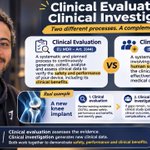
Clinical evaluation ≠ Clinical investigation.
If you’re a MedTech CEO, a Quality Director, or working in Regulatory Affairs, you need to understand the difference.
Because confusing these two can lead to the wrong clinical strategy.
Let’s start with the definitions.
1. Clinical evaluation (MDR Article 2(44))
A systematic and planned process to continuously generate, collect, analyse and assess clinical data.
The objective?
To verify the safety and performance of your medical device, including its clinical benefits, when used as intended.
2. Clinical investigation (ISO 14155:2026, Clause 3.9)
A systematic investigation involving one or more human subjects to assess the clinical performance, effectiveness or safety of a medical device.
In simple terms:
Clinical evaluation is the entire process of assessing your clinical evidence.
Clinical investigation is a study involving human subjects that generates clinical data.
Let’s take a real example.
You’re developing a new knee implant.
Your CEO asks:
“Do we need to conduct a clinical investigation to obtain CE marking?”
Before answering, you need to evaluate the existing clinical evidence.
You start with the clinical evaluation.
You define the intended purpose, clinical benefits and safety and performance endpoints.
You review the state of the art.
You identify the available clinical data, evaluate their quality and analyse whether they support your device’s claims.
Then you identify the gaps.
And perhaps you discover that existing data cannot adequately demonstrate the safety and performance of your new implant.
Now you may need a clinical investigation.
You design a clinical study, recruit patients and collect data on clinical outcomes, implant survival and complications.
Those results become part of your clinical evaluation.
See the difference?
Clinical evaluation asks:
“Do we have sufficient clinical evidence to demonstrate safety, performance and clinical benefits?”
Clinical investigation asks:
“How can we generate clinical data to address specific evidence gaps?”
And remember:
A clinical investigation does not replace clinical evaluation.
Clinical evaluation continues throughout the device’s lifecycle, including after CE marking.
A final point for CEOs:
Before allocating hundreds of thousands of euros to a clinical study, understand what evidence you already have, what evidence is missing and what the MDR requires for your device.
That is where a sound clinical evidence strategy begins.
✌️ Peace, Hatem
#MedicalDevices #ClinicalEvaluation #ClinicalInvestigation #EUMDR #MedTech

24
Sometimes, life reminds you why you chose to work in medical devices.
Every day, we talk about clinical evidence.
Clinical evaluation reports.
Safety. Performance. Clinical benefits.
We develop devices, evaluate technologies, and try to bring innovations to patients.
And somewhere along the way, we get lost in regulations, deadlines, and documentation.
Until life puts you on the other side.
And suddenly, you’re no longer thinking like a clinical evaluation expert.
You’re thinking like a human being.
Someone who hopes.
Someone who wishes medicine had a better answer.
A better treatment.
A better device.
And suddenly, the words “clinical benefit” mean something completely different.
Behind every endpoint, there is a person.
Behind every clinical claim, there is someone hoping it is true.
And behind every medical device, there may be someone whose life could change.
I’ve always believed in clinical evidence.
But life sometimes reminds us why that evidence matters.
To everyone developing medical devices:
Never forget the person waiting on the other side of your innovation.
Sometimes, that person could be you.
✌️ Peace,
Hatem
12
hatem rabeh retweeted
Sometimes, life puts you in a situation you never imagined you would face.
You hear about certain things happening to other people.
You feel sorry for them.
You try to imagine what they must be going through.
But deep inside, you think it could never happen to you.
Until one day, it does.
And suddenly, everything changes.
The future you imagined becomes uncertain.
The plans you made no longer seem so simple.
And you find yourself facing choices you never thought you would have to make.
Even with all your knowledge, experience, and understanding of life, nothing really prepares you for that moment.
But then, something beautiful happens.
You look beside you.
And you find someone who stays.
Someone who stands with you when things become difficult.
Someone who doesn’t need all the answers but is willing to face the uncertainty with you.
And in that moment, despite everything you’re going through, you realize something.
At least one choice you made in your life was the right one.
The person you chose to share your life with.
And that choice is forever.
People say life isn’t fair.
Maybe it isn’t.
Or maybe it is, in ways we don’t yet understand.
I don’t know.
But I’m learning that even in the most difficult moments, there can be something to be grateful for.
And sometimes, that something is simply the person standing beside you.
Be kind to people.
You never know what someone is silently going through.
With Love
Hatem
Your MedTech startup is based in Europe.
So you decide to get CE marking first.
That decision could cost you €500,000 and 18 months.
Your name is Marc. You’re 40.
You’ve raised €3 million.
Your clinical investigation will cost €450,000.
Then your investor asks:
“Why Europe first?”
You answer:
“Because we’re based here.”
He asks:
“Do we have a predicate device for FDA 510(k)?”
You don’t know.
“Would we need clinical data for US clearance?”
You haven’t checked.
“Can our European clinical study support an FDA submission?”
Nobody has assessed that either.
Silence.
You thought you were making a regulatory decision.
You were making a multimillion euro business decision.
And you made it without comparing your options.
Since MDR, some MedTech companies have started prioritizing the US.
For certain devices, a 510(k) pathway may offer a more attractive route.
For others, De Novo, PMA or European conformity assessment may require substantial clinical evidence.
And with proposed changes to the MDR, the landscape continues to evolve.
Now imagine spending €450,000 on a European clinical investigation.
Only to discover your endpoints don’t adequately address FDA expectations.
Another study?
Another budget?
Another delay?
Your clinical evidence strategy should come before your decision about which market to enter first.
From my experience as a medical doctor and clinical evaluation expert, I help MedTech companies answer these questions before committing their capital.
Because your clinical strategy affects your runway, your investors and your commercialization timeline.
The question isn’t simply Europe or the US first.
It’s:
Which regulatory and clinical evidence strategy gives your startup the best business opportunity with an acceptable level of risk?
✌️ Peace, Hatem
P.S. MedTech CEOs, are you planning FDA clearance or CE marking first?
#MedTech #FDA #MDR #ClinicalEvidence #MedicalDevices

1
37
Your medical device startup burns €100,000 every month.
Your clinical study is delayed by 6 months.
Do the math.
Your name is Alex. You’re 38.
You’re the CEO of a MedTech startup.
You’ve raised €4 million.
Your clinical investigation is scheduled for January.
Your commercial launch is planned for next year.
Then your clinical advisor asks:
“Why did you choose this primary endpoint?”
Your engineers chose it.
Because it’s easy to measure.
But does it demonstrate your claimed clinical benefit?
Nobody knows.
Your clinical team recommends revising the protocol.
New endpoints.
New sample size calculations.
New discussions with investigators.
Six months of delay.
Your CFO opens Excel.
6 × €100,000.
€600,000 in additional operating costs if your burn remains unchanged.
Your investors ask what happened.
You say:
“We had a clinical study problem.”
But you didn’t.
You had a business planning problem.
You committed to a costly investigation before defining what evidence your business actually needed.
From my experience as a medical doctor and clinical evaluation expert, clinical evidence strategy belongs in the business plan.
Because every month spent generating the wrong evidence is a month you cannot spend getting closer to market.
Your clinical strategy affects your runway.
P.S. CEOs, do you know how much a six month clinical delay would cost your startup?
#MedTech #ClinicalInvestigation #MedicalDevices #MDR

1
35
🚨 MedTech CEOs: Europe has millions available for innovation. Are you applying?
Clinical investigations. Medical AI. Regulatory preparation. Cybersecurity.
7 European opportunities worth checking before 2027.
💰 1. EIT Health: Up to €850,000
For clinical validation of digital and AI medical devices.
📅 13 January 2027
🔗 eithealth.eu/opportunity/inn…
🚀 2. EIC Accelerator: Grants below €2.5M + equity investment
For breakthrough MedTech and deep tech startups.
📅 Next full proposal deadline: 20 January 2027
🔗 eic.ec.europa.eu/eic-funding…
🔬 3. EIC Transition: Up to €2.5M
Turn eligible EU funded research into market ready technology.
📅 14 September 2027
🔗 eic.ec.europa.eu/eic-funding…
🧠 4. EU AI Factories: Free supercomputing access
For AI development, training and research.
📅 Applications ongoing
🔗 eurohpc-ju.europa.eu/ai-fact…
💻 5. FFplus: Up to €200,000
For SMEs adopting supercomputing to solve business challenges.
📅 14 to 20 January 2027, possibly earlier
🔗 ffplus-project.eu/en/open-ca…
🔐 6. SECURE: Up to €30,000
For eligible SMEs preparing for Cyber Resilience Act compliance.
📅 11 December 2026
🔗 secure4sme.eu/
🤖 7. Digital Europe: €3M to €5M per project
For AI powered cybersecurity solutions for SMEs.
📅 14 January 2027
🔗 cybersecurity-centre.europa.…
From my experience in clinical evaluation, funding clinical evidence can be one of the biggest challenges for medical device manufacturers.
Some of these opportunities could help.
⚠️ Each has specific eligibility and funding conditions.
Save this post. Share it with a MedTech CEO who needs funding.
✌️ Peace
Hatem
#MedTech #MedicalDevices #ClinicalEvaluation #EUFunding #DigitalHealth

1
49
Your medical device startup just raised €3 million.
You are 18 months away from discovering that you need another €1 million.
And the problem is not your technology.
Your name is Thomas. You’re 38. You’re the CEO of a medical device startup.
You’ve spent 3 years developing a revolutionary device.
Your engineers are brilliant.
Your prototype works.
Your investors are excited.
You have 12 employees and €3 million in funding.
Everything is going well.
Until someone asks:
“What’s your clinical evidence strategy?”
You smile.
“We’ll do a clinical study before CE marking.”
Simple.
Your regulatory consultant sends you a quotation.
€450,000 for the clinical investigation.
You approve it.
Six months later, your clinical team asks a question:
“What clinical benefit are we actually trying to demonstrate?”
You answer:
“Our device performs better than existing solutions.”
“Better according to which endpoint?”
Silence.
You organize another meeting.
Your engineers propose technical performance metrics.
Your clinicians propose patient outcomes.
Your investors want the fastest route to market.
Nobody agrees.
Three months later, you finally start the study.
Eighteen months later, the results arrive.
Good results.
You’re celebrating.
Then the notified body asks:
“How do these results demonstrate the clinical benefit claimed in your intended purpose?”
You send 200 pages.
They send 14 questions.
You answer.
They ask for additional clinical evidence.
Your regulatory consultant says:
“We may need another clinical investigation.”
Another €500,000.
Another 18 months.
Your investors are no longer smiling.
You call a clinical evaluation expert.
He asks you three questions:
1. What is the current state of the art?
2. What clinical claims must your evidence support?
3. What evidence gaps actually require new clinical data?
You realize nobody asked these questions before developing the study protocol.
Perhaps you needed a clinical investigation.
Perhaps you could have used existing clinical data for some claims.
Perhaps you needed a completely different study design.
But nobody built the clinical evidence strategy first.
You spent €450,000 collecting data.
Without first defining exactly what the data needed to prove.
Your problem was never the lack of a clinical study.
It was the lack of a clinical strategy.
I’m Hatem, a medical doctor and clinical evaluation expert.
I work with medical device startups to answer one question before they commit hundreds of thousands of euros:
Do you actually need a clinical investigation? And if yes, what exactly must it demonstrate?
Because the most expensive clinical study is the one that fails to answer the right question.
P.S. If you’re developing a medical device, let’s discuss your clinical evidence strategy before you launch your study.
#MedicalDevices #ClinicalEvaluation #MDR #MedTech #ClinicalEvidence

1
40

🚨 Another server is joining my home cluster.
My wife doesn’t know yet. 😂
And I’m not sure what’s going to arrive first:
💸 The electricity bill.
🏠 My eviction notice.
🔥 Or my next AI breakthrough.
Anyway, here we go again!
A new node joining my Proxmox cluster, with:
🧠 More than 80 GB of RAM
🎮 More GPUs
💾 More storage
🤖 More computing power for my local AI agents, automations, and experiments.
All of this running from home.
A few years ago, having your own AI infrastructure sounded crazy.
Today? You can build, experiment, deploy, automate, and run your own tools from your living room.
And that’s what I love about this era.
The barrier between having an idea and actually building it has never been so low.
You don’t need a massive team to start experimenting.
You need curiosity, a willingness to learn, and apparently a very understanding wife. 😂
Now, serious question for the homelab community:
How do you keep your electricity bill under control while running multiple servers and GPUs at home?
Asking for a friend. 👀
✌️ Peace,
Hatem
P.S. If you don’t hear from me next week, check whether my wife has listed my servers on Leboncoin. 😂


2
52
🚀 I just built and launched MedicalDeviceNavigator.com!
One website. Thousands of medical device resources. Completely FREE.
What’s inside?
🔍 5,000+ FDA medical device clearances
🏢 4,900+ medical device companies
📚 1,100+ regulatory resources and clinical guidelines
🏛️ 53 Notified Bodies
🌍 34 Competent Authorities
👨⚕️ 90 medical device experts
Plus regulatory news, FDA searches, medical societies, conferences, jobs, and more.
My idea is simple:
One place where medical device professionals can find the information they need.
But now I need your help.
👉 medicaldevicenavigator.com/
Please roast it. Seriously. 🔥
• Is the UI good or terrible?
• Is the UX intuitive or confusing?
• Are these tools actually useful?
• What’s missing?
• What would make you come back every week?
I’m a medical doctor and clinical evaluation expert learning to build software.
I don’t want compliments. I want honest, tough feedback.
If you could add ONE feature, what would it be?
Go ahead. Destroy my assumptions. 😂
Building in public. ✌️

4
63
End of the week. Stuck in Bucharest waiting for my flight. ✈️
A call with a quality engineer got stuck in my head.
Root cause? Human error.
CAPA? Retraining.
Problem solved? Until next Tuesday. 😂
So I wrote a song about it. 🎸
My first QA/RA hit!
What do you think? 🎶
1
1
54
We built this during a hackathon in Bucharest! 🚀
Meet ADHDCheck 🧠
The idea? A game that could help parents understand whether their child should be evaluated for attention difficulties.
Still an early prototype. Now we’re testing whether there’s a real market for it.
👉 adhdcheck-xi.vercel.app/
What do you think about the idea and the landing page?
Would you use it? Would you pay for it?
Roast it. Be honest. We need feedback, not compliments. 😁

4
3
323
WE WON THE HACKATHON! 🏆🇷🇴
At the Safe MedTech Challenge during BEHEALTH 2026 in Bucharest!
What made me happiest? Being surrounded by brilliant young minds, pushing them to dream bigger, and watching them WIN! 🚀
So proud of this team. ❤️

2
3
93
A new medical device game app is in development! 🎮🩺
Will share more soon! 👀
Man, what an exciting time to be alive! 🚀
Being a medical doctor, software engineer, and quality & regulatory expert, all in one brain…
One day I’m writing clinical evaluation reports.
The next day I’m building SaaS tools.
And now I’m developing a game about medical devices. 😂
Is it ADHD? 😆
Or just shiny object syndrome? ✨
What do you think, @marclou ( with your many start-ups )? 😂
Anyway, back to building!
#BuildInPublic #MedTech #IndieHacker

2
44
