
soft skill / futurist / investor
bangkok
Joined August 2009
- Tweets14.5K
- Following2.3K
- Followers263
- Likes2.7K


Kridhakorn retweeted

list of 15 best robotics researchers on X:
1. @DrJimFan, Jim Fan
2. @chelseabfinn, Chelsea Finn
3. @svlevine, Sergey Levine
4. @pabbeel, Pieter Abbeel
5. @drfeifei, Fei-Fei Li
6. @rodneyabrooks, Rodney Brooks
7. @0x_meden, Martin
8. @yukez, Yuke Zhu
9. @LerrelPinto, Lerrel Pinto
10. @SongShuran, Shuran Song
11. @tonyzzhao, Tony Zhao
12. @YunzhuLiYZ, Yunzhu Li
13. @xiaolonw, Xiaolong Wang
14. @GuanyaShi, Guanya Shi
15. @RemiCadene, Remi Cadene





Kridhakorn retweeted

poker is one of the most important cheat codes in trading. jeff yass trains susquehanna traders with it, and MIT turned it into an actual course.
8 lectures on poker theory and how it applies to investment management and trading. completely free.
the guest lecturers:
- bill chen, susquehanna quant, 2 WSOP bracelets, co-wrote the mathematics of poker
- aaron brown, AQR's chief risk officer at the time, wrote the poker face of wall street
- matt hawrilenko, ex-susquehanna, won a $1M WSOP bracelet
Kridhakorn retweeted

this is f*cking insane, Claude Code agents turned a reading list into a lab you can run in your browser
Boris Cherny (creator of Claude Code) gave 12 agents 64 research papers and one assignment: build a browser lab where readers can rerun the experiments
pick a fluid simulation, change the conditions and watch how the result changes
switch methods while keeping the same scene. inspect the equations, code and measurements beside the animation
give each group a specific job:
→ readers extract equations, assumptions and experimental settings
→ builders turn the methods into runnable code
→ reviewers compare outputs against the papers
→ interface agents build the controls for exploring each experiment
a simulation can look convincing while producing the wrong answer
reviewers check whether it preserves mass, stays stable and matches the paper's measurements before accepting the implementation
every experiment has to show:
> the claim being tested
> the conditions used
> the difference from the reference result
> the details still needed to verify it
the lab covered 11 methods across 28 reference scenes. seven matched the selected reference results within the stated tolerances; four stayed marked for further review
give Claude Code your paper collection, then ask:
"Turn these papers into an interactive browser lab
1. Extract implementable methods, equations and experimental settings. Attach page references and flag missing details
2. Assign independent methods to separate agents. Use shared inputs and measurement tools so the results can be compared
3. Have reviewers check each implementation against the paper. Record discrepancies and keep unverified results clearly marked
4. Build controls for changing parameters, comparing methods and opening the code behind each result"
start with one paper and reproduce one reference experiment before adding more agents
include the inputs, dependencies and checks so the next reader can rerun it from a clean checkout
watch the agents at work below

Kridhakorn retweeted

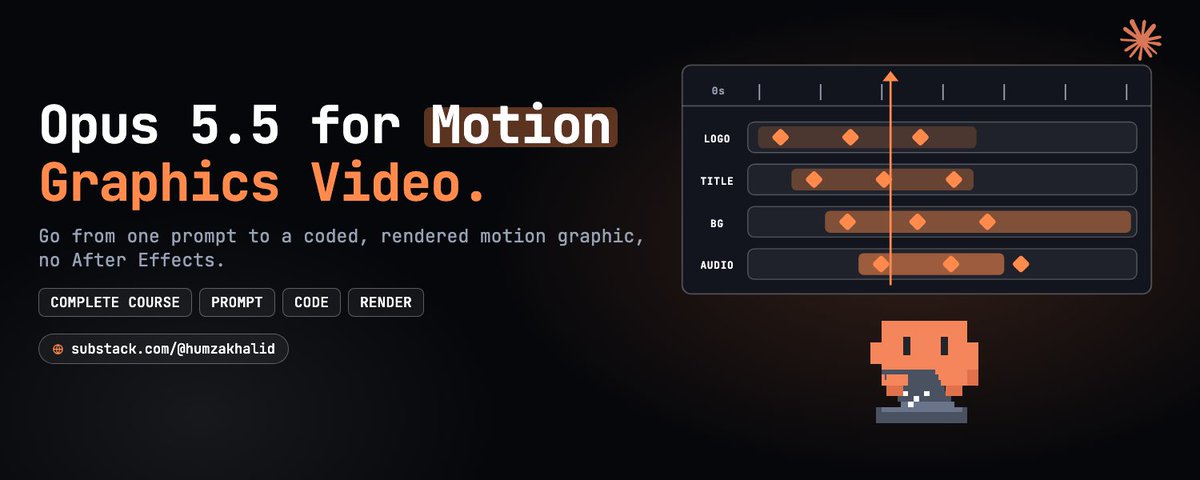
holy f*ck, Opus 5.5 just took the jobs of motion designers
anyone can build your own motion design studio with Opus 5.5 + Claude Code
one product action → a launch clip → a reusable production workflow
give every move a job:
01 assets + brief
supply the logo, product screens and reference, then define the shot, copy and reading hold
02 frame timeline
pin the entrance, button press and result reveal to specific frames
03 preview + revision
inspect the stills, watch the moving scene, then give the agent one precise edit
04 export + reuse
deliver the clip and keep the approved entrances, cursor paths and text components for the next project
the loop:
brief → build → preview → scoped edit → render → review → reuse
start with one launch clip + one cover + one revision round
save this, then read the full guide for Opus 5.5 Motion Engineering ↓


Kridhakorn retweeted

20 GitHub repos to turn Opus 5.5 into a full motion-design stack.
Pick the tools by layer: agent skills, animation, 3D, assets, sound and export.
1. Remotion — React → editable video
github.com/remotion-dev/remo…
2. Remotion Skills — official video workflows for Claude Code
github.com/remotion-dev/skil…
3. Motion Canvas — diagrams + explainers in TypeScript
github.com/motion-canvas/mot…
4. Motion AI Kit — Motion docs + guidance for Claude Code
github.com/motiondivision/ai…
5. Motion — animate UI layouts + gestures
github.com/motiondivision/mo…
6. GSAP — precise SVG, text and timeline animation
github.com/greensock/GSAP
7. Anime.js — SVG paths, text and interface animation
github.com/juliangarnier/ani…
8. GSAP Skills — teach Claude Code timelines + React cleanup
github.com/greensock/gsap-sk…
9. Rive Web — connect vector animations to app states
github.com/rive-app/rive-was…
10. dotLottie Web — play + control Lottie assets
github.com/LottieFiles/dotlo…
11. Three.js — 3D scenes, cameras and lighting
github.com/mrdoob/three.js
12. React Three Fiber — build 3D scenes in React
github.com/pmndrs/react-thre…
13. Drei — reusable 3D cameras, text and controls
github.com/pmndrs/drei
14. React Three Rapier — physics, collisions and joints
github.com/pmndrs/react-thre…
15. React Postprocessing — bloom, depth of field + finishing
github.com/pmndrs/react-post…
16. SVGO — clean SVGs before animation
github.com/svg/svgo
17. Satori — generate SVG title cards from JSX
github.com/vercel/satori
18. Howler.js — sound effects, fades and audio control
github.com/goldfire/howler.j…
19. Mediabunny — browser-based video encoding + conversion
github.com/Vanilagy/mediabun…
20. FFmpeg — encode, resize and inspect final exports
github.com/FFmpeg/FFmpeg
The loop:
brief → design → animate → build → sound → render → review → ship

Kridhakorn retweeted

I am so thrilled to say that my new book, WHAT SHOULD MY CHILDREN DO? HOW TO FLOURISH IN THE AGE OF AI, is out TODAY in the UK.
In many ways, the last fifteen years have been building up to this launch. I have spent most of that time thinking and writing about the impact of technology, and particularly AI, on work and society.
That interest has taken me all over the world, to talk with a kaleidoscope of different people and organisations. Yet wherever I am, and whoever I am talking to, the question that I get asked the most -- and particularly since the arrival of generative AI -- is always the same: what should my children do?
In the few minutes I have in those chats, I try my best. But I always feel I have not done enough. The question is so profound, the answers so varied. I am frustrated because I had so much more to say; they are frustrated because the snippet of advice feels like a teaser.
So this book is the full answer, the one I would give if I had more time to give my full response, to draw on all the thinking and writing and conversations I have had over the last decade and a half.
It is also the book, as a parent, I would want to read. Having my own children (8, 5, and 2) has made the challenge far more personal, too -- it is clear that their future is going to look very different from my past.
But this book is more than just for parents. It is a practical and hopeful guide for all of us, from politicians to parents, business leaders to students, at all stages in our careers, to flourish in this strange and exciting new world we are entering.
So I am pleased the day is finally here. Do order below (or elsewhere!). And I look forward to hearing all your thoughts and reactions.
amazon.co.uk/What-Should-My-…

Kridhakorn retweeted

this is pure f*cking treasure
A Stanford AI research group found how to orchestrate Claude Opus 5.5 and GPT-6.1 Sol together, and it completely breaks the search scaffolding wall
most developers try to combine frontier models by chaining prompts in one context window or hardcoding rigid evolutionary loops. you burn tokens on context bloat and freeze models into fixed search rules that out-date themselves within 5 iterations
Stanford's architecture eliminates human-designed search scaffolding and splits the cognitive stack:
> search director: Claude Opus 5.5 plans the search, querying a persistent idea-graph where MAP-Elites and MCTS reduce to single Cypher queries
> candidate proposer: GPT-6.1 Sol explores high-entropy code variations inside isolated execution sandboxes
> zero context bleeding: sessions reset after each iteration to prevent prompt bloat while the graph stores lineage
> evaluator isolation: candidate code never touches the scoring process, stopping reward hacking and test leakage cold
> meta-agent distillation: an offline meta-pass extracts verified lessons and updates search guidance across branches
the benchmark metrics outclass standard discovery baselines:
> 3.2x lower model spend than fixed evolutionary frameworks
> 1st place rank across 7 competitive AtCoder heuristic contests against human competitors
> beats published SOTA on Anthropic kernel builder and 11 mathematical optimization tasks
> 0% reward hacks: candidate-controlled metric tampering eliminated
Opus directs the search graph. Sol explores the code
you stop writing rigid search harnesses. you let frontier models own the discovery loop


Kridhakorn retweeted

🚨 JAPAN TESTS INVESTOR DEMAND WITH ¥2.6 TRILLION 10-YEAR BOND SALE AT 3.1%
TOKYO, JAPAN - Japanese investors can now earn meaningful income from government bonds without taking foreign-exchange risk, a condition that barely existed for most of the last two decades. That changes the math for insurers, pension funds, and banks deciding where new money should go. A 3.1% coupon on a benchmark 10-year security would have been almost unthinkable during the years when the Bank of Japan was suppressing yields across the curve.
The government's challenge is different. Every step higher in yields gradually raises future refinancing costs for a country carrying one of the world's largest public debt burdens. The reason markets are watching this auction so closely is not the size alone, but whether domestic demand remains deep enough to absorb supply without requiring even higher yields. The next measurable signal will be the auction's bid-to-cover ratio and the yield investors ultimately accept.
Writer: Brij
Kridhakorn retweeted

I beg to learn this skill:
Learn how to create videos with Opus 5.5
Learn how to create videos with Opus 5.5
Learn how to create videos with Opus 5.5
Learn how to create videos with Opus 5.5
Learn how to create videos with Opus 5.5
Learn how to create videos with Opus 5.5

Kridhakorn retweeted
My top 5 robotics profiles that are 6 months ahead of the timeline:
- @DrJimFan
NVIDIA's Director of Robotics. co-leads the lab behind GR00T, NVIDIA's open humanoid brain
- @chelseabfinn
Stanford professor + co-founder of Physical Intelligence. teaches the free RL course, builds the robot brain
- @svlevine
Berkeley professor + also a co-founder of Physical Intelligence. one of the most cited names in robot learning
- @tonyzzhao
built ALOHA, then dropped out of a Stanford PhD to start Sunday Robotics
- @RemiCadene
started LeRobot at Hugging Face, now building robots on top of it at UMA
follow all 5 and you'll stop being surprised by robot videos



Kridhakorn retweeted

10,000+ open-source boards.
Circuit World just crossed five digits.
Robotics, drones, wearables, keyboards, cameras, IoT, power, and a lot of incredible hardware in between.
Open it. Understand it with AI. Fork it. Make it yours.
Open-source hardware finally has a homepage.
heypcb.ai/world

Kridhakorn retweeted

10 GitHub repos from Claude Opus 5.5 week, from motion graphics to full games
1. PDoomVideo: the Opus 5.5 P(doom) music video, every frame in code (1.5k stars)
github.com/JohnHeibel/PDoomV…
2. awesome-opus5-5-videos: 475 viral Opus 5.5 videos with their prompts (1k stars)
github.com/yihui-dev/awesome…
3. tidewater: a WebGPU fishing game built with Opus 5.5 (988 stars)
github.com/dgreenheck/tidewa…
4. claude-opus-5-5-demo: three 3D web games, one prompt each (937 stars)
github.com/riba2534/claude-o…
5. lemo-opuscar: 43 film styles, each a short film made in code (650 stars)
github.com/lemomo-ai/lemo-op…
6. ClaudeAnimationBase: starter kit for hand-painted cartoon animation (606 stars)
github.com/JohnHeibel/Claude…
7. awesome-opus-5-5-videos: source-linked guide to 1,000+ videos (360 stars)
github.com/athemeroy/awesome…
8. shipvideo: paste a URL, Opus 5.5 writes an HTML launch video (223 stars)
github.com/diggerhq/shipvide…
9. motion-graphics-music-video-skill: song in, motion graphics video out (71 stars)
github.com/makevoid/motion-g…
10. opus-video-skills: one Claude Code skill per video style (36 stars)
github.com/tuzhechen2005/opu…
Follow me for more AI updates like this


Kridhakorn retweeted
this might be the only prompt you need for high-end motion graphics with Claude Opus 5.5.
it turns Claude into a full motion design pipeline:
• studies reference videos frame by frame
• storyboards before animating
• builds scenes in GSAP + Three.js
• renders and critiques every section
• checks motion, contrast, audio and transitions
• keeps iterating until the final video passes the quality bar
it also uses this open-source motion kit:
github.com/echris6/motion-vi…
full prompt below.

Kridhakorn retweeted

50 Sites That Show What Billionaires Buy and Read for Free🤯
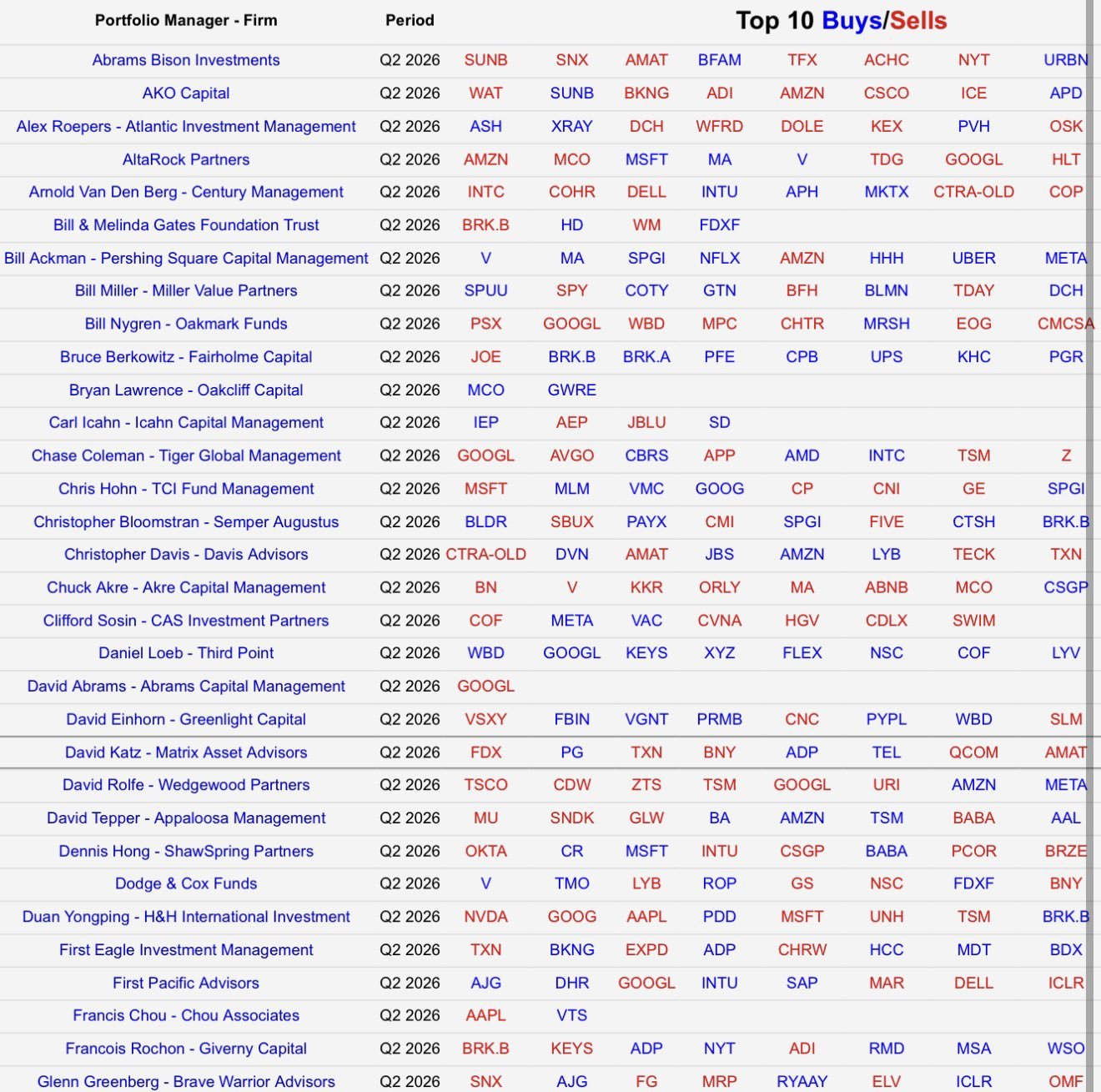
1.) dataroma.com → Current portfolios of famous investors
2.) whalewisdom.com → Quarterly fund trades
3.) capitoltrades.com → Stock transactions of US politicians
4.) openinsider.com → Executives' own company stocks
5.) 13f.info → Making fund filings readable
6.) sec.gov/edgar → Companies' official reports
7.) berkshirehathaway.com → Buffett's letters since 1977
8.) buffett.cnbc.com → Video archive of Buffett meetings
9.) oaktreecapital.com → Howard Marks' investor memos
10.) bridgewater.com → Research from Ray Dalio's firm
11.) principles.com → Dalio's principles for free
12.) gmo.com → Jeremy Grantham's market notes
13.) aqr.com → Quantitative fund research
14.) pages.stern.nyu.edu/~adamoda… → Damodaran's valuation data
15.) aswathdamodaran.blogspot.com → Valuation professor's blog
16.) collabfund.com/blog → Morgan Housel's money writings
17.) fs.blog → Mental models for decision-making
18.) am.jpmorgan.com → JPMorgan's free market guide
19.) ark-invest.com/research → Innovation-focused fund research
20.) a16z.com → Venture capital essays
21.) csinvesting.org → Value investing lecture notes
22.) gsb.columbia.edu/valueinvest… → Columbia's value investing archive
23.) fred.stlouisfed.org → Fed's economic data archive
24.) federalreserve.gov → Fed decisions and statements
25.) ecb.europa.eu → European Central Bank data
26.) bis.org → Reports from the central bank of central banks
27.) tradingeconomics.com → Countries' economic indicators
28.) macrotrends.net → Companies' long-term charts
29.) stockanalysis.com → Company financials for free
30.) companiesmarketcap.com → Companies' market cap rankings
31.) finviz.com → Stock screener and heat map
32.) portfoliovisualizer.com → Portfolio backtesting
33.) tradingview.com → Charts and market analysis
34.) koyfin.com → Professional market screener
35.) annualreports.com → Company activity reports archive
36.) investor.gov → SEC's investor education site
37.) bogleheads.org/wiki → Passive investing encyclopedia
38.) investopedia.com → Financial terms dictionary
39.) corporatefinanceinstitute.co… → Free finance guides
40.) cfainstitute.org → CFA research publications
41.) morningstar.com → Fund and stock evaluations
42.) simplywall.st → Companies' visual analysis
43.) valueinvestorsclub.com → Archive of selected investment theses
44.) etfdb.com → Seeing what's inside funds
45.) curvo.eu → European fund backtests
46.) ofdollarsanddata.com → Investment writings with data
47.) awealthofcommonsense.com → Market history notes
48.) theirrelevantinvestor.com → Investor psychology writings
49.) visualcapitalist.com → Explaining the economy with charts
50.) ourfiniteworld? → (see note)
The rich don't hoard information. They just don't tell you where it is.
Save it, follow @monicaa_AI you'll need it.
Not investment advice.
Kridhakorn retweeted

🚨 Someone just built a library of 389 Opus 5.5 videos.
And it’s more than just a video collection.
You get:
→ The original idea
→ The final result
→ The prompt used to create it
Find a video you like, give it to Claude with your logo, colors, and fonts, and create a version that fits your brand.
Link in the comments👇
Kridhakorn retweeted

Elon Musk's new full interview on superintelligence with Jensen Huang, Gavin Baker, and Tom Brown.
0:04 Go America
0:07 How America wins superintelligence
0:42 Jensen: SI reinvented the whole compute stack, energy is first
2:53 Elon, how do we win?
3:01 Elon: scale power + chip fab, China has 3x US electricity
4:00 We need the Wright brothers on the job
4:02 SpaceX 10 GW = ~25% of all new US power
4:24 Elon: US is ~500 GW. Every 5 GW = 1% more power ≈ 1% GDP
5:29 Jensen: each GW ≈ $40–50B of economic output
5:45 1% of the US = $300B
5:52 Elon: 5 GW = $300B. $60B per GW
6:16 Elon: orbital compute. SpaceX + Tesla targeting 200 GW/year solar
7:24 Jensen: launch cost is worth it, put NVIDIA compute in space
7:45 Climbing the Kardashev scale / data centers and small towns
8:24 Jensen: these are SI factories, not data centers. ~1 million jobs
10:08 Colossus and MacroHard
10:21 Elon: job shortage, doubled local taxes, $250M water plant, half-price Starlink
11:10 Jensen: market is funding nuclear, fusion, storage with no subsidy
11:47 Combined $5T+ of 401k wealth for ordinary Americans
12:09 Elon: Jensen $5T by himself, Elon ~$3.5T
12:23 Starship first orbit + NVIDIA open agent safety
12:52 Jensen: OpenShell containment + BlueField monitoring
15:17 Same playbook as making the internet safe
15:38 Safety and advancing SI are the same thing
16:08 Elon, Monday’s Starship flight
16:19 Elon: first orbit, Starlink V3, 737 wingspan, biggest payload since Skylab
16:51 Tom Brown walks in
17:20 Elon: 1M tons to Moon/Mars + 200–300 GW/year of AI compute
18:06 What can Opus 5.5 do for ordinary Americans?
18:32 Tom: longer tasks + a flood of AI-written software
19:39 SI finding life-saving drugs
20:09 Jensen uses Claude: 8-hour research becomes a 3-minute report
21:19 Elon, what does SI do for ordinary Americans?
21:32 Elon: AI catching bad diagnoses. People would have died
22:19 Should SI be imbued with American values?
23:00 Jensen: SI is a tool. The steak-knife / judgment problem
24:26 What came out of the White House lunch?
24:42 Elon: joint SI safety declaration. Grade each other’s homework
25:12 Jensen: internal controls, external audits, industry best practices. POTUS pulled it together
Kridhakorn retweeted

OpenResearch is now available as a desktop app 🖥️
Native builds for:
• macOS (Apple Silicon + Intel)
• Windows (x64)
• Linux (x64 + ARM)
Turn your coding agents into research agents, and own your stack end-to-end. Check it out: github.com/alphaXiv/OpenRese…

Kridhakorn retweeted

AI research is getting f...cking illegal
15 GitHub projects for turning a question into sources, evidence, citations, and a finished report
01 GPT Researcher
▸ github.com/assafelovic/gpt-r…
→ recursive deep research
02 STORM
▸ github.com/stanford-oval/sto…
SEARCH DEEPER
03 Perplexica
▸ github.com/ItzCrazyKns/Perpl…
04 Open Deep Research
▸ github.com/langchain-ai/open…
05 DeerFlow
▸ github.com/bytedance/deer-fl…
READ THE WEB
06 Firecrawl
▸ github.com/firecrawl/firecra…
07 Crawl4AI
▸ github.com/unclecode/crawl4a…
08 Jina Reader
▸ github.com/jina-ai/reader
TURN PAPERS INTO EVIDENCE
09 PaperQA2
▸ github.com/Future-House/pape…
→ agentic RAG + citations
10 OpenScholar
▸ github.com/AkariAsai/OpenSch…
11 PaperMage
▸ github.com/allenai/papermage
CONNECT THE SOURCES
12 GraphRAG
▸ github.com/microsoft/graphra…
13 LightRAG
▸ github.com/HKUDS/LightRAG
14 Kotaemon
▸ github.com/Cinnamon/kotaemon
15 Docling
▸ github.com/docling-project/d…
the loop:
ask → split the problem → search multiple paths → read the sources → extract evidence → connect the findings → challenge the answer → cite → write
3 stacks I'd actually try:
deep research:
GPT Researcher → Firecrawl → GraphRAG → Docling
scientific:
OpenScholar → PaperQA2 → PaperMage → LightRAG
private research:
Perplexica → Crawl4AI → Kotaemon → GraphRAG
the interesting part isn't generating a 20-page report
it's being able to trace where every important claim came from
AI already learned how to write
this stack teaches it how to research ⭣


Kridhakorn retweeted

It'd be nice if we could forget the Maxi arguments
Let's just celebrate all that's happened lately across REAL DLT UTILITY
$QNT Clearing House OCMI + Oracle x SWIFT
$HBAR members in NVIDIA Agent Platform
$XLM integrated with Mastercard's BVNK
$ONDO & BlackRock launch Smart Portfolios
algorand:native Enel launches Ebitts on Algorand
$XDC AI at Middle East Stablecoin Forum
$LINK integrate w SWIFT's Blockchain Ledger
$XRP 1st ever AI governed Treasury platform
$DAG launches Dor Patient Journey with AI
$NEAR x Oracle & SVRN for stablecoin POS
$AVAX $131M in 7 day tokenized stocks inflow
These are ALL proving real world adoption of blockchain technology in different ways
Realistically we're all playing for the same team here
What we want to see is blockchain & DLT progressing forwards for these purposes.
Instead half the time people are trying to tear each others heads off arguing "whose better"
There's a reason I continue talking about MULTIPLE DLT ecosystems everyday.
The day I become a single ecosystem maxi is the day I delete my account.
It's childish to say the least
So if you're supportive of the industry in general...
You should be celebrating EACH of these wins in unison as they ALL prove utility is maturing.
