
Freelance Writer, Specializing in Agriculture, Sustainability, & Food Policy
West Chazy, NY
Joined October 2024
- Tweets171
- Following20
- Followers275
- Likes47


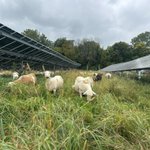


We recently began the long process of moving the stock home for the winter.
One of the more common questions we get is what our operations look like when the grazing season is over. Sometimes, this is paired with a bit of derision that really serves no purpose beyond just highlighting an ignorance of what ranching is like in the Northeast; there’s an underlying “gotcha!” when we “admit” that we do bring our animals home for the winter and don’t keep them grazing solar sites year-round.
This may come as a surprise to some, but grass does not grow in January in Clinton County, NY, when there’s as much as two or three feet of snow on the ground.
Now, sheep are actually pretty good at finding forage beneath a little snow - they will paw and nose around to find any residual vegetation under a few inches. We do frequently stockpile graze sites later into the year as long as the growing conditions cooperate (a few feet is a different story).
This year, our management plan and the early season frosts we got just didn’t allow for much leftover grazing. So we’re bringing them back home, where we will finish grazing out any of the forage left on our home pastures and then hay-feed until the spring green-up.
The other reason we bring animals home for the winter, besides the weather, is lambing. While we know many producers who lamb on pasture; we prefer not to do it. It would add an extra management layer for us, and we prefer to keep them close by during this season in case problems come up. With several hundred lambs expected this year, having to drive offsite to tend to the flock would be incredibly cumbersome.
Plus, selfishly, I really like popping out to the barn for lamb snuggles and snoot-boops whenever I want.

While the rest of the garden now looks like a crime scene (RIP to my tomatoes and squashes, which took a final killing frost last weekend), the raspberries are in their Michael Myers era. Every time I think they’re finally dead, I turn around and…there they are again.
We’ve been harvesting several quarts, several times a week, since early summer, with only a brief hiatus when things were super hot.
Even though we’re now approaching Halloween and we’ve had several nights of freezing temperatures, these babies are holding on (so, too, are the bees; I learned the hard way a few weeks ago not to stick my hand blindly into a cluster of berries 😬).
Anyway - send me your raspberry recipes! I’m running out of ideas faster than we’re running out of berries.

We’ve discovered a serious problem with our solar grazing operation.
Despite the Internet’s repeated assurances that “nothing grows beneath solar panels,” our sheep have been violating the laws of photosynthesis, agriculture, and the rabid Facebook comment sections all summer long.
Each fall, we measure our rams to get an idea of who to retain for breeding, who to send to market, and to get a benchmark of our management that will guide our decisions in the upcoming year.
This year, we averaged 0.41 pounds per day across our ram group. For reference, Penn State and Washington State extensions cite typical pasture-raised lamb gains of 0.25 to 0.35 pounds per day.
Not bad for animals who are supposedly grazing their way through the tenth circle of Dante’s Inferno.
The lion’s share of the credit goes to Josh for excellent grazing management, but shade and rotation each played a big role here, too.
I explained more of the science of forage quality beneath solar panels in my latest Substack, complete with research, citations, and receipts. It's linked in the comments, so give it a read before you throw shade yourself. Our sheep have already made better use of it, anyway. 😎
rebekahpierce.substack.com/p…?

I'm frequently informed that grazing sheep on solar farms isn't real agriculture because our sheep are supposedly “just lawnmowers,” and we're not producing an actual agricultural product.
Somebody better tell Meb, one of our herd sires.
He's currently working VERY hard to increase agricultural production, apparently unaware that he's supposed to just be mowing the lawn.
Enthusiastically, actually. Wildly inappropriate levels of enthusiasm.
He's attempting to turn every available lawnmower into approximately 1.5 lawnmowers.
The man has a business plan. Please respect it.
And I gotta say, his work ethic is inspiring. HR has, however, received several complaints from the ewes.
Who pays to clean up a solar farm when it shuts down?
Ah, yes. One of my favorite questions, one I’m asked several times per post, in comments that smugly assert confidence without expressing a single ounce of critical thinking.
Now, here’s something that might come as a shock: we have regulations for this. Strict ones.
Let’s talk specifically about New York, since that’s where I’m writing from, but keep in mind that almost every other state has similar-looking regulations as far as solar decommissioning goes.
(Yes, I’ve researched it. I wrote a book on agrivoltaics and believe it or not, traditional publishers prefer manuscripts with cited sources instead of 200+ pages of “trust me, bro, I know a guy.”).
Back to New York.
Here, large solar projects permitted through the state are required to have decommissioning plans AND financial security to pay for equipment removal and land restoration. The financial guarantee is calculated using estimated cleanup costs, plus a 15% contingency, minus projected salvage value. The financial security must remain in place until the project is fully decommissioned.
Now, before you darlings start furiously typing your “gotchas,” NO, that doesn’t mean every solar installation automatically has a decommissioning bond. Projects under 25 MW are permitted locally, so towns can (and typically do) require their own decommissioning plans and financial guarantees. Requirements vary by municipality, and some are stronger than others.
Should every commercial solar farm have an enforceable cleanup plan backed by adequate financial security? Absolutely, yes. Should those guarantees be reviewed periodically to account for changing costs? Also yes.
Look at me! Acknowledging that regulations can be improved without pretending the entire industry operates under the honor system. (There’s that critical thinking at work, folks!).
So let’s talk numbers. NYSERDA examined more than 100 New York solar decommissioning cost estimates produced between 2021 and 2024. The average was approximately $50,000 per megawatt in 2024 dollars, before contingencies and salvage value.
For perspective, that's roughly $5 MILLION in estimated cleanup costs for a hypothetical 100 MW project. The actual amount of financial security required depends on the project's specific estimates, contingencies and salvage value.
And providing that financial security is the developer’s responsibility, tied to the project, and meant to protect communities if the developer fails to fulfill its cleanup obligations.
While we're expressing such enthusiastic concern about who pays to clean up energy infrastructure, I'd love to discuss something else.
In November 2021, the federal government authorized $4.7 billion to address orphaned oil and gas wells and another $11.3 billion for abandoned coal mine reclamation.
That's $16 BILLION in federal funding allocated to address legacy pollution from energy infrastructure, including sites where the original operators are no longer available to pay for cleanup.
And yes, the coal industry contributes to certain reclamation funds, and modern fossil fuel operations have their own cleanup requirements. Still, the historical cleanup bill is substantial enough that we're still committing billions in public funding to address it to this day.
Somehow, though, I can post a picture of a sheep or cow standing under a solar panel and immediately get interrogated about who’s going to clean everything up in 30 years.
Listen, I’m delighted we’ve discovered environmental accountability. I’m a huge fan.
But perhaps we could find the same enthusiasm for addressing the environmental damage we're already spending billions to clean up, rather than reserving all our outrage for a hypothetical solar farm that hasn't even been decommissioned yet.
I'm all for holding energy companies accountable. ALL of them.
Apparently, environmental accountability is controversial when you apply it equally. I'll update my invoice for my Big Solar Shilling accordingly.

Our pigs have been enjoying an exquisite five-star farm-to-table dining experience, courtesy of North Point Community Farm.
Our friends at this local vegetable farm have been sharing their scraps, and the porcine reviews have been overwhelmingly positive.
Big thanks to our neighbors down the road!

Internet: “The grass is too tall. Those sheep obviously aren’t grazing.”
A quick note before we begin: most of the photos I post are taken right after we move the sheep or cows onto a fresh strip. They’re much easier to photograph when they’re busy eating and ignoring me, so yes, the forage often looks tall in those pictures.
But if “too tall” means “it doesn’t look like a golf course,” then, yeah. The Great Grass Detective are correct.
However, nobody is hiring us to manage pastures that way.
Nor should we. We’re managing a biological system, not detailing a putting green. We don’t leave our animals in one place until every plant has been shaved down to a uniform two inches. We move them through sections, let them eat, then give the pasture time to recover.
Why? Because grass needs leaves to regrow. Because bare soil gets hotter and loses moisture faster. Because repeatedly grazing fresh regrowth weakens the plants.
And because with sheep, parasite management is literally a life-or-death proposition. Allow the animals to return to the same short grass, and they’re more likely to graze close to the soil surface, where parasite exposure can be higher.
There may indeed be grass left standing, and there may be weeds the sheep don’t touch. That’s not a “solar grazing” problem, that’s a grazing problem, and it’s one we know how to manage already.
Our fields don’t look uniform. Good. That’s the point. Nature isn’t symmetrical, either.
New blog detailing more of our approach (linked below).
jrpiercefamilyfarm.com/blog-…

Anyway, here’s the unusable farmland.
If you’re interested in the actual data behind why the “solar panels are toxic” claims are mostly silly goose science, check out my Substack.
rebekahpierce.substack.com/p…
People hear “renewable energy” and think it’s just code for “green” or “good for the environment.”
That’s part of it. But the word renewable is actually pretty literal.
And I’m largely an advocate for renewables not from the environmental perspective (although that’s obviously important), but from an economic one.
Here’s why.
Coal, oil, natural gas and uranium are fuels. You have to dig them up, process them, transport them and keep buying more of them because once you use them, they’re gone. They’re nonrenewable because their supplies are limited to what we can mine or extract.
Solar and wind are different because the energy source itself is naturally replenished.
Yes, solar panels and wind turbines cost money to build.
So do gas plants.
In 2024, the average construction cost of new utility-scale solar was about $1,865 per kilowatt, wind about $1,882, and new natural-gas generation about $1,004 per kilowatt.
So yeah. Gas can absolutely be cheaper to build upfront.
But the wallet doesn’t seal shut once the facility is built. Then the plant has to run.
Solar doesn’t need a tanker truck full of sunshine every Tuesday. Wind doesn’t get a monthly wind delivery.
A gas plant has to keep buying gas. A coal plant has to keep buying coal. And a nuclear plant needs uranium fuel.
That ongoing input is significant because fuel prices move, and they become part of your operating cost every hour that plant runs.
Utility-scale solar has fixed operating and maintenance costs of $4 per megawatt-hour. A natural-gas combined-cycle plant also has an O&M cost of about $4…but an additional $23 per megawatt-hour in fuel costs.
Not cheap.
But unfortunately, a lot of people have the same relationship with resources that my six-year-old has with chocolate cake.
If there’s a whole cake sitting there, his first instinct is: eat the cake.
That’s a great plan…for the next five minutes.
Once the cake is gone and you feel terrible, you start questioning your life choices.
That’s basically the resource question.
We can keep burning through fuels that took geological time to form because they’re convenient right now (eat the cake because it tastes good and it’s RIGHT THERE), or we can build more systems that use energy sources that keep showing up.
None of this means solar and wind are free, impact-free, or capable of doing everything by themselves.
It means there’s a pretty significant difference between paying to build a machine that harvests an ongoing energy flow and paying to build a machine that then requires you to keep feeding it fuel forever. Eventually, that fuel is going to run out, but before it does, it’s going to get scarce. And it’s going to get a hell of a lot more expensive.
That’s what “renewable” is getting at.
Not magic. Not infinite electricity. Just a resource you don’t use up by using it.
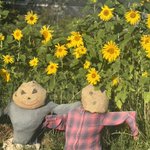
A few weeks ago, our son decided we should make scarecrows to round out our fall decor.
Meet Stacy and Gerald.
PS: Several hours into that project, I realized that what should have been a cute little autumn craft had taken a hard turn into something a little more...unsettling. (Peep Gerald, the scarecrow on the right with the nightmare face - he knows what you did last harvest. 😂).
Ostensibly, they're here to keep the crows away, but also...anyone else who comes within 500 feet of the farm, I guess.

Nobody looks at a brand-new Mason jar and screams, “Checkmate, homesteaders! So much for being sustainable and independent. That wide-mouth came from a FACTORY.”
Because we understand that sometimes you buy infrastructure once so it can keep producing value.
That’s one reason I advocate for solar. Done well, it can improve energy independence, strengthen farm viability, and reduce how much we depend on fuel that has to be extracted, transported, and continuously purchased.
And yet the energy conversation often goes like this:
No solar because mining. No wind because birds. No nuclear because waste. No hydro because rivers. No coal because (obvious). No transmission because ugly.
Excellent. Now, please proceed to Door Number Three, where the electricity is harvested organically from the forest floor.
We all know that doesn’t exist.
I’m including a photo of my own canned apple pie filling for homesteading street cred and to prove I have, in fact, interacted with a Mason jar before forming this opinion.
And I’m also including a link to my latest Substack where I elaborate on this only somewhat half-baked idea in more depth.
rebekahpierce.substack.com/p…

Sheep proved, quite a long time ago, that they work exceptionally well under solar. So, this summer, we asked a different question: what about cattle?
@Nexamp published this piece about the pilot we proposed at its Fort Covington sites, where five cattle have now completed several grazing rotations beneath the panels.
Our biggest lesson (and a surprising one): size was less important than temperament.
Read more:
nexamp.com/blog/from-sheep-t…
Some solar projects are bad.
Solar itself is not bad.
For whatever reason, folks struggle to grasp that. It sounds so simple to me. One bad solar project doesn’t invalidate solar (and especially not solar grazing), just like one bad dairy operation doesn’t invalidate cows.
The problem is that the smoking gun comes buried within 400 pages of permitting documents, which few of us take the time to read and even fewer comprehend.
Every time a project gets tossed at me of Exhibit A for Why Solar is Evil™, I try to read the documents.
Here are some thoughts.
rebekahpierce.substack.com/p…?

We talk a lot about preserving farmland.
But what, exactly, are we trying to preserve?
The soil itself? The view? A family name on a mailbox? A way of working that existed fifty years ago? The possibility that someone can still make a living from the land?
The concept of preservation has become rigid: we say we want farms to survive, but only if they look exactly the way we remember them.
It’s a strange and impossible standard to meet when land costs rise, margins thin, equipment gets more expensive, and the next generation has to find a reason to stay.
To me, “preserving agriculture” is less about keeping a hayfield untouched for the next fifty years and more about passing on a legacy of land stewardship we can be proud of. So we ask these questions:
Is the soil healthier? Are the animals well cared for? Is the land still productive? Can this farm support a family? Are we leaving behind something useful instead of merely something familiar?
And maybe most importantly: what are we teaching the next generation who's watching all of this?
We want our son to inherit more than acreage. We want him to see that good work means paying attention, solving problems, adapting when something stops working, and taking responsibility for the things in your care. We want him to understand that stewardship isn’t passive: you don’t preserve something by freezing it in place, but by doing the work required to keep it viable.
I want to preserve working land. Useful land. Land that can adapt and produce something, support a family, and be worth handing over to someone else someday. Land with healthy soil, healthy plants, and healthy animals.
I don’t think legacy always has to be about keeping everything exactly the same. Sometimes it means changing just enough that there’s still something worth passing on.
We started with five sheep in 2018. We have roughly 300 today, grazing 200 acres across nine solar sites.
The @adkexplorer recently wrote about what solar grazing looks like for us and others as the industry expands, including an interview with Josh about how our own business has evolved.
adirondackexplorer.org/envir…

Often, we're told that agrivoltaics isn't "real" farming, just a niche scheme worked up by the renewables industry. That solar farmers are "selling out," or "not real farmers."
This is fundamentally untrue for a number of reasons.
Though the term agrivoltaics wasn't coined until 2011, its first use traces back to 1981, when Adolf Goetzberger and Armin Zastrow published a scientific paper outlining dual use and its benefits for crop productivity. Hardly a modern scheme given that it was created long before AI, TikToks, viral content, or even cell phones themselves.
Second, the idea that the sheep or cattle or whatever it is you're producing is there just as a prop for the renewables industry ignores the fact that these animals are still part of a very robust agricultural system. We send all of our ram lambs for meat in the fall - this year, around 80 of them, with additional cull ewes that will go for mutton.
We raised sheep long before we got our first solar grazing contract. The difference, however, is that we can now raise sheep profitably.
Land is expensive. Very expensive. We graze around 200 acres. A similarly-sized plot of land near us is currently on the market for $2 million.
We get paid to manage productive acreage now instead of having to pay to lease or buy it. Our sheep still eat grass, they still lamb, they still go into the food system. The economics are just better.
For generations, the model for becoming a farmer has been: acquire a large, increasingly expensive chunk of land, and then somehow make enough money farming it to pay for the land you needed in order to farm.
That math is getting harder and harder to uphold (which is why 84% of household income from farming households comes from off-farm jobs).
Owning land is wonderful, but having access to productive land is what makes farming possible. Those aren't necessarily the same thing.
The critics call it "selling out." But maybe the next generation of farmers is just finding a way to do things differently.
A few years ago, solar grazing pretty much just meant sheep.
Now we’re curious what else can work.
This summer, we partnered with Nexamp on a cattle-grazing pilot at two solar sites in Fort Covington, New York. Five cattle rotated through the sites, grazed the vegetation down well, stayed comfortable around the equipment and gave us a much better sense of what’s important when you start thinking beyond sheep.
We found that breed mattered less than disposition (a surprise to us). Calm cattle that are used to rotational grazing, electric fence and frequent handling may have a real place in this model.
Sheep are still a flexible, adaptable fit for solar, and they’ll always be a huge part of what we do. But there’s room to keep experimenting with cattle, pigs, chickens and other forms of agricultural production under and around solar.
That’s the beauty of agrivoltaics, and why we’re so drawn to it. It isn’t one fixed system, and it’s constantly evolving. It’s also helping us figure out how to keep the land productive, support farmers, and make the agricultural use relevant and farmer-specific.
Really glad to see Nexamp cover the pilot and some of what we learned from it.
nexamp.com/blog/from-sheep-t…
I know nothing about growing soybeans.
So I don't tell soybean growers how to do it.
I know nothing about running a dairy.
So I don't tell dairy farmers what they're doing wrong.
I know nothing about orchards.
So I don't explain apples to orchardists.
I don't confuse having an opinion with having experience.
I know something about sheep. I know something about grazing.
And I know something about agrivoltaics.
Which is why it's interesting to hear, with certainty, that solar ruins forage. That the land can never be farmed again. That agriculture and solar can't coexist. Usually from people who've never done it.
Or even seen it.
Farming has taught me a useful habit: know where your expertise ends. Be willing to learn.
And when you know nothing about something, don't start by explaining it to the people who do.

Apparently, I’ve been exposed, so here’s my confession.
We’re paid by solar companies.
Scandalous.
We graze sheep on solar sites, as contractors. They send us contracts. We send them invoices. Sometimes there are even emails involved.
Real deep state stuff.
The sheep eat vegetation. We move them, fence them, manage their health, water them, haul them between solar sites.
Then, in a shocking twist, we expect to be paid for the work we’ve done.
And, because I’m proud of the work we do (and for the book I wrote on agrivoltaics), I write posts for social media about it.
I know. Total shill, right?
I wrote about the arrangement in my latest Substack. Meander over and have a look-see.
Link below.
rebekahpierce.substack.com/p…
