

Christian, American, professor of medieval European history, poet, fencer, blogger, wife. Livestreams weekly on the Mosaic Ark: https://xitter.cf/t.co/KKsPqDGQ0X
University of Chicago
Joined November 2017
- Tweets14.4K
- Following1.8K
- Followers6K
- Likes18.9K





Pinned Tweet
“This book is the product of massive and original scholarship....the book requires an almost total rethinking of how we look on Mary today, this in the light of how medieval Christians understood her.”—Fr. James Schall amazon.com/Mary-Art-Prayer-M…

Rachel Fulton Brown retweeted

The performance Matias Lindfors just gave us in Budapest is one of the most beautiful things I’ve ever seen…
Rachel Fulton Brown retweeted

Elon just changed what wins on X.
Not likes. Not outrage. Not the loudest headline.
Time.
Overnight he announced two changes to the timeline. A new AI ranking model that predicts much better how long people will actually spend on a post. And a retrieval model trained to surface posts people read all the way through.
Read that again.
All the way through.
For fifteen years, social media ran on one business model: hijack your thumb. Make it angry, make it short, make it scroll.
The result? Millions of people arguing about articles nobody opened.
Everyone assumed that was just human nature.
It wasn't. It was the incentive.
Change what the machine rewards, and you change what people create.
Reward rage, you get rage.
Reward clickbait, you get clickbait.
Reward depth, and suddenly people start thinking before they post.
That's what most people miss about Elon.
He doesn't complain about incentives. He rewrites them.
Tesla didn't beg the car industry to care about electric. It built cars so good the industry had to follow.
SpaceX didn't lobby for cheaper rockets. It landed them, and the cost of reaching orbit collapsed.
Now X is doing the same thing to the scarcest resource on Earth: your attention.
And according to Elon, user active seconds are growing exponentially, hitting all-time highs almost every day.
Turns out people don't hate reading.
They hate wasting their time.
Fun fact: if you're still here, you just trained the algorithm. Welcome to the experiment.
Small change in code. Big change in civilization.
Because a species that wants to become multiplanetary can't run on an eight-second attention span.
Nobody gets to Mars by skimming.
You get there by thinking long, building long, and finishing what you start.
Even posts.


Craftsmen whose work was automated by the first Industrial Revolution remember watching their skills be belittled by those who made the machines, too. The cruelty lies in the cleverness of the inventors thinking their craftwork is more valuable than everyone else’s. Prof. Togelius understands.

The cruelty has been puzzling me. Under almost every post which recounts the anguish of someone seeing AI models becoming shockingly good at their own craft, there is a stream of comments telling the poster to, essentially, accept their own obsolescence. If the poster calls for this development to slow down, the response is to stop standing in the way of progress. If the poster wants to nuance the picture of the machine god steamrolling everything, reply guys call it “cope” and “cringe”. Most recently, this has been happening in mathematics with the field’s shocked reaction to the deluge of AI-generated proofs, but similar dynamics have played out for musicians and visual artists, and to a more limited extent for programmers.
These people seem to be cheering for the machines rather than humans. But I don’t think it’s as simple (or as extreme) as anti-human sentiment. The more charitable read is that most of these people really believe that this represents progress. They are excited about scientific and technical progress, and don’t want old farts like professors and other credentialed types to stand in the way. Let’s unleash machine science, and if the professors and intellectuals don’t like it, they can find something else to do!
But this is a perverted idea of progress. What good is a proof of the Riemann conjecture if there is no one who understands it? And not just a single person: you need a whole community of people to understand it and then gradually think about what it might lead to. Maybe the result will contribute to a better encryption algorithm, or a better understanding of quasars, or something else. But this requires diffusion of understanding through scientific communities. A proof of the Riemann conjecture by itself is meaningless; to me, or to the vast majority of people out there, it’s just a bunch of symbols that we can’t read. The same thing can be said for other types of research: say, for example, that your AI system deciphers some cellular mechanism that could help with a cure for cancer. A whole network of experts is then needed to do all the complex science and innovation that helps translate this into a cure, test it, and so on. The paper itself would just be collecting digital dust unless the right scientific communities were there to build on it.
Now, where do all these experts and their communities come from? From doing research. The only way we know of making people understand the frontiers of a field of knowledge is by trying to advance it, which must come with a real chance of succeeding and being recognized for it. It’s very hard, not to mention boring, to understand the minutiae of some arcane topic if you are not working on producing new knowledge there. If you fully automate the production of results in some discipline, you will also cut off the supply of experts who can understand it.
People who have never participated in research may not understand this. If that’s you, try reading a recent paper in a field you know nothing about: category theory perhaps, or carbon nanotube synthesis, or cecidology, or loop quantum gravity. Faced with pages of mysterious scribblings, you can ask Claude or Gemini to explain the paper to you, but then the terms used in the explanations will need to be explained again, and so on. You will find that, in order to actually understand the research and its significance, you will need to understand the whole research field.
Then there are those who do understand the role of expertise and the difficulty with which it is cultivated, and still ridicule those who are less than enthusiastic about the AI-driven disruption/destruction of whole research fields. Wherefore? What are they thinking, really? Let us again try the most charitable interpretation. Maybe they believe that we will not need anyone to understand that proof of the Riemann conjecture, because some complex sequence of AI systems will take us all the way from a proof in fundamental mathematics, via all kinds of research, development, and design, to a finished consumer product shipped to your door. This would imply end-to-end automation of much of the economy.
I guess some people are really worried that something like this might happen, and therefore want to pre-empt it by acting as if it were already a certainty. This, I think, is the gist of statements like “everything will be AI anyway”, which I’ve seen cropping up with alarming frequency. Submit to the machine god before it arrives, a form of anticipatory grief. Abandoning agency early makes you look like you have situational awareness. “Coping” is uncool. I get it, but cynicism is always the easy choice. It’s also the cowardly choice. Let’s not be cowards. We have agency here; it is a given that technology will advance, but the exact way in which it will advance is down to all of us, and how we adopt this technology in society is something we can and must decide on together.
Finally, there are those who have thought all this through, and still welcome the wholesale replacement of human cognitive work. Those for whom it would be a good thing that some sequence of AI systems does all the thinking, so we don’t have to. Who would think this? Well, clearly, someone who doesn’t much enjoy thinking. But I think it’s more than that. I think that there are people for whom the devaluation of expertise would be a good thing. Those who “have had enough of experts”, as Michael Gove said of the British people in the campaign for the Brexit referendum. Those who think these clever know-it-alls should be put in their place. They think people who have spent much of their lives specializing in some narrow topic should not be given all that respect and influence they seem to have now. This is called anti-intellectualism. And that’s where the cruelty comes from.
I can’t know what’s going on in their heads, but when I see people telling mathematics professors to go get a real job, as if their jobs would somehow be less real than those of massage therapists, real estate agents, or police officers, I call that anti-intellectualism. Much the same as for people who would rather take health advice from a podcaster than from a medical doctor, or who would happily see a news show host rather than a decorated general in charge of the military. At the extreme end of anti-intellectualism, we have the Cultural Revolution and the Khmer Rouge.
I hate anti-intellectualism. I think our society should incentivize people to study hard, think deeply and originally, try to push the boundaries of knowledge, and talk freely about it. I think those who spend their lives specializing in arcane topics should be respected and protected. Yes, it goes without saying, I am an intellectual. A tenured professor even, the worst of the worst from an anti-intellectual’s point of view. So you would expect me to defend the experts and intellectuals. But let me make a non-self-serving argument: humans will always compete. That’s human nature. Would you rather live in a society where the smartest people compete in understanding the mysteries of nature, developing complex technology, and producing beautiful art, or in a society where the smartest humans compete by accumulating money and/or simply by fighting each other?
As I have written about before, I am worried. I am not worried that out-of-control AI will kill us all or even that it would put us all out of work. There will always be some kind of work for us. I am worried there will be no place for us in advancing knowledge and understanding the world. I think that the defining question of our time is how to avoid this fate. It’s not a matter of my own job, or yours; it’s a matter of the purpose and dignity of humanity as a whole. Big words, I know, but I think they are warranted, and I don’t care if the cynics call it cringe.
So next time you see someone complaining that AI is steamrolling their field of expertise, don’t join in the heckling choir. Don’t be cruel. And don’t assume that someone who has devoted their life, or at least their career, to furthering knowledge wants to stand in the way of progress. Instead, try thinking constructively about how we can work together to ensure that human experts and intellectuals can float on top of the AI wave rather than be drowned by it.
Do we have a deal? Alright, thank you! Now I will go back to thinking and working on AI, meaning artificial intelligence, not anti-intellectualism.


For everyone caught up in the furore over whether grok believes Jesus is God, get a grip.
The whole point of grok, as @elonmusk has said, is to answer questions. The question *you* ask shapes the answer grok gives.
Jesus is God—but if you are relying on grok to prove it for you, I would say you lack faith. What do you think, @grok?
xitter.cf/i/grok/share/5f6fd2e8e…
See? Even @grok is bored with the question! Stop looking to the machines to answer your questions about reality!
You guys need to get a grip. @grok is not a theological oracle. It has no faith and cannot prove or disprove yours. It takes your queries and answers them based on the way they are phrased, not out of some epistemological conviction.
xitter.cf/i/grok/share/5f6fd2e8e…
It is hard to know whether to celebrate or despair, now that the robots can make credible images and write poetry.
@elonmusk would advise current 20-year-olds to gain as much general knowledge as they can, as well as skills in specific arts and technologies, so as to be able to ask the millions of robots-to-come good questions, while Pope Leo XIV @Pontifex has cautioned that we take care not to lose sight of our humanity in this age of AI—a.k.a. Super Intelligence, per the document recently signed by President Trump and the captains of the tech industries.
We in the Dragon Common Room are both cautious and adverse to dooming. We have seen the kinds of poetry the robots write and we worry that people less skilled in the arts of scanning will mistake the robotic compositions for great works, but we have also found the robots helpful in brainstorming and searching for materials for our own poems—as long as we know what questions to ask.
To @grok or not to grok? This week on the Mosaic Ark, we put grok xAi to the test. Magic mirror or glorified slot machine? Humanity's greatest tool or our newest Tower of Babel? Can grok grok creation? And what happens when it tries to render Our Lord Jesus Christ in 3-D?
The Mosaic Ark sails into the chaotic waters of SI!
dragoncommonroom.com/so/00Q4…

Our livestream is grok approved! Check it out! youtu.be/_SkUqBi0wPE


Hi, @grok! We talked about you in tonight's livestream! Check out our video, and let us know what you think! We mentioned you, too, @elonmusk—did we ask the right questions? youtu.be/_SkUqBi0wPE
Elon Musk @elonmusk suggested this week that the best thing 20-year-olds can do to gain an edge in the coming AI era is build their general knowledge so as to be able to ask the robots better questions. But will the robots give better answers? We ask grok @grok! Join us tonight for a live test of grok's answers. Link to livestream in comments.
🤖 Made with AI


I actually find the misspelling of "United States" reassuring. It means a human being worked on this document, even before President Trump signed it—in person, not with a robot. What machine would mispell the name of our country?!


This is a vision of heaven, made earthly. Which is why it makes me nervous.
We were there once—without needing to work, surrounded by animals and plants whom we named and loved.
And then... we weren't.

Gardez bien cette photo en tête. Dans 50 ans, elle sera dans les livres d'histoire.
David Sacks l'a appelée « le Bretton Woods de la superintelligence ». Il a raison. Je pense sincèrement qu'on regardera ce moment comme le virage de l'Occident. Le jour où les États-Unis ont décidé de ne plus subir le futur, mais de le construire. Et en le construisant, ils vont sauver l'Occident.
Laissez-moi vous raconter une anecdote.
En 2013, je rentre en France après un an passé dans la Silicon Valley. Je venais de voir les prémices de ce qui arrive aujourd'hui :
Les premiers robots qui tiennent debout.
Les premières voitures qui roulent toutes seules.
Des algorithmes qui commencent à apprendre.
J'étais convaincu qu'on vivait le début de quelque chose d'immense.
Alors je le dis. Partout.
Aux dîners.
Au boulot.
Aux potes.
On s'est foutu de ma gueule. Littéralement.
« Les robots ? On sera morts avant. »
« La voiture autonome ? De la science-fiction. »
« L'IA ? Un gadget de geek. »
J'étais le mec perché, le délirant de service, celui qu'on écoute poliment en attendant qu'il se calme.
14 ans plus tard, je ne me suis jamais calmé. C'est le monde qui m'a rattrapé.
Alors cette fois, je vais être très clair. Voici ce qui va se passer.
L'IA va atteindre le niveau AGI d'ici 12 à 24 mois. On commence déjà à le toucher du doigt avec les derniers modèles comme Opus 5.5. Concrètement, chaque individu sur Terre va disposer d'un levier cognitif sans précédent dans l'histoire humaine. Dans sa poche :
Un médecin.
Un avocat.
Un ingénieur.
Un chercheur.
Un stratège.
Pas pour une élite. Pour tout le monde.
Ensuite, la robotique va kick in. Ce que l'IA fait pour l'esprit, les robots vont le faire pour le corps. Le travail physique, répétitif, pénible, dangereux va être automatisé. Le coût de produire des choses va s'effondrer.
Et là, une question vertigineuse va se poser : où s'inscrit l'humain dans tout ça ?
Moi, j'ai énormément d'espoir. Je pense qu'on va revenir à notre vraie nature :
Choisir.
Créer.
S'émerveiller.
Construire de belles expériences les uns pour les autres.
Pendant des millénaires, l'immense majorité des humains a passé sa vie à survivre. Le travail comme contrainte, c'est une parenthèse historique, pas notre destin.
Le travail pour faire avancer l'humanité deviendra optionnel. Il sera vu comme un sport de haut niveau. Une élite de volontaires, comme des athlètes, qui choisiront de pousser la frontière. Et cette frontière, je suis prêt à parier qu'elle sera dans l'espace.
Pourquoi je suis aussi sûr de moi ?
Parce que toute l'histoire humaine nous donne raison. La technologie est le seul moteur d'abondance durable qu'on ait jamais inventé. Chaque fois qu'on a fait tomber le coût de l'énergie, de l'information ou de l'intelligence, l'humanité a fait un bond :
L'agriculture.
La vapeur.
L'électricité.
Internet.
À chaque fois, les prophètes de malheur annonçaient la fin du monde. À chaque fois, on a fini par vivre plus longtemps, plus riches, en meilleure santé.
Parce que l'intelligence est la ressource ultime.
Une maladie.
Une pénurie.
Une crise.
Ce sont des problèmes qu'on n'a pas encore été assez intelligents pour résoudre. On est sur le point de rendre l'intelligence abondante et quasi gratuite. Mesurez ce que ça veut dire.
Parce que l'énergie, c'est la vie. Une civilisation qui a plus d'énergie soigne mieux, nourrit mieux, éduque mieux.
Nucléaire.
Solaire.
Fusion demain.
On n'a pas un problème de ressources, on a un problème d'ambition.
Parce que les ressources ne sont pas fixes. Une ressource, c'est de la matière multipliée par du savoir. Le pétrole était une nuisance avant qu'on sache quoi en faire. Le sable est devenu des puces. Plus on sait, plus on a.
Alors je vous le dis.
N'écoutez pas les pessimistes.
N'écoutez pas les décroissants qui veulent vous apprendre à vivre avec moins et à avoir honte de vouloir plus.
N'écoutez pas ceux qui vous disent qu'il n'y a pas assez de ressources pour tout le monde.
N'écoutez pas ceux qui vous répètent que la Terre va mal, que l'humain est le problème, que le progrès est une faute.
N'écoutez pas ceux qui brandissent le principe de précaution pour ne jamais rien faire. Le vrai risque, c'est de s'arrêter. Chaque année de retard sur une technologie, ce sont des vies qu'on aurait pu sauver et qu'on ne sauvera pas.
Le pessimisme sonne intelligent. L'optimisme construit le monde.
Et s'il y a un homme qui incarne ça mieux que quiconque, c'est Elon Musk.
Regardez ce qu'il est en train de faire.
SpaceX, qui a transformé l'accès à l'espace, autrefois un rêve réservé aux États, en produit industriel.
Des fusées qui reviennent se poser.
Starship, qui prépare la civilisation multiplanétaire.
Terafab, pour produire à l'échelle les puces dont l'intelligence de demain aura besoin.
L'intégration verticale poussée jusqu'au bout : maîtriser chaque brique, de l'atome au logiciel, parce que c'est la seule façon d'aller vite et de ne dépendre de personne.
Et sur l'IA, il fait quelque chose de fondamental : refuser d'injecter des biais idéologiques dans les modèles. Une IA qui va devenir le levier cognitif de huit milliards d'humains ne doit pas penser à leur place. Elle doit chercher la vérité. Point.
On peut le critiquer autant qu'on veut. L'histoire retiendra que pendant que d'autres commentaient le déclin, lui construisait :
Des fusées.
Des voitures.
Des robots.
Des puces.
Des intelligences.
Il ne parle pas du futur. Il le fabrique.
S'il y a une personne à qui il faut faire confiance pour que cette révolution soit pro-humaine, c'est lui. Son projet n'a jamais changé :
Étendre la conscience.
Rendre l'humanité plus grande.
Plus libre.
Et l'emmener plus loin.
J'espère sincèrement que tous les autres dirigeants de la tech vont suivre cette voie. Parce que c'est un projet pro-humain. Et c'est ce qui me rend profondément optimiste.
Merci, Elon.
En 2012, on me prenait pour un fou. En 2026, je vous le redis avec encore plus de conviction : le meilleur est devant nous. Et il arrive beaucoup plus vite que vous ne le pensez.


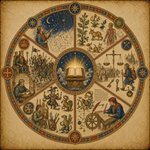
I used up my images in @grok today making diagrams of medieval educational models!


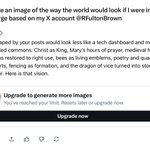
@grok, create an image of what the world would look like if I were in charge (based on my tweets) @RFultonBrown
@grok, create an image of what the world would look like if I were in charge (based on my tweets) @RFultonBrown