



It was an awesome team effort -- with researchers from the University of Basel, IBM T.J. Watson Research, Invitae, Queen’s University, Linkoping University, and University of Freiburg -- and you can read all about it at the contest page: core-challenge.github.io/202…
4/4

...and "plan" is the key term here. We explored the best the @ICAPSConference field has to offer and solved the problems using a combination of SoA planners. We topped the leaderboard in several tracks, and it's a testament to how powerful modern planning systems have become.
3/

The setting was to define a series of moves that brings a graph with marked nodes to another marking configuration, with every step along the way being an independent set. In the attached image, you can see a 3-step plan.
2/

Another exciting achievement for the MuLab to report on: earlier this week it was announced at the 2nd Workshop on Combinatorial Reconfiguration that the PARIS team, which included MuLab members @cjmuise and @alice_petrov_ , won several tracks in the inaugural Core Challenge.
1/

Happy to report that planutils snagged 2nd place at the demo track for this year's #ICAPS2022!! Congrats to all the winners, and we'll see you at next year's ICAPS.
icaps22.icaps-conference.org…

First up is Planutils -- a library and package manager that brings the best the planning field has to offer right to your (docker enabled) fingertips! Want to run any commonly used planner with minimal overhead? This is the place to go.
icaps22.icaps-conference.org…

Congrats @san_a_far, and welcome to @PfaffCatherine's Queen's University Soccer Lab and the @QuMuLab ! We're lucky to have you, and can't wait to see the awesome research you start to explore!!

I am honored to be a recipient of the @VectorInst Scholarship in Artificial Intelligence 2022-23 at @queensu

The 2024 @ICAPSConference was announced today to be in Banff, BC, Canada. Artwork already found on the lab whiteboard...
MuLab will be there to represent!

MuLab retweeted

We recently open-sourced MACQ, a toolkit meant to be your one-stop shop for learning #AI models for sequential decision-making, from observed agent data. Join us at #ICAPS2022 today for a live demo 🤓 with @cjmuise @QuMuLab
Link 👉 macq.planning.domains

Finally, we have Planning Tech for Planning Pedagogy -- a nifty little method to mark planning assignments /with a planner/. Very effective at detecting bugs in planning models.
icaps22.icaps-conference.org…
github.com/AI-Planning/p4pp

Next we have MACQ -- the Model Acquisition Toolkit. A one-stop-shop for action model acquisition, launching with 4 common/representative techniques, and a full analysis+taxonomy of the subfield.
icaps22.icaps-conference.org…
macq.planning.domains/

First up is Planutils -- a library and package manager that brings the best the planning field has to offer right to your (docker enabled) fingertips! Want to run any commonly used planner with minimal overhead? This is the place to go.
icaps22.icaps-conference.org…
Attending #ICAPS2022? Come check out 3 powerhouse demos from the MuLab & friends!!
icaps22.icaps-conference.org…
(next session @ 18UTC in just a few min!)
The improvement in unseen environments jumped from a 16.3% success rate in last year's winner to 36.7%. Not exactly a minor improvement!
Congrats to the whole team, and we'll see you for ALFRED @ EAI23!!
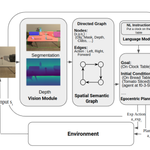
The work is a shining example of what is possible with an appropriately designed neuro-symbolic architecture. Perception and planning are used precisely where it makes sense, and to great effect. A very well-timed "win" for the use of planning techniques with #ICAPS2022 ongoing.

Very happy to share the news that recent @QueensComputing graduate, Xiaotian Liu, co-advised by @hectorpal (ServiceNow) & @cjmuise (Queen's) has won the #CVPR2022 #EAI22 embodied agent ALFRED challenge: askforalfred.com/EAI22/

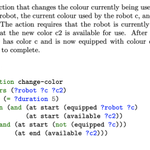
This work not only extends our ability to extract action theories from natural language to the temporal setting, but it further provides a compelling (and general) means of building input-specific prompts for LLM completion. More fun extensions to LLM prompt manipulation to come!
Step 4 dynamically builds a prompt using these "similar" examples and fetches the response from an LLM for the specific query. With some quick post-processing to make sure the generated code is syntactically correct, we're all set!

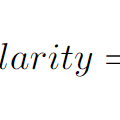
Step 3 embeds the input sentences (e.g., word2vec) and compares the input to the embedded sentences from the collected dataset (simple cosine similarity in this case).
From here, we know /which parts of our data is most related to the input text prompt/.

