





Qian Lin retweeted

Robot policies are getting remarkably capable—but are they robust enough to deploy?
We are moving towards an increasing deployment of pre-trained AI models with publicly released parameters and with no downstream retraining required.
But how vulnerable are these pre-trained models to adversarial attacks?
Our new work explores White-box, Grey-box and Black-box attacks across a range of both classic and recently proposed Imitation Learning(IL) algorithms, including Vanilla Behavior Cloning (Vanilla BC), LSTM-GMM, Implicit Behavior Cloning (IBC), Diffusion Policy (DP), and Vector-Quantized Behavior Transformer (VQ-BET).
1/3

Qian Lin retweeted

Excited to showcase our paper “ SyncSBC: Decentralized Swarm Behavior Prediction for Synchronized Autonomous Control” at #IROS2026!!
🧵 How does a robot in a swarm know what the collective swarm is doing?
Paper: lnkd.in/gmt2CNiJ
Website: lnkd.in/gwvUEFVp

Qian Lin retweeted

Super excited to work with an amazing group of people on developing the science of human-robot co-adaptation!

I'm incredibly excited to lead the new NSF Center for Human and Robot Co-Adaptation!
It is one of three new $30M, 5yr Centers launched under the @NSF STC program, and is led by @UTAustin , with partners @IUBloomington , @MIT , @TuftsUniversity , @UUtah , and @Yale
Excited to share our RLC 2026 paper! Big thanks to @ali_larian for leading, and to Chang Zong Wu & @daniel_s_brown. Teaching agents what you want so it survives environment shift 👇

Under identical budgets, HSCOT reaches higher constraint coverage and much lower regret on held-out environments than uniform teaching — rewards that survive a change in dynamics.
Paper: arxiv.org/abs/2607.08647
Code: github.com/Alilarian/multien…
🧵7/7

Qian Lin retweeted
Our paper "A Multi-Layer Sim-to-Real Framework for Gaze-Driven Assistive Neck Exoskeletons" is being presented this week at ICRA 2026!
arxiv.org/abs/2603.06779
🧵1/8

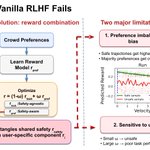
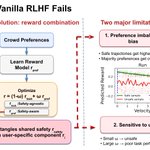
What if your task reward is imperfect — especially when it misses safety-related objectives? Maybe crowd preferences can help.
Excited to share our paper, Implicit Safety Alignment from Crowd Preferences, accepted to ICML 2026! Grateful to @daniel_s_brown for his guidance and support on this work.
Paper: arxiv.org/abs/2605.21822
🧵1/7

Our approach: compose safe skills instead of combining safety rewards. We first learn preference-aligned skills that capture different user preferences from crowd data. Then, a high-level policy composes these skills to solve new downstream tasks. The key idea is that the high-level policy solves the task, while the low-level skills provide safety
🧵6/7


Qian Lin retweeted

Excited to share that our paper, "Understanding the Effects of Neuron Dominance in Deep Reinforcement Learning", has been published in Transactions on Machine Learning Research!
Full paper: openreview.net/forum?id=VNV1…
Work with Qian Lin, Blake Lawlor, Haijun Zhao, and Daniel Brown.
Qian Lin retweeted
Super excited about our lab's new paper led by @zifan_w: "Understanding the Effects of Neuron Dominance in Deep Reinforcement Learning", that has been published in Transactions on Machine Learning Research (TMLR)!
openreview.net/forum?id=VNV1…
1/N

Excited to share that our paper, "Understanding the Effects of Neuron Dominance in Deep Reinforcement Learning", has been published in Transactions on Machine Learning Research!
Full paper: openreview.net/forum?id=VNV1…
Work with Qian Lin, Blake Lawlor, Haijun Zhao, and Daniel Brown.