





Quantum retweeted

We are closing in on one million error-free operations!
Helios has achieved a logical fidelity of 99.9995%—equivalent to just five uncorrectable errors per million operations. Importantly, errors fell exponentially as we increased the strength of error correction. This is the behavior required to build fault-tolerant quantum computers: add more protection, and the computation becomes exponentially more reliable.
This result also highlights the resource advantages of our architecture. Based on demonstrated color-code scaling, a Quantinuum system could reach a target logical error rate using approximately 30 times fewer physical qubits than a comparable superconducting approach.
This result, using the color code, is coming hot off the heels of our September record with the Helix code. Our ability to run multiple codes at record breaking fidelities showcases our flexible logical architecture and highly accurate trapped-ion technology.
Ultimately, this result highlights the power of Helios in ‘pathfinder’ mode: results like this validate the hardware, error-correction architecture, decoding, and control capabilities that underpin our path to Apollo—our universal fault-tolerant quantum computer planned for 2029.
Read the full story on our blog: quantinuum.com/blog/quantinu…

Quantum retweeted

A QUANTUM COMPUTER JUST BEAT GOOGLE’S ERROR RECORD BY 100X
$QNT (Quantinuum), reported this morning that its Helios machine hit 99.9995% logical fidelity. In plain terms, a protected qubit now makes about five errors per million operations. A month ago the same hardware held the record at roughly fifty.
A quantum computer is useless until its errors are rare enough to correct faster than they appear. Every roadmap to a useful machine is really a roadmap to that error rate. Quantinuum says it’s now inside the range its 2029 fault tolerant machine Apollo, was designed around.
They compared it to about 100 times fewer errors than the best published result on Google’s superconducting chips. Trapped ions are slower than superconductors, but each operation is far cleaner, and today that gap got wider.
The new code uses up to 37 physical qubits to make one good logical qubit, up from 10 in September. Better qubits, bought with more of them. The number comes from a company release, not yet a peer-reviewed paper. A Sandia physicist not involved in the work said it could mean useful fault tolerance at under a million physical qubits.
Google cut magic state errors 40x last Wednesday. Quantinuum cut logical errors 10x today. The physics is moving faster than the stocks.
$QNT $IONQ $INFQ $GOOGL


GOOGLE IS ONE STEP CLOSER TO A FAULT TOLERANT QUANTUM COMPUTER
Every useful quantum computer needs a supply of something called magic states. They’re the ingredient that lets a machine run real algorithms instead of simple ones, they can’t be reused, and making them is so expensive that some estimates say 95% of a future quantum computer’s capacity would go to manufacturing them. That’s been the quiet bottleneck behind every roadmap in the industry.
Today Google published a paper in Science showing a new way to make them on its Willow chip. Instead of building a magic state from scratch at huge cost, you start with a rough one, grow it inside a small protected patch of the chip, measure it over and over, throw away every attempt that shows an error, and keep the survivors. They call it cultivation.
The numbers were a 40-fold cut in errors versus the raw state, and the highest-fidelity magic state ever produced on hardware, 99.99%. They also showed the grown state can be transplanted from one type of error correcting code into another, which is the plumbing a real machine needs.
Google’s own caveat is that it has to work at much larger scale before it counts for practical computing. Fair, but the bottleneck everyone assumed would be the expensive part just got a lot cheaper, on a chip that exists.
$INFQ $IONQ $QNT $GOOGL

Quantum retweeted

Quantum computing is getting closer to becoming genuinely useful. 👀
For builders, this could open entirely new frontiers in materials, energy, biotechnology, and scientific discovery.
Entire industries could emerge around capabilities that don't exist today.
We're still early. But every improvement in quantum error correction brings us closer to machines capable of doing far more than today's quantum computers.
Why does this breakthroughs matter?
One of the biggest challenges in quantum computing isn't just building more qubits.
It's making them reliable enough to perform complex computations without errors destroying the results.
Magic states are essential resources for many universal quantum computing architectures, but producing them reliably can consume enormous computational resources.
Google's new approach progressively refines quantum states through error-detecting measurements, retaining only successful attempts.
THE RESULT: a 40× reduction in state infidelity, with approximately 8% of attempts retained for the reported high-fidelity result.
The bigger picture is what makes this interesting.
More efficient quantum error correction could reduce the resources required to run powerful quantum algorithms.
If these techniques continue advancing and scale to larger systems, we could move closer to quantum computers capable of simulating complex molecules, discovering better materials, improving catalysts, and tackling problems that are extremely difficult for classical computers.👀
We're still not at the point where quantum computers can routinely deliver these breakthroughs.
But researchers are making progress on the fundamental engineering challenges that stand between today's machines and tomorrow's applications.
FUTURE Implications will be amazing to see!
blog source:
blog.google/innovation-and-a…
paper:
science.org/doi/10.1126/scie…


Published in Science today: Magic state cultivation works in practice on our Willow processor. We achieved a 40x error reduction, compared to without cultivation, and 99.99% fidelity. Learn how this addresses a critical resource bottleneck: goo.gle/4yr8V0H

Quantum retweeted

🔥 INSIGHT: Morgan Stanley says quantum computing could eventually become a $100 billion market.


Quantum retweeted

Published in Science today: Magic state cultivation works in practice on our Willow processor. We achieved a 40x error reduction, compared to without cultivation, and 99.99% fidelity. Learn how this addresses a critical resource bottleneck: goo.gle/4yr8V0H
Quantum retweeted

BREAKING: Google says it has broken through a bottleneck that has held back quantum computing for 20 years.
Quantum computers need special building blocks called "magic states" to run useful programs.
They are so hard to make that up to 95% of a machine's capacity could go to making them.
Google's new method cuts errors by about 40x on its Willow chip, with a record 99.99% accuracy.
This is the first time a practical fix for this problem has worked on real hardware, according to Google's research published in Science today.


Quantum retweeted

Wait, you need approval to research an idea?
Meanwhile @QANplatform is lining up their clients, building exactly what they need to adopt post quantum Blockchain tech


Quantum retweeted

Read the recap: medium.com/qanplatform/septe…

Quantum retweeted
September Milestones: XLINK Goes On-Chain and Deterministic QVM Metering Takes Shape
September was a month of deep engineering for QANplatform. Our team turned their attention to the work that will define the production network: moving XLINK signature management on-chain, building a caching layer to speed up QVM executions, advancing our deterministic gas-metering research toward a real pricing model, and hardening the network against the subtle edge cases that only appear under sustained load.
This month also brought a major strategic milestone: with the execution-layer rebase complete, our audited quantum-safe stack is ready for the final security-audit phase.
Read the full technical recap on our blog (link in replies)🔗👇

Quantum retweeted
[Audit status update]
Based on all received feedback, we have finalized the decision on the consensus layer integration for the mainnet stack.
After careful consideration, we selected Lighthouse by Sigma Prime.
As discussed previously, Lighthouse is the most widely used consensus client and is considered semi-official due to its broad adoption among node operators. This choice best meets the technical and policy requirements of our strategic partners.
What happens next:
Step 1:
We are currently preparing the official Go-Ethereum based execution client to be compatible with the modified Lighthouse consensus client.
Step 2:
Once these modifications are ready, we will submit the execution client to the auditors, expected by end of next week.
Step 3:
Once the required Lighthouse modifications are completed, we will also submit the consensus client to the auditor.
Just to clarify, the above steps do not alter the mainnet launch timeline, as these processes are fully parallel.
Quantum retweeted

@IBM has been selected for Stage C of @DARPA’s Quantum Benchmarking Initiative: ibm.co/6015EpaS9
The next step: independent testing of our approach as we advance toward IBM Quantum Starling, our first fault-tolerant quantum computer, planned for 2029.

Quantum retweeted
NVIDIA JUST TOLD YOU WHERE TO INVEST NEXT.
QUANTUM IS THEIR FOCUS.
This morning Nvidia committed $1 billion to US science. Three priorities including, Quantum Computing, healthcare and energy.
Nvidia doesn’t build quantum computers, it built NVQLink, the plug that connects a quantum processor to Nvidia GPUs. Every quantum computer that wants to run error correction at speed goes through it.
Here's who to watch:
$IONQ: Trapped ions, named a DARPA finalist this week.
$INFQ: Neutral atoms, sqale processor runs on NVQLink.
$QNT. Quantinuum, runs its error correction decoder on Nvidia chips.
Last January Jensen said quantum was 15 to 30 years out and the whole sector crashed. Today he’s funding it with the White House.
Follow the money.
$INFQ $IONQ $QNT
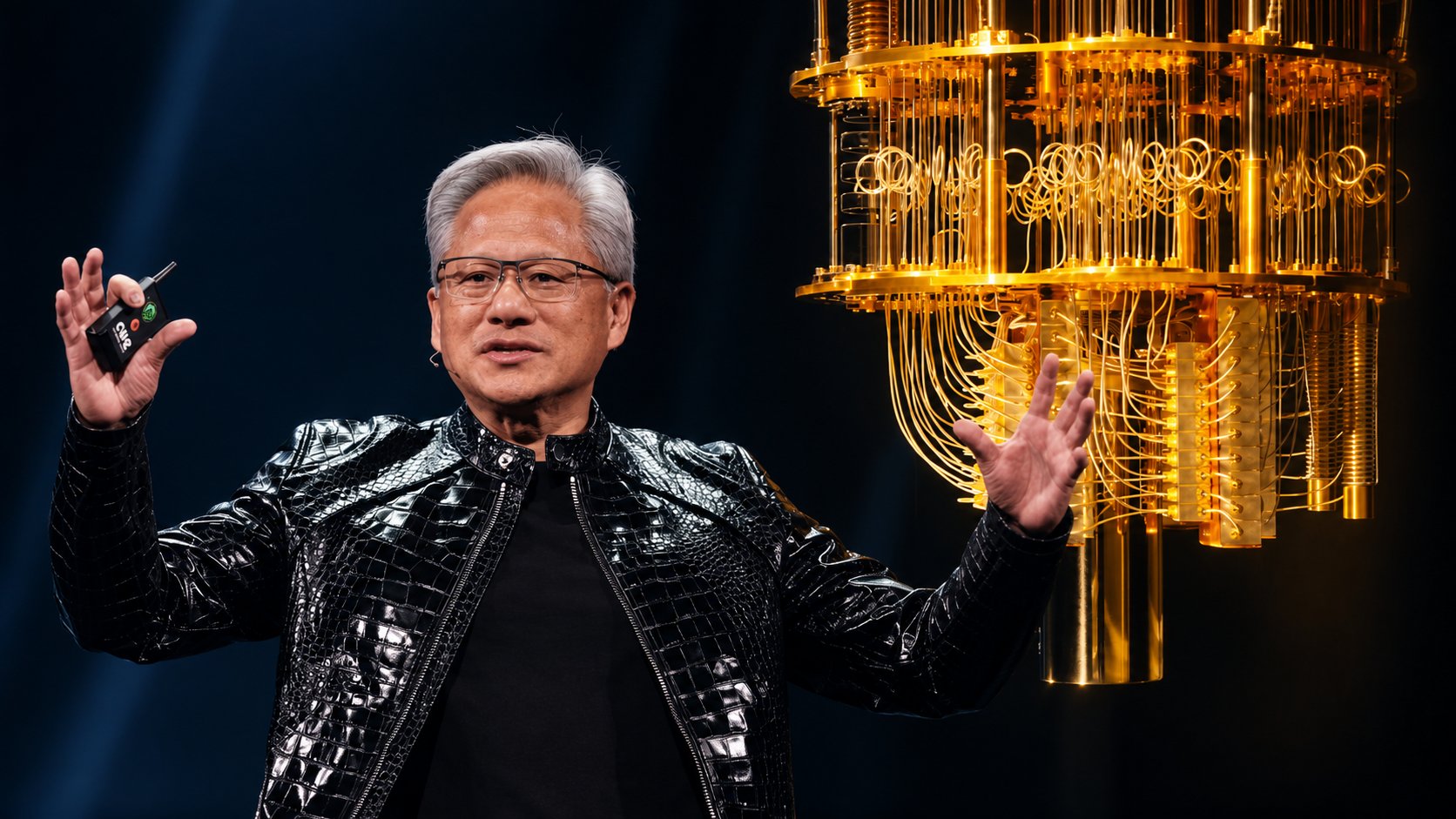

Today, NVIDIA is committing $1 billion over the next five years to help U.S. scientists advance research in quantum computing, healthcare, and energy.
This builds on more than two decades of work with U.S. national labs.
Read the release ➡️ nvda.ws/3VAeXhQ

Quantum retweeted
Europol “Quantum Computing and Cryptocurrencies” report: europol.europa.eu/publicatio…
QAN XLINK cybersecurity audit: hacken.io/audits/qanplatform…

Quantum retweeted
Europol mentions QANplatform in its recently published report, “Quantum Computing and Cryptocurrencies,” as a proven example of quantum-safe blockchain technology.
QAN XLINK, a cross-signer protocol that utilizes NIST’s primary-recommended post-quantum cryptography (PQC) algorithm and enables the integration of Ethereum-compatible wallets with quantum-safe, signature-capable key pairs, successfully completed a comprehensive cybersecurity audit by blockchain security firm Hacken (@hackenclub) in November 2025.
The solution is already deployed on the QAN TestNet.
Find the links to the report and audit in the replies. 👇

Quantum retweeted

europol.europa.eu/cms/sites/… Interesting to see Europol explicitly name @QANplatform in its latest report on quantum computing and crypto.
Europol says $QANX has already successfully implemented post-quantum signatures.
Notable institutional recognition of QAN’s technology.

Quantum retweeted

Europol's 2026 report on quantum computing and crypto names @QANplatform as a project that already has post-quantum signatures working.
On the radar of EU law enforcement. Just an example... or is there more going on? Mmmm 🤔
$QANX
europol.europa.eu/cms/sites/…
#NIS2 #NASA
Quantum retweeted
We built for a future where quantum-safety and auditability are mandatory, but public network dependency is optional.
Thanks to the hybrid architecture, enterprises can keep their data private while still achieving trust by anchoring proofs to the public blockchain.
On the budget side, there is one batched transaction instead of thousands. The cost model changes from per-transaction to predictable operational cost.
Public-chain immutability without having to pay public-chain fees on internal operations.
Both sides are quantum-safe, protected by NIST-standard post-quantum cryptography.
Cost and auditability are often a tradeoff. This architecture doesn't require enterprises to choose.
Quantum retweeted

$IONQ Intel's CEO says quantum can be 10 times bigger than AI.
Lip-Bu Tan calls it a national-security race for the lead.
Full interview on QuantumJane:
youtu.be/MwxUkWty6ao?t=1085
#IonQ #Quantum #Intel

$IONQ $INTC Intel's CEO: "The first one I invested is actually IonQ."
Lip-Bu Tan made that first quantum bet with his own money, outside his venture fund. He says he still holds half of it.
Spotted by @Rick101284.
Full interview on QuantumJane: youtu.be/MwxUkWty6ao?t=500
#IonQ #Quantum