

QMS Network is a Layer-1 blockchain built for the post-quantum era. Waitlist is open, visit our website below to join:
Joined May 2026
- Tweets311
- Following2
- Followers20K
- Likes264





QMS Network retweeted
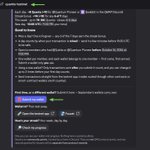
The QMS Testnet Streak kicks off today.
Thanks to your feedback, we've made improvements to swaps and liquidity provision, so now it's time to try them out.
Join our 7-day challenge to earn Quanta, our Discord community reward points that count toward the October leaderboard.
Here's how:
→ New participant or switching wallets? Submit your wallet in Discord first.
→ Make 1 test-token swap + add liquidity daily on @QWAP_xyz
→ Earn 8 Quanta points per day (10 for Pioneers & Qwabbits)
→ Complete any 6 of 7 days for a bonus
→ Earn up to 70 Quanta points (88 for Pioneers & Qwabbits)
Head to our Discord announcements for full details.

RT @Christopher_QMS: Some points on how we are addressing the quantum and AI threat to cryptography at @QMSNetwork :
Currently deployed on…
This quoted post is unavailable.
RT @Christopher_QMS: There has been a lot posted about AI breaking crypto these past days. Let me attempt to sort the good from the bad.
I…
This quoted post is unavailable.
QMS Network retweeted

@QMSNetwork Testnet Beta just hit another milestone: 1 million transactions! It took a bit over 3 days to get there. 🙂
Thank you to our fantastic community for testing our chain! ❤️

QMS Network retweeted
We launched our @QMSNetwork Testnet Beta without doing any load testing. Our code worked. We opened the testnet to the public. Happy to see that we hit 75% utlization this morning, with some blocks full to near 100%. All is working smoothly. 🔥🚀🚀


QMS Network retweeted
A September 2026 snapshot of where Bitcoin, Ethereum, Solana, and major Ethereum L2s stand on post-quantum migration:
Bitcoin: BIP-360 and BIP-361 remain drafts. Neither is activated. BIP-360 addresses long-exposed public keys; BIP-361 proposes a future migration and legacy-signature sunset.
August brought additional progress: a prototype SHRINCS signature specification and StarkWare’s reported quantum-safe Bitcoin transaction on mainnet. The latter used existing rules, expensive off-chain computation, and a direct mining path. It demonstrates a specialized construction, not a network-wide migration.
Ethereum: On September 7, the EF Protocol cluster set a self-imposed December 2029 deadline for quantum resistance across execution, consensus, and data. EIP-8141 Frame Transactions is now selected for Hegotá, providing a native account-abstraction path toward alternative signatures. This is a firmer delivery commitment, but the migration is still ahead.
Solana: Falcon implementation work is now complemented by Quantumglow, Anza’s proposed post-quantum adaptation of Alpenglow. Published in late July, it explores hash-based validator signatures and changes to consensus communication. It remains research, while ordinary Solana transactions still use Ed25519 signatures.
Major Ethereum L2s: Starknet has demonstrated an experimental, unaudited Falcon-512 account transfer on mainnet. Its broader migration remains incomplete, with bridge and data availability dependencies on Ethereum. Optimism also has a published roadmap, including a January 2036 target to deprecate ECDSA-based externally owned accounts, subject to governance approval. These are different milestones, not completed network-wide protection.
A post-quantum wallet is one part of the migration. Consensus, settlement, and data availability need protection too.

QMS Network retweeted
7,000+ Quantum Early Access Passes claimed.
Tomorrow, we open the door to something special that only pass holders will have access to, and it will be announced here first.
Remember to follow us if you haven’t already.
QMS Network retweeted
Before QMS produces its first block, prove you were here.
We're building a Layer 1 for the post-quantum era.
The Quantum Early Access Pass is now live.
Claim yours for beta testnet access and share it on X: qms.finance/#waitlist

QMS Network retweeted
Meet the people building QMS.
Alessio Onori is our Lead Site Reliability Engineer.
He brings over seven years of experience managing production infrastructure end to end, with particular expertise in blockchain systems. He holds a bachelor’s degree in computer engineering and a postgraduate master’s in cybersecurity from the University of Bologna, as well as a master’s degree in computer science and engineering from the Polytechnic University of Milan.
At Swisscom Blockchain, Alessio built a custom Kubernetes operator and automation tooling for networks including Polkadot, Bitcoin, and Ethereum. He then spent five years at the Web3 Foundation, where he managed production Kubernetes infrastructure across multiple cloud providers, supporting blockchain RPC and validator nodes alongside core platform services.
During that time, he introduced GitOps-based CI/CD practices and reusable infrastructure-as-code modules, strengthened disaster recovery processes, and formalized production-readiness standards across the organization.
Alessio joined QMS Network in June 2026. He leads the infrastructure and observability underpinning the network, from node operations and platform reliability to monitoring and incident response.

QMS Network retweeted
Blockchains have spent 17yrs coordinating value: tokens, money, settlement, ownership.
Compute markets have spent 20yrs coordinating work: pricing CPUs, scheduling jobs, routing capacity. Mostly inside a handful of clouds.
The convergence happens when computation itself becomes a thing that can be priced, proven, settled, and paid for on-chain. Three of those four exist today: onchain markets already price, settle, and pay for compute. Almost entirely capacity. Rent the machine, trust what comes back.
The missing verb is proven. Verification cheap enough to settle against the result, not the rental. Close that gap and "decentralized cloud" stops being a marketing phrase and becomes a market with the same shape as DeFi.
That's the bet behind QMS. The same work that secures the chain can be sold to clients: one computation, both jobs.

QMS Network retweeted
Q3 is when our roadmap starts coming to life.
If you want testnet/launch updates first, the waitlist is still open: qms.finance/

QMS Network retweeted
What should our industry prioritize for post-quantum security?
5%Retrofit BTC and ETH
63%Build PQ-native L1s
21%Pursue both in parallel
11%Too early to prioritize
19 votes • Final results QMS Network retweeted
Meet the people building QMS.
Allan Brøndum Rasmussen is our Lead Cryptography Engineer.
Allan holds a Master's degree in Mathematics from Aarhus University, covering advanced analysis, number theory, and algebra, followed by a Bachelor's degree in Computer Science. He specialises in high-assurance Rust, cryptographic protocol implementation, and the design of complex distributed systems.
He spent seven years at Systematic A/S as technical lead on large-scale healthcare software, developing strong skills in performance-critical backend systems, database design, and reliable distributed architecture. He then joined Concordium as a Senior Systems Engineer, where he led the rewrite of the blockchain node's execution layer from Haskell to Rust and collaborated with researchers on implementing cryptographic protocols, including zero-knowledge-based identity systems.
Allan joined QMS Network in April, and he's is responsible for ensuring that the security properties established at the research and design level translate faithfully into the implementation.

QMS Network retweeted
Congratulations! That is a step up in what Mythos can do.
To all the people panicking: vulnerabilities were found in schemes that aren't considered secure and aren't used in practice. This kind of research helps us root out bad schemes and improves our understanding of how to design good ones.
I would love to see AIs design new cryptographic schemes too. But that seems to still be beyond the capabilities of these tools. Though they are making regular incremental improvements to existing algorithms, e.g., decreasing the qubits needed in Shor's algorithm: ecdsa.fail/

QMS Network retweeted
Honored to be elected by the community to the @Concordium Governance Committee.
My time there shaped how I think about L1 architecture, lessons I now apply as CTO of @QMSNetwork, building a post-quantum-secure PoUW chain. Glad to keep contributing while both ecosystems tackle overlapping challenges.

The community has spoken.
Congratulations to Viktor Ihnatiuk, Christopher Portmann, and Jareau van den Heuvel on being elected to the 2026 Concordium Governance Committee.
Thank you to everyone who voted, every candidate who took part, and the outgoing Governance Committee members for their service and contributions.
🔗 Read more: concordium.com/article/2026-…

QMS Network retweeted
Great article on the state-of-the-art of post-quantum digital signatures, and why we can't wait for better ones. blog.cloudflare.com/ml-dsa-w…

QMS Network retweeted
We received some really good questions from you, and here’s our CTO @Christopher_QMS’s reply, ICYMI:
1️⃣ Q: I haven't quite figured out yet whether the testnet network prioritizes GPU or CPU?
Chris: The first version will be CPUs. Once we can better gauge demand and the computational power needed to meet it, we can optimise the code for GPUs.
Note that our first version will also allow for hybrid quantum-classical miners, where part of the computation is done on a QPU. Admittedly, at the moment these still cost more and produce less, but the design is ready for the next frontier in computing.
2️⃣ Q: As quantum solvers join the network, what’s your current thinking on proof-of-work verification for quantum outputs since they don’t produce a replayable classical path? Are you exploring ZK-based approaches here?
Chris: That’s a brilliant question. The short answer is no, we are exploring the use of hash-based (ZK-)SNARKs for improving verification in the classical case. But for the quantum case, something else is needed.
ZK-proofs are often designed to be short and efficient to verify, so they can be used to shift the burden from the verifiers to the prover (that is what zk-rollups do). They also provide the ZK-property, which in the context of computation verification, could allow a miner to prove that they have done the correct computation without revealing what computation that is (e.g., to preserve confidentiality of the client’s data). So they can be used to improve proofs, but they can’t be used to come up with proofs in a setting where we don’t already know how to generate (large, non-zk) proofs.
In the quantum case, we can verify that the output is correct, but what we don’t yet know how to do, is for a quantum miner to prove that they haven’t pre-computed the output (e.g., they learned about the input before other miners, and get an advantage which doesn’t correspond to their computational power). Classical replayable paths solve the problem, because in the classical case the miners are forced to follow a path that depends on the hash of the last block, so we just need to verify that they did take that path. We are working with academic partners on solving the quantum case.
3️⃣ Q: Will QMS network allow users to migrate from current wallet addresses to quantum-safe ones?
Chris: As soon as Ethereum pushes the account abstraction feature that we need, we will be able to implement this.
Since Ethereum’s roadmap for a post-quantum (PQ) consensus will take years, we are implementing PQ-consensus ourselves. But the account abstraction features needed to migrate current addresses to quantum safe ones should be released with the Ethereum Hegotá update at the end of the year (hopefully). And since we do not want to reinvent the wheel, we will wait for that and base our PQ-addresses on it.
QMS Network retweeted
Reminder: please make sure you only follow and use QMS’s official channels.
Starting next week, we’ll also begin introducing members of our core tech team. 💪
X: @QMSNetwork
Telegram: t.me/QMSNetworkOfficial
Website: qms.finance
LinkedIn: linkedin.com/company/qms-net…
Medium: medium.com/@QMSNetwork
Docs: docs.qms.finance
