

Private Investigator. We investigate psychiatrists. We created & now manage the world's largest database of public records on psychiatrists.
Joined February 2022
- Tweets3.4K
- Following195
- Followers4.6K
- Likes2.4K





PsychSearch
Psych Drugs Kill More Than Heroin
Colin Taufer
Every day, politicians, the press, and the president condemn the heroin epidemic currently ravaging the country. They talk about its toll in lives lost and communities ruined. They appropriate millions for prevention, treatment recovery, and drug education. They declare it a public health emergency and proclaim their commitment to fight the scourge with the Prescription Opioid and Heroin Epidemic Awareness Week every September.
Yet as bad as the curse of heroin is in this country, there is a much worse plague. Psychiatrists kill more Americans than heroin dealers.
When he met with adversity, Marine Corps veteran Jason Simcakoski was trained to overpower challenges with the perseverance to win battles. But there was one opponent Corporal Simcakoski could not overcome: psychiatrist David Houlihan.
On August 28, 2014, Houlihan added suboxone to Simcakoski’s already crippling cocktail of 14 (fourteen!) prescribed drugs which included antipsychotics, tranquilizers, muscle relaxants and the opioid painkiller tramadol. Simcakoski was so sedated he could barely speak. Two days later, he died from “mixed drug toxicity” leaving behind a widow and young child.
Houlihan, as readers of PsychSearch know, is the psychiatrist known as the “Candy Man”, he gave out drugs like candy. He earned this nickname as the chief of staff at the U.S. Department of Veterans Affairs medical center in Wisconsin where he quintupled the number of opiate prescriptions under his watch. (Prior to his work at Veterans Affairs, Houlihan was disciplined by the Iowa Board of Medicine for being “inappropriately engaged in a social relationship with a patient”.)
This is not an isolated, headline-grabbing incident of one rotten psychiatrist extinguishing a life and destroying a family with deadly psych drugs. In 2014, 10,574 people died of heroin overdose while 15,778 people died from psychiatric drugs, nearly 50% more.
The villain of this epidemic is not the shady dope dealer in a dark alley, or South American drug cartels, but the psych drug pusher writing prescriptions that poison the brain and kill.
psychsearch.net/colin-taufer…


PsychSearch
Coercion and Profits by Confusion
Colin Taufer
Open any magazine and chances are you will find its pages filled with ads from Big Pharma. This is because Big Pharma is far and away the biggest spender when it comes to magazine ads. In fact, it spends nearly double that of the number two magazine advertiser, retail and online apparel. In 2015 Big Pharma’s spending on such ads peaked at more than $1.5 billion, a 19% jump over the previous year.
Such advertising is known as Direct to Consumer Pharmaceutical Advertising. Not only do we see it in magazine ads, but everywhere else you’d expect: radio, television, billboards and online banner ads. In 2016 it was reported that nine prescription drugs were on pace to break $100 million worth of TV ad time for the year.
In an effort to reach as wide an audience as possible, pretty much anything and everything which can be labeled with a drug’s name has been: scissors, cups, flash drives, pens, pads of paper, stress balls, calculators, you name it. In fact, the bulk of Big Pharma’s marketing budget goes for drug samples and gifts for doctors. Shire Pharmaceuticals once created a set of nesting dolls to promote its ADHD drug Adderall. The dolls were intended to promote ADHD as genetically inherited, a specious concept used to push adult ADHD.
One impact of such promotion is a serious conflict of interest that benefits the doctor but not the patient. A 2007 survey found that 97% of physicians have relationships with drug companies, but many still believe they are immune to influence.
While such advertising is seemingly everywhere, to most of the world it is not. In fact, there are only two countries in the world which allow Direct to Consumer Pharmaceutical Advertising: the United States and New Zealand. The other 194 countries do not.
We’ve all seen the ads. They’re hard to avoid. If you’re like me, what happens when you read these ads are two things. First, the artful headlines, photos, colors and copy draw you in and capture your attention. Here’s an actual ad headline:
“Soar Confidently into summer and the new school year. Try Adderall…”
Then you turn the page and are overwhelmed and confused by the stark and hard to read page of safety information and indications. Written in tiny print, it is an entire page full of frightening side-effects (suicidal thoughts, seizures, diarrhea), hard to understand words (sertraline hydrochloride, premenstrual dysphoric disorder, tachycardia), unknown abbreviations (MDD, PMDD, MAOI), and all sorts of statistics and numbers.
This one-two punch of the pleasant artfulness of the first page followed by the bewildering and alarming “safety information” page leaves the reader confused and lost. A mental stress and discomfort immediately sets in leaving one more suggestive to the message of false hope proclaimed by the slick presentation. The confusion created by the analytical discord is perhaps “solved” by adopting a belief in the drug as the solution. “I guess I should give Adderall a try.”
This begs the question, given the obvious success of Big Pharma advertising, is the intellectual disorientation created by such ads intentional?
Seventy percent (70%) of primary care physicians, when surveyed, said that Direct to Consumer Pharmaceutical Advertising confuses their patients either “a great deal” (28%) or “somewhat” (42%) about the risks and benefits of prescription drugs. And seventy-five percent (75%) said such advertising causes patients to believe either “a great deal” (32%) or “somewhat” (43%) that drugs work better than they do. These findings come from a survey conducted by the FDA published November 19, 2004.
Further confusing patients are their own misconceptions. A survey of consumers found that 50% of respondents thought the ads were approved by the government (they’re not), 43% though that medication had to be completely safe for it to be advertised (it doesn’t); and 22% thought that a drug known to have serious side effects could not be advertised (it can).
The point is amplified in this article from The Guardian urging health professionals to use clearer language. In particular, patients’ failure to understand what the doctor said or what they have read stops them from understanding the diagnosis and leads to misunderstanding or not spotting warnings about medication.
The conclusion is simple. If people really understood what psychiatry was selling – false diagnoses and damaging “treatment”- would they buy it?
No.
psychsearch.net/colin.taufer…

PsychSearch
Psychiatry Made My Mother Crazy
Cindy Bevington
It would take writing a book to tell my mother’s story―which is something I don’t intend to do here―but what I am going to say is that I don’t believe my mother was born crazy. Again, I’m using that not-so-nice term because it is what it is, regardless of whether the PC police come after me for it. If you look up “crazy” in the dictionary, the definition is: “mentally deranged, esp. as manifested in a wild or aggressive way.” My mother fit the bill. She was crazy. The crazy things she did to me and my five siblings are unspeakable, indescribable, and, well, crazy. And I blame psychiatry for pulling her into the abyss of craziness. It was an abyss that, once she was in it, there was no getting out.
While my mother’s craziness began shortly after I was born―when she was institutionalized with a “nervous breakdown” and given shock treatments―I was about 10 when I overheard her and my aunt talking about valium. From the sounds of it, valium was a great thing. To hear them talk, everybody had some. And the magic that it could do for hard-working mothers of the late ‘50s and early ‘60s was absolutely wonderful. I don’t know how or when my mother graduated to more powerful drugs. I just know that, by the time I had graduated high school, it was quite common to hear my mother say, “I think I’ll just take five soma and go to bed.” In the cupboard along with the soma, you could find darvocet and darvon, and a drug store-full of “helpful” over-the-counter drugs like diet pills (for the amphetamines) and Sominex (for when the diet pills kept you awake all night). Of course I know that soma, pain relievers and diet and sleeping pills are not psychotropics or antidepressants, but the fact is that they have similar effects on the human brain and body as psychotropics and antidepressants. And once my mother figured that out, she had an open book of all kinds of drugs that she could take to get the desired effect — high or low. Psychotropics and antidepressants were simply frosting-on-the-cake additions to her drug closet.
I also don’t know when the parade of doctors began. I just know that it was winter, 1972, when the family physician called me and told me that, as the oldest child, I needed to “do something” about my mother’s drug problem, because my father wouldn’t. Stunned, I learned that a new drug store warning system had caught my mother getting the same prescription from more than 15 different doctors. That’s right. FIFTEEN. They were putting a kabosh on her prescription party. But I needed to “do something” about her problem. NOT. My mother moved 800 miles away and continued with her life, spiraling downward, downward, downward into the oblivion known as mental illness. Ten years later, I sat in front of her psychiatrist in southern Georgia, listening to him tell me that, as the oldest child, I needed to do something because nobody else would, including my father. The psychiatrist had put my mother in the psych ward after her infamous chase after a deputy with a butcher knife in her hand. As I sat there bawling, saying, “Why me? Why do I have to always be the one to do something about her?” the doctor asked me if I’d like a valium.
“WHAT!? That’s what put her here in the first place!” I yelled back at him. “No, I don’t want any valium. What I want is for this to stop! If it weren’t for all these drugs she would have been forced years ago to face reality and deal with her life instead of escaping it. No, I don’t want any valium!”
Sobbing, I signed the papers accepting responsibility for my mother. The courts made me her legal guardian, and I set off on a quest to make her well. Along the way, it was a psychiatrist who informed me that “they” never get well. “They” could get better, but only if “they” decided to do it on their own, he told me. “But YOU need to get the idea that you can make her well out of your mind,” he told me. I think those are the most true words I’ve heard spoken by a psychiatrist―except maybe those written by Loren R. Mosher, MD, in his resignation letter from the American Psychiatric Association. Since he said it first, I’ll repeat it here: “Unfortunately, APA reflects, and reinforces, in word and deed, our drug dependent society.” Mosher said. “Yet it helps wage war on ‘drugs’. ‘Dual diagnosis’ clients are a major problem for the field but not because of the ‘good’ drugs we prescribe. ‘Bad’ ones are those that are obtained mostly without a prescription. A Marxist would observe that being a good capitalist organization, APA likes only those drugs from which it can derive a profit — directly or indirectly.
“’This is not a group for me. At this point in history, in my view, psychiatry has been almost completely bought out by the drug companies”
Mosher’s letter goes on to skewer the APA for what has obviously become a group solely to benefit the drug industry, but the point is that long before I sat in my mother’s psychiatrist’s office sobbing, the drug industry had already stolen her mind and thrown her away into the Land of Crazy.
In the years following, I learned so much about psychiatry’s dance with the drug industry inferno that I couldn’t begin to describe it here. Let it suffice to say that by the time I became her guardian, it was too late to save her. I couldn’t save her. She was too far gone on all the drugs they fed her; from thorazine to lithium to elavil to haldol and countless others, they pumped pills and liquid drugs into her as fast as they could. It was no different for my brother when he took over the guardian position. In the end, in desperation, we signed her in to a permanent care facility, where she died a few years ago.
The life that I led, along with my siblings, was horrific, and I blame the psychiatry industry for it. I’ve written newspaper columns ripping the APA to shreds, mocking them for their “ideals” and goals, especially when the goals involve the bible of psychiatry―the DSM, the Diagnostic and Statistical Manual of Mental Disorders, a book designed for the sole purpose of creating diseases that can be treated by psychiatrists and paid for by insurance.
“You made her crazy” is a mantra I’ve repeated often, and I’m saying it again. I hold the psych industry and its big, fat, 947 pages of crazy diagnoses wholly and totally responsible for making my mother crazy. I don’t deny it. I’m angry. I’ve been angry about this for a long time. And I don’t need any valium to take the edge off that anger. It’s time to expose psychiatry for the fraud that it is.
Cindy Bevington is an award winning investigative journalist.
psychsearch.net/cindy-beving…


PsychSearch
Psychiatric Diagnosis from Afar
Colin Taufer
When psychiatrists make a claim in which they cite their “ethical responsibility” as justification for doing so, it is both absurd and laughable. Psychiatrists cannot and should not be trusted.
Such was the case in April of this year when a group of psychiatrists proclaimed, “We have an ethical responsibility to warn the public about Donald Trump’s dangerous mental illness.”
Visit the homepage of PsychSearch any day of the week and you will find a fresh assortment of mugshots of psychiatrists in trouble with the law for sex crimes, drug abuse, or fraud – often all three at once. Then there’s the never-ending stream of complaints against psychiatrists filed to government agencies through PsychSearch. They arrive by the boatload every week. All of this comes as no surprise when you realize the “science” of psychiatry is built on the lie of the “chemical imbalance of the brain.”
They can’t even be trusted to follow their own rules.
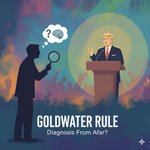
The American Psychiatric Association is very clear on what it considers professional conduct from its members: “On occasion psychiatrists are asked for an opinion about an individual who is in the light of public attention…it is unethical for a psychiatrist to offer a professional opinion unless he or she has conducted an examination and has been granted proper authorization for such a statement.” This is known as the Goldwater Rule because the last major political figure to be smeared by psychiatry in such a way was 1964 Presidential candidate Barry Goldwater.
Psychiatrists’ political motivations for making such a decree are clear. They have distinct political leanings to the left. Or, as the New York Times put it, “Your Surgeon is Probably a Republican, Your Psychiatrist a Democrat.” Like Trump, Goldwater was also a Republican.
But never mind their political intrigues. It is their more fundamental beliefs we should view with disdain and eliminate from society. Any group can make a statement maligning a public figure. But when that character assassination comes from group full of professional sex perverts, drug pushers and con men, we must bring to justice the authors of the piece not its subject.
psychsearch.net/colin-taufer…

“The following article was originally published on Inside Investigator”
Inside Investigator
CT psychiatrist allegedly defrauded patients, supplied them with crack; “The grief is massive.”
Marc E. Fitch
September 3, 2026
Hartford-based psychiatrist Dr. Douglas Zelisko faces a long list of charges by the Department of Public Health, including presenting his romantic partner as a therapist, fraudulent billing, and supplying both his partner and private practice patients with controlled substances and street drugs, while also being employed by the State of Connecticut as a psychiatrist at Connecticut Valley Hospital.
According to the Department of Public Health’s statement of charges and information supplied by one of his victim’s family, Zelisko referred his private practice patients to his romantic partner, Aleixander Puerta, presenting Puerta as a therapist and life coach despite Puerta having no credentials, training, certification, or education beyond high school.
The pair then allegedly used struggling psychiatric patients to fraudulently bilk families for money and steal medications for personal use, while the patients’ conditions worsened as Zelisko and Puerta plied them with drugs and alcohol, paid for with money taken from the patients’ families. Six patients are cited in DPH’s report.
According to the laundry list of charges, between 2023 and 2025, Zelisko and Puerta engaged in the following:
* Zelisko prescribed ketamine, testosterone, and at least thirteen other medications for a patient but had those shipped to his home for Puerta’s use.
* Zelisko and Puerta met with patients at bars and restaurants, supplied them with alcohol and illicit drugs, and had them sleep at Zelisko’s home.
* Zelisko allowed Puerta, with no official license or training, to administer medications to patients.
* Zelisko and Puerta billed for treatment sessions that never happened, including while a patient was in the hospital and another was on vacation out of the country.
* Abandoned multiple patients by not responding to phone calls, showing up for appointments, or properly transferring records.
* And prescribed vast amounts of controlled substances “in quantities greater than a seventy-two-hour supply for approximately 242 patients.”
According to DPH’s investigation, doctors at psychiatric facilities warned at least one victim’s family that it appeared Puerta was “grooming” the patient after he brought a vape pen and possibly illicit drugs to the patient while that patient was hospitalized. Somehow, despite glaring warning signs, no one at the state or federal level caught on to these crimes until a family came forward.
Zelisko appeared before the Connecticut Board of Medical Examiners on September 3. The board was scheduled to consider whether to revoke Zelisko’s license to practice. However, Zelisko did not have an attorney and asked to continue the proceeding at another time, which the board granted.
Susan (pseudonym), the mother of one of the victims listed in DPH’s findings, says her son had experienced a psychotic episode due to heavy marijuana use. Following inpatient treatment, her son was in the early stages of recovery and had returned to college. In seeking to build a support team to aid in his recovery, Susan searched for psychiatrists in the West Hartford area, and Zelisko came highly recommended.
“My son was finally heading back to college, with sobriety and stability, and some buy-in to his recovery,” Susan said in an interview. “When I met Dr. Zelisko, I thought he was wonderful. He was younger, he kinda had a hip vibe, he had vast experience with addiction and psychosis and mental health. So, we felt confident we have found the most important piece of my son’s care.”
Zelisko allegedly then presented them with multiple credentials for Puerta to act as her son’s life coach, which Zelisko said was “key component,” of recovery. The credentials were allegedly all fake; there was even a fake business website for Puerta’s life-coaching business called Unleash Your Hue. The two also created Integrative Psychiatry, LLC, in April 2025, according to state business records.
Zelisko and Puerta, however, began to provide her son with cocaine, methamphetamine, and alcohol, and Puerta engaged in sexually explicit text messages with her son. They charged for sessions that never occurred or held “therapeutic” sessions at restaurants like Dave & Buster’s.
All of this, she said, led to her son’s deterioration and worsening condition, resulting in multiple in-patient hospitalizations. Instead of recovering from his addiction, her son now carries a diagnosis of schizophrenia.
“We saw our son come home relatively stable, start college with this team of individuals that were apparently wrap-around support, but our son was continuing to get worse through the year,” Susan said. “We couldn’t figure out why; he didn’t have money; he didn’t have a car and had oversight by these two individuals.”
Susan says they finally made the decision to get her son out of Zelisko’s care, which was difficult. Shortly thereafter, she received a letter from an inmate in Massachusetts who informed her of who Puerta really was and said that Zelisko and Puerta were using her money to supply her son and themselves with drugs. It was then that Susan reached out to DPH officials. The unnamed inmate claimed to have previously sent multiple letters to federal law enforcement agencies.
“The ‘team’ we entrusted to move my son towards sobriety and stability was actually dismantling any stability he had achieved, causing my son to continually slip into his fractured reality of psychosis -causing multiple hospitalizations trauma and literal damage to my son that can never be reversed,” Susan wrote in a follow-up email. “The financial misconduct is a part of it, but the human toll is summed up by the fact my son’s future -his entire life trajectory was permanently altered under the care of Dr Zelisko. The loss is so pervasive and the grief is massive.”
Susan’s son, along with five other patients, was abused and defrauded by Zelisko between 2023 and 2025, according to DPH’s charges. During that time, Zelisko was also employed by the State of Connecticut as a per diem psychiatrist at Connecticut Valley Hospital, which is run by the Department of Mental Health and Addiction Services (DMHAS).
State open records show Zelisko was employed by DHMAS between 2020 and 2025 and made, collectively, over $1.6 million during that time, including $483,575 in 2024 alone. Online records show he was also previously employed by the Institute of Living.
The DPH investigation indicated that Zelisko did not cooperate with investigators and ignored subpoenas for information.
“Respondent failed to provide the Department with the requested medical records despite repeated requests.” Lorraine Cullen, branch chief for the Regulatory Affairs Branch. “The Department thereafter issued a subpoena to obtain the patient medical records, and the subpoena was similarly ignored. To date, Respondent failed to cooperate with Department’s investigation.”
In brief comments before the board, Zelisko blamed “everything that happened,” on “a pretty severe domestic violence situation,” claiming it is why he hasn’t been responsive to DPH’s investigator nor the subpoena for records, because he wasn’t at his office or home.
Court records show Zelisko had his Glastonbury house foreclosed on in 2026; was evicted from his business premises in 2025 for nonpayment; was evicted again in 2026 from a new business location; is being sued by several creditors, including a Porche leasing service, and owes a $630 debt to a bail bond service for getting Puerta out of jail in January 2026.
In signing for the bond, Zelisko listed his employer as “State of Connecticut DMHAS – private practice.”
Puerta was reportedly arrested again on August 12, 2026, for possession of drug paraphernalia, driving an unregistered vehicle, and violation of a protective order. According to arrest records in Florida, Puerta was arrested for domestic violence in 2019.
While likely the most egregious and damaging to vulnerable patients, Zelisko is not the only state employee or state contractor to have been caught engaging in fraud.
Office of Policy and Management employee Suhail Aponte and a partner defrauded Medicaid of $1.8 million under a fraudulent business that purported to help children with autism while earning $90,000 per year from taxpayers; psychologist Michael B. Pines, who was regularly used by Connecticut’s family court system, defrauded Medicaid of roughly $1.6 million, much of it while he was under supervision of the Board of Medical Examiners; Armand Ntchanawas convicted of $600,000 in Medicaid fraud while operating two state-funded residential care homes.
“We thought we were doing everything right, and in reality, our son was being harmed every day under their care,” Susan said. “We did our research, and we vetted him, and it still wasn’t enough. How do families protect themselves from something like this?”
“I want justice served,” Susan said. “It’s a crime and they need to be arrested for it.”
psychsearch.net/douglas-zeli…


PsychSearch
A Basic Human Right Violated
Colin Taufer
“No one shall be subjected to torture or to cruel, inhuman* or degrading treatment or punishment,” states article 5 of the Universal Declaration of Human Rights, a milestone document that set out, for the first time, to universally protect everyone’s fundamental human rights.
In headlines, we read about violations of this human right every day. The CIA waterboarding suspected terrorists, ISIS soldiers brutalizing their kidnapped victims, war criminals committing genocide. Clearly these are acts of torture. They are cruel, inhuman and degrading. They cause outrage. They start wars, they prolong them.
If a female social worker from the United States was captured by a militant group in the Middle East then freed from the clutches of the terrorists by a daring military rescue, the nation would be full of patriotism and pride. There would also be a measure of revenge on our collective minds.
As a country, we would piece together the facts of this case and our sense of furious revenge would boil over. We’d demand the president take action. We’d insist Congress do everything in their power to right this injustice. We’d overwhelm social media with petitions and pleas for reprisals and an overhaul of every step in the system that brought about this national nightmare. We’d be filled with vengeance and ready for forceful retaliation. We’d rail against the uncivilized animals that tortured one of our own.
Imagine too, as this rescued patriot settled back into life in the States, details of her captivity and post-trauma health hit the media. We’d learn that her arms were maimed by the wrenching twists of her captors, her love of life drained by the dehumanizing ordeal, her faith in mankind shattered, her ability to love and be loved by her family gone. Maybe she was sexually assaulted while drugged…she can’t remember. She can remember being tied down and forced to lie in her own waste. Clearly no one would dispute the fact that this was torture and an egregious example of a violation of human rights.
But what about the psychiatric patient who is committed without consent, held against her will, manhandled and bruised, drugged for being “resistive”, strapped to a bed and refused bathroom breaks and groped and assaulted?
Without a doubt this too is torture and a violation of human rights. But the uncivilized animals committing these atrocities are not extreme terrorists or cruel despots** or insane generals of faraway lands. They are criminal psychiatrists and they are committing these cruelties every day, in our communities, often supported by tax money that came from our pockets. Look no further than the front page of PsychSearch.net for proof.
Stand up for human rights and fight psychiatric torture.
---
*Inhuman: lacking human qualities of compassion and mercy; cruel and barbaric.
**Despot: a ruler or other person who holds absolute power, typically one who exercises it in a cruel or oppressive way.

PsychSearch
The Shrinks are Shrinking
Colin Taufer
“Psychiatry is in decline and is becoming obsolete.”
This statement does not come from an anti-psychiatry group or a former patient with an axe to grind or a dubious website. This quote comes from an article published by The British Journal of Medical Practitioners, a professional, peer-reviewed online medical journal. The title of the article says it all Psychiatry in Decline. How does the author, a noted English psychiatrist, make his point? Plentifully, honestly and accurately:
● Psychotropic drugs are perceived as a form of control by psychiatrists towards their patients.
● Psychiatrists are denigrated for being in the grip of Big Pharma and perceived as drug pushers.
● Shock therapy is considered barbaric.
● Psychiatry is a victim of its own psychobabble and increasingly mind-numbing research.
● Outcome studies are quoted as favorable, when the very principle of their foundations is very shaky.
● Abuse of psychiatric practice does occur. (As readers of PsychSearch are well aware.)
● Political regimes throughout the world have used and still use powerful psych drugs to subdue and control individuals who challenge the authority of the State.
● Psychiatry has been used by some totalitarian regimes to enforce political control: Nazi Germany, the Soviet Union and apartheid in South Africa.
Not a favorable outlook. But not only is psychiatry becoming obsolete, the number of psychiatrists is also shrinking.
According to one leading journal of healthcare policy, the population of US practicing psychiatrists declined between 2003 – 2013. Interestingly, during the same period the number of primary care physicians grew. In 2012, U.S. News & World Report discussed the trend of the declining number of US medical students choosing psychiatry as a specialty. This downturn is on top of a psychiatric shortage, the same article claims.
In July, when asked about the shortage of psychiatrists, the president of the World Psychiatric Association, Dinesh Bhugra, lamented the dour future of psychiatry. He told PsychSearch that a dwindling number of students were interested in pursuing psychiatry and they needed to improve recruitment and training of new students.
Psychiatry is a dying profession. Its theories are outmoded and inaccurate, its practices inhumane and ineffective, its numbers declining.
The shrinks are shrinking.
youtu.be/9UIXaeei-j8

PsychSearch
Psychiatry and Accountability
Colin Taufer
“Your son needs medication to control his impulsive behavior in my classroom.”
These words, or some variation of them, are the ones that begin millions of our nation’s children down a destructive path filled with unfortunate consequences. One such effect, usually lost sight of, is the insidious damage such diagnoses do to the child’s sense of personal responsibility. After all, the most important people in the child’s life, his parents and teachers, have agreed that he cannot control his own behavior. They’ve concluded that self-control is not something he is capable of, let alone responsible for. Further, with this analysis stated as “fact”, the teacher and parent are comforted to know that it wasn’t their fault the child acted that way. A tacit agreement develops absolving all involved. After all, he must have a chemical imbalance in his brain. It’s a “disease”.
“When children are told they have ADHD and need medications, they are given the idea that they cannot control their behaviour. The diagnosis of ADHD discourages personal responsibility. This almost inevitably disrupts emotional growth and renders the child less able to grow up into a mature adult.” Those are the words of psychiatrist Dr. Peter Breggin, a tireless advocate for reform in the field of mental health.
What happens to these same children who’ve been indoctrinated to the idea that their poor self-control has nothing to do with them but a nebulous “imbalance of brain chemicals”?
They become adults with the same problems:
“I can’t focus because of my adult-ADHD.”
“My anxiety medication helps me to cope with my stressful job.”
“I keep my desk very orderly. I must have OCD.”
We also get Big Pharma and their billions recruiting celebrities such as Maroon 5’s Adam Levine shilling for “adult ADHD”. In a typical interview from 2014 Levin cunningly excused his inability to focus on his “disease”, “People notice my ADHD as an adult on a daily basis. When I can’t pay attention, I really can’t pay attention.” Speaking of celebrity endorsements, Big Pharma marketing executives must have cartwheeled around their offices in joy when photos of Carrie Fisher’s ashes being carried in a porcelain Prozac pill hit the media in December 2016.
Beyond the false diagnosis of “it’s not your fault”, the medication itself compounds the problem. For all psychiatric drugs have debilitating side effects that further reduce one’s ability to exercise accountability within one’s own control or power: aggression, anxiety, abnormal behavior, fatigue and depression — just a few of the most commonly reported side-effects of psychopharmaceuticals. Responsibility for their actions lies even further beyond their awareness when these mind-numbing drugs are mixed in.
In the hands of psychiatry the moral child, the moral adult, the moral society all become amoral at best, immoral at worst.
psychsearch.net/colin.taufer…

PsychSearch
Shock Treatment in your Neighborhood
Colin Taufer
You might think the barbaric psychiatric “treatment” of applying electricity to the temples and passing it through the brain to produce grand mal seizures is obsolete.
You might think that a “treatment” that causes brain damage in patients would not be tolerated by a modern, civilized society and would no longer exist.
You might think a patient winning a malpractice suit against her psychiatrist for shock treatment or a class action lawsuit against manufacturers of shock treatment machines would outlaw the practice.
But, as unbelievable as it may seem, today shock treatment is still very much in use and considered legitimate in the eyes of psychiatry.
Last year the National Institute of Mental Health proudly boasted approximately 100,000 people in the U.S. and over 1,000,000 worldwide receive shock treatment annually . This means, on average, 275 people receive shock treatment in the United States every day of the week. Most of them women — they are subjected to electroshock two to three times as often as men. Some are children.
Right now, as you read this, patients in your neighborhood are receiving shock treatment.
Each patient is strapped down and administered a mixture of anesthetics and drugs to paralyze muscles, to suppress fear and pain, and to cut down on the number of broken bones — particularly in the spine, a common occurrence before drugs were used. Next, a pair of electrodes are attached to their temples and 150 to 400 volts of electricity are passed through their skin and skull and into their brain, directly hitting their memory centers in the tip of the temporal lobes. The shock induces a grand mal seizure, damages brain cells, and generates a temporary coma. After several minutes of unconsciousness the patient comes to and feels all the typical symptoms of severe head trauma including headache, nausea, memory loss, disorientation, confusion, impaired judgement, loss of personality, and emotional instability. They are now mentally apathetic and emotionally indifferent .
The attending psychiatrist declares the treatment a success and schedules the next eight treatments, the average number a patient receives.
Yes, this is happening where I live in Clearwater, Florida. Shock treatment psychiatrists in my backyard can be found below.
CLEARWATER, FLORIDA
Shock Treatment Psychiatrist
Theresa L. Clark
1200 7TH AVENUE NORTH, ST PETERSBURG, FL 33705
holds staff privileges at Morton Plant Hospital, 300 Pinellas Street, Clearwater, Florida
Shock Treatment Psychiatrist
Maykel Luna Concepcion
300 PINELLAS STREET, MS 70, CLEARWATER, FL 33756
holds staff privileges at Morton Plant Hospital, 300 Pinellas Street, Clearwater, Florida
Shock Treatment Psychiatrist
Francis K Butler
100 MAIN STREET, SUITE 203, SAFETY HARBOR, FL 34695
holds staff privileges at WINDMOOR HEALTHCARE OF CLEARWATER, 11300 U.S. 19 North, Clearwater, FL 33764
psychsearch.net/colin-taufer…


PsychSearch
Drugging Children for Conformity
Colin Taufer
Throughout its long history, Ritalin has been a drug in search of a “disorder”. Its manufacturer Ciba (now Novartis) has spent millions on advertising and “doctor education” trying to find and create a profitable “disease” for its drug.
In the mid-1950’s Ritalin was advertised as a way to boost spirits and to make patients more cooperative and manageable. Later, in the same decade, Ciba tried another approach and marketed Ritalin as a “safe, effective geriatric supplement”. In the 1960’s promotional focus again shifted and it touted itself as a way to “restore alertness, enthusiasm and drive” and a way to “spark energy”.
In the late 1960’s and early 1970’s, housewives became the target population for this wandering drug. One magazine ad of the day was quite blatant. It featured a photograph of an exhausted homemaker sitting atop her vacuum, bags under her eyes, head resting in her palm. With RITALIN, trumpeted the ad, “fatigue and worry seem to vanish”. Even pop culture of this era reflected the sudden popularity of drug manufacturers targeting mothers. The Rolling Stones’ 1966 hit song “Mother’s Little Helper” contained these lyrics:
Mother needs something today to calm her down
And though she’s not really ill, there’s a little yellow pill
She goes running for the shelter of a mother’s little helper
And it helps her on her way, gets her through her busy day
But it wasn’t until the 1970’s when Ritalin began its ascent to become one of the biggest players in the multi-billion dollar market we know today. That was when it began selling itself to worried parents with anxiety-stoking ad copy like this:
The mean child who doesn’t mean it… Is he a “hyper-active” problem child?
At the same time, doctors began pushing childhood MBD, or Minimal Brain Dysfunction in children. Ads trumpeted with authority:
Mischief or MBD? (Don’t mistake one for the other)
He has disrupted his family…his teacher’s classroom…and his own life. But he can’t help it. He has MBD.
MBD was the “all-encompassing, wastebasket diagnosis for any child who does not quite conform to society’s stereotype of normal children”. These words come from the article The Minimal Brain Dysfunction Myth published in November 1975 in the Journal of the American Medical Association, Pediatrics.
In the eyes of the psychiatrist and big pharma, what is a “normal” (conformist) child today? Using their own criteria, directly from the ADHD checklist, such a child:
● interferes with no one
● answers questions politely
● never interrupts
● pleasantly stands in line
● quietly waits for their turn
● stays focused on homework
● always completes activities before moving on to the next activity
● never makes careless mistakes
● stays organized
● never loses anything
● keeps self under control
● never fidgets
● remains seated
● always says the right thing at the right time
● sits quietly on task
I myself can think of no child I know or have known, no matter how stellar their grades or wonderful their accomplishments or fantastic their parents, who meets all these criteria.
Every child who does not conform to psychiatry’s definition of normal is the “right” target for Ritalin (or Concerta or Adderall or any other drug that targets such children) — the “right” target being all children. And thus, Ritalin’s “disease” of the “hyperactive child” was born: ADHD, attention deficit hyperactivity disorder. (Not surprisingly, since 2000, the FDA has cited every single major ADHD drug manufacturer for false and misleading advertising.)
Methylphenidate, the drug that is Ritalin and the basis of all ADHD drugs, has a high potential for abuse and it produces many of the same effects as cocaine, according to the DEA. It has also been shown to specifically suppress social play behavior.
With over ten million Americans currently taking ADHD drugs, millions of adults included, psychiatry and big pharma are on their way to creating a nation full of quiet, unquestioning, and non-interfering conformists.
Unless we do something about it.
One suggestion is to file complaints against psychiatrists. psychsearch.net/complaints/ States seldom take action without first receiving a complaint.
psychsearch.net/colin.taufer…

USA Psychiatrist gets the firing squad.
youtube.com/shorts/TQgjS2YP0…

