

Answering the Strongest Challenges to Protestantism | Dr. Christopher Cloos
Joined January 2022
- Tweets3.2K
- Following590
- Followers2.8K
- Likes3.3K




Pinned Tweet
On November 14, I'm teaching a live masterclass on Catholic miracles.
I grant every case, Fatima, Lourdes, Zeitoun, Lanciano, and ask one question. Before it happened, what did they say it would prove?
Waitlist gets first access and $10 off:
protestantacademy.com/the-ob…

New video. Does a Miracle Have to Be Announced in Advance? youtu.be/1YSTqJ1i4Ls?si=3Eb8…
I joined Jordan on The Analytic Christian to talk about Catholic miracles. I grant them for the sake of argument, and they still don’t get you to Rome. A sign confirms what it was declared to confirm, and none of these was declared to confirm Rome as God’s legate. Jordan pushed back in some good ways too.
youtu.be/5ncSm9cXtS8?si=wwr4…

Do you only have one big private judgment whether to join the Catholic Church and after that you simply defer your judgment to the Church on important theological matters? That's what Catholic apologists used to often tell me. But, that's false, as the disagreement over capital punishment has shown. You not only need to judge what CCC 2267 means, you also need to judge how much it binds you. And your answer to the former informs your answer to the latter, and vice versa.
The Protestant Philosopher retweeted

I can tell you I have had multiple occasions irl where people have brought up the Catechism change on the death penalty as an obstacle in their devotion to the Faith or in their conversion.
It is absolutely a problem.

The Protestant Philosopher retweeted
If the pope or the DDF would just clearly and explicitly reaffirm "The death penalty is not intrinsically wrong..." before going on to criticize its use in practice however harshly they like, it would instantly resolve this problem for most of the people troubled by the issue. There is no rational basis for refraining from doing this.

The Protestant Philosopher retweeted

The Catechism of the Council of Trent said the magistrate bears the sword and the power of life and death, and that the exercise of that power is not murder. The Bible teaches its propriety, Paul said he was not afraid to die if he had committed a crime for which it was the proper punishment, and yet, once you abandon sola scriptura, you get to "develop" doctrine X into doctrine NOT X in a relatively short period of time. What other doctrines will undergo similar "development" in Rome?

The death penalty is inadmissible because it is an attack on the inviolability and dignity of the person. The common good can be safeguarded and the requirements of justice can be met without recourse to capital punishment: effective systems of detention have been developed that protect citizens while at the same time do not completely deprive those who are guilty of the possibility of redemption. #NoDeathPenalty
This is problematic. It supports a reading of CCC 2267 according to which capital punishment is wrong because it is an "attack on inviolability and dignity of the person," yet there was a necessary exemption in the past due to needing to protect the public from violent criminals. That exemption doesn't apply any more, as our criminal justice system can keep them locked up safely, so that dignity weighing against execution now isn't overridden. That means it wasn't punishment and retribution making capital punishment permissible in the past, it was a necessary exception due to public welfare. But, that means if dignity is really inviolable, then past executions weren't exempted violations. They were violations full stop. Necessity doesn't make the inviolable violable. That's a contradiction. To avoid this the Pope's claim collapses into the intrinsic reading of CCC 2267. The Church's past permission of execution was an error. And Feser seems to consider this a contradiction of Scripture and tradition. We get error and innovation, not permissible action and continuity.
The death penalty is inadmissible because it is an attack on the inviolability and dignity of the person. The common good can be safeguarded and the requirements of justice can be met without recourse to capital punishment: effective systems of detention have been developed that protect citizens while at the same time do not completely deprive those who are guilty of the possibility of redemption. #NoDeathPenalty
The Protestant Philosopher retweeted

Complete contradiction with Scripture and the official Catechism the Roman Catholic Church taught for over 400 years.
“The just use of this power, far from involving the crime of murder, is an act of paramount obedience to this Commandment which prohibits murder.”
-CCC Trent
The death penalty is inadmissible because it is an attack on the inviolability and dignity of the person. The common good can be safeguarded and the requirements of justice can be met without recourse to capital punishment: effective systems of detention have been developed that protect citizens while at the same time do not completely deprive those who are guilty of the possibility of redemption. #NoDeathPenalty
The Protestant Philosopher retweeted
The reason I highlight the pope’s strong rejection of both Scripture and Catholic Tradition is not to attack his supposed infallibility.
It is to do something more important.
It shows that the pope and the RC authority is simply not trustworthy. Because infallibility isn’t the real reason people run to Rome. It’s the sense that they have a faithful and trustworthy source for guidance and clarity in Christian truth.
But history (and the last several days) proves this is not true.
RCism’s trustworthiness is not as advertised.
Go to Scripture as your final authority. Learn from history.
Are Catholic miracles so strong that anyone unpersuaded must be uninformed, irrational, or resisting God? Gil Sanders and I take apart "miracle triumphalism," starting with what the vindicatory apologists get right. youtu.be/CPqD4-zYkrk
"A miracle is not performed prior to the proposal of the divine doctrine but, instead, afterward, as a sign in confirmation thereof, like the seal placed at the end of a letter."
- Garrigou-Lagrange, On Divine Revelation, vol. 2, trans. Minerd

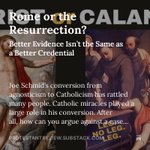
New video. Joe Schmid says the evidence for Catholic miracles is "manifestly better" than the evidence for the resurrection. Does that mean you have to choose between Rome and the resurrection? No. Better evidence isn't the same as a better credential.
youtu.be/pdXjbbIPACI?si=di7J…
This is an excellent one-stop shop of all critiques of Catholic Miracles. contrapapam.substack.com/p/m…
Joe Schmid says the evidence for Catholic miracles is “manifestly better” than the evidence for the resurrection. I’ve heard that this has shaken people, even to the point of deconversion.
Article Link: protestantreview.substack.co…
So I wrote a reply. I grant the miracles for the sake of argument. The question is what they prove. The resurrection answered the claim Jesus staked on it. Fatima and Calanda weren’t staked on Rome.
Rome or the Resurrection? Spoiler: It’s a false choice.

The Protestant Philosopher retweeted

Great synopsis of an issue seen, a problem addressed, and a solution posited, by @glenscrivener here.
youtu.be/iwmRGl_oL9M?si=xbNa…
