

Prospex*Agro is a dynamically developing commodity-brokerage company that operates in the international agricultural market.
Ukraine
Joined June 2024
- Tweets3K
- Following27
- Followers1.3K
- Likes3K





Pinned Tweet
🌾 New Global Grain Report Is Out 🌾
🔗 Want to stay on top of the grain market? Subscribe on Patreon: patreon.com/c/prospexagro
📊 The latest Prospex*Agro Global Grain Report is now available, covering the key developments shaping wheat, corn and barley markets this week.
🔎 Get the latest price moves, market drivers, global balances, trade flows, tenders and Black Sea freight insights in one report.
#GrainMarket #GrainTrading

🇪🇺 Europe’s Crop Losses Reshape Grain And Oilseed Trade 🌾
🌽 Maize is the clearest pressure point: EU imports are rising sharply as drought cuts domestic supply. Expana forecasts production at 44.9 million tonnes, while France’s AGPM expects just 7 million tonnes nationally, the lowest since 1976. This leaves buyers more dependent on overseas supplies.
🚢 Securing those volumes could prove challenging. Expana estimates the EU may need 11 million tonnes of Ukrainian maize, versus 9.1 million last season, despite disruption to Black Sea shipments. Feed use is also expected to fall as availability tightens.
🌾 Wheat presents a different picture. EU soft wheat exports remain broadly steady, while barley and durum shipments trail sharply. Reduced Black Sea competition is opening opportunities for French wheat outside the EU, even as FranceAgriMer expects those exports to remain below last season.
🌻 Oilseed and vegetable oil imports show contrasting trends. Sunflower seed arrivals are accelerating while sunflower oil imports decline; rapeseed shows the reverse pattern. In their October update, FAS analysts raised the full-season oilseed import forecast by 7% from spring, as weather losses reduce domestic production and favourable margins support crushing.
🌱 Supply risks extend into the next harvest. Expana expects EU soft wheat area to decline by 2% in 2027 as production costs weigh on planting intentions, while dry conditions add uncertainty.
💬 Which supply origins are you watching most closely for EU import demand this season?
#GrainTrade #EU


🇪🇺 Europe’s Sunflower Crush Rebounds As Global Processing Slows 🌻
📈 Sunflower led September’s recovery in EU and UK oilseed crushing, while stronger soybean processing helped offset weaker rapeseed activity. However, cumulative sunflower crush remained below last year, leaving the recovery incomplete.
🌍 Globally, the picture is different. Oil World estimates a record sunflower crop of 65.3 million tonnes, yet reports processing at multi-year lows in recent weeks as seed marketing progresses slowly. Larger seed supplies are not translating into greater immediate availability of oil and meal.
📉 September–December 2026 sunflower crush could fall 1.5–2 million tonnes below the three-year average. Increased processing in the EU and other origins is expected to remain insufficient to offset declines in Ukraine and russia, keeping sunflower oil supply constrained while seed stocks accumulate.
💬 Which regional crushing trends are you watching most closely?
#Sunflower #FEDIOL

🇺🇸 Soybean Exports Strengthen As Corn Harvest Lags 🌾
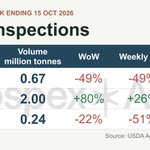
🚢 Soybeans led U.S. export inspections, with stronger weekly shipments and cumulative growth over last year. Corn’s weekly decline contrasts with a modest cumulative shortfall, while wheat continues to lag on both measures.
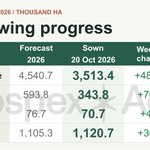
🌽 As of October 18, corn harvest reached 44%, trailing the five-year average by 8 percentage points. Soybeans were 64% harvested, nearly matching the normal pace.
🌱 Winter wheat planting reached 63%, 6 points behind average. Oklahoma showed a sharper delay, with just 37% planted versus the usual 59%.
☀️ Warm, mostly dry weather should support fieldwork across much of the country this week, offering an opportunity to narrow these gaps.
💬 Which will you follow more closely next week: export movement or fieldwork progress?
#GrainExports #CropProgress

🇺🇦 Rapeseed Sowing Tops Target As Corn Leads Export Gains 🌾
🌱 Ukraine’s winter sowing remains uneven. Rapeseed has exceeded its planned area and rye is nearing completion, while barley has the most ground left to cover. Wheat and triticale account for the largest weekly increase in sown area.
🚢 Grain and legume exports reached 5.986 million tonnes by October 19, including 2.065 million tonnes of corn. Corn shipments already exceed the 1.271 million tonnes reported by October 22 last year, while wheat and barley remain below that prior-season snapshot. Stronger corn flows have only partly offset weaker shipments of the other major grains.
💬 Which will you be watching more closely: winter sowing progress or the pace of grain exports?
#Ukraine #GrainExports

🇺🇦 Ukraine’s Harvest Advances, But Export Bottlenecks Squeeze Margins 🌾
🌽 Ukraine’s harvest remains uneven: wheat, barley, peas and rapeseed are effectively finished, while soybean and sunflower harvesting is well advanced. Corn remains the main unfinished crop, leaving producers exposed to further rain delays and higher drying costs.
🌧️ According to PUSK analysts, additional corn drying costs could reach $10–20/t, and up to $30/t in some cases. Combined with weak domestic purchasing prices, this puts further pressure on farm margins and could extend harvesting into winter.
🚢 Logistics also limit the benefit of stronger overseas demand. PUSK estimates Ukraine’s corn export potential at 17–19 million tonnes, below the USDA forecast of 22 million tonnes cited in the report. Restricted shipping capacity could keep domestic prices under pressure even if global quotations strengthen.
🫛 Soybean trade shows how logistics are reshaping destinations. APK-Inform reports September exports of just 36K tonnes, the lowest September volume in five seasons, with 91% going to the EU. Nearby European demand provided an outlet while access to more distant markets remained constrained.
🌻 Processing faces a similar bottleneck. Ukroliyaprom warns sunflower oil exports could fall to 300K tonnes from the usual 500K tonnes. Difficulty shipping finished products could force crushers to reduce output, weakening their ability to purchase the incoming oilseed crop.
💬 Which factor do you expect to have the greatest influence on Ukraine’s near-term crop market: harvest weather, export logistics or European demand?
#Ukraine #GrainTrade

🇦🇺 Record Crop Potential Meets An Uneven Australian Harvest 🌾
📊 Australia could harvest record barley and canola crops, while wheat faces lower production. Most forecasts support a strong barley and canola outlook, but contrasting regional conditions mean the gains are far from uniform.
🌱 Southern states are driving the improvement. Rabobank forecasts winter-crop production rising 43.7% in South Australia and 11.2% in Victoria, compared with a 47.6% decline in Queensland. Strong southern yields are offsetting weaker northern crops, concentrating production further toward the south and west.
📈 Western Australia’s outlook has also improved. GIWA’s October report lifted the state’s total crop forecast by 870K tonnes to 23.93 million tonnes. Higher wheat and barley estimates led the increase as mild conditions supported grain filling, particularly in later-emerging wheat.
🌼 Canola is the exception within WA: GIWA lowered its forecast by 179.5K tonnes to 4.6 million tonnes because of poor pod development. National record potential therefore sits alongside a weaker monthly outlook in a key producing state.
🔎 Harvest results and quality will determine how these forecasts translate into available supply. Early WA yields are encouraging, although growers have started with their best paddocks. GIWA expects considerable variation in grain size and protein, while rain is delaying harvest in northern New South Wales.
💬 Which part of Australia’s harvest outlook are you watching most closely: regional yields, canola performance or grain quality?
#Australia #Grains

🇧🇷 Bigger Crops But Tighter Balances Ahead 🌾
📊 According to Conab’s first forecast for 2026/27, Brazil’s total grain production could reach 367.1 million tonnes. Yet larger corn and soybean crops are expected to coincide with lower ending stocks as demand outpaces production growth.
🌽 Corn expansion is driven by planted area, while yields are forecast to decline. The first crop accounts for most of the additional output, with the second crop broadly stable. Ethanol demand supports higher domestic consumption, while stronger exports further reduce the stock cushion.
🫛 Soybean production is projected to rise only slightly as lower yields offset part of the acreage expansion. Growing domestic use and exports leave a tighter carryout. Sowing was 15.6% complete in early October, leaving much of the production outlook dependent on the season ahead.
🏭 The soy complex shows diverging export prospects: meal shipments are expected to increase, while stronger domestic soyoil consumption limits availability for overseas buyers. Biodiesel demand remains an important driver of domestic oil use.
🌾 Wheat faces a sharper supply squeeze as both acreage and yields decline. Higher imports and lower exports only partly offset the smaller harvest, leaving ending stocks substantially lower. Harvest was 40.3% complete.
💬 Which part of Brazil’s outlook will you be watching most closely: crop development, domestic demand or export flows?
#Brazil #Conab


🇺🇳 Bigger Grain Supplies Ease Pressure, But Stocks Still Tighten 🌾
📊 According to the IGC, global grain production was revised up by 7 million tonnes from September, mainly on improved corn and barley prospects. With consumption revised only slightly higher, projected ending stocks rose by 11 million tonnes, easing supply concerns compared with last month’s outlook.
🌾 The annual balance remains tighter, however. Production is expected to fall below last season, while consumption reaches a new high. Lower stocks-to-use ratios across grains point to smaller supply buffers despite this month’s upward revisions.
🚢 Trade prospects diverge: corn shipments are expected to expand, while wheat and barley trade contract. The latest reduction in the overall trade forecast reflects weaker wheat prospects.
🫛 Record soybean production is expected to accompany record trade, supported by Asian buying interest. Yet growing demand for soy products is projected to reduce carryovers, with major exporters’ reserves falling sharply.
📉 Export prices reflect near-term supply pressure: IGC price sub-indices fell 7% for corn, 5% for wheat and 3% for soybeans. Improved supply prospects weighed most heavily on corn, while seasonal factors and favourable early planting conditions in Brazil also pressured soybeans.
💬 Which factor are you watching most closely: crop prospects, export demand or exporters’ stocks?
#IGC #Grains

🇺🇸 Crush Slows As Soyoil Supply Tightens 🫛
📊 According to NOPA, September soybean crush fell to a 13-month low, while soyoil stocks reached their lowest level since November 2014. Both came in below market expectations, highlighting weaker processing activity alongside tighter oil availability.
🏭 Seasonal maintenance and rain-delayed harvesting disrupted operations, limiting soybean supplies at some plants. Iowa, the largest soybean-processing state, recorded a 13.2% year-on-year decline in crush.
📉 The report sends mixed signals across the soybean complex: slower crushing softens near-term processing demand for beans, while lower oil inventories leave a smaller supply cushion. Expanded processing capacity has yet to translate into stronger throughput amid these disruptions.
💬 Which will you watch more closely in the next report: the pace of crushing or soyoil inventories?
#Soybeans #NOPA

🇺🇸 Harvest Pressure Meets Fresh Chinese Buying 🌾
🚢 According to USDA, corn and soybean export inspections eased from the previous week but remained above last year’s levels. Soybeans lead cumulative export growth, while wheat continues to lag despite a slight weekly improvement.
🚜 USDA reports that 46% of soybeans and 33% of corn were harvested as of Sunday. Growing supplies weigh on futures, with drier weather expected to help fieldwork resume after midweek rains.
🫛 According to Reuters, China booked 8 to 10 US soybean cargoes, helping limit soybean losses. Further purchases will be important as harvesting adds to available supplies.
🌾 Wheat futures edged higher on Black Sea shipment disruptions, even as US wheat inspections remained well below last season’s pace.
💬 Which factor are you watching most closely: harvest progress, Chinese buying or Black Sea logistics?
#Soybeans #GrainMarkets

🇪🇺 Rising Corn Imports Meet Deepening Crop Losses 🌽
🚢 According to European Commission trade data, EU corn imports are running ahead of last season, while exports have weakened. Common wheat exports remain broadly stable, but barley shipments lag considerably.
🇫🇷 According to France’s farm ministry, the maize crop forecast was cut to 7.3 million tonnes from 8.1 million last month, the lowest in records dating back to 1980. Heatwaves and persistent drought damaged yields, potentially reinforcing import needs as domestic supply shrinks.
🌻 Sunflowerseed imports have strengthened sharply, while soybean and rapeseed arrivals remain below last season. France’s sunflower yields are forecast at their lowest since at least 1980, adding pressure to regional supply, while its rapeseed crop estimate remains unchanged and slightly above last year.
🛢️ Rapeseed oil stands out as the only vegetable oil in the table with higher imports. Soybean, sunflower and palm oil arrivals have all declined, showing that stronger imports are concentrated in specific products.
💬 Which EU grain or oilseed trade flow will you be watching most closely this autumn?
#EU #Corn


🇺🇦 Harvest Gains Momentum As Sunoil Outlook Tightens 🌻
🚜 Ukraine’s latest harvest update shows strong weekly progress in corn, sunflower and soybeans. Corn harvesting remains at an early stage, leaving most supply still to reach the market, while sunflower and soybean harvesting is considerably more advanced. Wheat harvesting is nearly complete, alongside finished barley and rapeseed campaigns.
🌻 According to APK-Inform, Ukraine’s 2026/27 sunflower oil production forecast was lowered to 5.49 million tonnes from 5.65 million, while expected exports were cut to 5.03 million tonnes from 5.20 million. Despite progress in sunflower harvesting, the revised outlook points to less Ukrainian oil available to international buyers than previously anticipated.
🚢 According to the State Customs Service, grain and legume exports reached 5.661 million tonnes as of October 12, including 440 thousand tonnes shipped this month. Wheat remains the largest export crop, followed by corn.
🚆 According to Ukrzaliznytsia, grain transportation for export increased in early October compared with September, but port restrictions and attacks on railway infrastructure continue to disrupt deliveries. Vegetable oil transportation moved in the opposite direction, highlighting uneven export flows across commodities.
💬 Which factor are you watching most closely for Ukraine’s export outlook: harvest progress, logistics or overseas demand?
#Ukraine #SunflowerOil

🇲🇾 Record Palm Oil Stocks Put Export Recovery In Focus 🌴
📊 According to MPOB, Malaysia’s palm oil inventories reached a record high in September as production surged and exports weakened. Stocks exceeded the Reuters survey forecast of 3.37 million tonnes, reinforcing supply pressure on the market.
🏭 Favourable weather and delayed processing from August boosted output, while competition from Indonesia and cheaper rival vegetable oils constrained exports. The combination leaves a larger surplus for demand to absorb.
🚢 October signals are stronger. According to ITS and AmSpec, exports during October 1–10 rose 33.5%–37.7% compared with the same period in September. Buying from India and China, alongside disruptions to Black Sea sunflower oil shipments, could support further recovery.
⚖️ Palm oil is now trading at a discount to soyoil and sunflower oil, improving its competitiveness. However, sustained export growth will be needed to ease the inventory overhang.
💬 Which factor are you watching more closely in October: export demand or production trends?
#PalmOil #MPOB

🇺🇸 More Soybeans, Smaller Grain Crops And Slower Harvests 🌧️
🌱 According to USDA/NASS, acreage shifts and yield changes are reshaping the U.S. crop outlook, with soybean expansion contrasting with lower corn, wheat and barley production compared with last year.
🌽 Smaller harvested acreage and lower yields reduce corn output from last season. Even so, the crop could still be the second-largest in U.S. history, keeping production substantial despite the annual decline.
🫛 Soybeans are heading for record production, driven mainly by expanded harvested acreage. Yield improvement is modest, making the larger area the main contributor to growth.
🌾 Winter wheat faces the sharpest production decline among these crops, as harvested area and yields both fall. Durum’s contraction is primarily acreage-driven, while lower yields also weigh on barley and spring wheat output.
🌧️ Heavy September rainfall disrupted Midwest fieldwork and threatened crop quality. As of October 4, corn harvesting was 4 percentage points behind the five-year average, while soybean harvesting lagged by 8 points.
🌼 Canola production is forecast at a record 2.44 million tonnes, up 15% from last year. Acreage expansion more than offsets weaker yields, adding to domestic oilseed supply.
❓ Which crop are you following most closely as the U.S. harvest progresses?
#USDA #CropProduction


🇺🇸 October WASDE: Corn Under Pressure, Wheat Finds Balance, Soybeans Supported by Oil Demand 📊
🌍 October's WASDE revisions are predominantly bearish for corn, while wheat and soybeans remain closer to neutral.
🌾 Wheat: Global ending stocks reached 276.04 MMT vs 276.63 MMT expected. Stronger global consumption provides some support, but weaker export activity and rising U.S. stocks limit bullish momentum. Black Sea logistics remain a potential source of volatility, particularly if disruptions further restrict export flows.
🌽 Corn: Global ending stocks climbed to 280.44 MMT vs 273.78 MMT expected, exceeding even the upper forecast limit of 279.82 MMT. Higher U.S. production and carry-in stocks outweighed stronger demand and production cuts elsewhere. U.S. yield rose 2.7 bu/acre to 181.2, substantially easing the balance compared with September. Stocks remain below last season, but the larger-than-expected increase weakens the tightening story.
🫛 Soybeans: Global ending stocks stood at 124.28 MMT vs 123.33 MMT expected, above the trade average but within the forecast range. Higher production and slightly lower total consumption lifted stocks despite stronger crush and exports. Increased U.S. exports only partly absorbed the additional supply, leaving a modestly bearish signal.
⚖️ Overall, corn delivered the clearest bearish surprise versus expectations. wheat's outlook is constrained by weak export performance, and soybeans remain highly sensitive to vegetable oil demand.
❓ Will traders give more weight to higher-than-expected corn stocks or to inventories remaining below last season?
#WASDE #GrainMarkets


🇦🇷🇧🇷 Crop Expansion Meets Weather Risks 🌾
🌱 Argentina’s Agriculture Secretariat and Brazil’s Conab report planting ahead of last year. Rainfall supports crop development but disrupts fieldwork locally. Conab also highlights faster wheat harvesting alongside storm damage and growing grain-quality concerns.
🌽 The Buenos Aires Grains Exchange puts Argentina’s corn harvest at 64 million tonnes, exceeding its initial forecast by 6 million. USDA FAS Buenos Aires forecasts soybean output at 52.5 million tonnes and record sunflower production of 7.4 million for 2026/27, strengthening the oilseed supply outlook.
🏭 Abiove reports a 13% increase in Brazil’s soybean crushing capacity and forecasts record processing of 63.5 million tonnes in 2026. According to Oil World, stronger shipments to other destinations offset lower soybean exports to China during July–September.
💬 Which factor are you watching most closely: crop conditions or processing demand?
#Argentina #Brazil


🇨🇳 China Cuts Soybean Outlook While Corn Supply Builds 🌾
🫛 October’s CASDE report cuts the 2026/27 soybean production forecast by 0.59 Mt as area and yields fall below expectations. Lower output, higher growing costs and rising international prices are expected to keep domestic soybean prices elevated.
🌽 For 2025/26, corn feed use was revised down by 9.4 Mt, while industrial use rose by 4.0 Mt, with corresponding adjustments to the new season. A larger harvest adds supply pressure, but stronger starch demand and planned reserve buying should help stabilize prices.
🛢️ The vegetable oil balance remains unchanged. Seasonal consumption and higher international prices should support the domestic market, while excessive rainfall poses risks to rapeseed sowing.
💬 Which market are you following most closely: corn, soybeans or vegetable oils?
#China #CASDE

🇲🇾 Palm Oil Jumps As Black Sea Disruption Redirects Indian Demand 🌴
📈 Malaysian December palm oil futures rose 3.14% to RM4,666/ton at the midday break on October 8, rebounding after two sessions of losses. Stronger Indian buying shifted attention from high Malaysian inventories to palm oil’s role in replacing disrupted sunflower oil supplies.
🇮🇳 India purchased 150K tons of crude palm oil in just three days for November–December shipment. September palm oil imports were estimated at 810K tons, up 3.5% MoM, while sunflower oil imports dropped 36% to 103K tons. This signals a shift in the import mix rather than broader demand growth: total edible oil imports fell 3.75%. Official September figures are still pending.
🌦️ The longer-term balance could also tighten. USDA FAS’s Kuala Lumpur office projects Malaysian production at 19.70 million tons in MY2026/27, down from 20.20 million, while B15 biodiesel demand increases domestic absorption. Separately, Oil World’s Thomas Mielke forecasts a global production decline of at least 2 million tons in calendar 2027, citing delayed El Niño effects. These forecasts point to supply pressure beyond the current inventory overhang.
⚖️ Indian purchases could help draw down producer stocks, but high Malaysian inventories remain a near-term constraint. Expectations of a possible CPO export-duty waiver in the October 9 budget also supported sentiment; the measure has not been confirmed.
💬 Which factor are you watching most closely: Indian buying, Malaysian stocks or weather risks?
#PalmOil #VegetableOils

🇪🇺 Corn Imports Rise As Wheat Trade Faces New Challenges 🌾
🚢 EU corn imports are climbing while soft wheat exports remain close to last season’s pace. Weaker barley and durum exports underline an uneven start to the season.
🌽 France’s drought-hit corn crop adds supply concerns: just 22% is rated good or excellent, versus 62% last year. Rapid harvesting reflects dry weather and a smaller crop, rather than stronger yields.
🫛 Oilseed and oil imports show contrasting trends. Sunflowerseed arrivals are rising despite lower sunflower oil imports, while rapeseed oil is gaining as rapeseed imports decline. Soybean, soy oil and palm oil arrivals are also lower.
🇩🇪 Germany’s soybean area expanded by nearly 21%, putting production on track for a record despite drought-reduced yields. The increase highlights how acreage growth can offset weaker productivity.
🇲🇦 Morocco’s recovering wheat harvest could curb French export demand. French soft wheat shipments are tentatively estimated at 2.5 million tonnes for September to May, as Morocco’s domestic wheat crop more than doubled to 4.4 million tonnes. Black Sea uncertainty and potential port congestion remain risks for purchasing and deliveries.
💬 Which factor will have the greatest influence on EU trade flows this season?
#EU #GrainTrade


