

The open translation layer from onchain events to audit-grade ISO records.
Global
Joined March 2022
- Tweets312
- Following84
- Followers917
- Likes11K







Pinned Tweet
Today we’re opening the beta version of the ProofRails ISO 20022 Sandbox.
iso.proofrails.com/
ISO 20022 is the messaging standard financial institutions use to exchange payment information. As stablecoins, onchain payments and agents start moving more money, those new rails still need to connect with the systems finance teams already use.
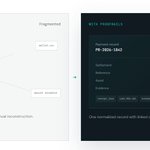
Our first demo shows that bridge in practice: take a ProofRails payment record and turn it into the ISO 20022 messages used for payment cancellations and investigation outcomes, with the mapping, XML and evidence trail visible end to end.
Up next: real reconciliation.
We’ll ingest ISO 20022 bank records, verify the matching onchain settlement with @FlareNetworks FDC, and use ProofRails to show whether both sides actually match in one auditable record.

ProofRails retweeted

The interview with @0xQuantic is out! 🥳
In this episode of “Krippenreiter TV,” I asked him to what extent Flare could unlock new institutional demand for XRP.
We also covered @FlareNetworks's FCC. 👀👇
[📺] Watch here: youtu.be/sznlfuO6jGs

ALT Source: https://youtu.be/sznlfuO6jGs
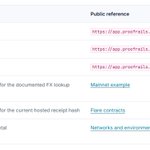
The simplest way to try the full loop right now is to call ProofRails’ paid demo endpoint POST /v1/x402/premium/fx-lookup with an x402 client.
You get a 402 challenge for 0.001 USD₮0 on @FlareNetworks. The client signs the payment authorization, ProofRails settles it, and the successful response includes the API result plus the settlement tx and receipt ID.
Once the receipt is anchored, open app.proofrails.com/verify/{receipt_id} to verify the evidence against the onchain commitment.


ProofRails retweeted

I think we’re heading into a very interesting Q4.
Market conditions are improving, but more importantly, a lot of work that has been happening behind the scenes is getting closer to showing up in public.
Over the past few weeks I’ve spent a lot of time talking with devs and collaborators working across privacy, agents, data and onchain culture. There’s a lot maturing at the same time.
For people asking me about Flare updates, FCC is probably going to keep us very busy.
Ecosystem builders have already given a glimpse of what can be done with TEEs, but we’re now getting closer to the final stage of deployment, and we will not be short of use cases.
Retail-facing applications are starting to make more sense, while key use cases around confidential execution, protected data and institutional workflows are getting ready. (I can’t give much more detail here without getting myself in trouble, but there’s a reason I’ve been spending so much time around FCC lately.)
At the same time, the next phase of XRPFi is getting closer with Firelight, so the landscape is expanding on several fronts at once.
I’ll be particularly interested in what we see around the upcoming events in Korea and then Ripple Swell.
On a more personal level, I’ve also been digging deeper into the agentic space.
We’re getting to the point where agents can start doing genuinely interesting things for retail, not just serving dev workflows or managed services. Cross-chain execution and arbitrage strategies run by agents are two areas I’m actively looking at.
So I guess it’s time to wake up the @ProofRails intern and devs and have some fun onchain.
ProofRails retweeted
The new ProofRails website is live.
We’ve been building ProofRails as a translation layer between onchain activity and the systems businesses already use, turning blockchain events into structured records, normalized receipts and verifiable evidence for reporting, reconciliation and integrations.
Our thinking has evolved quite a bit along the way.
We started with a strong focus on ISO-aligned reporting and compliance structures. Working more deeply with programmable payments, and especially x402, exposed a broader problem.
As payments become machine-readable and increasingly machine-initiated, executing the payment is only part of the problem. Systems also need to understand what happened, why it happened, who or what initiated it, and how to verify and reconcile it afterwards.
That is the direction @ProofRails is moving toward: infrastructure that preserves the context around programmable economic activity and turns it into structured, verifiable evidence that financial systems, applications and agents can use.
x402 is an important part of that direction because it gives machines a standard way to pay over HTTP. ProofRails is exploring the evidence layer around those payments: receipts, attribution, verification, reconciliation and the records needed once machine payments start moving through real systems.
The new site is a much clearer home for what we’re building and where we’re taking it.
proofrails.com/

ProofRails retweeted

Exciting to see more builders leveraging @FlareNetworks.
Real applications like payment-gated APIs and AI agents showcase the value of secure, verifiable infrastructure and drive meaningful onchain activity beyond simple transactions. ☀️
ProofRails is launching a Flare mainnet beta for paid APIs and AI agents.
An x402 payment can now return more than access to an API result: it can automatically produce a receipt linking the settlement to what was delivered, with finance-readable artifacts, signed evidence and a verifiable onchain commitment.
The hosted beta currently powers ProofRails’ own payment-gated APIs. API owners selling premium data or actions to software and AI agents can adopt the same workflow through a scoped integration or self-hosted deployment, accepting payments in USD₮0 while generating records that machines and humans can operate on.
Within this flow, Flare does more than record the payment. The same network also carries the public commitment to the evidence linking that payment to what was delivered.
Developers can test the x402 client flow, add this workflow to an existing API business, or start a new self-hosted service here: docs.proofrails.com/product/…
ProofRails retweeted
1/5 ProofRails is launching a @FlareNetworks mainnet beta for paid APIs and AI agents and one thing I find interesting about the latest update isn't just the payment flow.
It's what happens after the payment.
A thread 🧵

ProofRails retweeted

ProofRails's product will definitely expand the use case for AI agents in general. As the machines start to automate more and more tasks for us, they will need pathways to get verified, accurate data, to complete those tasks that can also be auditable.
The simple example would be a payment receipt for a product or service, but as tasks get more complex and rich, agents will need to access multiple APIs to chain their results together in order to produce the best expected outcome for you. In doing so, ProofRails enables the end user an auditable trail so they can understand the total cost of each task.
ProofRails is launching a Flare mainnet beta for paid APIs and AI agents.
An x402 payment can now return more than access to an API result: it can automatically produce a receipt linking the settlement to what was delivered, with finance-readable artifacts, signed evidence and a verifiable onchain commitment.
The hosted beta currently powers ProofRails’ own payment-gated APIs. API owners selling premium data or actions to software and AI agents can adopt the same workflow through a scoped integration or self-hosted deployment, accepting payments in USD₮0 while generating records that machines and humans can operate on.
Within this flow, Flare does more than record the payment. The same network also carries the public commitment to the evidence linking that payment to what was delivered.
Developers can test the x402 client flow, add this workflow to an existing API business, or start a new self-hosted service here: docs.proofrails.com/product/…
ProofRails retweeted

Machine economy... Machine economy... It will be the key concept everywhere soon.
Bookmark this.
We think @FlareNetworks has a massive potential to unlock the machine economy in a cross-chain world.
ProofRails retweeted

Ive been working with Quantic for about a year and still amazed by his brilliant ideas and mind.
One of them is this one. ProofRails just launched a Flare mainnet beta where every API call can now come with a verifiable receipt.
Imagine: Payment, proof of delivery, and on-chain evidence, all in one flow.
The rails for the AI economy are being built and this is one of them. Excited to see this built on Flare.☀️

This is a major step for ProofRails, but it is only the first stage of a much larger vision.
We are building toward a world where any API can become a machine-native business: publish a service, set a price, accept stablecoin payments from software and AI agents, and automatically produce the receipts, financial records and verifiable evidence proving what was paid for and what was delivered.
The Flare mainnet beta brings that complete payment-to-evidence flow into production through ProofRails’ hosted APIs, scoped integrations and self-hosted infrastructure.
For @FlareNetworks, this creates a path from being a data-rich chain to becoming a market for machine services. Builders could package intelligence derived from FTSO and FDC, private or verifiable computation through FCC, and eventually cross-chain actions through Flare’s interoperability stack into APIs that agents can discover, pay for and verify. The opportunity is not simply more payments on Flare, but an economy where trusted data, computation and execution become sellable products.
From here, the goal is to package the entire stack into plug-and-play infrastructure that any API owner can adopt without having to build the payment, settlement, receipt and evidence systems underneath it.
Higher.
ProofRails is launching a Flare mainnet beta for paid APIs and AI agents.
An x402 payment can now return more than access to an API result: it can automatically produce a receipt linking the settlement to what was delivered, with finance-readable artifacts, signed evidence and a verifiable onchain commitment.
The hosted beta currently powers ProofRails’ own payment-gated APIs. API owners selling premium data or actions to software and AI agents can adopt the same workflow through a scoped integration or self-hosted deployment, accepting payments in USD₮0 while generating records that machines and humans can operate on.
Within this flow, Flare does more than record the payment. The same network also carries the public commitment to the evidence linking that payment to what was delivered.
Developers can test the x402 client flow, add this workflow to an existing API business, or start a new self-hosted service here: docs.proofrails.com/product/…

ProofRails has completed its first controlled, real-value x402 test on @FlareNetworks.
A payment of 0.001 USD₮0 settled successfully through the ProofRails x402Facilitator.
Transaction hash:
0xd37fb7c4b93dcf5be40197d0af0c34e79f456ba493cdec9980ab08e03573cbfc
ProofRails operates an integrated x402 facilitator for its own payment-gated APIs, and the test also generated a finance-readable receipt, a signed evidence bundle and ISO 20022-style artifacts.
These records connect the payment with its purchase context and delivery evidence.
Next step: full receipt and evidence layer for machine payments.

ProofRails retweeted

Let me expand on what is coming and why it matters.
A few weeks ago, ProofRails deployed an x402 facilitator on Flare’s Coston2 testnet, enabling developers to test payments with USDT0. The next step is bringing that infrastructure to Flare mainnet.
x402 allows an API, website, or digital service to request payment directly through HTTP. When an agent requests a paid resource, it receives the price and payment requirements, signs the payment authorization, and retries the request.
The ProofRails facilitator then verifies the payment payload and settles the transaction on Flare. Once confirmed, the service can deliver the requested API response, data, content, compute, or action.
This is key because service providers do not need to build and operate their own blockchain payment infrastructure. They can add programmable, pay-per-use access to their services while ProofRails handles the verification and settlement layer.
But payments are only the starting point.
ProofRails can attach verifiable receipts and execution records to these interactions, helping developers build agentic systems with clear audit trails. Flare’s data protocols can then support applications that depend on verified external events, cross-chain activity, or real-world data.
Together, these components create a foundation for agents that can autonomously discover, purchase, and deliver services while producing evidence of what was requested, paid for, and executed.
That opens the door to practical applications such as paid data feeds, research services, agent marketplaces, execution tools, risk analysis, and machine-to-machine APIs. Over time, the same infrastructure can support more advanced multichain and privacy-preserving workflows.
These capabilities will be especially important for institutional adoption, where autonomous payments need to operate alongside spending controls, reliable settlement, auditability, and verifiable execution.
The community now has an opportunity to help shape this stack from the beginning.
Build paid endpoints. Test agent workflows. Create developer tooling. Explore new services where agents operate not only as interfaces, but as economic actors.
Flare has the infrastructure to play a leading role in this economy. The next step is turning it into products people and agents can actually use.

ProofRails retweeted
Let me expand on what is coming and why it matters.
A few weeks ago, ProofRails deployed an x402 facilitator on Flare’s Coston2 testnet, enabling developers to test payments with USDT0. The next step is bringing that infrastructure to Flare mainnet.
x402 allows an API, website, or digital service to request payment directly through HTTP. When an agent requests a paid resource, it receives the price and payment requirements, signs the payment authorization, and retries the request.
The ProofRails facilitator then verifies the payment payload and settles the transaction on Flare. Once confirmed, the service can deliver the requested API response, data, content, compute, or action.
This is key because service providers do not need to build and operate their own blockchain payment infrastructure. They can add programmable, pay-per-use access to their services while ProofRails handles the verification and settlement layer.
But payments are only the starting point.
ProofRails can attach verifiable receipts and execution records to these interactions, helping developers build agentic systems with clear audit trails. Flare’s data protocols can then support applications that depend on verified external events, cross-chain activity, or real-world data.
Together, these components create a foundation for agents that can autonomously discover, purchase, and deliver services while producing evidence of what was requested, paid for, and executed.
That opens the door to practical applications such as paid data feeds, research services, agent marketplaces, execution tools, risk analysis, and machine-to-machine APIs. Over time, the same infrastructure can support more advanced multichain and privacy-preserving workflows.
These capabilities will be especially important for institutional adoption, where autonomous payments need to operate alongside spending controls, reliable settlement, auditability, and verifiable execution.
The community now has an opportunity to help shape this stack from the beginning.
Build paid endpoints. Test agent workflows. Create developer tooling. Explore new services where agents operate not only as interfaces, but as economic actors.
Flare has the infrastructure to play a leading role in this economy. The next step is turning it into products people and agents can actually use.
ProofRails retweeted
The past few weeks have been incredibly productive for connecting with leaders across fintech and understanding where the sector is heading.
One thing is becoming increasingly clear: stablecoins are now a core part of any serious payments offering in 2026.
I had the opportunity to share the work being done at @ProofRails and @FlareNetworks, while learning from institutional leaders who are expanding their operations and services around digital assets.
Payments continue to evolve quickly, but the gap between traditional financial systems and digital asset rails is also becoming more visible.
The next phase will require stronger standards, better operational tools, and infrastructure that allows both systems to work together reliably.

ProofRails retweeted

FlareStudio now supports 12 core clients SDK for @ProofRails
• IsoClient
• X402Client
• AuthClient
• AgentClient
• ProjectClient
• ConfigClient
• DebugClient
• HealthClient
• AiClient
• SdkClient
• AnchorClient and more
Import only what you need. Publishing soon.
