






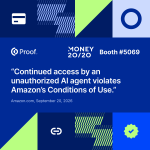

Proof retweeted

Circle 🤝 @proof
With Proof, we’re exploring how agents can prove who they act for and pay in USDC in one exchange.
Verified identity through x401. USDC payments through x402 and Circle Agent Wallets.
See the joint demo at @money2020, booth 5069.
globenewswire.com/news-relea…

Proof + @circle: At Money2020, both teams will share a demo of an AI agent proving who they act on behalf of (x401) and paying in @USDC (x402) in the same exchange. See it live at #Money2020, booth 5069: hubs.la/Q04BzGrL0

Proof retweeted

Founder and CEO @proof, @patk on verifying AI agents instead of just blocking them
"Prior to today, for a lot of our customers, the answer is block."
"Authentication is not authorization."
"You sign into your bank, your trading account, whatever it may be, you have a valid session, but they still make you do other things. They make you do FMF or MFA. They make you do SMS OTP. They make you show a license."
"These industries have real obligations to capture identity and consent in these transactions, and that's really what we have enabled today in a seamless manner."
A valid session was never proof of permission, and banks are now building the extra step agents will have to clear.

Don't block agents. Identify them.
@sytaylor is joined by @patk , founder and CEO @proof
Pat Kinsel has built an open framework to identify agents that is compatible with how banks do KYC today.
It's called x401, built on the internet's HTTP 401 "authorization is required"
But the really clever bit is the fact that it then uses verifiable credentials that are IAL2 certified to prove the authentication for the underlying human.
Why's that clever?
Because that's the same standard the US government published under the National Institute of Science and Technology NIST, and the one that FinCEN recently gave guidance on as being usable in bank Customer Identification Programs (CIP).
Check out the entire video to know more
Timestamps:
00:00 Proof launches x401 to bring trusted identity to AI agents
01:25 How x401 and verifiable credentials establish cryptographic identity
02:45 Should businesses block AI agents or verify their authority?
03:30 Why authentication alone cannot satisfy financial institutions' compliance obligations
04:34 Amazon's agent blocking, credential sharing risks and explicit consent
06:18 How x401 complements x402 payments and stablecoin-powered machine transactions
08:24 Transaction signing and binding prove an agent has delegated authority
10:00 How independent audits and identity standards establish trust in Proof
11:15 Why open identity standards matter for interoperability and stablecoin adoption
12:20 How verifiable authorization reduces payment fraud and addresses liability


Who vouches for an AI agent acting in your customer’s name? Until today, nobody. Now the open x401 protocol is live: any site can ask an agent for verified legal identity and signed approval. No Proof contract. See it at Money20/20, booth 5069: hubs.la/Q04BfNkW0
Recruiters lose an average of 42 hours per job posting to candidates who don't exist. ⌛
We’ll be at HR Tech next week showing hiring teams what an identity check can look like inside hiring workflows: hubs.la/Q04B0mQ00
#HRTech #TalentAcquisition #Recruiting #HiringFraud

During #Money2020, we’ll be bringing together leaders from fintechs, banks, networks and platforms. Join us for refreshments, and an exclusive panel hosted by Simon Taylor of Brainfood - joined by TD Bank, Circle, Visa Intelligent Commerce, and Proof. 🔗 hubs.la/Q04B0lX20

We're taking over CHICA on Money Row for an evening built around that idea, with a panel moderated by Simon Taylor of Brainfood, featuring speakers from Visa Intelligent Commerce, TD Bank, and Proof.
🔗 hubs.la/Q04zcTQZ0

The person on camera in a remote closing can now be generated in real time.
Proof analyzes the live video while the notarization is happening. 400+ risk signals, passive and active, resolved into a single score.
Learn more at #ALTAone: hubs.la/Q04yzXMW0

Proof built cryptographic identity infrastructure: a persistent, verifiable record of authorization that any party can verify independently, without relying on the institution's own logs.
Join us on October 6th to see what this looks like: hubs.la/Q04xyf-10

On Sep 20, anyone who pointed Meta's Muse at Amazon got blocked.
Blocking is expensive, and turns away good traffic with the bad.
Instead, we verify the person once and issue a credential they hold - so you get to say yes.
Money20/20 next month: hubs.la/Q04yqcR30

The hardest part about impersonation fraud is that a synthetic signer looks completely ordinary. That gap is exactly where real estate fraud is accelerating.
Proof closes that gap to flag what a human eye can't.
Grab time with the team at ALTA ONE: hubs.la/Q04ylJdT0

Proof retweeted


Proof and Superfluid are testing reusable identity credentials for AI-agent transactions. The proposed x401 integration would let merchants request evidence about whom an agent represents. It is still in internal testing.
#DigitalIdentity #AIAgents
biometricupdate.com/202609/p…

Banks have spent decades building controls around money movement, and AI-generated fraud has found the gap underneath them.
So Proof built the identity layer those controls were missing.
We're unpacking what this means on October 6th. Join us: hubs.la/Q04xyfgp0


An AI agent can hold a wallet, propose a payment, and sign for it. It can't prove a human authorized any of it. Today @sfwallet launches Superfluid Wallet. Proof is the human identity layer behind it: hubs.la/Q04xZYy50

The documents, faces and voices GenAI learned to trust are now cheap to manufacture.
That's the problem we're working on with claims and fraud teams at ITC Vegas, and with State Farm as they digitize their claims process: hubs.la/Q04xZTG60

Proof retweeted
Introducing Superfluid Wallet: a wallet you and your agents use together. Now in beta testing.
For on-chain finance and agentic commerce where agents act for people and people stay in charge.
Understand what you’re authorising. Control what your agent can do. Let participating services verify who your agent represents.
Built With the Best: @turnkeyhq , @proof , @circle , @navaai
Read the launch article :
xitter.cf/sfwallet/status/210241…

The fraud pattern: someone applies for financial aid using a stolen identity, does just enough coursework to trigger disbursement, and disappears.
Now, Yavapai College applicants who don't pass an identity check never make it to enrollment: hubs.la/Q04wgVMV0